All of the interviews on Paul’s blog – The Wombwell Rainbow – are interesting and worth your time. Paul’s doing a fabulous job. I have selected Bozhidar Pangelov’s interview to feature today because it includes a tidbit of a reference about what it is like to be a writer and lover of literature in times and places of repression. Though those of us who came of age during the Cold War are conscious of this, I often wonder about younger people. Perhaps I’m just out of touch. Bozhidar also shares some thoughts on authenticity that I appreciate as well as his practical perspective on the poet as professional.
At any rate, many of you are familiar with Bozhidar’s work since he is a frequent contributor to The Poet by Day, Wednesday Writing Prompt (as is Paul) and he has also been featured on this site before.
My thanks to both Paul and Bozhidar for permission to share this interview with you here today. And thanks to Paul for doing this series. I think it’s a real contribution. / J.D.
Prolific Yorkshire Poet, Paul Brookes
PAUL BROOKES (The Wombwell Rainbow): “I am honoured and privileged that . . . poets, local, national and international have agreed to be interviewed by me. I gave the writers two options: an emailed list of questions or a more fluid interview via messenger.
“The usual ground is covered about motivation, daily routines and work ethic, but some surprises too…”
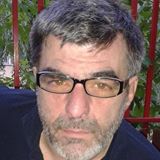
Bozhidar Pangelov
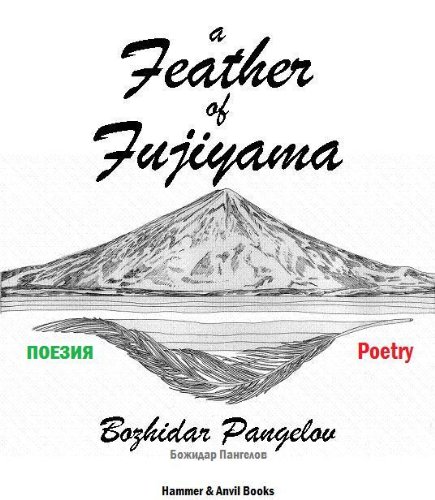
BOZHIDAR PANGELOV (bogpan – блог за авторска поезия блог за авторска поезия ) was born in the soft month of October in the city of the chestnut trees, Sofia, Bulgaria, where he lives and works. He likes joking that the only authorship which he acknowledges are his three children and the job-hobby in the sphere of the business services. His first book Four Cycles was written entirely with an unknown author but in a complete synchronicity on motifs of the Hellenic legends and mythos. The coauthor (Vanja Konstantinova) is the editor of his next book Delta. She is the woman to whom The Girl Who… is dedicated. Bozhidar’s last (so far) book is The Man Who. A bilingual poetry book A Feather of Fujiama is being published on Amazon as a Kindle edition.
Some of Bozhidar’s poems are translated in Italian, German, Polish, Russian,Chinese, Turkish, Arabic, Romanian, Portuguese and English languages and are published on poetry sites as well as in anthologies and some periodicals all over the world. Bozhidar Pangelov is on of the German project Europe .. takes Europa ein Gedicht. Castrop Rauxel ein Gedicht RUHR 2010 and the project SPRING POETRY RAIN 2012, Cyprus.
Bozhidar’s pen name “bogpan” means “god Pan” – in Greek religion and mythology.
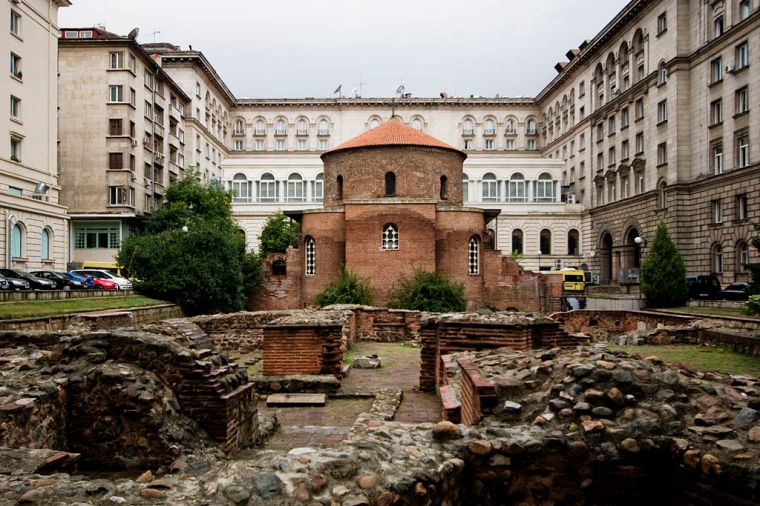
The Fourth Century St. George Rotunda is considered the oldest building in Sofia, the capital of Bulgaria, the city in which Bozhidar was born and lives. Photo courtesy of Sveti Georgi underCC BY 2.0 license.
The Interview
What were the circumstances under which you began to write poetry?
I have the feeling that I have always written poetry. At home we used to have quite rich book library. Throughout my awkward past the (the political system), reading was a way of having a life in another worlds. Can you imagine that there used to be long queues for each translated book from a foreign author! Well, eventually the cause of writing my first poem was quite funny. Me and a friend of mine used to be in love with the same girl. The conflict about who is going to meet her was resolved after each of us wrote a poem. Romantics of the youth.
2. Who introduced you to poetry?
To answer this question I would like to make some clarifications concerning the educational system in my country. In that system literature is considered as a compulsory subject and leads to serious exams that allow you to apply for a higher educational degree. In the study books are included national as well as international authors. In that aspect, if you like literature you just start writing.
3. How aware were you of the dominating presence of older poets?
During the time when I was young, the government used to dictate names of poets, but I have always been a rebel and that’s why I never accepted any names. Later on, when the political system changed what remained was my love and amusement by the great worldwide poets.
4. What is your daily writing routine?
I am not a professional poet and I don’t need to write every day to earn my living. Certainly I don’t trust poems written by professional poets because in most of the cases these poems have unclear aesthetic values and are there to satisfy the popular reader’s taste.
5. What motivates you to write?
The emotions. Despite the fact that everybody feels the defined emotions as love,pain and etc., each person senses them in their own unique way. The thought that inevitably exists in a poem rests between the conscious and unconscious. I think that a poem written only by the conscious effort of one’s mind is rather a short essay or a short novel. Still there should be a cross point between poetry and prose and for me that’s the emotions.
6. What is your work ethic?
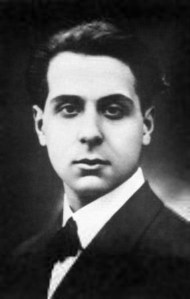
George Seferis [Georgios Seferiades] (1900 – 1971). One of the most important Greek poets of the last century, a diplomat and a Nobel laureate.I understand this question as related to writing. Ethic for me means to write a “real” poem. Now I sense the forthcoming question which would be what is the criteria or how would you determine what “real” is. A possible answer to this question is the one of the Nobel winner of Greek origin Georgius Seferis, who answers to a similar question in the following way: “But he must somehow have an instinct—a guiding instinct—which says to him: ‘My dear boy, my dear chap, be careful; you are going to fall. You are exaggerating at this moment.'” In this sense my instinct tells me that it’s an absurdity to expect everybody to understand poetry. Whoever wants to understand everything can read newspapers or magazine news. Still it’s uncertain that one will understand everything. At that point I would like to remind the following thought of T.S. Eliot: “Genuine poetry can communicate before it is understood.“
7. How do the writers you read when you were young influence you today?
Youngsters, who tend to get highly impressed after reading an author who relates to their inner self remember this artwork and this author which remains forever in their subconscious no matter if they are aware of it or not. That’s how the model works, which we reproduce in our own way. A poem doesn’t emerge from the nowhere.
8. Who of today’s writers do you admire the most and why?
Considering my experience and age it’s hard for me to get impressed. I just get extremely happy when I come across with an author, who has his/her own unique style, who is distinguishable from the majority. I would like to point at one single name, so I don’t miss out on some of my favourite authors. Stefan Goncharov – a young poet, who established his presence in a quite powerful and mature way just within few months time and having in mind that these were his first poems! As I can say – this man was born a poet.
9. Why do you write?
With writing I’m trying to express the inexpressible.
10. What would you say to someone who asked you “How do you become a writer?
In case that your question is – how can I become a professional writer, I can’t reply. I guess that this is something you can learn at the creative writing courses. For me this question has never been important. I just write. I think that if one wants to become a good writer, not only many books need to be read, but that person at a certain point needs to forget about all the knowledge and without a fear start writing in the way of expressing his/her own thoughts and feelings. To be honest with himself/herself and without thinking how to be liked by the readers. There isn’t an ultimate audience of readers that is there to like your writing. Here I would give a longer quote from the interview with Georgius Seferis – Henri Michaux “You know, my dear, a man who has only one reader is not a writer. A man who has two readers is not a writer, either. But a man who has three readers”—and he pronounced “three readers” as though they were three million—“that man is really a writer.”
11. Tell me about the writing projects you have on at the moment.
At the moment I don’t run my own projects. I’m engaged as an editor of the monthly magazine, New Asocial Poetry. We are preparing surprises for the published authors and new sections. There is already a new section for translations from mostly English language. At this point I would like to say that most of the young people know English, but unfortunately only few people for whom English is their mother tongue know my language. Maybe the reason for that the Cyrillic alphabet is mistaken for the Russian alphabet. Historically is exactly the opposite. Translations require hard work, especially when the literature is created in another language. For that reason we came up with the idea of having a new section for foreign literature dedicated to foreign authors who are a living example for language’s application and usage. All the authors, who are interested in participating in such project can read more about it HERE. .Whoever wants to learn more about the publishing requirements is kindly invited to apply with his/her literature by contacting me at newasocialpoetry@gmail.com.
Poet and writer, I was once columnist and associate editor of a regional employment publication. Currently I run this site, The Poet by Day, an information hub for poets and writers. I am the managing editor of The BeZine published by The Bardo Group Beguines (originally The Bardo Group), a virtual arts collective I founded. I am a weekly contributor to Beguine Again, a site showcasing spiritual writers.
My work is featured in a variety of publications and on sites, including: Levure littéraure, Ramingo’s Porch, Vita Brevis Literature,Compass Rose, Connotation Press, The Bar None Group, Salamander Cove, Second Light, I Am Not a Silent Poet, Meta / Phor(e) /Play, and California Woman.
Thank you for sharing your love of words. Comments will appear after moderation.
“I really should talk to him. He’s had a near-death experience!”
“We all have. It’s called living.”
TerryPratchett (1948-1915) English writer of fantasy and comical works
the grandmother stone
at the medical center you put your ear
to the trunk of a birch and listened to my heart
while i roasted potatoes in a snowed-under parking lot
and managed the effects of a shrinking brain
when i heard the door to the crematorium slam shut,
i found myself floating on waves of heat that flayed my skin,
mom held me in mourning and sang Salve Regina
(she was slightly off-key)
but i found the grandmother stone you left in my hand
it pulled me back to the earth and the snow
i heard you say you savored the taste of my blood
in the kalamata olives you ate the day i died
i listened to doves cooing and watched the wind
wrap silver filigree around tree branches
the morning was crisp and fresh
the others came to say goodbye, arms full of flowers
but your arms were empty and heavy with love
i decided to live
The road to the hospital lies under the weight of fog.
Perhaps that’s as it should be, all things considered.
I’m tempted to fuss with speculations and simile,
though it might be unwise, maybe even unkind,
to say that road is like a passage leading to salvation,
the undoing of cardiac arrest, then I’d have to
knock on wood in my mother’s way, not to jinx it,
not to jinx raising Lazarus from his hospital bed –
The quality of resuscitation is the quality of a mercy,
which might not show itself this day, so we pray.
We wonder, does consciousness survive brain death?
Will he come back from over the brink like a drunk
from a binge, ready to swear-off his bad habits,
suddenly enamored of Christ, whom he’d forsaken?
Will he change from his tech job to a confession
of sins and martyr himself in social services ~
a nouveau-saint of the died-and-came-back genus,
kin to those other types of marketers, not to be rude…
But it is a stretch, though I’d be happy if he survives
and over-brims more Light into our darkness. Amen.
Ascent of the Blessed by Hieronymus Bosch is associated by some NDE researchers with aspects of the NDE. public domain illustration
Near Death Experience (NDE): We hear a lot about them these days. For the most part, the experiences reported appear to be consistent with the culture/religion of the person reporting. There are many differing opinions on the validity of the experience and more than a few studies. Tell us about your views, experience/s, observations.
Share your poem/s on theme or a link to it/them in the comments section below.
All poems on theme will be published next Tuesday. Please do NOT email your poem to me or leave it on Facebook. If you do it’s likely I’ll miss it or not see it in time.
IF this is your first time joining us for The Poet by Day, Wednesday Writing Prompt, please send a brief bio and photo to me at thepoetbyday@gmail.com to introduce yourself to the community … and to me :-). These will be partnered with your poem/s on first publication.
PLEASE send the bio ONLY if you are with us on this for the first time AND only if you have posted a poem (or a link to one of yours) on theme in the comments section below.
Deadline: Monday, October 1 by 8 p.m. Pacific.
Anyone may take part Wednesday Writing Prompt, no matter the status of your career: novice, emerging or pro. It’s about exercising the poetic muscle, showcasing your work, and getting to know other poets who might be new to you. This is a discerning nonjudgemental place to connect.
Poet and writer, I was once columnist and associate editor of a regional employment publication. Currently I run this site, The Poet by Day, an information hub for poets and writers. I am the managing editor of The BeZine published by The Bardo Group Beguines (originally The Bardo Group), a virtual arts collective I founded. I am a weekly contributor to Beguine Again, a site showcasing spiritual writers.
My work is featured in a variety of publications and on sites, including: Levure littéraure, Ramingo’s Porch, Vita Brevis Literature,Compass Rose, Connotation Press, The Bar None Group, Salamander Cove, Second Light, I Am Not a Silent Poet, Meta / Phor(e) /Play, and California Woman.
Thank you for sharing your love of words. Comments will appear after moderation.
The urban poor buy water from water vendors for, on average, about five to 16 times the metered price. Photo courtesy of Oxfam East Africa under CC BY 2.0
“Wealth does not trickle down to the poor. Oxfam knows this, the IMF knows this, the World Bank knows this. Poor people have always known this.” Winnie Byanyima, Oxfam International Executive Director
These responses to the last Wednesday Writing Prompt, which was “poverty,” September 19th demonstrate sensitivity, observation, conscience, compassion and skill. Clearly, these are more than good poets. They are the most decent human beings. Thanks Irene Emanuel, Paul Brookes, Irma Do, Sonja Benskin Mesher, Marta Pombo Sallés and bogpan (Bozhidar Pangelov). Also with appreciation for participating and sharing their fine work, a warm welcome Wendy Bourke and Alethea Kehas.
Read on, enjoy, be inspired and do join us for the next Wednesday Writing Prompt tomorrow. All are encourage: novice, emerging and pro.
souls and human beings
she walked down the street median … passed the row
of idling cars that would have raced by her,
but for, the bright red orb that signalled: stop
she held a cardboard sign ‘pregnant – need money for food’ …
I could not tell, if the gloom upon her old young face
reflected anger or hate or sadness or pain or all of it
it is impossible to move around this manic city without anguish …
without words like ‘souls’ and ‘human beings’ tumbling
across your mind, like tosses of dice in a game of craps
she caught me … staring at her through the window …
and I sheepishly cast my eyes down – for I knew the look I wore
expressed my shock and frightened thoughts of the fate
that awaited the unborn child … if there was an unborn child
she came up to my car door, as if she’d been summoned
and, rolling down the window, I pressed a blue five bucks
into a limp and grimy hand … wondering … if I’d just been played …
as if such speculations have a place … where human beings beg
WENDY BOURKE lives in Vancouver, Canada where she writes, goes on long rambling walks gathering photos and inspiration – and hangs out with family and friends. After a life loving words and scribbling poetry lines on pizza boxes and used envelopes, Wendy finally got down to writing ‘in earnest’ seven years ago. Her work has appeared in over 100 poetry anthologies and journals.
Bloated Bellies
I wasn’t poor for long,
At least that’s what I chose to believe
My grandmother tells me the story of our return
From the Hare Krishnas
Faces the color of ashes, bellies bloated
Over skinny legs
I was too young to remember
But the ache has become
A troublesome cyst
I refuse to extract
Inside a place to dark and deep
For life. Like the hole in our outhouse
I don’t remember walking in the night
But I remember shame folded
Into second-hand clothes
And the pink satin nightgown
Never worn by another child
All that was missing was a crown
When she was two, ALETHEA KEHAS spent several months in hiding with the Hare Krishnas from a father she chose to believe was a villain until she reunited with him at the age of thirty-six. Alethea’s story is told in her memoir, A Girl Named Truth. She is also the author of The Labyrinth, Book 1 in the Warriors of Light fantasy series for children of all ages, but especially those who feel a little different on the inside and outside. Alethea’s Amazon page is HERE.
A Penny Drop
must never happen.
We must always be misunderstood
to communicate clearly and cogently.
Wrong end of the stick grasped firmly.
Vagueness is clarity.
If you let the penny drop confusion
and disillusion will result.
As many of you know, Paul launched a series of interviews a few weeks ago. HERE is the link to the most recent. It’s with Deborah Alma, one of my faves. She was also featured on The Poet by Day and in The BeZine regarding #Me Too a women’s poetry anthology. She is England’s “Emergency Poet.”
HERE is the link to Paul’s U.S. Amazon page. HERE is the link to Paul’s U.K. Amazon page.
Togetherness
They’re there;
hollowed into make-shift sponge-foam beds,
tight-curled into malodorous rag-blankets
and plastic of dubious origin.
They’re there;
the shadow-ghost people
of no fixed abode,
gathered loosely together
in cohesive misery.
They’re there;
existing on society’s fringe,
sustained by the government’s pandering promises;
sharing glue-highs and garbage rot.
They’re there;
old children, dying people,
together in perpetual poverty.
They’re there;
trampled contours on grass verges,
silhouettes on street corners,
robotic vendors with nothing to sell but themselves.
Sonja Benskin Mesher, RCA paintings (This is her Facebook page, so you can connect with her there as well as view photographs of her colorful paintings.)
Spring anticipation in the air
Orange reddened sun
Gets ready to hide its rays
Behind the lowest of all mountains
Mirroring itself on the lake.
Vanity at its highest level.
Yet the picture turns out different
In a mixture of yellow and blue
Of greed and sadness a faithful clue.
“You’re so vain,
You probably think
This march is about
You…”
Reads the banner
At the Women’s March
January 21, 2017.
Millions came together
Across the globe
To raise their voices
Against your choices
Mr. Trump.
Your misogyny,
Racism,
Xenophobia,
Your greed and your lies
Are most unwelcome
Because it is your vanity
That makes you lie.
Where’s the first media-built man
That promised jobs for the working-class
To make America First and great again
When all you bring is constant pain
Erasing truths and liberties from earth.
The second man’s now on the surface,
Two sides of the same coin,
And the reddened sun sets down
While Vanity School runs high
For Marine Le Pen, Geert Wilders,
Frauke Petry, Beppe Grillo…
And the like.
Even Spain’s Rajoy’s a little Trump,
Profound ignorant and clown,
Who drains the fund backing pensions
With an air smell of corruption.
Won’t you grant us, Catalans,
Once for all that referendum
Any democratic state would offer
To a stateless people to decide:
The right to self-determination.
No, instead, you’re blurring powers
Just exactly as Donald Trump
Judicializing politics and sending
The very democrats to court
For organizing a participatory process
In Catalonia, November 9, 2014.
Vanity School expands its limits
And buys a handful Orwell’s 1984
While the sea has just began to weep:
Mare Nostrum, Mare Mortum,
In 2016 almost 5.000 people
Drowned and died
From 2000 till now 30.000 dead!
With Barcelona’s pro-refugee rally,
The largest in Europe and perhaps
In the entire world till now,
We will surely not have enough
To eradicate our human misery.
The red sun has just hidden
Behind the lowest mountain
And as darkness unfolds
The picture changes colors:
Grayish blues carrying their shadows
On a rippled lake obscured
Where birds and ducks move
Swiftly countercurrent.
Marta’s “A tasty lentil soup” served up in both English and Catalan was published in response to another prompt, but we’re going to share it again … Enjoy!
A tasty lentil soup
keeps you warm from the cold.
Coldness outside
speaks of emptiness,
sadness in a cloudy day.
Or is it just the fog all around
that saddens your mind and spirit?
Going through the streets
the walking dead
if they can still walk.
You saw poverty’s face
the system’s decay.
Needles in their hands,
hollow eyes, ailment,
people lost without a second chance.
Is this what you came here for?
But you had your lentil soup
that kept your body warm
while your bleeding heart
sank into the deepest darkness.
You detached it from the body
took it to analyze and
put it on to a microscope
And the bleeding heart spoke up
vomited nothing but the truth
awaiting the other truth that hurts.
You knew it would happen.
The lentil soup eaten
in the Arabian restaurant
and then a sudden sound,
a slight noise on the floor,
something moves near your table.
You raise your eyes and there it is:
A black pigeon inside
walks a few steps toward you
as if he wanted to speak.
“Do we have a new guest?”
The waitress gently guides him
to the main room
near the entrance door.
The bird moves his wings
flies inside the restaurant.
The waitresss, a little scared,
utters an “oh” sound
while the black pigeon
displays his wings, flies away
through the restaurant door.
A sad bird looking
for temporary company,
maybe a friendship
but forever unattainable.
El colom negre
Una saborosa sopa de llenties
t’escalfa del fred.
La fredor a l’exterior
parla de buidor,
tristesa en un dia plujós.
O és només la boira per tot arreu
que t’entristeix la ment i l’esperit?
Anant pel carrer
els morts caminant
si és que encara poden caminar.
Has vist el rostre de la pobresa,
la decadència del sistema.
Agulles a les seves mans,
ulls buits, malaltia,
gent perduda sense una segona oportunitat.
És per això que has vingut aquí?
Però tu et menges la teva sopa de llenties
que t’escalfa el cos
mentre la teva ànima sagnant
s’enfonsa en la més profunda foscor.
La separares del teu cos
i l’agafares per analitzar
posant-la en un microscopi.
I l’ànima sagnant va parlar
vomitant res més que la veritat,
esperant l’altra veritat que fa mal.
Ja sabies que això passaria.
La sopa de llenties menjada
en el restaurant àrab
i llavors, un soroll sobtat,
una remor al terra,
alguna cosa es mou prop la teva taula.
Alces la mirada i és allí:
Un colom negre a dins.
Camina uns passos cap a tu
com si volgués parlar.
– Tenim un nou convidat?
La cambrera el guia gentilment
cap a la sala principal.
L’ocell mou les seves ales,
vola dins del restaurant.
La cambrera, una mica espantada,
deixa anar un “oh!”
mentre el colom negre
desplega les ales, vola lluny
a través de la porta del restaurant.
Un ocell trist, buscant
companyia temporal,
potser una amistat
però per sempre, inabastable.
Poet and writer, I was once columnist and associate editor of a regional employment publication. Currently I run this site, The Poet by Day, an information hub for poets and writers. I am the managing editor of The BeZine published by The Bardo Group Beguines (originally The Bardo Group), a virtual arts collective I founded. I am a weekly contributor to Beguine Again, a site showcasing spiritual writers.
My work is featured in a variety of publications and on sites, including: Levure littéraure, Ramingo’s Porch, Vita Brevis Literature,Compass Rose, Connotation Press, The Bar None Group, Salamander Cove, Second Light, I Am Not a Silent Poet, Meta / Phor(e) /Play, and California Woman.
Thank you for sharing your love of words. Comments will appear after moderation.
“Poetry. It’s better than war!” Michael Rothenberg, cofounder of 100,000 Poets (and friends) for Change
The slide show below displays some of the posters for 100TPC events happening in different parts of the world. To find something in your area check 100tpc.org or Michael Rothenberg’s 100,000 Poets for Change Communication Hub. I’ve also been trying to track the events and post links to them on The Poet by Day Facebook Page. The Zine is an online event, so you can go to an event in your area and still participate inThe BeZine‘s virtual 100TPC on Saturday, September 29th.
Over 2,000 groups and individuals have signed-up to read poems to children (part of 100TPC Global 2018) from September 24-29.
If you are reading this post from an email subscription, you’ll likely have to click through to this site to view the slide show.
This slideshow requires JavaScript.
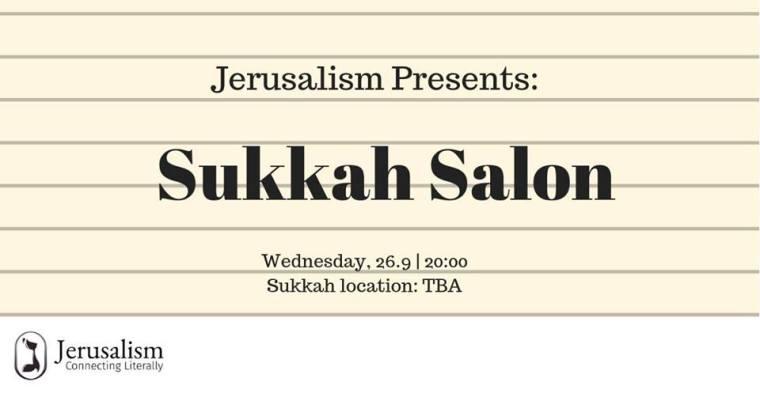
HEADS-UP ISRAEL …
SEP
26
Sukkah Salon
Public · Hosted by Jerusalism.
This 100TPC event is hosted by our own Michael Dickel (Meta/ Phor(3) /Play) and his friends.
Our poster for 100TPC 2018. It was designed by Corina Ravenscraft (Dragon’s Dreams)
Michael Dickel is also the Master of Ceremonies for The BeZine Virtual 100TPC event, Sept 29. Join with us on Saturday and support this great global effort, read some fine work, share your poetry and other art, and meet poets and other artists who share your values and concerns.
By focusing on efforts across the country to remove or restrict access to books, Banned Books Week draws national attention to the harms of censorship. The books featured during Banned Books Week have all been targeted with removal or restrictions in libraries and schools. While books have been and continue to be banned, part of the Banned Books Week celebration is the fact that, in a majority of cases, the books have remained available. This happens only thanks to the efforts of librarians, teachers, students, and community members who stand up and speak out for the freedom to read. Banned Books Week is an annual event celebrating the freedom to read. Typically held during the last week of September, it highlights the value of free and open access to information. Banned Books Week brings together the entire book community – librarians, booksellers, publishers, journalists, teachers, and readers of all types – in shared support of the freedom to seek and to express ideas, even those some consider unorthodox or unpopular.
About Book Bans and Challenges
Books are still being banned and challenged today. A challenge is an attempt to remove or restrict materials, based upon the objections of a person or group. A banning is the removal of those materials.
While books have been and continue to be banned, part of the Banned Books Week celebration is the fact that, in a majority of cases, the books have remained available. This happens only thanks to the efforts of librarians, teachers, students, and community members who stand up and speak out for the freedom to read.
Poet and writer, I was once columnist and associate editor of a regional employment publication. Currently I run this site, The Poet by Day, an information hub for poets and writers. I am the managing editor of The BeZine published by The Bardo Group Beguines (originally The Bardo Group), a virtual arts collective I founded. I am a weekly contributor to Beguine Again, a site showcasing spiritual writers.
My work is featured in a variety of publications and on sites, including: Levure littéraure, Ramingo’s Porch, Vita Brevis Literature,Compass Rose, Connotation Press, The Bar None Group, Salamander Cove, Second Light, I Am Not a Silent Poet, Meta / Phor(e) /Play, and California Woman.
Thank you for sharing your love of words. Comments will appear after moderation.









 Jamie Dedes' THE POET BY DAY Webzine