Page 16 of 74

READY, SET, NA-NO-WRI-MO … Tips, Tricks and Writing Rules from P.L. Travers, Henry Miller, John Steinbeck, Jack Kerouac

ravers in the role of Titania in a production of A Midsummer Night's Dream, c. 1924
Travers in the role of Titania in a production of A Midsummer Night’s Dream, c. 1924

200px-Poppinsfirst4

Some of us say we write from the heart, some from spirit. P. L. Travers, OBE (1899-1996, Australian national, British citizen),  actress, poet and the conjuror of Mary Poppins, wrote in a Parabola* article that

I sit down inside my abdomen and brood and brood until I figure out how I feel about it.”



E1tZzQ4WVeS._SL250_FMpng_

I noted the quotation above but I don’t remember the exact context of the piece. I think it was Tavers’ way of talking about the exploration of a painful childhood, one out of which she created a children’s classic. She once told a friend that the people and the objects of her early life were like a spindle around which she wove the threads of her imagination. That worked for her as a writer and for us as readers. In using her childhood to create characters and stories, she gave us a gift that ranks with those given to us by J.M. Barrie, L. Frank Baum, C.S. Lewis and Lewis Carroll.

Of course art-making isn’t therapy, but I often think artists don’t need to be quite so loath to admit some relationship between art-making and therapy.” Short-story writer, Deborah Eisenberg, Paris Review Interview #218, 2016

Travers’ why of writing was – at least in part – to heal and to imagine the childhood she would have liked.

Ultimately, we write for many reasons: to recover, to find closure or completion, to find meaning and understanding and to cherish the gifts of life. I relish life through writing. When I write a poem about an experience or observation, it’s often a way to savor it, prolong or relive the pleasure or heal the wound. It’s a way to live hugely. On the other hand, sometimes I use fiction to reframe experience. I think most people would agree that we also write to have our say and – in the spirit of Joseph Conrad – to help the reader see. That may sound to some like colossal chutzpah, but we all have something to say. We all have a perspective to share.

No matter where our writing comes from or why we write, we have to get the job done. For many of us the muse is a fairly consistent companion. For others it’s a struggle to connect. Either way, we develop habits, disciplines, and rituals to court the muse. It is often as though there is a sort of magical thinking or personal superstition in play. We must sit in this chair at this desk or at this cafe or we simply can’t write. Perhaps that’s why well-known and prolific writers are always being asked how, when and where they write, just another way of saying, “How do you court the muse?”  The answers writers give can reveal demons, superstitions, irritation with the question, or even a tongue firmly in cheek. The “tips” or “rules” can be wise, cool, pragmatic, quirky, absurd or disagreeable. You may end up feeling affirmed, acquiring a useful tool, or finding yourself entertained.

Henry Miller‘s policy was to work on one project at a time. Some will disagree with that. I do. I think many of us find one activity feeds another, that our multiple projects or different artistic outlets form a rich diet for the muse and make us more productive. I have a writer friend who says, “suum cuique” . . . to each his own  . . . though to the old Romans that phrase was about justice (may each get their due), not about writing rituals. But the point is made.

200px-Journal-of-a-novel_cover-smallJohn Steinbeck’s tips are pragmatic, born of a long, intense and consistent experience. In the fall of 1968, Steinbeck was actually too ill for a standard interview and one was pieced together from the East of Eden diaries (Journal of a Novel) and from some letters, which were later collected and published in one book. The tips have been widely published and were also included in Steinbeck’s Paris Review, The Art of Fiction** interview. [The Paris Review Interviews are required reading for writers and poets.]  Steinbeck’s second tip is “Write freely and as rapidly as possible and throw the whole thing on paper. Never correct or rewrite until the whole thing is down. Rewrite in process is usually found to be an excuse for not going on. It also interferes with flow and rhythm which can only come from a kind of unconscious association with the material.” This is consistent with the philosophy and structure of NaNoWriMo. You write, write, write all month and don’t do your rewrites, editing and proofing until after that.

Jack Kerouac’s famous thirty tips are … well, they’re Jack … quirky … but useful  … You can check them out HERE on the Gotham Writers’ Workshop site.
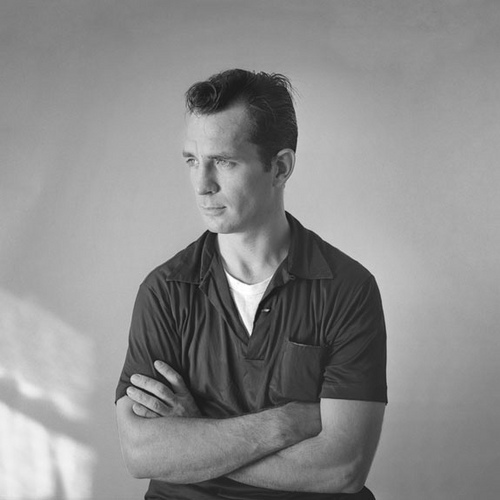
Jack Kerouac by Palumbo
Jack Kerouac (1922-1969), American poet and novelist

The best tip I ever got was to “listen to and feel, see and smell the world around you.” Inspiration is everywhere: in the air and its scents, in the conversations you overhear, in your self-talk and memories, in the arguments with your spouse and the aroma of dinner cooking. It’s in the coo of the mourning dove, in the feel of your child’s hand in yours, in your own hopes and dreams and the life experiences and observations others share with you. Inspiration is in the news and in history. Be open to everything without exception. Nora Ephron constantly reminded those around her that everything “is copy.” We might say that everything holds the seed of a story, a character, or a scene.

Some of my most profitable lessons came from my high school English teacher, Sister Francis of Assisi, C.S.J. who encouraged my early writing. Sometimes I imagine her leaning over my desk and I hear her whispering  …

What is it you really want to say?
Is this word appropriate? It is accurate?
What is your theme?
Does this really have to rhyme? Be cautious of rhyming.
Is this artfully dramatic or is it bad melodrama?
Is that lyrical or flowery?”

Read and read some more:
What writers do you enjoy most? Why? What can you learn from reading their work?
What novels do you dislike? Why? What can you learn from your reaction?

Reorder and rename the everyday. In truth the ordinary is often extraordinary and it’s your job to recognise and illustrate this.

Practically speaking, the muse is probably most responsive to the simple act of gluing the seats of our pants to our chairs and staying there until the job is done. Perhaps the muse is not fickle. Perhaps to be constant she requires our constancy.

Tips, tricks and rules are helpful and can be inspiring, but take them under advisement. In the end, the best magic for courting the muse is the magic that works for you ….

Work calmly, joyously, recklessly on whatever is in hand”. Henry Miller

* Parabola is a magazine of The Society for the Study of Myth and Tradition. P.L. Travers was one of the founders.
** The Paris Review, The Art of Fiction interviews from 1953 through 2016 are freely posted online.

© 2016, essay, Jamie Dedes, All rights reserved; Photo credits ~ P.L. Travers via Wikipedia, uploaded there by Rossiter and in the Australian public domain. The book cover art likely belongs to the publisher or estate and is courtesy of Bookworm  (Mary Poppins) and Wikipedia (Journal of a Novel), Jack Kerouac by Palarmo licensed under Creative Commons Attribution-Share Alike 2.0 Generic


ABOUT

Poet and writer, I was once columnist and the associate editor of a regional employment publication. Currently I run this site, The Poet by Day, an information hub for poets and writers. I am the managing editor of The BeZine published by The Bardo Group Beguines (originally The Bardo Group), a virtual arts collective I founded.  I am a weekly contributor to Beguine Again, a site showcasing spiritual writers.

My work is featured in a variety of publications and on sites, including: Levure littéraure, Ramingo’s PorchVita Brevis Literature,Compass Rose, Connotation Press, The River Journal, The Bar None GroupSalamander CoveSecond LightI Am Not a Silent PoetMeta / Phor(e) /Play, and California Woman

Implicit Bias in Sacred Stories, a guest post from Rev. Terri Stewart of Beguine Again and “The BeZine”

“The attitudes or stereotypes that affect our understanding, actions, and decisions in an unconscious manner.  These biases, which encompass both favorable and unfavorable assessments, are activated involuntarily and without an individual’s awareness or intentional control.  Residing deep in the subconscious, these biases are different from known biases that individuals may choose to conceal for the purposes of social and/or political correctness.  Rather, implicit biases are not accessible through introspection.” The Ohio State University, Kirwan Institute for the Study of Race and Enthnicity.


A Few Key Characteristics of Implicit Biases from the Kirwan Institute:

  • Implicit biases are pervasive.  Everyone possesses them, even people with avowed commitments to impartiality such as judges.

  • Implicit and explicit biases are related but distinct mental constructs.  They are not mutually exclusive and may even reinforce each other.

  • The implicit associations we hold do not necessarily align with our declared beliefs or even reflect stances we would explicitly endorse.

  • We generally tend to hold implicit biases that favor our own ingroup, though research has shown that we can still hold implicit biases against our ingroup.

  • Implicit biases are malleable.  Our brains are incredibly complex, and the implicit associations that we have formed can be gradually unlearned through a variety of debiasing techniques.

  • Further details HERE.

Given the events of last week in which implicit bias is seen all over the news (we have seen the news of the eleven Jews gunned down in Pittsburgh and held vigils, but have we seen the news of the two black folks gunned down in Kentucky by a white nationalist? And the reticence to label it as a hate crime, although the police are now investigating it as such-after public pressure.  And the dude had tried to enter a traditional black church to gun down folks before he settled on the grocery store.

And implicit bias affects how these killers were taken in. They are both alive and untouched. And yet we hear the call all the time with regard to people of color who are shot and killed–we must keep the community safe–we had no choice but to kill this man in his own backyard (Stephan Clark) or we had no choice but to kill this cooperating man in his own car (Philando Castile). Surely, if they couldn’t be “taken alive,” then two mass murders … well, you know. They were white. Implicit bias affects how we treat and approach folks. If there is bias in favor of whiteness, they there is a chance of having a kinder, gentler approach taken that allows life to continue on. Anyway, my rant of the day.

Onward to my daily practice that instigated it all!

Altar’s smoke rises
Blurring earth and the cosmos
Connecting us all

[end]

Judges 13
This is the beginning of the story of Sampson of the tale of the super strong guy who lost his strength when his wife cut all his hair off.

I was so excited by his birth story that I didn’t read through to the entire allegory. Because, #biblegeek. Come on!

Anyway, I forgot the bit about his parents not having children and that they entertained a stranger who told them they would have a child anyway. Hmm…who does this sound like? Sarah and Abraham? And later, Elizabeth and Zechariah? Miraculous birth stories abound!

What I had remembered was that Sampson was pledged to be a Nazarite from birth. In Numbers 6, the rules for being a Nazarite for “men and women” is revealed. I even looked in the KJV version…the inclusion of women was not a modern-day inclusion. It was there from the beginning. The basic rules for Nazarites was no cutting of hair, no drinking of alcoholic beverages, no going near dead people, dedicated to God.

What I liked most about this story was the birth story and the messenger of God that came to Manoah and his wife (another unnamed woman in the Bible). The messenger goes to Mrs. Manoah first. Then manoah who doesn’t get it and needs clarification and asks for the messenger to come talk to him directly.

Manoah asks the “messenger” to stay so they can have a goat together and the “messenger” says, “No, make a burnt offering to the LORD.” So they do that and when the flames and smoke rises, the “messenger” rises up into the heavens along with the smoke (hence today’s drawing).

Then Manoah declares, “We’ve seen God.” The messenger wasn’t a messenger, it was God.

The leadership challenge may be one of implicit bias. Do we let implicit bias drive our “double checking” of voices (like Mrs. Manoah’s voice) or do we believe them?

Peace,

Rev. Terri Stewart


Editorial Notes:

  • Terri Stewart (a.k.a. Clocked Monk) is a pastor in the United Methodist Church at the Church Council of Greater Seattle’s Youth Chaplaincy Coalition. She is the founder of Beguine Again, focusing on spiritual practice and ideals. Terri is a member of the Zine’s core team. Beguine Again is the sister site to The BeZine
  • The Kirwan Institute for the Study of Race & Ethnicity announces the nation’s first free and publicly available online implicit bias module series tailored specifically toward K-12 Educators. Details HERE.


ABOUT

Poet and writer, I was once columnist and the associate editor of a regional employment publication. Currently I run this site, The Poet by Day, an information hub for poets and writers. I am the managing editor of The BeZine published by The Bardo Group Beguines (originally The Bardo Group), a virtual arts collective I founded.  I am a weekly contributor to Beguine Again, a site showcasing spiritual writers.

My work is featured in a variety of publications and on sites, including: Levure littéraure, Ramingo’s PorchVita Brevis Literature,Compass Rose, Connotation Press, The River Journal, The Bar None GroupSalamander CoveSecond LightI Am Not a Silent PoetMeta / Phor(e) /Play, and California Woman
 

INKTOBER 29TH: Photon Refractor, art and acrostic poem by Gary W. Bowers

20181029_093054

I [Gary, not Jamie] have been seriously pursuing excellence in acrostic poetry for more than eleven years. The most excellent, the Holy Grail, of acrostic poetry is an array of words with a flawless meter and rhyme scheme, with something important to say, well said, in the content of the poetry, and with the acrostic words providing the ideally meaningful title of the poem.

This may seem like an odd pursuit to be throwing over a decade’s effort toward its furtherance. But if you want to be not merely a poet, nor even a Capital-P Poet, but the absolute best P*O*E*T it is in you to be, writing acrostic poetry makes sense. You are challenged to find words to fit the array, and the words you find may be new to you. They then become part of your arsenal. And it is even possible, as has happened today on my page, that you are compelled to bring into being words that did not yet exist. That may seem like cheating, but did you know that the name Wendy did not exist until J. M. Barrie, creator of Peter Pan, invented it?

Notice, though, how few words there are in the dual array above. How there are always three letters between acrostic elements. This is as minimal as I can possibly get with double and triple acrostic.  Let us unfold and enhance the array:

Photon Refractor

1: Photon

Prest/Helio/Onion

2: Refractor

Resurrect/Ecstatico/Felicitor

A photon is an infinitesimal thing that may or may not be visible light, depending on its frequency. PHO is something to eat. TON is a measure of heaviness. A photon has a rest mass of zero.

Prest? It’s a variant of Pressed, just as Blest is a variant of Blessed. Helio? Relates to the Sun, to mythology, and to the flower Heliotrope. Onion? It may remind people of getting to the truth, as a typical onion has many peelable layers.

A refractor is something that alters the path of a…particle? wave? Wavicle. REF is short for Referee. RAC is a versatile acronym. Here is a partial list, courtesy of The Free Dictionary:

RAC Recovery Audit Contractors (CMS, Medicare program)
RAC Religious Action Center
RAC Rent-A-Center
RAC Real Application Cluster
RAC Royal Automobile Club (UK)
RAC Railway Association of Canada
RAC Rural Assistance Center
RAC Royal Agricultural College (Cirencester, UK)
RAC Rent-A-Coder (freelancer matching service)
RAC Refrigeration and Air Conditioning
RAC Regional Advisory Council (Canada)
RAC Recombinant-DNA Advisory Committee
RAC Rotaract
RAC Research Advisory Committee
RAC Ratchet and Clank (gaming)
RAC Recent Average Credit (distributive computing)
RAC Royal Armoured Corps
RAC Room Air Conditioner
RAC Retirement Annuity Contract (UK)
RAC Reliability Analysis Center
RAC Rubber Association of Canada

It also may be pronounced “rack” which may be defined as an organizational substrate for an array of things. Above this paragraph is a RAC rack.

It is also “car” backwards.

As for Tor, it is “a hill or rocky peak” according to any number of sources. It is also a paperback book publisher specializing in the otherworldly.

Resurrection is coming back to life. Ecstatico is kind-of Spanglish for “being in a joyously energized place.” Felicitor has Happiness as its root and “one who brings about” as a suffix.

When you get this minimal, some of the heavy meaning-lift will be done by the reader. An analogous creation that comes to my mind is “Les Demoiselles d’Avignon,” a painting by Pablo Picasso. The first time I saw the painting I was repelled. It seemed ugly. Ugly colors, variably attentive anatomy, weird color and composition choices. But it has historical significance, and has been called “the first truly Cubist painting.” And the more you live with it visually, the more a word emerges from the mist: Extraordinary.

© 2018, Gary W. Bowers (One With Clay / Image and Text)


Poet and Artist, Gary W. Bowers

Poet and Artist, Gary W. Bowers

Gary Bowers (One With Clay) is one of our triple-threat poets: poetry, art and humor.  Words like “quick-witted” and “pithy” come to mind. He is adapt at combing his talents in a unique and engaging way.  Gary is a frequent contributor to The Poet by Day, Wednesday Writing Prompt and look for something from him in the December issue of The BeZine. There’s lots more of Gary’s poetry, art and unique style to be enjoyed on Gary’s blog,where he often acknowledges other creatives. Recommended. J.D.


My (Jamie) intro to acrostics is I believe well-known among Roman and Orthodox Catholics, perhaps by other Christian sects as well.  It is from the Greek for Jesus Christ, Son of God Our Savior. The initials spell ΙΧΘΥΣ, that is “fish.” The sign of the fish or the “Jesus fish” was adopted by early Christians as a secret symbol.

Ιησούς    I  esous   Jesus
Χριστός   CH ristos  Christ
Θεού      TH eou     of God
Υἱός      Y  ios     son
Σωτήρ     S  oter    saviour 
Courtesy of Wikipedia

ABOUT

Poet and writer, I was once columnist and the associate editor of a regional employment publication. Currently I run this site, The Poet by Day, an information hub for poets and writers. I am the managing editor of The BeZine published by The Bardo Group Beguines (originally The Bardo Group), a virtual arts collective I founded.  I am a weekly contributor to Beguine Again, a site showcasing spiritual writers.

My work is featured in a variety of publications and on sites, including: Levure littéraure, Ramingo’s PorchVita Brevis Literature,Compass Rose, Connotation Press, The River Journal, The Bar None GroupSalamander CoveSecond LightI Am Not a Silent PoetMeta / Phor(e) /Play, and California Woma

“The Bride Wore Yellow” and “Heart Under Lock and Key”, two poems . . . and this week’s Wednesday Writing Prompt


“…weddings are giant Rorschach tests onto which everyone around you projects their fears, fantasies, and expectations — many of which they’ve been cultivating since the day you were born.” Susan Jane Gilman, New York Times Best Selling Author. She went to Stuyvesant High School on Chambers Street in Manhattan where Frank McCourt was her English teacher and a mentor.


after Ann’s wedding

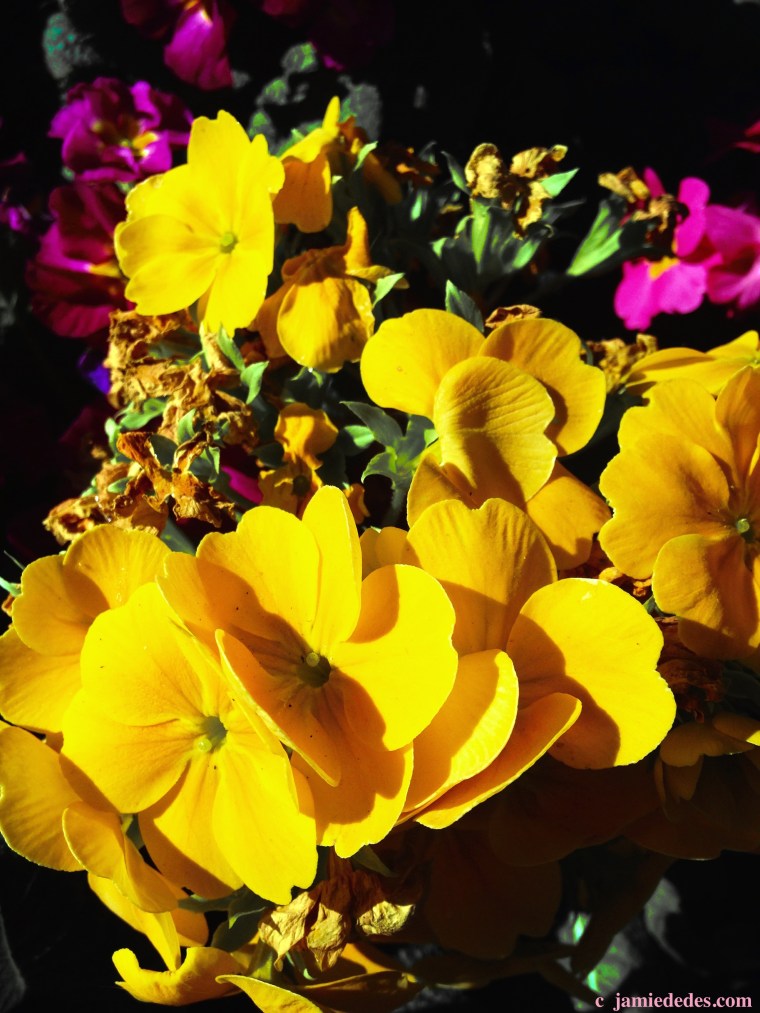
yellow, like it highlights the flames of autumn
and sparks cornfields and the California hills,
the oranges and ruddy browns of some cats,
the sunrise at springtime, a harvest moon,
jack-o’-lanterns on Halloween and daffodils

yellow, like her accidental wedding, unplanned
but so perfect, subtle yet somehow spicy nice,
symbol of joy and delight, fourth chakra powers,
way of summer hugs and roses saying goodbye,
honest, you know, not like a silly tale told in white

Originally published in Bay Area Poet Ann Emerson’s online Wedding Album. Ann was married from her hospital bed just two days before she died. A sad but beautiful story. The complete back story and samples of her poetry are HERE.

© 2013, Jamie Dedes, All rights reserved


I wait until I hear a gate latch lift
the turn of key in lock.
I sit amongst toys and unwashed clothes,
I sit and she fingers the beads until you speak
in a voice that no longer seems familiar, only strange.
I turn as our child tugs at the string.
I hear a snap and a sound like falling rain.
The Albatross, Kate Bass, The Pasta Maker
I really wanted
to speak to you of this:
the love I had wild
and so long ago
Now it’s dry,
a land parched
by drought
.
Once a love moist
as a spring rain,
delicate as snow drops,
prolific as a poet
I gave you my love
a tender thing
.
A well-written poem
on twenty-pound linen
You tossed love back
wrinkled and torn,
nicotine stained,
smelling of whiskey
.
I handed you love
on our white wedding day
when you kept your heart
under lock and key
Your eyes wouldn’t
seek mine at the rail
.
I gave my love to you
in the palms of our child
You brushed his sweet face
and flew on your way
You lost yourself in a
the land of golden girls
.
Now, I too keep my heart
safe under lock and key
Heavy the lock is
closed so tight with rust
No hope in sight
No hope wanted
© 2010, Jamie Dedes

“Jamie, I was touched that you used my poem as a starting point for one of your own. I liked your imagery, particularly the love in the palms of a child, and it is good to see that you touched others too.

“The time when you have young children is a very difficult time in any relationship, however strong it is. This was one of a series I wrote to try and document the complex mixture of emotions: love, hate, despair, hope, frustration and fulfilment, that new parents feel regardless of whether their relationship survives or not.” Kate Bass


WEDNESDAY WRITING PROMPT

As with all human institutions and traditions, weddings and marriages can be very mixed things. Share your poem/s on weddings or marriage in the comments section below or leave a link to it/them.

All poems on theme are published on the following Tuesday. Please do NOT email your poem to me or leave it on Facebook. If you do it’s likely I’ll miss it or not see it in time.

IF this is your first time joining us for The Poet by Day, Wednesday Writing Prompt, please send a brief bio and photo to me at thepoetbyday@gmail.com to introduce yourself to the community … and to me :-). These are partnered with your poem/s on first publication.

PLEASE send the bio ONLY if you are with us on this for the first time AND only if you have posted a poem (or a link to one of yours) on theme in the comments section below.  

Deadline:  Monday, November 5 by 8 p.m. Pacific.

Anyone may take part Wednesday Writing Prompt, no matter the status of your career: novice, emerging or pro.  It’s about exercising the poetic muscle, showcasing your work, and getting to know other poets who might be new to you. This is a discerning non-judgemental place to connect.


ABOUT

Poet and writer, I was once columnist and the associate editor of a regional employment publication. Currently I run this site, The Poet by Day, an information hub for poets and writers. I am the managing editor of The BeZine published by The Bardo Group Beguines (originally The Bardo Group), a virtual arts collective I founded.  I am a weekly contributor to Beguine Again, a site showcasing spiritual writers.

My work is featured in a variety of publications and on sites, including: Levure littéraure, Ramingo’s PorchVita Brevis Literature,Compass Rose, Connotation Press, The River Journal, The Bar None GroupSalamander CoveSecond LightI Am Not a Silent PoetMeta / Phor(e) /Play, and California Woman