Page 10 of 11

“FILL THE AIR WITH POEMS so thick even bombs can’t fall through …” (Peter Levitt)

Iraq War
Iraq War

It’s nothing new for poets to write poems against war, to write poems to raise the general consciousness of injustice, to express their pain and to speak truth to power. What is relatively new is the use of technology and social media to make it easy for poets to come together in protest as we see now with 100,000 Poets for Change (100TPC). In 2011, Michael Rothenberg, cofounder of 100TPC, put out a call for poets on Facebook and just five years later we have a huge global movement and a thriving community of poets and other creatives to stand up for peace, social justice and sustainability.

516Z7PHWT6L._SX309_BO1,204,203,200_On the eve of the Iraqi War, poet Sam Hamill received an invitation from Laura Bush to attend a White House literary salon to celebrate the works of Emily Dickinson, Langston Hughes and Walt Whitman. Hamill had just read about President Bush’s plan for the invasion and saturation bombing of Iraq that would kill innumerable civilians, a plan that did not rule out the possibility of using nuclear weapons. Hamill felt he couldn’t sit restrained among politicians and poetic aristocracy. He had to speak out.  He contacted colleagues, asking them to join with him in using this event to make a stand for peace.

Poetry readings were scheduled outside the White House and across the country on February 12, the day the event was scheduled. A website was started to collect and display antiwar poetry. Such prominent poets as Rita Dove, Peter Levitt, Lawrence Ferlinghetti, W.S. Merwin and Adrienne Rich contributed work.  Their poems and many others were collected in a print volume.  Contributions for the webstie continued to flow in for several years. The poems were screened by a team before publication. I contributed two, which were my first anti-war poems. Ultimately I think some 5,000 poems were collected. The poems are now archived in a university library.

We all know that Poets Against the War didn’t stop the invasion. Poet, peace activist and Jesuit priest, Daniel Berrigan wrote, “One is called to live nonviolently, even if the change one works for seems impossible.”  So too are we called to speak truth to power, ignorance and cruelty no matter how hopeless things seem and no matter that we may never see the fruits of our labors in our lifetime. Peace has to start somewhere and it might just as well start with us.

If you are viewing this post from email, you’ll have to click through to the site to see the video.

© 2016, Jamie Dedes; photo montage credit, Futuretrillionaire under CC BY-SA 2.0 license

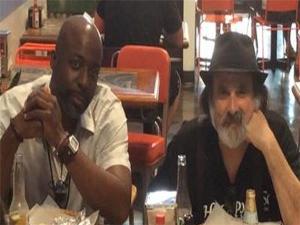
In Conversation: Poet/Musician Graffiti Bleu & Michael Rothenberg, cofounder of the global peace initiative, 100,000 Poets for Change

810919_RJ8dSr1y

You can listen to the two-hour podcast HERE. Recommended! This post is meant as an alert and also to share my two cents.

As I write, it’s just a few hours after listening to Just My Thoughts with Graffiti Bleu on BlogTalk Radio. The show started with an exploration of What does the revolution look like? with Graffiti Blue, Michael Rothenberg, and the show’s panel and callers comprised of poets involved in 100,000 Poets for Change (100TPC).

Harkening back to Gil Scott-Heron and his poem, The Revolution Will Not Be Televised,  part of the discussion was on technology and social networking and their roles in fostering peace, social justice and sustainability. When Heron wrote his poem in 1971, the means to formulate and distribute information and opinion were dominated by mainstream media and corporate interest, which were not in sympathy with the revolution Heron envisioned. Those interests are still dominant and still lack sympathy, but there’s something of a balance occurring – however imperfect – now that we plain folk have access to the tools of technology and social networking. Without social networking, we wouldn’t have 100TPC, which can happily be said to have gone viral since Michael Rothenberg put out a call on Facebook for poets to join in a global peace effort back in 2010. While each of us in the “100,000” has a relatively small “audience” together we touch many, many minds and hearts. We do have an agenda, but it doesn’t foment strife. We’re not in anyone’s pocket. That’s clean power. It’s power to …

On a personal level, one benefit of technology is that people who are homebound – as I sometimes am – can take part in change-making initiatives more actively than simply writing letters-to-the-editor or to our legislators, which is not to say we should give that up. I started a virtual 100TPC via The BeZine and with The Bardo Group Beguines so that disabled people and people who do not live near a 100TPC event would have the opportunity to have their say, to lend their support. Our 2015 commemorative page is HERE.

We need to do more than “talk.”  Agreed. And I think that one of things 100TPC gives us is hope … huge hope from seeing that there are people in every nook-and-cranny of the world who share our values and priorities. This helps us to keep on keeping on with our local grassroots initiatives as well as our broader advocacy. This serves to sustain our faith and commitment.

Ultimately for me, 100TPC is about breaking down barriers, crossing boarders. It leads the way in our evolutionary journey toward a sustainable peace. In the documentary film Ten Questions for the Dalai Lamathe Dalai Lama says “we need more festivals.”  In other words, if we get to know people, if we break bread with them or share a bowl of rice, we are less likely to think of them as “other.”  It will be more difficult to turn around the next day and do harm.  100TPC is our festival. Once we’ve shared hearts, souls and stories through poetry, how can we marginalize anyone? How can we abandon or abuse?

Can the revolution be bloodless? The question is really “will it be?” I don’t think so. I don’t think revolutions are by their very nature “bloodless.” The psychopaths will always be with us and until we stop marginalizing people and leaving them desperate and vulnerable to tyrants, we’ll never have bloodless reform. We’ll never achieve a sustainable peace. Peace is a state that takes awareness and awareness takes growth, which is an evolutionary process.  That doesn’t mean we should give up. It means that as poets we should continue to bear witness, to touch hearts, to raise consciousness and to nurture the process of growth. As poet Michael Dickel said in an interview on this site HERE: “. . . it may not be ours to see the work completed, but that does not free us from the responsibility to do the work.”

© 2016, words, Jamie Dedes, All rights reserved; photograph courtesy of Graffiti Bleu and Michael Rothenberg.

A Potpourri for Poets and Writers

13444741_ae809af345_o

Recommended Reading

Ta-Nehisi Coast won the National Book Award for nonfiction for Between the World and Me, an exploration of his experience of being a black man in America.  Well done.  Must read.

51ViHdI1ZtL._SX327_BO1,204,203,200_

“The classroom was a jail of other people’s interests. The library was open, unending, free.”

“You must resist the common urge toward the comforting narrative of divine law, toward fairy tales that imply some irrepressible justice. The enslaved were not bricks in your road, and their lives were not chapters in your redemptive history. They were people turned to fuel for the American machine. Enslavement was not destined to end, and it is wrong to claim our present circumstance—no matter how improved—as the redemption for the lives of people who never asked for the posthumous, untouchable glory of dying for their children. Our triumphs can never compensate for this.”

Poetry Reading

FullSizeRender-2On December 5, at 5:30 p.m. Michael Rothenberg is reading along with San Luis Obispo Poet Laureate, Dian Sousa at Laurel Bookstore, 1423 Broadway, Oakland, CA 94612.  Details HERE.

Michael is an American poet, songwriter, editor and environmentalist. In 1989 Michael started a fine print literary press, Big Bridge, with artist Nancy Davis. Big Bridge has published work by Jim Harrison, Joanne Kryger, Allen Ginsberg, Philip Whalen among other.  Michael also edits Big Bridge, a poetry webzine and Jack magazine.He is the co-founder (with Terri Carrion) of 100,000 Poets for Change (100TPC).  Bay Area residents will be familiar with Shelldance Orchid Gardens (Pacifica), an orchid and bromeliad nursery, co-owned by Michael.

Transatlantic Poetry

TRANSATLANTIC Poetry is global poetry movement bringing some of the most exciting poets from the US, UK, Europe and beyond together for live online readings and conversations. With the help of notable partners, we are transforming the way people experience poetry in the twenty-first century.”

Transatlantic Poetry was founded by an American poet living in England, Robert Peake, the “Transatlantic Poet.”  Peake’s most recent collection of poetry is The Knowledge (Nine Arches Press, 2015).  He writes about poetry and culture. His essays may be found on Huffington Post HERE. Robert Peake also hosts Poetry Writing Prompts.

A Poem a Day

The Academy of American Poets publishes a poem a day online.  You might want to take your morning break with them.

Poem-a-Day is the original and only daily digital poetry series featuring over 200 new, previously unpublished poems by today’s talented poets each year. On weekdays, poems are accompanied by exclusive commentary by the poets. The series highlights classic poems on weekends. Launched in 2006, Poem-a-Day is now distributed via email, web, and social media to 350,000+ readers free of charge….”

The BeZine

398px-Heroesjourney.svg

Our fourteenth issue will publish on December 15.  Submissions should be sent to bardogroup@gmail.com for consideration. Guidelines are HERE. Deadline is December 10.

The theme for the December 2015 issue is The Hero’s Journey.

100TPC Group Discussion Page

The BeZine is hosting an ongoing discussion page on Facebook where we share information related to peace, sustainability and social justice.  Our focus for 2016 is environment/environmental justice.  If you would like to join the Group and you are on Facebook, leave me a message in comments.

From Second Light Network of Women Poets (SLN)

ARTEMISpoetry submission deadline for Issue 16: FEBRUARY 29th.

If you live in the area (Worcestershire, England) or expect to be there, you might be interested in

  • AUGUST 2016: Mon 1st to Fri 5th, Holland House Residential, Worcestershire; and/or
  • JULY/AUGUST 2017: Mon 31st July to Fri 4th August, Holland House Residential, Worcestershire

Copyright (United States)

Creative Commons

Thanks to Corina Ravenscraft (Dragon’s Dreams) for these:

Copyright Laws + Licensing Digital Content Resources

U.S. Copyright Fair Use Index

Resources for Photographs &

llustrations

IMG_2254

First off, I’ve found two sources of public domain* photos, which might serve you well as either inspiration or as illustrations to go with your poem or story.  The first is Public Domain Review.

“Founded in 2011, The Public Domain Review is an online journal and not-for-profit project dedicated to the exploration and sharing of curious and compelling works from the history of literature, art and ideas. In particular, the focus is on showcasing digital copies of public domain works – all drawn from a wide range of various online archives – with a mission to facilitate the appreciation, use and growth of a digital cultural commons which is open for everyone. With a focus on the surprising, the strange, and the beautiful, the site provides an ever-growing cabinet of curiosities for the digital age, a kind of hyperlinked Wunderkammer – an archive of materials which truly celebrates the breadth and variety of our shared cultural commons and the minds that have made it.”

The other is Emilian Robert Vicol Public Domain Photos.

It’s always nice to credit the source even when it’s public domain.

These both come from Flickr, where there are lots of other photos available.  Some are “all rights reserved” but some are available under a Creative Commons license and you should comply with the rules and link the photo back to its source.

Two sites I’ve used for years are: PublicDomainPictures.net and morgueFile. Directions for use are on the sites. You don’t have to sign in to use these and they offer quick and easy downloads.

Wikipedia is another resource.  It’s not enough to just put Wikipedia as the source. You’ll note if you click on the photographs in Wikipedia, the name of the “author” is on the left under the photograph and on the right you’ll see the licensing.  It’s usually either public domain or it’s one of the Creative Commons licenses.

public domain: belonging to the public and not subject to copyright

©Photograph by Chilli Head under CC A-2.0 Generic license and public domain illustration courtesy of Slashme via Wikipedia. Michael Rothenberg’s photograph and the rose illustration are mine.

The BeZine, 15 Oct. 2015, First Anniversary Edition (Visual Arts), Table of Contents with Links

15 October 2015

Time does indeed fly and – almost unbelievably –  here we are publishing our first anniversary edition.  It’s been a lot of fun collaborating, batting around ideas, connecting with new contributors and producing a rather remarkable body of work over the course of the last twelve months.

Safe to say we are all grateful to be able to make a contribution – modest as it may be – to peace and understanding.  We are grateful too for the readers who make this work worthwhile. We’re especially grateful to those readers who participated in 100,000 Poets for Change (100TPC) this year.  Thank you! More on that soon.  Meanwhile … for our anniversary issue, the theme is Visual Arts: Shape, Color, Movement and Meaning …

00da8d_12fd11dad3344c89888ab297ac2fd005.jpg_srb_p_826_551_75_22_0.50_1.20_0.00_jpg_srbThe American graphic designer, Milton Glaser, has said that art is “terribly important” as a survival mechanism, as a means of cultural survival. Good art, he says, “makes us attentive.”  It inspires us to re-engage with what we think something or some circumstance is and see it for what it truly is. It seems our poets have decided to comment on art by using it as inspiration for poetry. Not surprising that. In the light of Glaser’s words, I think this “appropriation” of art for poetry helps to make an even stronger statement of culture and values and moves us closer to the truing of our vision.  “Why ask art into life at all,” asks poet Jane Hirschfeld, “if not to be transformed and enlarged by its presence and mysterious means?”

And so this month we present diverse works of art largely commented upon in poem – ekphrastic or otherwise – or used as a jumping off point and moved into new directions. In some cases the art is the poet’s own photographs or digital art.

New to our pages this month is professional photographer Donatella D’Angello with a set of poems in both Italian and English (translations in collaboration with Michael Dickel) as well as with her photographs, which inspired the poet in Michael.  Our wonderful cover photo (the header) is courtesy of Donatella.  You can enjoy more of her work HERE. Michael tells me “the photos are as shot in the camera. She borrows techniques the Futurists used for motion-studies of long exposures (and subdued lighting, often) and moves into and within the frame (or has her subjects move, but I used all self-portraits in the post).”

Italy stars in three pieces. Two are by Michael Watson who shares photographs and meditations from a trip to Italy. The third is a piece by Michael Dickel on his trip to Salerno this past June for the 100TPC summit.

We are also pleased to introduce Professor Aprilia Zank.  Aprilia is a photographer, poet and literature professor who coordinated the National Beat Festival in Munich this year. We hope to share more of her work here in the future.

We start with the graphics produced around the world to promote 100TPC and move on to Priscilla Galasso’s “Art, Time and Love,” which is as thoughtful and characteristically provocative as her work always is.  You’ll find two of Naomi Baltuck’s wonderful photo-stories, artwork by Corina Ravenscraft, and a flash fiction piece by Liliana Negoi … All alongside the aforementioned wealth of poems. Enjoy … Let us know what you think.

On behalf of The Bardo Group and Beguine Again and in the spirit of peace and community,

Jamie Dedes

THEME

VISUAL ARTS: SHAPE, COLOR, MOVEMENT, MEANING

Design Art: 100TPC Posters

This slideshow requires JavaScript.

Posters are followed by some photographs of Mimes for Change in Egypt and then Michael Rothenberg’s flag to welcome refugees. (These are not the same posters that we displayed in a slideshow on the blog.)

Lead Features

Art, Time and Love, Priscilla Galasso
~ A Dragon’s Day ~, Corina Ravenscraft
An Autumn Photo from Spring, Michael Dickel
Salerno Like a Painting, Michael Dickel
Regretting Its Death by Drowning, Jamie Dedes

Fiction

bonds, Liliana Negoi

Poetry

Parallel Worlds, John Anstie
Decline, John Anstie
Battle Horse, John Anstie
Three Poems (Italian and English), Donatella D’Angello (translations with Michael Dickel)
her power leaps, Jamie Dedes
Cassandra, Jamie Dedes
A dream walker hands you the door, Michael Dickel
White Angel Feathers, Michael Dickel (with photographs by Donatella D’Angello
Framed, Joseph Hesch
Fields of Lavender, Joseph Hesch
a beautiful enigma, Charles W. Martin
war’s cold night, Charles W. Martin
Not That I Really Know, Charles W. Martin

GENERAL INTEREST

Essay

the land remembers, Michael Watson
Cinque Terra, Michael Watson

Photo-Story

Two Subjects (and one important thing to remember), Naomi Baltuck
Turning Night into Day, Naomi Baltuck

Special Feature

Imagine the Beats (Readings, Photography, Music), Munich, German, Aprilia Zank

BIOS WITH LINKS TO OTHER WORKS BY OUR CORE TEAM AND GUEST WRITERS

FOR UPDATES AND INSPIRATION “LIKE” OUR FACEBOOK PAGE, THE BARDO GROUP/BEGUINE AGAIN

MISSION STATEMENT

Back Issues Archive
October/November 2014, First Issue
December 2014, Preparation
January 2015, The Divine Feminine
February 2015, Abundance/Lack of Abundance
March 2015, Renewal
April 2015, interNational Poetry Month
May 2015, Storytelling
June 2015, Diversity
July 2015, Imagination and the Critical Spirit
August 2015, Music
September 2015, Poverty (100TPC)
100,000 Poets for Change, 2015 Event