Page 5 of 8

CELEBRATING AMERICAN SHE-POETS (16): Victoria C. Slotto, Jacaranda Rain …

Victoria C. Slotto, the poet as captured in (c) photo by David Slotto

Plain as a needle a poem may be, or opulent as the shell of the channeled whelk, or the ace of the lily, it matters not; it is a ceremony of words, a story, a prayer, an invitation, a flow o words that reaches out and, hopefully, without being real in the way that the least incident is real, is able to stir in the reader a real response.” San Dabs, Seven from Winter Hours by Mary Oliver
51+5zJY7zaL._SX326_BO1,204,203,200_

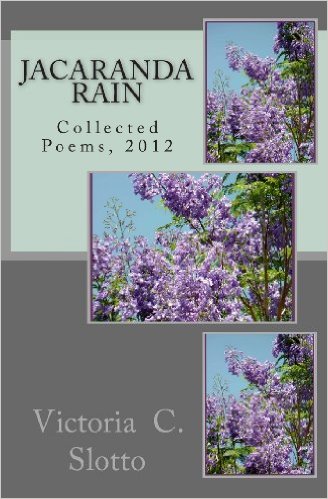
Thus begins Victoria C. Slotto’s 2012 poetry collection, Jacaranda Rain, which she dedicated to Oliver “my mentor unaware.”  Like Mary Oliver, nature is frequent inspiration for Victoria. The collection includes some fifty-five poems on nature, spirituality, death and dying, which are arranged rather charmingly in alpha order.

What haunts me,” said the dead man
to his wife whose ashes mingled with
his own, “are books I’ve never read –”
from About the Dead Man and Books

“What haunts me more,” the dead man said
for no one else to hear, “are books I never
wrote — ideas fanned to life by life …”
from More About the Dead Man and Books

Victoria certainly will have no such regrets. Since 2009 she’s been publishing her poetry on her blog  (Victoria C. Slotto, Author; Fiction, Poetry, Essays). Her original intention in starting the blog was to promote her first novel, Winter Is Pastwhich was ultimately published by Lucky Bat Books in 2011.

Victoria is however a lover of poetry and was drawn to write and published more and more poetry – Lovely! – becoming involved in poetry groups. (We met via Jingle’s poetry group for those of you who have been around as long as we have and remember that dear lady.)

Victoria eventually became involved with dVerse ~ Poets Pub, “a place for poets and writers to gather to celebrate poetry. We are many voices, but one song. Our goal is to celebrate; poets, verse & the difference it can make in the world. To discover poetry’s many facets and revel in its beauty, even when ugly at times.”  dVerse is a collaborative effort offering inspiration, encouragement and education. I highly recommend it, especially if you are just getting started online and want to make connections. Jacaranda Rain includes several poems that were part of an anthology published by dVerse (also recommended). Victoria was for a time a core-team member of The BeZine where she offered monthly prompts for poets and writers.

Victoria’s collection includes explanatory notes for some of the poems and these are engaging and not intrusive.

I dreamt
I flew among the stars
skirted between planets,
cracked open doors
to distant worlds
from Quantum Leaps in Jacaranda Rain

In all since 2009, Victoria has maintained a blog, been an inspiration to poets and a friend to many, written two novels (the second is The Sin of His Father) and a nonfiction book, Beating the Odds: Support for Persons with Early Stage Dementia. Victoria is a former registered nurse who worked primarily with the elderly. She writes from that experience and the more intimate experience of caring for her own mother. As her mother faced early stages of dementia, they worked together to devise practical steps to help her mom remain independent for as long as possible. Victoria offers memory prompts, health care considerations, ideas to help one find meaning in life, suggestions for preparing for the future and more in this very worthy book.

This slideshow requires JavaScript.

Though I must leave you
I’ll come to you again
a shower of purple petals
on dew covered sod –
from the poem Jacaranda Rain in the collection

Victoria now has a second blog, Be Still and Know That I Am God.

© poem excerpts, book covers/art, and portrait, Victoria C. Slotto


CELEBRATING AMERICAN SHE-POETS (14): Mary Oliver, “I got saved by poetry. I got saved by the beauty of the world.”

Mary Oliver (b. 1935)
Poet & Essayist Mary Oliver (b. 1935)

I love the line of Flaubert about observing things very intensely. I think our duty as writers begins not with our own feelings, but with the powers of observing.

AWARDS: Mary Oliver’s fourth book, American Primitive, won the Pulitzer Prize for Poetry in 1984. She  received the Shelley Memorial Award; a Guggenheim Fellowship; an American Academy and Institute of Arts and Letters Achievement Award; the Christopher Award and the L.L. Winship/PEN New England Award for House of Light; the National Book Award for New and Selected Poems; a Lannan Foundation Literary Award; and the New England Booksellers Association Award for Literary Excellence.

When it’s over, I want to say: all my life I was a bride married to amazement. I was the bridegroom, taking the world into my arms.

How often we turn to certain poets for certain healing, to those greater “technicians of the sacred” (to borrow from Jerome Rothenberg): Jane Hirchfield for her gentle Buddhist sensibility, John O’Donohue for his lilting Celtic reflections, W.S. Merwin and his deep ecology. Not the least among the greater technicians is Mary Oliver. Our hunger for spiritual healing is underscored by her popularity. The New York Times declared her the best-selling poet. Poet, activist and critic Alicia Ostriker writes of Oliver that she is as “visionary as Emerson.” Where there is criticism, it tends to be among feminists and others who feel she idealizes the feminine connection with nature.

51-N2B0NtNL._SX327_BO1,204,203,200_Mary Oliver’s work is deeply rooted in nature and a sense of place, the Ohio of her childhood and the New England of her adult life. More recently Florida, where she moved to be with friends after her partner of forty years died.

Influenced by Thoreau and Whitman, she’s a keen observer. She has said that she found healing in nature and the greater beauty of the world. Nature was her refuge through a difficult childhood and from an abusive father. She writes about her experience of her father in Rage from Dream Work (the Atlantic Monthly Press, 1989).

Rage

You are the dark song
of the morning…
But you were also the red song
in the night..
When the child’s mother smiles
you see on her cheekbones
a truth you will never confess
and you see how the child grows
timidly, crouching in corners…
In your dreams she’s a tree that will never come to leaf..
in your dreams you have sullied and murdered
and dreams do not lie.

However dark Rage might be, Oliver’s poems are more often filled with light and encouragement. Journey is one such:

You strode deeper and deeper
into the world,
determined to do
the only thing you could do,
determined to save
the only life you could save.

excerpt from The Journey, in Dream Work

and Wild Geese 

You do not have to be good.
You do not have to walk on your knees
for a hundred miles through the desert, repenting.
You only have to let the soft animal of your body
love what it loves. […]
The world offers itself to your imagination,
calls to you like the wild geese, harsh and exciting-
over and over announcing your place
in the family of things.

excerpt from Wild Geese in Dream Work 

When we want to breathe the clear air of nature and the best of the human spirit, we turn to Mary Oliver and the singular meditative grace of her poetry.

– Jamie Dedes

© poems Mary Oliver; photo credit, Rachel Giese Brown, 2009 – that and lists of awards are from Mary Oliver’s Amazon Page; book cover design, publisher. 

CELEBRATING AMERICAN SHE-POETS (13): Poet Laureate Natasha Trethewey, writing at the intersection of personal and cultural history

Natasha Trethewey (b. 1966), U.S. Poet Laureate, Poet Laureate of Mississippi, Pultizer Prize for Poetry, Robert W. Woodruff Professor of English and Creative Writing at Emory University
Natasha Trethewey (b. 1966), U.S. Poet Laureate, Poet Laureate of Mississippi, Pulitzer Prize for Poetry, Robert W. Woodruff Professor of English and Creative Writing at Emory University

After hearing Natasha Trethewey read at a poetry festival, Librarian of Congress Emeritus James H. Billington said he was “struck by a kind of classic quality with a richness and variety of structures with which she presents her poetry … she intermixes her story with the historical story in a way that takes you deep into the human tragedy of it.”

Natasha Trethewey is perhaps uniquely equipped by personal history, American history and public discourse, place of birth, education, inclination and innate talent to address a cruel and criminal aspect of our culture that dogs us unrelentingly: the roots, memory and legacy of racism. She is the daughter of a white father (poet Eric Trethewey) and black mother (social worker Gwendolyn Ann Turnbough).  Her background is rooted in the South. Born in Mississippi, when she was six years old her parents divorced and her young life was then split between Louisiana and Georgia. In Trethewey’s hands the juxtaposition of her biracial heritage and our shared history of colonialism, slavery and racism make a powerful case for the role of poetry to effectively and unflinchingly deliver truth.

At the time of her parent’s marriage and Trethewey’s birth anti-miscegenation laws were still in place, making their marriage illegal. Our laws against interracial marriage were struck down in 1967:

“Loving v. Virginia, 388 U.S. 1 (1967),[X 1] [X 2] is a landmark civil rights decision of the United States Supreme Court, which invalidated laws prohibiting interracial marriage.

“The case was brought by Mildred Loving, a black woman, and Richard Loving, a white man, who had been sentenced to a year in prison in Virginia for marrying each other. Their marriage violated the state’s anti-miscegenation statute, the Racial Integrity Act of 1924, which prohibited marriage between people classified as “white” and people classified as “colored”. The Supreme Court’s unanimous decision determined that this prohibition was unconstitutional, reversing Pace v. Alabama (1883) and ending all race-based legal restrictions on marriage in the United States.” [Wikipedia]

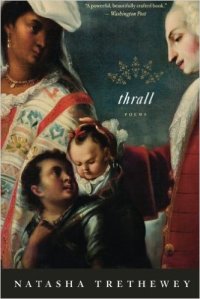
51T8yxaK1xL._SX331_BO1,204,203,200_ Thrall: Poems (Houghton Mifflin Harcourt Publishing Company, 2006) – a sequel to Native Guard (Houghton Mifflin Harcourt Publishing Company, 2005) –  is breathtakingly eloquent. Trethewey explores her relationship with her father in the first poem about a fishing trip. Written as an elegy though he is still alive, it tells him in effect that she is the better poet . . . or so I infered.

Tretheway moves on from that quiet meditation to questions of identity and race, exploring colonial attitudes about race reflected in the art of Spanish painters and the Casta (caste, categorization of mixed-race peoples) Paintings of 17th and 18th Century Mexico. I was unfamiliar with most of the paintings and painters, chose to look them up.  That, however, did not detract one iota from engagement with this collection.

The work is exquisite: formal, clear, precise, perceptive … Although the material is distressing, I find Trethewey’s style understated. These poems are not strident but they have sinew and bone. Her forms are mostly free verse. One poem is a series of cinquains and another is a villanelle.

13550802017232

In the video below, Trethewey offers some insight into the development of the collection and reads the eponymous poem. You will also find a sampling of her poems HERE.

Note: The painting Thrall that inspired the poem is by Juan de Pareja who was apparently the child of indentured servants and left as property to the Spanish painter Diego Rodríguez de Silva y Velázquez to whom he became an assistant. Juan de Pareja was born in 1606, freed in 1650 and died in 1670. The painting featured on the book’s cover is Spaniard and Indian Produce a Mestizo by Juan Rodríguez Juárez (1675-1728).

If you are reading this post from an email, you will have to click through to the site to view the video.

© 2016, essay, Jamie Dedes, All right reserved; Natasha Threthewey’s photograph, Jalissa Gray under CC BY-SA 3.0; cover design, publisher

CELEBRATING AMERICAN SHE-POETS (11): Adrienne Rich, wrestling for the soul of our country

Adrienne Rich (1929-2012)
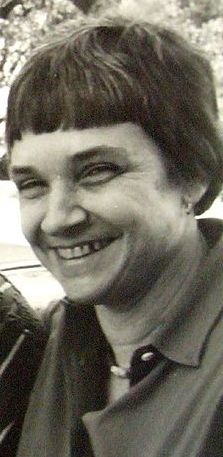
Audre Lorde, Meridel Le Sueur, Adrienne Rich

Madeline Ostrander wrote this article for YES! Magazine, “a national, nonprofit media organization that fuses powerful ideas with practical actions.” Madeline was YES! Magazine‘s senior editor at the time of this writing. She is now an independent journalist and contributing editor to Yes! Magazine.

“I know you are reading this poem listening for something, torn between bitterness and hope…”

I was 19 when I first read Adrienne Rich and these words from “An Atlas of the Difficult World,” which seemed to tear down the barriers between the poem and me, and let me in.

Like Rich, I grew up at a distance from true poverty: “reader reading under a summer tree in the landscape of the rural working poor,” she writes. But I knew how fractured and unstable the world around me was becoming. I was part of the first generation to grow up knowing about climate change, brought to world attention by James Hansen and to my school classroom by a forward-thinking science teacher. I was in high school when the Soviet Union collapsed; as a child, I had nightmares about nuclear war. Rich’s poetry gave me hope that stories could change things—could force us to confront and heal what is painful and give us hope, strength, and compassion.

Rich belonged to an activist strain of poetry; she believed words needed to be reclaimed by the people who have been left out of the history books.

When Rich died a profound loss at a time when we urgently need more storytelling that reaches across our fragmented, politically divided culture. “Atlas” is still one of the most searing and honest descriptions I’ve read about how broken and divisive the modern world is. It’s a 26-page poem that sweeps across the landscapes and histories of North America and elevates people and scenes that are ordinary, neglected, and counted out—farmworkers made sick from pesticides, a woman beaten by her partner, the wasting of our ecological landscapes, weedy fields of Jerusalem artichoke “that fed the hobos, could feed us all.”

Here is a map of our country …
This is the haunted river flowing from brow to groin
we dare not taste its water
This is the desert where missiles are planted like corms …
This is the cemetery of the poor …
This is the sea-town of myth and story when the fishing fleets
went bankrupt … processing frozen fish sticks hourly wages and no shares

Occupy didn’t exist then, of course, but Rich was crafting poetry for the 99 percent: “a poetry older / than hatred. Poetry / in the workhouse, laying of the rails.”

Rich’s long, image-dense lines could seem of out-of-step with a world obsessed with rapid-fire information, Twitter, and text messages. But Rich knew that the marginalization of poets is always a detriment to civil society. In the early 1980s, she traveled to Nicaragua, where she felt the culture “manifested a belief in art, not as commodity, not as luxury, not as suspect activity, but … one necessity for the rebuilding of a scarred, impoverished, and still-bleeding country.”

Rich belonged to an activist strain of poetry; she believed words needed to be reclaimed by the people who have been disempowered and left out of the history books. Her own life is a testament to the power of story in creating cultural change. Rich started college in the late 1940s, when she says even Elizabeth Barrett Browning’s writing was radical for a university campus and certainly no one spoke of feminist ideas in the classroom.

Early in her career, Rich had to scrape together a new kind of language. She used poetry to utter ideas that were almost unspeakable at the time: her poetry pulled back the veil around women’s sexuality and lesbian love and exposed the power and politics that enable war and violence: “I felt driven—for my own sanity—to bring together in my poems the political world ‘out there’—the world of children dynamited or napalmed, of the urban ghetto and militaristic violence—and the supposedly private, lyrical world of male/female relationships,” she said. She published Snapshots of a Daughter in Law, which she calls her first book to overtly tackle sexual politics, in 1963. Decades later, her poetry is still radical, but it’s also a mainstay in college literature classrooms across the country. Her poetry has been a beacon to feminists and social justice activists for several generations, and is included a digital poetry anthology pieced together by organizers of Occupy Wall Street.

Rich never wanted her poetry to be a medium primarily for academe. And she never believed words alone could solve the abuses and inequalities that she wrote about. But reclaiming, decolonizing, and taking charge of language was for Rich the first step in become personally whole and politically powerful. “Because when poetry lays its hand on our shoulder, we can be to an almost physical degree touched and moved. The imagination’s roads open again, giving the lie to that slammed and bolted door, that razor-wired fence, that brute dictum,” she said in a 2006 speech at the National Book Awards, where she received a Medal for Distinguished Contribution to American Letters.

We owe Rich a debt for unlocking the doors that barred the voices of women from art, academe, and the halls of influence for so long. And though she insisted on marking each poem with a date—so that it would stand in the historical context in which she wrote it—everything about her poetry still speaks with urgency and timeliness. Her work illuminates the dark, messy, often painful territory of sex, race, violence, and poverty in America but holds all of us responsible for taking power, ending suffering, and breaking apart social inequalities. In “Atlas,” she writes, “A patriot is one who wrestles for the / soul of her country / as she wrestles for the soul of her own being.” This is what Rich did her whole life, and her poetry enjoins the rest of us to do the same.

– Madeline Ostrander

© feature is courtesy of Yes! magazine under CC license ; photographs are courtesy of Kay Kendall under CC BY 2.0 and were taken in 1980 at a writing conference in Austin, Texas.