Page 6 of 8

CELEBRATING AMERICAN SHE-POETS (10): Audre Lorde, “My mother had two faces and a frying pot.”

Audre Lorde (1934-1992)

“your severed daughter
laughing our name into echo
all the world shall remember ”
Audre Lorde, The Black Unicorn: Poems

I discovered Audre Lorde when I happened upon From the House of Yemanjá (below). Wow! She’s been peaking in our window, I thought. How could she know? I was very young and didn’t start really delving into her work until recently. Time sadly lost.

How many women and men grew up with two-faced mothers who took care (albeit resentfully) of the pragmatic aspects of motherhood, but were unable to love and demanded perfection of their children in return for their own unhappiness. Many, no doubt; but no one writes about the experiences of being marginalized in the home – or in the greater world – like Audre Lorde, a seminal poet. She had a keen mind, courageous spirit, was stunning in her crafting and had a gift for expressing emotion.

“Poetry is the way we help give name to the nameless so it can be thought.”

Audre Lorde was born in New York City, the child of immigrants from Caribbean. She was a writer and poet, a radical feminist, a womanist and lesbian, an activist for right and the rights of the marginalized.

“Institutionalized rejection of difference is an absolute necessity in a profit economy which needs outsiders as surplus people.”

The_Cancer_JournalsAudre Lorde wrote seventeen books by my count, both poetry and prose including her fictionalized biography, Zamie, A New Spelling of My Name – a Biomythology and The Cancer Journals, about her battle with breast cancer.

Lorde was New York State poet laureate in 1991 and until her death from liver cancer in 1992.

“The fact that we are here and that I speak these words is an attempt to break that silence and bridge some of those differences between us, for it is not difference which immobilizes us, but silence. And there are so many silences to be broken.”

From the House of Yemanjá

My mother had two faces and a frying pot
where she cooked up her daughters
into girls
before she fixed our dinner.
My mother had two faces
and a broken pot
where she hid out a perfect daughter
who was not me
I am the sun and moon and forever hungry
for her eyes.

I bear two women upon my back
one dark and rich and hidden
in the ivory hungers of the other
mother
pale as a witch
yet steady and familiar
brings me bread and terror
in my sleep
her breasts are huge exciting anchors
in the midnight storm.

All this has been
before
in my mother´s bed
time has no sense
I have no brothers
and my sisters are cruel.

Mother I need
mother I need
mother I need your blackness now
as the august earth needs rain.

I am
the sun and moon and forever hungry
the sharpened edge
where day and night shall meet
and not be
one.

– Audre Lorde (1978)

“What are the words you do not yet have? What do you need to say? What are the tyrannies you swallow day by day and attempt to make your own, until you will sicken and die of them, still in silence.”

© From the House of Yemanjá, The Collected Poems of Audre Lorde (W. W. Norton and Company Inc., 1997); portrait courtesy of K. Kendell under CC BY 2.0 license; book cover art, Estate of Audre Lorde

CELEBRATING AMERICAN SHE-POET (9): ANN EMERSON, Far From Eyes Broken Like Windows

San Francisco Bay Area poet, Ann Emerson, was one of the first two people I invited to join in the collaboration we now call The BeZine. It was originally named Into the Bardo, in reference to the Buddhist state of existence between death and rebirth; so named because of life-compromising illnesses.

Ann was a gifted poet, but she didn’t find that out until after she was diagnosed with a rare bone cancer. She discovered her voice in a hospital poetry class. Ultimately she studied with Ellen Bass in Santa Cruz, California. 

img_0961

After diagnosis, Ann survived for an almost consistently tortured six years. Physical pain. Trauma. Fear. Chemo. Poverty. She had signs posted around her house that said, “Live!”

While Ann spent a lot of time in the hospital, her home was a cabin in the Redwoods of La Honda, a stone’s throw from the log cabin where Ken Kesey and the Merry Pranksters so famously partied in 1964. She lived with her cats. Originally there were six and they were all blind. No one would take them in, so Ann did.

l.NbSuLbZWIcnyodRP

Ann was just a thesis away from her Ph.D. A few weeks before she died, four of Ann’s poems were published in American Poetry Review

416250017_370-jpg

Two days before Ann died, she married the gentleman who was her sweetheart of thirty years. Ann’s wedding was held in her hospital room. Those of us in the attendance were required by the hospital to wear yellow gowns over our street clothes. The bride wore yellow too. The flowers and the ring were from the hospital gift shop. The founder and leader of our support group for people with catastrophic illness, a Buddhist chaplin, performed the ceremony. One of us took wedding photographs using a cell phone.  I created a virtual wedding album.The wedding was in its way lovely, but it was achingly sad.
IMG_8407

When Ann died, we sat with her for some time because Buddhists don’t believe the soul leaves the body right away. Ann’s Buddhist teacher – someone she held in high regard – came and lead us in meditation and blessing.

Here – on the third anniversary of Ann’s death – are three of her poems. In closing, I added A Hunger for Bone, the poem I wrote the day her ashes were released to the sea near Julia Pfeiffer Burns State Park in Big Sur. My poem in no way comes up to the gold standard Ann set, but it tells the story. 

Julia_Pfeiffer_Burns_State_Park

– Jamie Dedes


Elegy for Cat Five

Fuck the Glory that is Poetry,
fuck the smell of God in my hair,

The world is the color of driftwood,
this ordinary Wednesday in June.

Let’s have a moratorium on poems
about my shitty news from Stanford

and how I can’t tell heat from cold.
My blood dirty as brown sand in a museum,

and my cat, well, he has news too.
Death woman, skeleton cat,

I turned 57 yesterday when
the veterinarian said No.

I am taking us both to the ocean
for as long as we need:

red sand staining white fur.
I am smelling my cat’s iodine breath,

I am putting my hand in the wound
in my side. Dry brine stinking up

the air, seawater choking the
cawing gull in his throat.

And my face, he’d better
not fucking forget.

One more day leaving me
for a little peace of mind.

.
A Modern Poem (draft 1)

.
I am walking again through an American night,
past police stations with barred gates, windows
glazed warm with doughnuts, patrol cars in the lot.
I stand outdoors seeking coffee: someplace where
eyes will not wander through me when I sit in a red
booth filled with books as women fearing Altzeimer’s
hoard cats. I stay up until dawn, waiting for panic
to subside, to find the meaning in all things
in a city which says I am nothing.

..
I wake in my American forest, from a dream
of being shot: when one lives in a forest one cannot expect
the humane society always arriving in time. I walk through
the cabin and on down the path: moonlight blurs the redwoods,
wind blurs water. I feel like a girl safe in a picture book.
Indoors the television screen shines blue as topaz.
I am walking again through the forest aglow with
snowy owls and see-through salamanders.
Far from eyes broken like windows, and people
thinking they are nobodies, reading the paper
about life being rebuilt by night so that
no one notices it tumbling by day.


The Wrong Side of History

Fifty years ago, a house of
pale cinderblock. Sixty miles

north of here, Richmond
California, the poor

mending holes with colored thread.
I live in a house of

unnatural law, I am painting
landscapes in black: horses

and floating carpets of leaves.
When I am ten my father fills my mouth

with dirt for saying I want to die:
a ripped sheet twisted over my eyes,

my ankles hobbled in bed;
I summon the kingdom of horses

where lullabies murmur
brittle-legged ponies to sleep.

When I am twelve the city catches fire:
ruined faces of mares stretch for pages,

and when the tar roof seeps into
my room, I still do not run away.

Say nothing about the comfort of solitude,
stars crowded like sensations under the skin.

Say nothing about the morning blow of light,
the herd coughing on last night’s oily weed

– Ann Emerson


A Hunger for Bone

we scattered your relics, yours and your cats,
chared bone to be rocked by waves,
to be rocked into yourself, the rhythm
enchanting you with cool soothing spume
merging your poetry with the ether,
rending our hearts with desolation,
shattering the ocean floor with your dreams
lost in lapping lazuli tides, dependable ~
relief perhaps after pain-swollen years of
suckle on the shards of a capricious grace

those last weeks …
your restless sleeps disrupted by
medical monitors, their metallic pings
not unlike meditation bells calling to you,
bringing you to presence and contemplation,
while bags hung like prayer-flags on a zephyr
fusing blood, salt, water
into collapsing veins, bleeding-out
under skin, purple and puce-stained,
air heavy and rank; we came not with chant,
but on the breath of love, we tumbled in
one-by-one to stand by you

to stand by you
when death arrived
and it arrived in sound, not in stealth,
broadcasting its jaundiced entrance
i am here, death bellowed on morphine
in slow drip, i am here death shouted,
offering tape to secure tubing, handing
you a standard-issue gown, oversized –
in washed-out blue, for your last journey
under the cold pale of fluorescent light

far from the evergreen of your redwood forest,
eager and greedy, death snatched
your jazzy PJs, your bling and pedicures,
your journals and pens, your computer and
cats, death tried your dignity and identity –
not quickly, no … in a tedious hospital bed,
extending torment, its rough tongue salting
your wounds, death’s hungering, a hunger
for bones, your frail white bones – but you
in your last exercise of will, thwarted death,
bequeathing your bones to the living sea

– Jamie Dedes

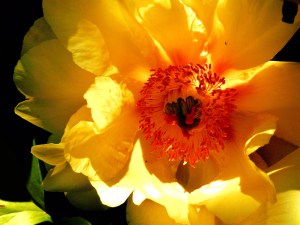
© 2011, Ann’s poems, her photo and that of her cat, Ann Emerson estate; © A Hunger for Bone and the yellow flower photograph,  Jamie Dedes; photograph of Julia Pfeiffer Burns State Park in Big Sur courtesy of wordydave under CC BY SA 3.0

CELEBRATING AMERICAN SHE-POETS (8): Lucille Clifton, homage to my hips

Lucille Clifton (1936-2010)

” . . . writing is a way of continuing to hope … perhaps for me it is a way of remembering I am not alone.” Lucille Clifton in an interview with Michael S. Glaser

I am one of those – like the people of Buffalo – who think of Lucille Clifton as a New Yorker. She was born in Depew and grew-up and was educated in Buffalo. I suppose some Californian’s claim her as theirs because she lived in Santa Cruz for a while. Most of the world, however, sees her as belonging to Maryland. I don’t know that she lived there longest but she was that state’s Poet Laureate from 1979 – 1985.

Lucille and Fred James Clifton (professor and sculptor)  were friends with writer, playwright and publisher Ishmael Reed. It was he who introduced them to one another when he organized the Buffalo Community Drama Workshop. They acted together in a version of The Glass Managerie.  Reed took some of Lucille’s poems to Langston Hughes who included them in The Poetry of the Negro, 1746-1970.

Lucille Clifton won many grants and awards including the Ruth Lilly Poetry Prize, the Shelley Memorial Award, and Lannan Literary Award for Poetry. Two of her books were finalists for the Pulitzer Prize. In addition to poetry collections, she wrote a memoir and twenty-some children’s books. The latter include the popular well-regarded Everett Anderson series.

“Lucille Clifton is an African-American whose consciousness of her race and gender informs all of her poetry, though she never gets preachy. Instead, she has chosen a minimalist mode that clears out human society’s clutter, the mess we’ve made by identifying ourselves in contending genders, ethnicities, nations. Lightly, as if biting her tongue, with a wise smile, she shows us a radically egalitarian world where no one or no capitalized word lords it over others. …” Peggy Rosenthal, The Christian Century

Denise Levertov wrote of Lucille Clifton’s work as “authentic and profound.” I find it marked by pragmatism, strength, endurance and humor. You will see the later demonstrated in this poem and her intro to it, her ode: homage to my hips.

these hips are big hips.
they need space to
move around in.
they don’t fit into little
petty places. these hips
are free hips.
they don’t like to be held back.
these hips have never been enslaved,
they go where they want to go
they do what they want to do.
these hips are mighty hips.
these hips are magic hips.
i have known them
to put a spell on a man and
spin him like a top

– Lucille Clifton

© Lucille Clifton, “homage to my hips” from her collection Good Woman: Poems and a Memoir 1969-1980 (BOA Editions Ltd., 1987) – definitely recommended

© introduction, Jamie Dedes; Lucille Clifton’s portrait is from her Amazon Page.

CELEBRATING AMERICAN SHE-POETS (7): Chirlane McCay, New York City’s First Lady

Chirlane McCray by Kelly Weill, NYU Local.com

CHIRLANE McCAY is a writer and poet, a speechwriter and wife of New York City’s Mayor Bill de Blasio. She is also the mother of two children, Chiara and Dante.

According to her bio on de Blasio’s website,

“Chirlane began writing at a young age. In high school she discovered ways to use writing as a tool for activism. While studying at Wellesley College and the famed Radcliffe Publishing Course, Chirlane became a member of the Combahee River Collective, a pioneering black feminist collective, which inspired her to write groundbreaking prose and poetry.”

The poem below is the one – according to the man himself – that made de Blasio fall in love with her. It is from Home Girls: A Black Feminist Anthology].

NEW YORK, NY - SEPTEMBER 10: Public Advocate and mayoral candidate Bill de Blasio kisses his wife Chirlane McCray after voting in the New York City mayoral primary on September 10, 2013 (Photo by Spencer Platt/Getty Images)
NEW YORK CITY: Former public Advocate and then mayoral candidate Bill de Blasio kisses his wife, Chirlane, after voting in the mayoral primary on September 10, 2013 (Photogrpah by Spencer Platt via Getty Images)

I Used To Think

I used to think
I can’t be a poet
because a poem is being everything you can be
in one moment,
speaking with lightning protest
unveiling a fiery intellect
or letting the words drift feather-soft
into the ears of strangers
who will suddenly understand
my beautiful and tortured soul.
But, I’ve spent my life as a Black girl
a nappy-headed, no-haired,
fat-lipped,
big-bottomed Black girl
and the poem will surely come out wrong
like me.

And, I don’t want everyone looking at me.

If I could be a cream-colored lovely
with gypsy curls,
someone’s pecan dream and sweet sensation,
I’d be

poetry in motion
without saying a word
and wouldn’t have to make sense if I did.
If I were beautiful, I could be angry and cute
instead of an evil, pouting mammy bitch
a nigger woman, passed over
conquested and passed over,
a nigger woman
to do it to in the bushes.

My mother tells me
I used to run home crying
that I wanted to be light like my sisters.
She shook her head and told me
there was nothing wrong with my color.
She didn’t tell me I was pretty
(so my head wouldn’t swell up).

Black girls cannot afford to
have illusions of grandeur,
not ass-kicking, too-loud-laughing,
mean and loose Black girls.

And even though in Afrika
I was mistaken for someone’s fine sister or cousin
or neighbor down the way,
even though I swore
never again to walk with my head down,
ashamed,
never to care
that those people who celebrate
the popular brand of beauty
don’t see me,
it still matters.

Looking for a job, it matters.
Standing next to my lover
when someone light gets that
“she ain’t nothin come home with me” expression
it matters.

But it’s not so bad now.
I can laugh about it,
trade stories and write poems
about all those put-downs,
my rage and hiding.
I’m through waiting for minds to change,
the 60’s didn’t put me on a throne
and as many years as I’ve been
Black like ebony
Black like the night
I have seen in the mirror
and the eyes of my sisters
that pretty is the woman in darkness
who flowers with loving

– Chirlane McCray