Angel of the Divine Presence Bringing Eve to Adam, William Blake (The Creation of Eve and She shall be Called Woman), Ca.1803 Courtesy of the New York Metropolitan Museum of Art / public domain
“The soul of sweet delight, can never be defiled.” The Marriage of Heaven and Hell, William Blake
William Blake painted lots of men with burly thighs
He painted endings & impasses, full of weepings, warrings and sighs,
Showed us discontent and turbulence much, often, and more.
Because, as he knew of himself, ‘for double the vision my Eyes do see
And a double vision is always with me.’ As one does, he gets stuck in that place of mourning, like we do.
But he came forth back. To beginnings. Painting his “The Nativity,”
his baby Jesus spun flew out of birth through the air, arms stretched open wide,
Here in this balanced bringing Eve here, the birth-hood of woman.
No angry stretched fight-ready faces, no muscled thighs on the ready.
What a field of eyes, an effusion of gentle, this place of peaceful,
so fresh it looks transparent. Nothing weighed this down.
No rib mangling or second best. This is just fresh air.
Adam in some boyish expectation and Eve coming down curly,
Her heart and body sweet singing naked.
Down down down is up up up, it seems, a way forward to.
Birds beaked colors that faded gentle blue.
And Blake knew of misogyny and androgyny
But he let himself paint here a new equality story:
“Love and harmony combine,
And around our souls entwine.”
And he turns open nakedness into a blessing
Natural and sacred. Sweet sweet sweet.
more green woods Blake “going forth to faire free”
“When the green woods laugh with the voice of joy, And the dimpling stream runs laughing by; When the air does laugh with our merry wit, And the green hill laughs with the noise of it.” William Blake
I am delighted to let you know that Linda Chown’s Narrative Authority and Homeostasis in the Novels of Doris Lessing and Carmen Martín Gaite(Routledge Library Editions: Modern Fiction) is now available through Amazon in hardcover and Kindle. Linda tells me a budget-wise paperback edition will be available in six-to-eight months.
This study, originally published in 1990, assesses a shift in the presentation of self-consciousness in two pairs of novels by Doris Lessing and Carmen Martín Gaite: 1) Lessing’s The Summer Before the Dark(1973) and Martín Gaite’s Retahílas (1974) and 2) Lessing’s The Memoirs of a Survivor (1974) and Martín Gaite’s The Back Room (1978). Three major structural divisions facilitate examining implications of the novels for 1) feminism 2) literary narrative and 3) the lives of people-at-large. / J.D.
LINDA E. CHOWN grew up in Berkeley, Ca. in the days of action. Civil Rights arrests at Sheraton Palace and Auto Row. BA UC Berkeley Intellectual History; MA Creative Writing SFSU; PHd Comparative Literature University of Washington. Four books of poetry. Many poems published on line at Numero Cinq, Empty Mirror, The Bezine, Dura, Poet Head and others. Many articles on Oliver Sachs, Doris Lessing, Virginia Woolf, and many others. Twenty years in Spain with friends who lived through the worst of Franco. I was in Spain (Granada, Conil and Cádiz) during Franco’s rule, there the day of his death when people took to the streets in celebration. Interviewed nine major Spanish Women Novelists, including Ana María Matute and Carmen Laforet and Carmen Martín Gaite.
Jamie Dedes. I’m a freelance writer, poet, content editor, and blogger. I also manage The BeZineand its associated activities and The Poet by Dayjamiededes.com, an info hub for writers meant to encourage good but lesser-known poets, women and minority poets, outsider artists, and artists just finding their voices in maturity. The Poet by Day is dedicated to supporting freedom of artistic expression and human rights and encourages activist poetry. Email thepoetbyday@gmail.com for permissions, commissions, or assignments.
It’s been a long time since I posted, and I have many things that I’m working on, but nothing current suitable to publish. But going over REALLY OLD files, back in 2007 when I was doing Journal Pages faithfully every day, with not much regard for calligraphy but some for inked color, and I ran across this fable about a meet-cute with a short guitar-playing guy and a really tall girl…
I remember that I was using the finest-point pen I could find–might have been a Rollerball or a Razor–and a set of Faber-Castell ink markers for the color. I also had a thing about presenting the date a different way every day, sort of like Will Eisner did with his SPIRIT logos.
And I remember yearning.
Operations
Of music, sacred smiles, and nagging doubt: Pitch-perfect was the Evening. And the Girl: Enchanting, very tall, she was…
Lear and Cordlia in Prison c. 1779 / courtesy of the Tate / Image released under Creative Commons CC-BY-NC-ND (3.0 Unported) License this image
He who binds to himself a joy
Does the winged life destroy;
But he who kisses the joy as it flies
Lives in eternity’s sun rise.
William Blake
How this softer Blake burns.
Who’s to say how
to know this
way beyond way?
This tremendous reaching,
feeling sticking out, conspicuous.
Once, Vita Sackville-West dove
herself far, like Blake,
after a new balance,
to hold onto stasis,
memorialize apotheoses,
and make making more momentous.
Her book “All Passion Spent,”
probes the very soul wrench
of this stillborn painting
whose people stay fully
clothed yet fully undone
in silent grief beyond saying.
Blake gives Lear and Cordelia
the whole stage to lie about in,
bathed in a clash of terribly gentle color
and terribly gruesome agitation.
This father and daughter
touch without holding,
athwart in a pain beyond knowing:
they cannot face the other nor touch.
They grip themselves instead,
fingers heavy and listless
Keen faces screaming, soundless
like inside a stranger’s coffin.
Told once to be “less extravagant,” Blake gives even more
intensely in simplicity, this way beyond the way beyond.
In the gentle pastels, passion roils, boils all the more.
This frozen love fills everything up, all the bareness.
They touch on in the tragedy without holding,
in a barren consummation.
Lost in a lightyear of lonely.
“We never actually see Lear and Cordelia in prison in Shakespeare’s King Lear, but a scene like this appears in Nahum Tate’s adaptation of the play, and Blake might have seen a performance in this, the only version staged in the eighteenth century. However, Martin Butlin thinks a more likely source is John Milton’s History of Britain, where Lear is the last of the descendants of Brutus and the first King of England, thus making this early work by Blake part of a series of pictures he planned to call The History of England, a small book of Engravings (31).”
The other poems in Linda’s ongoing Blake-poem series:
I am delighted to announce today that Linda Chown’s Narrative Authority and Homeostasis in the Novels of Doris Lessing and Carmen Martín Gaite(Routledge Library Editions: Modern Fiction) is now available through Amazon in hardcover and Kindle. Linda tells me a budget-wise paperback edition will be available in six-to-eight months.
This study, originally published in 1990, assesses a shift in the presentation of self-consciousness in two pairs of novels by Doris Lessing and Carmen Martín Gaite: 1) Lessing’s The Summer Before the Dark (1973) and Martín Gaite’s Retahílas (1974) and 2) Lessing’s The Memoirs of a Survivor (1974) and Martín Gaite’s The Back Room (1978). Three major structural divisions facilitate examining implications of the novels for 1) feminism 2) literary narrative and 3) the lives of people-at-large. / J.D.
LINDA E. CHOWN grew up in Berkeley, Ca. in the days of action. Civil Rights arrests at Sheraton Palace and Auto Row. BA UC Berkeley Intellectual History; MA Creative Writing SFSU; PHd Comparative Literature University of Washington. Four books of poetry. Many poems published on line at Numero Cinq, Empty Mirror, The BeZine, Dura, Poet Head and others. Many articles on Oliver Sachs, Doris Lessing, Virginia Woolf, and many others. Twenty years in Spain with friends who lived through the worst of Franco. I was in Spain (Granada, Conil and Cádiz) during Franco’s rule, there the day of his death when people took to the streets in celebration. Interviewed nine major Spanish Women Novelists, including Ana María Matute and Carmen Laforet and Carmen Martín Gaite.
Jamie Dedes. I’m a freelance writer, poet, content editor, and blogger. I also manage The BeZineand its associated activities and The Poet by Dayjamiededes.com, an info hub for writers meant to encourage good but lesser-known poets, women and minority poets, outsider artists, and artists just finding their voices in maturity. The Poet by Day is dedicated to supporting freedom of artistic expression and human rights and encourages activist poetry. Email thepoetbyday@gmail.com for permissions, commissions, or assignments.
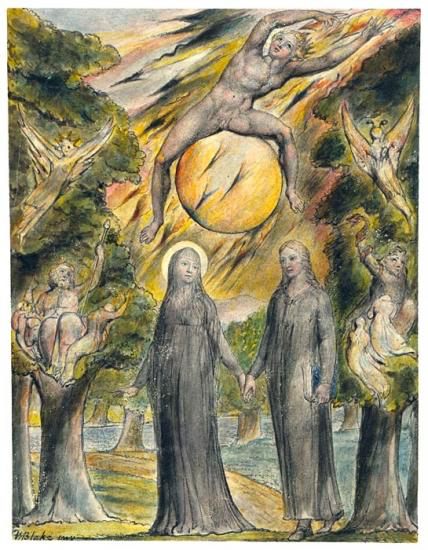
Blake’s Stage Directions : [“Milton led by Melancholy into the Groves away from the Suns flaring Beams who is seen in the Heavens throwing his darts & flames of fire The Spirits of the Trees on each side are seen under the domination of Insects raised by the Suns heat.”]
It is my honor and pleasure to bring you the sixth in what will be a series of ten Blake poems by the extraordinary American poet, Linda Chown. /. J.D.
How this splurge of Blake’s fairytale painting haunts my soul
in its wispy lingering transcendental colors and mystery.
Spontaneous Blake always makes me want to study,
to know his axes whole and catch more turns
layered and hidden inside such trenchant color treasure.
It is like I need a whole new key to see
who’s who and what in this vast Cartesian shakedown.
Body and soul, heat and shade, green and orange
vibrate in my watch. Melancholy walks with book-bound
Milton in all his academic hesitation he goes
under Apollo cavorting his leg-spread body around.
See him again. Look how he mates the sun.
As always, Blake layers his 360 degrees
to let more come through. That strange crooked melon sun
draws these serious people and insects into opaque light.
Blake knew Milton would hide in his robes, wouldn’t he?
This world is all too fecund for him to see.
And this timidity cranks this sun energy crooked
The all mental mind that encloses itself
And hides in a forest crocks the sun’s heart-heat
Blake joyfully proffered once:
“He who kisses joy as it flies by
will live in eternity’s sunrise.”
No sunrise here, or joyful kissing.
Melancholy and a lot of missing.
This haunting half-hearted vision of intensity,
this twisted sun face stuck squeezed and squinting.
LINDA E. CHOWN grew up in Berkeley, Ca. in the days of action. Civil Rights arrests at Sheraton Palace and Auto Row. BA UC Berkeley Intellectual History; MA Creative Writing SFSU; PHd Comparative Literature University of Washington. Four books of poetry. Many poems published on line at Numero Cinq, Empty Mirror, The BeZine, Dura, Poet Head and others. Many articles on Oliver Sachs, Doris Lessing, Virginia Woolf, and many others. Twenty years in Spain with friends who lived through the worst of Franco. I was in Spain (Granada, Conil and Cádiz) during Franco’s rule, there the day of his death when people took to the streets in celebration. Interviewed nine major Spanish Women Novelists, including Ana María Matute and Carmen Laforet and Carmen Martín Gaite.
Jamie Dedes. I’m a freelance writer, poet, content editor, and blogger. I also manage The BeZineand its associated activities and The Poet by Dayjamiededes.com, an info hub for writers meant to encourage good but lesser-known poets, women and minority poets, outsider artists, and artists just finding their voices in maturity. The Poet by Day is dedicated to supporting freedom of artistic expression and human rights and encourages activist poetry. Email thepoetbyday@gmail.com for permissions, commissions, or assignments.

 I am delighted to let you know that Linda Chown’s Narrative Authority and Homeostasis in the Novels of Doris Lessing and Carmen Martín Gaite (Routledge Library Editions: Modern Fiction) is now available through Amazon in hardcover and Kindle. Linda tells me a budget-wise paperback edition will be available in six-to-eight months.
 Jamie Dedes. I’m a freelance writer, poet, content editor, and blogger. I also manage The BeZine and its associated activities and The Poet by Day jamiededes.com, an info hub for writers meant to encourage good but lesser-known poets, women and minority poets, outsider artists, and artists just finding their voices in maturity. The Poet by Day is dedicated to supporting freedom of artistic expression and human rights and encourages activist poetry. Email thepoetbyday@gmail.com for permissions, commissions, or assignments.


 Jamie Dedes. I’m a freelance writer, poet, content editor, and blogger. I also manage

 Jamie Dedes' THE POET BY DAY Webzine