Page 2 of 3

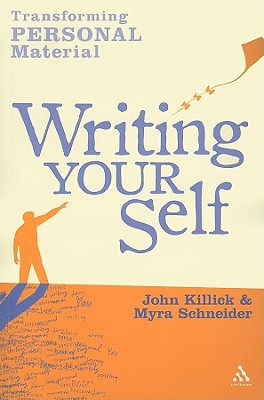
WRITING YOUR SELF, Transforming Personal Material with John Killick & Myra Schneider
9781847062529_l

“We wrote the book because we believe that personal writing is very potent both for the writer and the reader, because some of the greatest literature is rooted in personal material.” Myra Schneider in an interview with Jamie Dedes

It always seems to me that writing  about life – “personal material” –  is a healing activity, a way to live hugely, and a way to empower ourselves and others. Whether we do it for ourselves alone or whether our purpose is to leave history behind for family, to set the record straight, or simply to share and entertain, the experience is rewarding.

Writing Your Self is a comprehensive book organized into two parts:

  • Part I: Here the focus is on life experiences, the exploration of those human experiences that are universal. These include childhood, self-concepts, relationships, displacement, physical and mental illness and disability, and abuse.
  • Part II: Here the focus is on writing techniques, recognizing material that is unfinished, working on refinements, and developing work projects.

Writing Your Self is rich with examples from unknown (students) and known writers including the authors. By example as well as explanation the authors reinforce what we intuitively understand to be true: that telling stories preserves identity and clarifies the human condition. It helps us understand what it means to be human. The experience of working through the book is rather like a rite of passage.

I can see the use of this book by individuals training themselves and by teachers of adult learners who wish to write memoir, poetry, fiction, or creative non-fiction. It would be useful in hospital therapeutic writing programs or in writing programs for active seniors.

Memories, both recent and distant, tell us who we are and so play a crucial role in our experience of life…

You may have memories which you want to plunge into or you may have material like a diary or letters which summon them up. There are other ways though of triggering memories. We offer a series of suggestions. Chapter 13, Accessing memories, secret letters, monologues and dialogues, visualizations.

Chapter 13 alone is worth the price of admission. I work a lot off of childhood memories and even the event that happened two minutes ago comes back to me with a dreamlike quality when I sit to write. I have not thought of the things I do naturally as triggers, but indeed they are. It was quite interesting to see these natural aids laid-out in the book: objects and place as starting points, physical sensation as triggers, people in memory and predominant feelings. The section on secret letters – that is, letters that you write someone and never send – was interesting. I’m sure it would make a fine jumping-off point for some. The authors go on to monologues and dialogues and visualization. We all do those things in our heads anyway. If you can see it or hear it in your mind, you can write it.

If you are inexperienced or stuck midway in a transition from one form of writing to another, you’ll benefit from the exercises, ideas, and instruction in Writing Your Self: Transforming Personal Experience. If you are a more experienced writer, you might find this book will stimulate the muse. This text is a definite thumbs-up.

13550802017232

Myra Schneider  is a British poet, a poetry and writing tutor, and author of the acclaimed book: Writing My Way Through Cancer.

John Killick was a teacher for 30 years, in further, adult and prison education. He has written all his life. John Killick’s work includes both prose works and poetry. 

DILYS WOOD’S “ANTARCTICA”…the work of a highly original poet

Antarctica: The blue ice covering Lake Fryxell, in the Transantarctic Mountains, comes from glacial meltwater from the Canada Glacier and other smaller glaciers. The freshwater stays on top of the lake and freezes, sealing in briny water below.

Editorial Note: Today The Poet by Day features two stellar poets, Myra Schneider and Dilys Wood. Myra, an award-winning poet, poetry coach and author of eleven collections, reviews Antarctica by distinguished poet, Dilys Wood, author of two collections, founder of Second Light Network of Women Poets, managing editor of ARTEMISpoetry (biannual magazine), and co-editor and publisher of poetry anthologies.

Myra Schneider‘s Review of Dilys Wood: Antarctica (Greendale Press, 2008)

Polar explorer Apsley Cherry-Garrard in front of his typewriter in the Terra Nova hut at Cape Evans (Ross Island, Antarctica)

codwantarctica100In her collection, Antarctica, Dilys Wood has drawn on her considerable knowledge of this continent in remarkable ways. One of these is to produce a brilliant four page monologue, Apsley Cherry-Garrard addresses the Royal Geographical Society. Cherry-Garrard was a member of Captain Robert Falcon Scott’s tragic expedition to the South Pole in 1912 although he was not in the final group which reached the Pole. He was also in the team which found Scott in 1913, blamed himself for Scott’s death and had problems with depression for the rest of his life. The imagined lecture marvellously creates the sense of what it feels like to be in Antarctica:

Darkness at noon. But how also explain
too much light? Trapped inside a diamond,
you haul sledge in some spot rifted with crevasses –
you wrench off goggles to guide the team
and know you’ll not sleep that night, eyes sewn
with the burning wires of snow-blindness!

The speaker emerges as an emotionally charged man who was still bound up with his Polar experiences when the First World War, which he fought in, was over. References to the war heighten the tension in the poem. He also reveals his concern for the planet and anticipates the possibility of climate change:

……Not hard to guess
how steel’s icy sheen might have whirled round,
freezing life across five million square miles!

This ice-age, then, could be reversed? At a stroke!

The short poem Snow is an original way to write about finding the bodies of Scott and his two companions. This is also in Cherry-Garrard’s voice. He begins by comparing the frozen spicules of snow with the very different snowflakes on the nursery window which his father lifted him to look at when he was a child. Then, after one verse about the tent buried in a drift and his distress, he relates an arresting dream he’d had of ‘women called Mary’ searching for Jesus. They become mourners walking behind his father’s coffin.

Nearly three-quarters of the book is occupied by The South Pole Inn, a long and ambitious dramatic narrative. It is set in West Ireland in the 1920s mainly in The South Pole Inn which was bought and given this name by Tom Crean who had taken part in early Antarctic exploration. These expeditions feature in the poem but it is Crean’s wife Nell who is the key character. The story centres on her need for a fuller life and her love affair with Frank Worsley, a friend of Crean’s who was also member of the expeditions. There is an exciting plot about smuggling out of the country money left by Tom’s old aunt so that it’s kept in the family. This has connections with the earlier Irish Troubles. Although the main characters are known people they and the story around them are invented. Fact and fiction are seamlessly woven together and every aspect of the Irish background is totally convincing. Each chapter of the poem is in the voice of one of the main characters. The dialogue is earthy, the action immediate and the characters feel very alive. Here is Nell in the first chapter revealing her frustration:

                    I said I wouldn’t –
would never, never marry. But Tom Crean

He’d spent those years away, hadn’t he?
Smelled different, so I thought. Oceans, ice.
Not like the spiders who never leave
the stinking cupboard. Forgetting, of course,
He came back! Christ what for? Why crawl back?

Tom, it’s like you’ve gone nowhere, done nothing.
A sliver of ice nailed through my husband’s tongue!

Some of the short poems feature women. These include Love in a Freezing Climate, a sequence of witty and imaginative poems, all of which also focus on the extreme coldness. Here is the first which has a wonderful extravagance:

Her Birthday Present

I dreamt I gave you the White Continent.
I wrapped it in white wedding wrap, embossed
with silver penguins and skies. Your parcel
was tied up with rainbow ribbons – Aurora –
because you said Let’s go and see the Lights.
Out there it’s like bathing in pure colour!
Dreaming, I hold your gift: only then
I ask, What is it? What shall I say it is?
Is it something soft, bright, rich, gorgeous
or ice, more ice and, under ice, bare rock?

Antarctica establishes Dilys Wood as a highly original poet. Her work is complex, probing and her use of language exciting and varied. She is particularly known as organizer of the Second Light Network and as the gifted editor of ARTEMISpoetry, the Network’s comprehensive magazine for women poets which includes articles and book reviews – her own are outstanding. Her achievements as an organizer, editor and critic shouldn’t be allowed to obscure the fact that she is an outstanding poet.

– Myra Schneider

Note: Antarctica can be purchased through Second Light or poetry p f. All proceeds go to the Second Light Network of Women Poets.

RELATED FEATURES:

© 2016, Myra Schneider, All rights reserved; feature here with the permission of the author; Antarctic photograph courtesy of Joe Mastroianni of the U.S. National Science Foundation and in the public domain; Cherry-Garrard photograph is by Herbert Ponting – British Antarctic Expedition 1910-13 (Ponting Collection) Reference: P2005/5/475 and in the public domain

OF SHADOW AND LIGHT AND TWO-HEADED DOUBTS, the poetry of Adam Zagajewski

51-hxZt2IbL-1._SX322_BO1,204,203,200_Mysticism for Beginners, Adam Zagajewski
Translated from the Polish by Clare Cavenagh

Adam Zagajewski (b. 1945) is a new poet to me, discovered on reading Tim Beck’s article, The Other Half of a Poem. I did a bit of reading and research and in sum found that Zagajewski began as a protest poet of the Polish “New Wave.” He felt that poetry should address current social needs, incorporating but not serving politics and using unambiguous language. Poetry should undermine communist double-speak. Not surprisingly, Zagajewski was exiled from Poland in 1982.

Zagajewski I found is generally well-considered by his peers, though there are some who criticize him (Czeslaw Milosz is one) for being “one-dimensional.”

I sent for three of Zagajewski’s books. Mysticism for Beginners is among them.  I find the poems in this collection beguiling and disquieting at once.

From Vermeer’s Little Girl

Johannes Vermeer, c. 1665, Oil on canvas, 44.5 cm × 39 cm (17.5 in × 15 in), Mauritshuis, The Hague, Netherlands
Johannes Vermeer, c. 1665,
Oil on canvas, 44.5 cm × 39 cm (17.5 in × 15 in), Mauritshuis, The Hague, Netherlands

“Oh, Vermeer’s little girl, oh pearl
blue turban: you are all light
and I am made of shadow.
Light looks down on shadow
with forbearance, perhaps pity.”

From The Traveler

“putting his hand to his chest, checking warily
to make sure he still had his return ticket
to the ordinary places we all live”

From Holy Saturday in Paris

“And two-headed doubts
slim as antelopes,
barricade the street
Lord why did you die”

A week after the Twin Towers collapsed, The New Yorker magazine ran Zagajewski’s Try to Praise the Mutilated World on the final page of its special 9/11 issue along with W.S. Merwin’s To the Words. It became – according to a Newsweek article – “the best known poem in decades.” The poem was not inspired by 9/11. It was written a few years before.

“You’ve seen the refugees heading nowhere,
you’ve heard the executioners sing joyfully.
You should praise the mutilated world.”

So, yes: an intriguing poet full of shadow and light and two-headed doubts.
13550802017232

© poetry, Zagajewsik; the photograph of Vemeer’s Girl with a Pearl Earing is in the public domain; thumbs up courtesy of Public Domain Files.

Natasha Head: “Nothing Left to Loose” & “Pulse”

Natasha Head, Poet & Writer, Nova Scotia
Natasha Head

Canadian poet Natasha Head (The Tashtoo Parlour and, along with Roger Allen Baut, The Creative Nexus™) is the author of three poetry collections.


This slideshow requires JavaScript.

Natasha says she …

“has been weaving words since I was but a wee lass running with crayons and scribblers …”

… and she continues with her poems online along with Running With Crayons, her whimsical art

Natasha’s debut poetry collection was Nothing Left to Loose (Winter Goose Publishing, 2012)  It was a Pushcart Prize nominee. A year later – almost to the day – Pulse (Winter Goose Publishing, 2013) was launched, the second of her three collections. Natasha’s third collection is Birthing Inadequacy (Lulu, 2014).

Nothing Left to Lose is a collection of self-contained poems that tell the author’s personal story of everyday difficulties, disillusionment, and disappointment to which we can all relate. Ultimately it is about trial and transformation, which is the essential theme of both books.

Trapped between what was, what
is …no movement; fear
holds me motionless.

All directions equal no choice, as
fear gives way to chaos …
enslavement.

What needs to be done, I
don’t want to do, my thoughts
constant, my nightmares

real, feeling force, breaking
pressure, resisting to the point
of stagnation

Static, Natasha Head in Nothing Left to Lose

Pulse is a short epic, a narrative stream of poems that together form a modern-day odyssey of a family caught in a web of prostitution and abandonment, alcohol and drugs, delusion and deceit. When the worst happens to the young woman who is central to the story she is wrapped in silence … at first unchosen and then embraced … In this silence appears the potential for her to reinvent herself. She is being tested. Will she answer the call to transformation?

Pulse is a dramatic fiction, but I didn’t find it melodramatic or manipulative, which it could have been in hands less skilled than Natasha’s. The poems here are lucid and direct. The language is plain and mostly understated, interesting in its relative coolness juxtaposed against the girl’s grit as it unfolds.

There is nothing worse
than waiting in the dark,
no distraction,
alone.
Mother trying her best
and she
ducked low
in the furthest corner
of a forgotten closet
where she was safe to shine the flashlight
on ancient magazines
and little golden books
where she would realize
there was no such thing as fairy tales,
and princes never stayed.”

Sal, Natasha Head in Pulse

© 2016, review, Jamie Dedes, All rights reservedportrait, cover art, and poems, Natasha Head/Winter Goose Publishing, all rights reserved ~ used here with permission