Page 3 of 4

CELEBRATING AMERICAN SHE-POETS (12): Sharon Frye, Last Chance for Rain

SharonSharon Gariepy Frye – a.k.a. Sharon Frye -is a photographer as well as a poet with one chapbook published, Last Chance for Rain (White Knights Press, 2014) and a new collection, Red Dashboard (Elizabeth Dillon, 51T8-CyhKSL._SX322_BO1,204,203,200_2016) to be published later this year, the exact date to be announced.

Last Chance for Rain offers us twenty poems. Each presents a compassionate look at the complex architecture of everyday lives – occasionally her own – with all their bays and battlements, their facades and their niches. Understanding comes with small intimate descriptions like this one of an elderly gentleman:

“She noticed his wrist, a small pear stone,
silver hair planted, bloomed over stone.”

excerpt from the Last Chance for Rain, the poem that lends its name to the book

When I first encountered Sharon’s poetry, I was impressed with the detail, the sense of a spiritual journey, and with her compassionate imagination, which is both her strength and her distinction. No surprise that Sharon was nominated for the Pushcart Prize for Poetry and most recently made the shortlist for the 2016 Blackwater International Poetry Festival.

JAMIE: Congratulations on making the Blackwater shortlist. It was so pleasant to see the announcement go up. I think it’s not the only award you’ve received. Bravo!

It seems to me your interests are as eclectic as most of us who read and/or are featured here: art and photography, music and dance, literature and poetry. I think I’m not alone in enjoying your nature photography. With the wealth of your interests, how and why did you come to focus on poetry?

SHARON: Thanks for the warm regards on making the Blackwater shortlist. I was a little surprised myself.

From an early age poetry dazzled me. I remember my first anthology of poetry was called Reflections on a Gift of Watemelon Pickle. I was mesmerized by the play and dance of words across the pages. I have been hooked ever since.

I began writing more as my children moved into adulthood, one by one. Now that I have an empty nest, I have more time to follow the muse. I have to say I am pleasantly surprised where it has taken me, from reading to FDNY firefighters, to Ireland and Sacramento…to various stops along Route 66.

JAMIE: This is a question people think is reserved for women, but I ask it of everyone I interview: How do you do it? How do produce a fair amount of poetry, well-crafted and well-considered, and juggle all your interests, your job with the U.S. Postal Service and your family responsibilities?

SHARON: It’s not easy, all this juggling… and I get frustrated. I try to be a good daughter to my aging parents, a good parent and an active grandmother. I also work full time as a rural mail carrier and am an active member of a local writing club. I think the experience and interaction with what has become my focus is also what inspires and serves as a catalyst to express – or record – some of my feelings and observations that result from these experiences.

I once wrote about the Asian man who was giving me a pedicure. I felt my heart expand as I considered what his life and history might have been. It’s a good practice, trying to perceive the worldview of those you come into contact with throughout the day. It gives the gift of empathy, which then always circles back to gratitude, always.

JAMIE: Do you find inspiration in the landscapes of Wyoming, where you come from, and Oklahoma, where you live now?

Jamie, you are a keen observer. I do love the landscape of my birthplace Wyoming and now those in my home of Oklahoma. There is just as much beauty in an Oklahoma sunset as there is on a snow-capped range nestled in the pines. I have learned to love Oklahoma’s red-dirt roads and often meander on a Sunday afternoon, taking pictures of abandoned farms and rusted Studebakers, forgotten in fields.

JAMIE: If I’m not mistaken, you have a strong affinity with what is probably your ancestral country, Ireland. You come honestly then by your love of and gift for poetry. Who is your favorite Irish poet and why?

SHARON: You are right, my maternal grandmother’s family hailed from Kilkenny. Of the Irish poets, I love Seamus Heaney, the earthiness of his words. You spoke of landscape: Heaney seemed to meld the inner landscape with the outer world in a mystical way. I also like some of Yeat’s work…The Stolen Child and A Prayer for my Daughter.

JAMIE: Tell us about Writing Knights and Equador Das Coisas.

SHARON: Writing Knights Press is an independent publishing company in Ohio. They publish many aspiring poets’s chapbooks, as they did my book, Last Chance for Rain. I was pleased that the publisher, Azriel Johnson, nominated one of my poems, Dollar Store Princess for a Pushcart Prize in 2015.

O Equador Das Coisas (the equator of things!) is a lovely journal of art and literature from Brazil. Editors Carol Piva and Germano Xavier have invited me to be a regular contributing poet, with my own page in the journal. Carol translates my poems from English to Portuguese for this endeavor… Oh, sometimes the world is so wonderfully small, you know? 😊

Poverty Line

It started with my back tooth,
much cheaper to extract wisdom.
Now tongue swirls in dark abyss
around black cavity, nothingness.

I feel unbalanced as I walk
one molar gone, orthodontic
shift in class, the have­-not caste,
one millstone followed by another.

How much grinding bore holes
in enamel, uprooting the bed?
Babies sucked from natal stream
drained the marrow, shriveled the bone.

Frayed blue collar underscores
my lopsided, one­-less­-tooth smile
while white starched collars
curl below rows of faultless teeth.

—Sharon Frye

Here is a slide show of Sharon’s photography ~

This slideshow requires JavaScript.

You’ll find some of Sharon’s poems in past issues of The BeZine. (Just type her name into the search feature.) We are sharing some of Sharon’s poems in the April issue – due out on the 15th – which celebrates poetry month.

© 2016, poem, words and photographs, Sharon Frye, All rights reserved

CELEBRATING AMERICAN SHE-POETS (8): Lucille Clifton, homage to my hips

Lucille Clifton (1936-2010)

” . . . writing is a way of continuing to hope … perhaps for me it is a way of remembering I am not alone.” Lucille Clifton in an interview with Michael S. Glaser

I am one of those – like the people of Buffalo – who think of Lucille Clifton as a New Yorker. She was born in Depew and grew-up and was educated in Buffalo. I suppose some Californian’s claim her as theirs because she lived in Santa Cruz for a while. Most of the world, however, sees her as belonging to Maryland. I don’t know that she lived there longest but she was that state’s Poet Laureate from 1979 – 1985.

Lucille and Fred James Clifton (professor and sculptor)  were friends with writer, playwright and publisher Ishmael Reed. It was he who introduced them to one another when he organized the Buffalo Community Drama Workshop. They acted together in a version of The Glass Managerie.  Reed took some of Lucille’s poems to Langston Hughes who included them in The Poetry of the Negro, 1746-1970.

Lucille Clifton won many grants and awards including the Ruth Lilly Poetry Prize, the Shelley Memorial Award, and Lannan Literary Award for Poetry. Two of her books were finalists for the Pulitzer Prize. In addition to poetry collections, she wrote a memoir and twenty-some children’s books. The latter include the popular well-regarded Everett Anderson series.

“Lucille Clifton is an African-American whose consciousness of her race and gender informs all of her poetry, though she never gets preachy. Instead, she has chosen a minimalist mode that clears out human society’s clutter, the mess we’ve made by identifying ourselves in contending genders, ethnicities, nations. Lightly, as if biting her tongue, with a wise smile, she shows us a radically egalitarian world where no one or no capitalized word lords it over others. …” Peggy Rosenthal, The Christian Century

Denise Levertov wrote of Lucille Clifton’s work as “authentic and profound.” I find it marked by pragmatism, strength, endurance and humor. You will see the later demonstrated in this poem and her intro to it, her ode: homage to my hips.

these hips are big hips.
they need space to
move around in.
they don’t fit into little
petty places. these hips
are free hips.
they don’t like to be held back.
these hips have never been enslaved,
they go where they want to go
they do what they want to do.
these hips are mighty hips.
these hips are magic hips.
i have known them
to put a spell on a man and
spin him like a top

– Lucille Clifton

© Lucille Clifton, “homage to my hips” from her collection Good Woman: Poems and a Memoir 1969-1980 (BOA Editions Ltd., 1987) – definitely recommended

© introduction, Jamie Dedes; Lucille Clifton’s portrait is from her Amazon Page.

CELEBRATING AMERICAN SHE-POETS (7): Chirlane McCay, New York City’s First Lady

Chirlane McCray by Kelly Weill, NYU Local.com

CHIRLANE McCAY is a writer and poet, a speechwriter and wife of New York City’s Mayor Bill de Blasio. She is also the mother of two children, Chiara and Dante.

According to her bio on de Blasio’s website,

“Chirlane began writing at a young age. In high school she discovered ways to use writing as a tool for activism. While studying at Wellesley College and the famed Radcliffe Publishing Course, Chirlane became a member of the Combahee River Collective, a pioneering black feminist collective, which inspired her to write groundbreaking prose and poetry.”

The poem below is the one – according to the man himself – that made de Blasio fall in love with her. It is from Home Girls: A Black Feminist Anthology].

NEW YORK, NY - SEPTEMBER 10: Public Advocate and mayoral candidate Bill de Blasio kisses his wife Chirlane McCray after voting in the New York City mayoral primary on September 10, 2013 (Photo by Spencer Platt/Getty Images)
NEW YORK CITY: Former public Advocate and then mayoral candidate Bill de Blasio kisses his wife, Chirlane, after voting in the mayoral primary on September 10, 2013 (Photogrpah by Spencer Platt via Getty Images)

I Used To Think

I used to think
I can’t be a poet
because a poem is being everything you can be
in one moment,
speaking with lightning protest
unveiling a fiery intellect
or letting the words drift feather-soft
into the ears of strangers
who will suddenly understand
my beautiful and tortured soul.
But, I’ve spent my life as a Black girl
a nappy-headed, no-haired,
fat-lipped,
big-bottomed Black girl
and the poem will surely come out wrong
like me.

And, I don’t want everyone looking at me.

If I could be a cream-colored lovely
with gypsy curls,
someone’s pecan dream and sweet sensation,
I’d be

poetry in motion
without saying a word
and wouldn’t have to make sense if I did.
If I were beautiful, I could be angry and cute
instead of an evil, pouting mammy bitch
a nigger woman, passed over
conquested and passed over,
a nigger woman
to do it to in the bushes.

My mother tells me
I used to run home crying
that I wanted to be light like my sisters.
She shook her head and told me
there was nothing wrong with my color.
She didn’t tell me I was pretty
(so my head wouldn’t swell up).

Black girls cannot afford to
have illusions of grandeur,
not ass-kicking, too-loud-laughing,
mean and loose Black girls.

And even though in Afrika
I was mistaken for someone’s fine sister or cousin
or neighbor down the way,
even though I swore
never again to walk with my head down,
ashamed,
never to care
that those people who celebrate
the popular brand of beauty
don’t see me,
it still matters.

Looking for a job, it matters.
Standing next to my lover
when someone light gets that
“she ain’t nothin come home with me” expression
it matters.

But it’s not so bad now.
I can laugh about it,
trade stories and write poems
about all those put-downs,
my rage and hiding.
I’m through waiting for minds to change,
the 60’s didn’t put me on a throne
and as many years as I’ve been
Black like ebony
Black like the night
I have seen in the mirror
and the eyes of my sisters
that pretty is the woman in darkness
who flowers with loving

– Chirlane McCray

Celebrating American She-Poets (4): Pearl Buck “Words of Love”

I give you the books I’ve made,
Body and soul, bled and flayed.
Yet the essence they contain
In one poem is made plain,
In one poem is made clear:
On this earth, through far or near,
Without love there’s only fear.

Essence by Pearl Buck, novelist and humanitarian

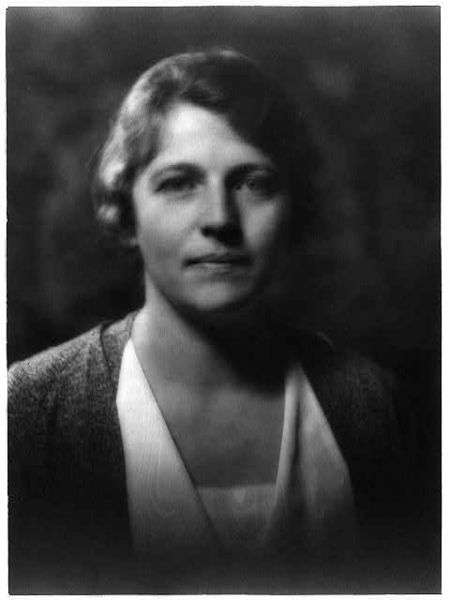
No one will think first of poetry when they think of Pearl Buck. She was primarily a novelist and memoirist. She did write poetry though and one collection was published. I consider her a sort of spiritual mother and so include her early in this ongoing Thursday series: Celebrating American She-Poets.

Pearl S. Buck (1892-1973) was born in Virginia, the daughter of Presbyterian missionaries. She grew up in China and spoke Chinese before she spoke English. Her Chinese name was Sai Zhenzhu.

Pearl Buck was a prolific writer of novels and memoir who started publishing her stories and essays in the 1920s in popular periodicals of the day: The Nation, The Chinese Recorder, Asia, and The Atlantic Monthly. Her first novel was East Wind, West Wind (John Day Company, 1930).

Of her novels, The Good Earth is the best known. It won the Pulitzer in 1932. The focus of most of her writing was China and the Chinese. When Chinese-American author Anchee Min wrote Pearl of Chinaa fictionalized account of Pearl Buck’s life, she said that she was touched by the warmth and understanding with which Ms. Buck had written about Chinese peasants and their lives.

Pearl Buck was awarded the Nobel Prize for Literature in 1938.

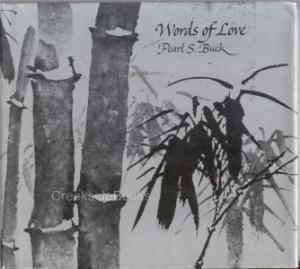
To my knowledge, there is only one small book of her poems. The collection is titled Words of Love. It is simply illustrated with Asian art by Jeanyee Wong and was published a year after Ms. Buck’s death by the John Day Company, the publishing firm run by Pearl Buck’s second husband, Richard Walsh.

I found a copy of Words of Love in a used-book store some years ago. The poem quoted above is an excerpt. In brief, eloquent, deft strokes, Ms. Buck’s poems do indeed express the themes of her novels. I can’t help but wonder whether there might be more of her poetry stored in some university archive awaiting discovery by an ambitious student or devoted biographer.

Dust-jacket, Words of Love by Pearl S. Buck.

© 2016,  Jamie Dedes, All rights reserved; illustrations are in the public domain