Page 3 of 4

Honoring All Nurses, a poem and its backstory by Anjum Wasim Dar

Photograph courtesy of Jesoots.com@jeshoots, Unsplash

“It is impossible to describe exactly what I learn, though I know it lies somewhere between science and art. It is all about the smallest details and understanding how they make the biggest difference.”  Christie Watson, The Language of Kindness: A Nurse’s Story


Anjum wrote me that she’d penned this some years ago. It was originally published in the Pakistan Times. She’s dusted it off in light of the current COVID-19 travesties and the heroism of nurses in response. I value her wish to honor those compassionate health care providers who are putting themselves in harms way for the greater good. / J.D.

The day is near its ending
The sun is slowly sinking,
The black veil of night is spreading,
Covering the day’s golden gown

Air outside is cold, but she is ready
With her cap, cape and coat,
Pen and red pencil, her pockets hold,
Pips and buttons shine like gold

For duty she is bound,
To the ward, she makes her way,
To look after the sick in the dark hours
As they rest and sleep till day

Alone, as midnight strikes, she goes
To give patients the medicine due,
Two gulps of a “mixture’
A ‘capsule’ or ‘tablets’ two

Awake alert ready she will be
To ease the pain and all misery
Never tired never with a frown
Comforting all in painful recovery

Darkness gently slips away
Silence prevails, peaceful and holy
Her duty done, she leaves the ward
As dawn approaches, slowly, slowly

Nurse on Duty

One night as I was about to drop off to sleep a sharp pain in my armpit shook me. I almost screamed. I put my hand where I was feeling the pain and my heart missed a beat. There was a hard lump there. 

Terrified, I felt a shiver run down my spine. I realized I was running a fever. Should I wake my mom who was dead tired after a heavy days work.? No, wait, the inner voice said. I don’t remember how I spent the night, my pillow was wet with tears of pain and  fear.  In the morning I was taken to the hospital, a military hospital.  Upon evaluation, surgery was recommended and then followed the most unforgettable eleven days of my life.

On that first day, I was struck by the smiles on the nurses faces, a welcoming smiles, reassuring comforting. “No need to worry all will be well,” said Captain Maryam as she tucked me in. I put my head on the white pillow and noted the red blanket that covered the bed. Red was the official color of the blankets of the military hospital. They gave me a sedative and the nurses smiles were a warming touch as I succumbed to a deep oblivion.

The next day the Operation Theatre Nursing Officer: quick, efficient, deft in her handling,  prepared me by helping me put on the gown and suddenly  I was on the operating table.  Presently in came the Surgeon. Then another man walked in with a mask on his face, the nurse held my hand: “Count till ten” . . .  and at  3 … 4……5…I fell asleep.

Four hours later I came to myself and the same tall nursing officer was leaning over me putting plaster across my chest. She covered me with another red blanket. I felt myself being lifted and carried on a stretcher. The ambulance moved slowly I dozed in and out of consciousness. I  vomited from the anesthesia …lost consciousness and later woke up again vomiting. Dozed again and so it went until . . . I don’t know how many hours passed by.

And so it was the care of the nursing officers of that Military Hospital where I spent eleven days and recovered from my critical operation. I was lucky to have a benign tumor but I was more lucky to be under the loving responsible care of the Nursing Angels who gave me the emotional physical and medical care I needed most.

I wrote a poem for them which I wish  to share. Here I would like to Dedicate this story to all the Brave Nurses of the World in this Pandemic time. Day and night they doing  their duty courageously, risking their lives and I will never forget my time of need.

© 2020, Anjum Wasim Dar

Anjum Wasim Dar

ANJUM WASIM DAR (Poetic Oceans) was born in Srinagar (Indian occupied Kashmir) in 1949. Her family opted for and migrated to Pakistan after the Partition of India and she was educated in St Anne’s Presentation Convent Rawalpindi where she passed the Matriculation Examination in 1964. Anjum ji was a Graduate with Distinction in English in 1968 from the Punjab University, which ended the four years of College with many academic prizes and the All Round Best Student Cup, but she found she had to make extra efforts for the Masters Degree in English Literature/American Studies from the Punjab University of Pakistan since she was at the time also a back-to-college mom with three school-age children.

Her work required further studies, hence a Post Graduate Diploma in Teaching English as a Foreign Language (TEFL) from Allama Iqbal Open University Islamabad and a CPE, a proficiency certificate, from Cambridge University UK (LSE – Local Syndicate Examination – British Council) were added to  her professional qualifications.


Jamie Dedes:

Your donation HERE helps to fund the ongoing mission of The Poet by Day in support of poets and writers, freedom of artistic expression, and human rights.

Poetry rocks the world!


FEEL THE BERN

For Peace, Sustainability, Social Justice

Maintain the movement.

“Democracy is not a spectator sport.” Bernie Sanders


“Every pair of eyes facing you has probably experienced something you could not endure.”  Lucille Clifton

Coalition of Forty Arts Organizations Call for COVID-19 Relief for Arts and Literary Sectors


Collage courtesy of Aza24 under CC BY-SA 4.0 license. From right to left: Min Huifen playing the erhu, Pablo Picasso’s Les Demoiselles d’Avignon, Canto I from the Inferno, the first part of the Divine Comedy by Dante Alighieri and Rudolf Nureyev and Margot Fonteyn in the Grand adage from Nureyev’s staging of the Petipa/Minkus “The Kingdom of the Shades” for the Royal Ballet, London, 1963.

“In the months to come, the American economy will need the arts and culture sector to deliver on its unique mission and also to catalyze economic activity in other devastated industries such as restaurants, hotels, travel, and tourism. In March 2020, the Bureau of Economic Analysis reported that the arts and culture workforce contributed $877.8 billion, or 4.5 percent, to the nation’s gross domestic product (GDP) in 2017. The arts sector is an economic engine that directly employs more than 5 million workers. Attendees at nonprofit arts events spend $31.47 per person, per event, (beyond the cost of admission) on items such as meals and parking—valuable commerce for local businesses and essential during times of economic recovery.”The Arts Sector and COVID-19 Relief April 2020 MORE


More than forty arts and cultural organizations calling on Congress and the Trump administration to direct a substantial portion of the COVID-19 fiscal stimulus relief to the artistic, literary, and cultural sectors.  Such relief that will “sustain the arts sector’s unique capacity to support the U.S. economy, uplift the human spirit, and provide lifelong learning.”

In March 2020, the Bureau of Economic Analysis reported that the arts and culture workforce contributed $877.8 billion, or 4.5 percent, to the nation’s gross domestic product in 2017. The arts sector is an economic engine that directly employs more than five million workers.

Included in the detailed statement are requests for “substantial additional dedicated COVID-19 relief funding administered by the National Endowment for the Arts, National Endowment for the Humanities, and Institute of Museum and Library Services, as they uniquely address the operational needs of the cultural sector.”

The statement goes on to note that funding for the National Endowment for the Arts can go beyond the initial $75 million investment in the recently enacted CARES Act by dedicating new substantial resources in the following ways:

  • Make COVID-19 relief grant opportunities fully available to all eligible organizations as defined in the NEA’s authorization statute (as described in 20 U.S.C. §954). Limited resources necessitated restricting eligibility to prior grantees from the past four fiscal years. New resources could increase eligibility from approximately 3,700 nonprofit cultural organizations to more than 100,000 nonprofit cultural organizations nationwide.
  • Enable national non-profit organizations to sub-grant federal arts funds to support community-based arts and culture organizations, agencies, and artists across the country in order to assist the NEA in quickly and efficiently supporting the nation’s cultural infrastructure and workforce.
  • Expand waivers for public/private matching requirements to apply to all active FY 2019 and FY 2020 NEA grant awards, in addition to the new waivers included in the CARES Act. Allow current grantees that have a balance not yet drawn to re-allocate that funding for general operating support that helps to address COVID-19 economic losses.

“There is a specific and substantial contribution to economic recovery that can come from sustaining literary, arts and cultural organizations across the country,” said PEN America Washington director Thomas O. Melia. “This obliges policy-makers to include small and medium sized enterprises, especially non-profit organizations, as a focus of the next fiscal stimulus package.”

This post is courtesy of the PEN America, the arts sector coallition, and Wikipedia.


Jamie Dedes:

Your donation HERE helps to fund the ongoing mission of The Poet by Day in support of poets and writers, freedom of artistic expression, and human rights.

Poetry rocks the world!


FEEL THE BERN

For Peace, Sustainability, Social Justice

Maintain the movement.

“Democracy is not a spectator sport.” Bernie Sanders


“Every pair of eyes facing you has probably experienced something you could not endure.”  Lucille Clifton

In the Wake of COVID-19: Free Speech and Freedom of Artistic Expression Threatened

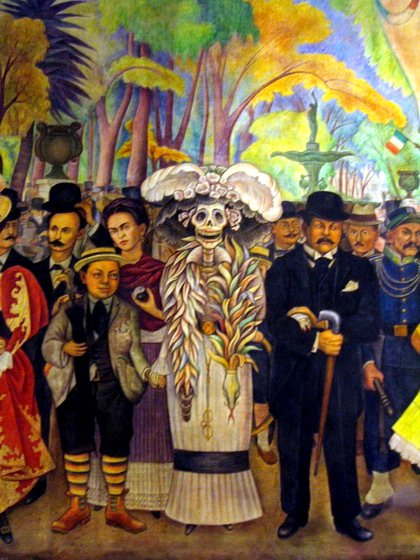
Rivera himself, as a pug-faced child, and Frida Kahlo stand beside the skeleton; mural in Mexico City courtesy of Diego Rivera Núñez and one more author under CC BY 2.0

“Freedom of expression is a human right and forms Article 19 of the Universal Declaration of Human Rights. Freedom of expression [a foundation for other rights] covers freedom of speech, freedom of the press, and gives individuals and communities the right to articulate their opinions without fear of retaliation, censorship or punishment. (The right to freedom of expression wouldn’t be worth much if the authorities also had the right to imprison anyone who disagrees with them.) An effective media also depends on the legal basis that freedom of expression gives the right to function and report freely, sometimes critically, without threat or fear of punishment.

“Freedom of expression is not an absolute right: it does not protect hate speech or incitement to violence. That said, many other rights which are intrinsic to our daily lives build on and intersect with this protection for free thought and individual expression. Freedom of expression covers everything from satire to political campaigns to conversations in your own home. It’s a fundamental human right which allows for citizens to speak freely and without interference.” Ten Reasons Freedom of Expression is Important, The Legal Media Defense Initiative (UK)


It’s not news that in times of upheaval when confusion reigns, the power elite use that as cover or excuse for violations of human rights and the rule of law.  With the outbreak of COVID-19, we saw the beginning of this type of abuse relative to the virus when Chinese physician, Li Wenliang, conscientiously sounded an alert and was subsequently arrested and accused of “rumor-mongering” by Wuhan police. According to Worldometer.info, as of today deaths from this virus total 2,081,733. That number would include the good Dr. Wenliang and no doubt underestimates the total since testing is not widely available.

To one degree or another the curbing of the arts and of news articles related to COVID-19 is happening all over the world in both developed and developing nations. Certainly, in my own country (the U.S.), we’ve seen journalists, advisors, and politicians denounced, fired, or banned based on their reporting, advice, or political positions. Just yesterday Missouri Governor Mike Parson’s placed a ban on attendance by reporters at state briefings. Reporters are now required to email their questions one hour in advance of meetings for prescreening by officials.

Earlier this month three Burmese artists were arrested for painting a mural depicting the dangers of COVID-19.  “Zayar Hnaung, Ja Sai, and Naw Htun Aung were charged with violating article 295A of the Myanmar penal code, which criminalizes speech that ‘insults or attempts to insult’ religion or religious beliefs. The artists were arrested after painting a mural intended to raise awareness about the coronavirus epidemic.” reports PEN America. The intent of the mural was to urge citizens to stay at home. It depicted the grim reaper, which some Buddhists said looked like a monk. Hence the accusation.

On Monday, the Indian government filed a complaint against  Siddharth Varadarajan for reporting on one of Uttar Pradesh’ officials for not adhering to the national public lockdown.

This is by no means a comprehensive report. It is, however, a sad sample of the current state of affairs, especially sad when so many lives are in danger in the most absolute terms and in terms of quality of life.
.

The resources for this post include: The Media Legal Defense Initiative (UK), PEN America, Kansas City News, and The Indian Express, 
.
Some resources for journalists and artists at risk:
RELATED:

Jamie Dedes:

Your donation HERE helps to fund the ongoing mission of The Poet by Day in support of poets and writers, freedom of artistic expression, and human rights.

Poetry rocks the world!


FEEL THE BERN

For Peace, Sustainability, Social Justice

Maintain the movement.

“Democracy is not a spectator sport.” Bernie Sanders


“Every pair of eyes facing you has probably experienced something you could not endure.”  Lucille Clifton

Daily Quarantine Questions courtesy of the Contemplative Monk

The Contemplative Monk on Facebook HERE for comfort and inspiration.Recommended.


Jamie Dedes:

Your donation HERE helps to fund the ongoing mission of The Poet by Day in support of poets and writers, freedom of artistic expression, and human rights.

Poetry rocks the world!


FEEL THE BERN

For Peace, Sustainability, Social Justice

The Poet by Day officially endorses Bernie Sanders for President.

The New New Deal

“Democracy is not a spectator sport.” Bernie Sanders


“Every pair of eyes facing you has probably experienced something you could not endure.”  Lucille Clifton