Rev. Benjamin Meyers, Minister, Unitarian Universalists of San Mateo
Rev. Ben Meyers and the Unitarian Universalists of San Mateo invite San Mateo residents to join in the creation of an open, drop-in community space where people can come together in a supportive environment to make our voices heard.
Justice Action Mondays: Flash Advocacy!
Mondays, 5:30 – 6:30 pm, Beck Hall, Unitarian Universalists of San Mateo, 300 E. Santa Inez Ave., San Mateo, CA 94401, Phone: 650 342-5946, Office Hours: Tu – Fri 10-5
This Week: The focus is on writing thank you notes to journalists and legislators who are challenging Trump’s falsehoods and investigating Russian involvement in the election. Cards, stamps, snacks and conversation provided. Do drop in for a fun hour of solidarity and activism!
A distribution list will be created to keep you informed of the topic each Wednesday.
Who are the Unitarian Universalists?
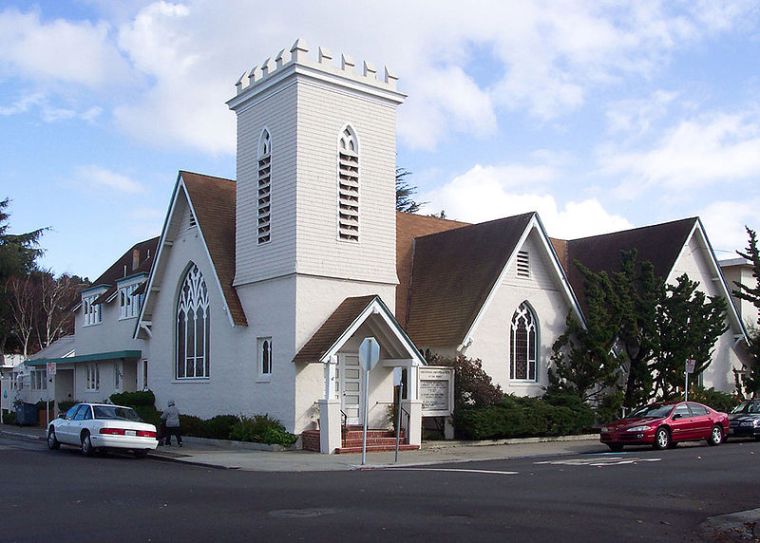
UU San Mateo
Unitarian Universalist congregations are filled with caring, open-minded people. Our faith encourages you to seek your own spiritual path. Our congregations are places where people gather to nurture their spirits and put their faith into action by helping to make our communities—and the world—a better place. We are committed to spiritual growth and transformation.
Principles and Sources
There are seven principles which Unitarian Universalist congregations affirm and promote:
The inherent worth and dignity of every person;
Justice, equity and compassion in human relations;
Acceptance of one another and encouragement to spiritual growth in our congregations;
A free and responsible search for truth and meaning;
The right of conscience and the use of the democratic process within our congregations and in society at large;
The goal of world community with peace, liberty, and justice for all;
Respect for the interdependent web of all existence of which we are a part.
Unitarian Universalism (UU) draws from many sources:
Direct experience of that transcending mystery and wonder, affirmed in all cultures, which moves us to a renewal of the spirit and an openness to the forces which create and uphold life;
Words and deeds of prophetic women and men which challenge us to confront powers and structures of evil with justice, compassion, and the transforming power of love;
Wisdom from the world’s religions which inspires us in our ethical and spiritual life;
Jewish and Christian teachings which call us to respond to God’s love by loving our neighbors as ourselves;
Humanist teachings which counsel us to heed the guidance of reason and the results of science, and warn us against idolatries of the mind and spirit.
Spiritual teachings of earth-centered traditions which celebrate the sacred circle of life and instruct us to live in harmony with the rhythms of nature.
These principles and sources of faith are the backbone of the UU religious community.
UUSM is
a Welcoming Community
a Beloved Community in the spirit of Rev. Dr. Martin Luther King, Jr.
a sanctuary congregation and active in the American Sanctuary Movement
A few days ago, February 18, Pulitzer Prize winning columnist, Bret Stephens gave the Daniel Pearl Memorial Lecture at the University of California, Los Angeles. Time magazine reported on it and you can read the entire text HERE. I urge you to do so.
In his talk Intellectual Integrity in the Age of Trump Stephens, a conservative, warns us not to “dismiss President Trump’s attacks on the media as mere stupidity.” He writes that open-mined and diligent reporting is important and that “truth is not merely in the eye of the beholder.”
I admit to being beyond irritated with news-as-entertainment that caters to the sensational and salacious, that betrays us by serving up too much free on-air time to people with questionable intentions and morally deficient characters. This is unfortunate, but thankfully it is not descriptive of the whole of the American press.
Let’s give kudos were kudos are deserved: to those hard-working truth-seekers, our occupational cousins: professional journalists who put the truth first and work hard to bring it to us. They don’t deserve to be denigrated by a Republican administration that has lost its backbone participating in attempts to suppress what is crtical to the maintenance of a functioning democracy – an independent press working with impunity.
Our journalists – as with any other professional group – don’t deserve to be painted with one broad brush by us – their readers (customers). Let’s not confuse earnest journalists with celebrity journalists who often deliver nothing more substantive than political gossip.
Among Bret Stephen’s points:
“Many people say” is what’s known as an argumentum ad populum. If we were a nation of logicians, we would dismiss the argument as dumb.
“We are not a nation of logicians.
“I think it’s important not to dismiss the president’s reply simply as dumb. We ought to assume that it’s darkly brilliant — if not in intention than certainly in effect. The president is responding to a claim of fact not by denying the fact, but by denying the claim that facts are supposed to have on an argument.” MORE
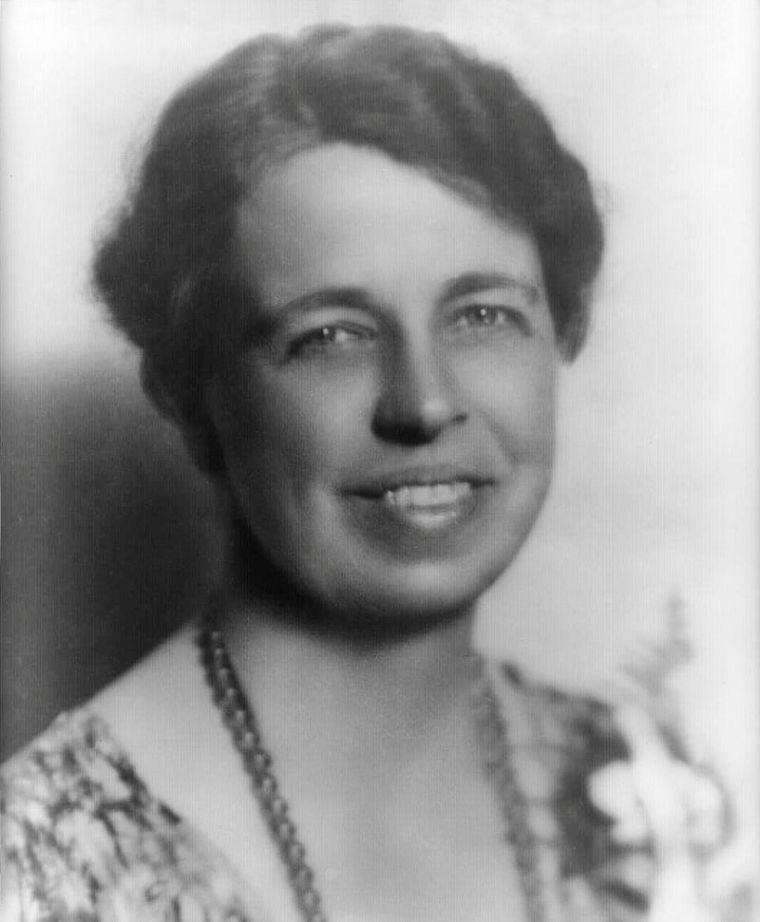
Anna “Eleanor” Roosevelt from the United States Library of Congress’s Prints and Photographs division, ID cph.3c08091.The White House Portrait of Mrs. Roosevelt painted by Douglas Chandor, 1949
Eleanor Roosevelt, the wife of Franklin Delano Roosevelt (32nd President of the United States, is often referred to as an iconic first lady, as someone who changed the rules. She was active politically, advocated for social justice and human and civil rights, wrote and gave speeches, formed a White House press corp of women reporters and photographers and was the first Chair of the Presidential Commission on the Status of Women (under John F. Kennedy). She is the gold standard for the first ladies who follow her.
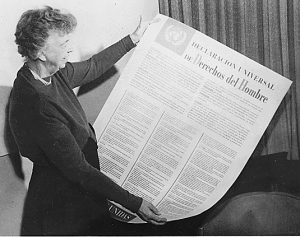
Mrs. Roosevelt with the Spanish version of the Universal Declaration of Human Rights, which includes Franklin Roosevelt’s Four Freedoms.
One of the projects Mrs. Roosevelt was most proud of was the drafting of the Universal Declaration of Human Rights, which included her husband’s four freedoms:
Freedom of speech
Freedom of worship
Freedom from want
Freedom from fear
These are from what is known as President Roosevelt’s Four Freedoms Speech, which was his 1941 State of the Union address. He proposed these freedoms for everyone “everywhere in the world.”
Mrs. Roosevelt’s poem, Footprints in Your Heart, is chock full of wisdom, high ideals and good advice. If you’ve never read it before, I hope you enjoy it here. If you have read it before, I know you’ll enjoy reading it again. It is not the most well-written poem or perhaps it’s collection of her sayings that someone might have put together as a “poem.” Either way its sentiment is refined and there lies its value.
Footprints In Your Heart
Many people will walk in and out of your life,
But only true friends will leave footprints in your heart.
To handle yourself, use your head;
To handle others, use your heart.
Anger is only one letter short of danger.
If someone betrays you once, it is his fault;
If he betrays you twice, it is your fault.
Great minds discuss ideas,
Average minds discuss events,
Small minds discuss people.
He who loses money, loses much;
He who loses a friend, loses much more;
He who loses faith, loses all.
Beautiful young people are accidents of nature,
But beautiful old people are works of art.
Learn from the mistakes of others.
You can’t live long enough to make them all yourself.
Friends, you and me.
You brought another friend,
And then there were three.
We started our group,
Our circle of friends,
And like that circle –
There is no beginning or end.
Yesterday is history.
Tomorrow is mystery.
Today is a gift.
That’s why it’s called the present.
Eleanor Roosevelt
The photographs here were all taken as documentary record by government photographers and as such are in the public domain.
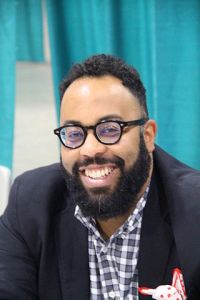
2015, Kevin Young at Library of Congress National Book Festival September 5, 2015 Washington, DC, by fourandsixty, CC BY SA 2.0
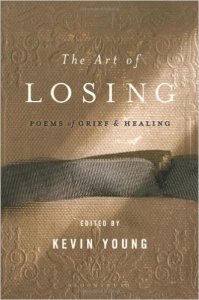
The recommended read for this week is The Art of Losing by Kevin Young. I find this to be an extraordinarily beautiful anthology about grief and recommend it for all those who work with living and dying, clergy of all faiths, hospice workers, physicians and nurses as well as those grieving a lost family member or friend. It was conceived and edited by Kevin Young, a poet in his own right and the editor of four poetry anthologies. His book Jelly Roll: A Blueswas a finalist for both the National Book Award and the Los Angeles Times Book Prize. It won the Paterson Poetry Prize.
By shopping at Amazon through The Word Play Shopor through links in the body of a post, you help to support the maintenance of this site. Thank you!
The WordPlay Shop offers books and other tools especially selected for poets and writers.
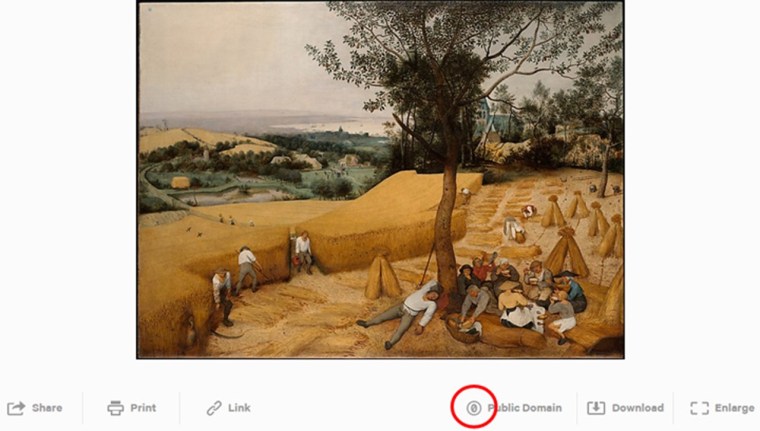
Thomas P. Campbell, Director and CEO of The Metropolitan Museum of Art, announced today its adoption of a new policy: all images of public-domain artworks in the Museum’s collection are now available for free and unrestricted use. This updated policy, known as Open Access, utilizes the Creative Commons Zero (CC0) designation. This policy change is an update to The Museum’s 2014 Open Access for Scholarly Content (OASC) initiative. The Met’s Open Access policy facilitates the use of more than 375,000 images of public-domain artworks for both scholarly and commercial purposes. The Museum is collaborating with global partners to enable greater access to the collection.
In making the announcement, Mr. Campbell said
We have been working toward the goal of sharing our images with the public for a number of years. Our comprehensive and diverse museum collection spans 5,000 years of world culture and our core mission is to be open and accessible for all who wish to study and enjoy the works of art in our care. Increasing access to the Museum’s collection and scholarship serves the interests and needs of our 21st-century audiences by offering new resources for creativity, knowledge, and ideas. We thank Creative Commons, an international leader in open access and copyright, for being a partner in this effort.”
“Sharing is fundamental to how we promote discovery, innovation, and collaboration in the digital age,” said Ryan Merkley, CEO, Creative Commons.
“Today, The Met has given the world a profound gift in service of its mission: the largest encyclopedic art museum in North America has eliminated the barriers that would otherwise prohibit access to its content, and invited the world to use, remix, and share their public-domain collections widely and without restriction. This is an enormous gift to the world, and it is an act of significant leadership on the part of the institution. I want to congratulate Thomas P. Campbell, the board of trustees, and The Met staff for making such a strong commitment to collaboration and sharing, and I hope that other institutions, both public and private, will follow the path they are setting out here today.”
Middle Kingdom Dynasty:Dynasty 12 Reign:Senwosret I to Senwosret II Date:ca. 1961–1878 B.C. Geography:From Egypt, Middle Egypt, Meir (Mir), Tomb B no. 3 of the nomarch Senbi II, pit 1 (steward Senbi), Khashaba excavations, 1910 Medium:Faience -William the Hippo is the mascot for the Met – public domain photograph
To maximize the reach of The Met’s Open Access initiative, the Museum announced its new partnerships with Creative Commons, Wikimedia, Artstor, Digital Public Library of America (DPLA), Art Resource, and Pinterest. The Museum also welcomes its first Wikimedian-in-Residence, Richard Knipel, who will collaborate with Wikimedians around the world to bring images of public-domain artworks into Wikimedia Commons, Wikipedia, and diverse GLAM-Wiki initiatives. Creative Commons will support search and re-use of The Met collection with its CCSearch beta .
“The Met has again proven itself a leader among the world’s great cultural institutions. By opening their vast collection of art and antiquities to be freely available under Creative Commons Zero, they are lighting the way for other institutions to follow,” said Katherine Maher, Executive Director of the Wikimedia Foundation. “Wikipedia’s hundreds of millions of users from around the globe will now be able to experience The Met’s greatest treasures, no matter where they live. This remarkable cultural heritage is now free for anyone to view, share, and use.”
Washington Crossing the Delaware by Emanuel Leutze, MMA-NYC – Public domain photograph
Loic Tallon, The Met’s Chief Digital Officer, said:
“In our digital age, the Museum’s audience is not only the 6.7 million people who visited The Met’s three locations in New York City this past year, but also the three-billion-plus internet-connected individuals around the world. Adopting the CC0 designation for our images and data is one of the most effective ways the Museum can help audiences gain access to the collection and further its use by educators and students, artists and designers, professionals and hobbyists, as well as creators of all kinds. I am particularly delighted to be launching the Museum’s CC0 policy in collaboration with Creative Commons, Artstor, DPLA, Pinterest and the Wikipedia community, and for their support in bringing the Museum’s collection to their users.”
The Met’s new agreement with Artstor, a service affiliated with the education not-for-profit ITHAKA, will make the images discoverable throughout its digital resources, which support a global education community and provide tools to encourage image and data use in research and teaching.
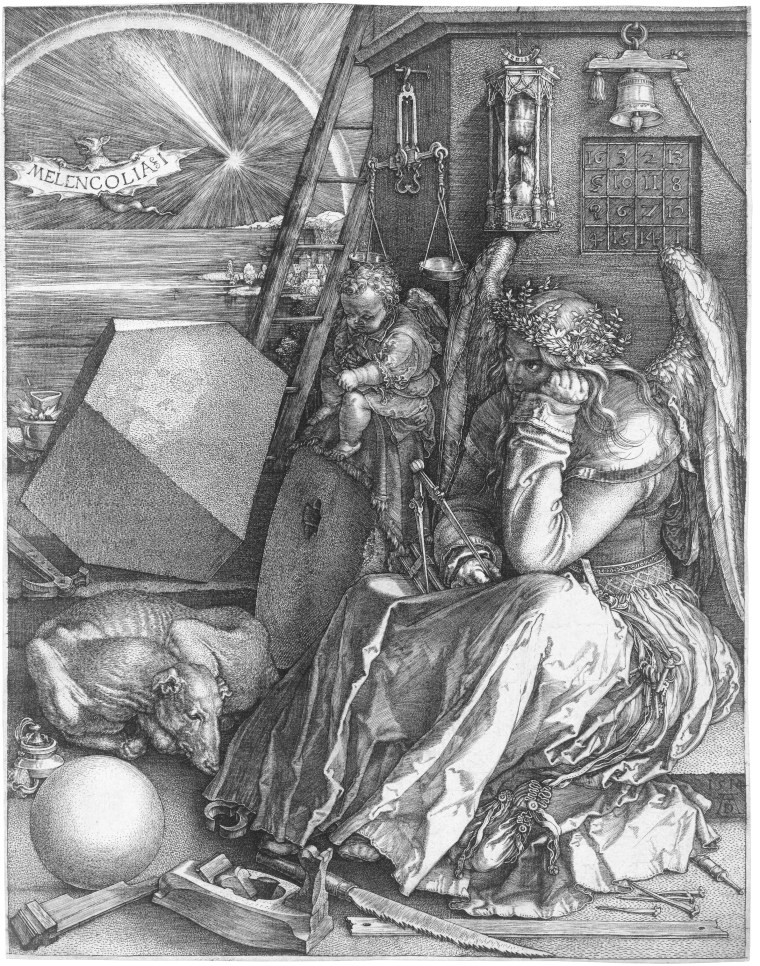
Melencolia I (B. 74; M., HOLL. 75) *engraving *24 x 18.8 cm *1514, public domain photograph
“We are thrilled to help further the impact of The Met’s bold public digital access initiative through our work in the global educational community,” said Kevin Guthrie, President of Artstor and ITHAKA.
“We look forward to making these 375,000 images available so that teachers, students, and researchers around the world can find them, use them, and most importantly re-use them. The CC0 license for these images is a sea change that will help educators and students advance our collective understanding of art and human values by encouraging their use, not only in traditional classrooms and scholarly publications, but also in new digital projects and online courses.” Guthrie added, “Access is just the beginning. We look forward to continuously finding ways to work with those engaged in education to enhance and encourage the reach of this collection.”
The public can also find images offered from this initiative on Pinterest, thus making the collection more easily accessible to their community.
Evan Sharp, co-founder and Head of Product at Pinterest, said:
“Pinterest is where more than 150 million people discover ideas for their lives, whether they collect images of artistic masterpieces or the art of the everyday. We’re honored to partner with The Met to make this unprecedented collection accessible to the Pinterest community.”
The rollout of this change in policy is an ongoing process, as the Museum continues to collaborate with new and existing partners to develop our content-distribution efforts and explore new opportunities.
While all images of works the Museum believes to be in the public domain are included in this initiative, certain works are not available for one or more of the following reasons: the work is still under copyright, or the copyright status is unclear; privacy or publicity issues; the work is owned by a person or an institution other than The Met; restrictions by the artist, donor, or lender; or lack of a digital image of suitable quality.
The Museum continues to work with Art Resource for licensing images of works under copyright or other restrictions, or for images not available on The Met’s website.
The Met’s Open Access initiative is made possible through the Bloomberg Philanthropies.
“The Metropolitan Museum of Art’s new initiative brings its collection to an even larger audience. One of the first museums to offer audio guides, invest in mobile apps, and develop a robust website, The Met continues to be a leader in providing access to its encyclopedic resources for millions of people all over the world,” said Kate D. Levin of Bloomberg Philanthropies.
Related blog posts about The Met’s new image policy can be found on Now at The Met and Digital Underground, as well as on the websites of our partners Creative Commons, Wikimedia Foundation, and Artstor.
Additional information and instructions can also be found at metmuseum.org/openaccess.

 Principles and Sources
 RELATED:









 Jamie Dedes' THE POET BY DAY Webzine