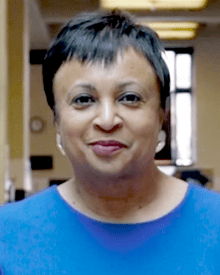
Dr. Carla Hayden (b. 1953), Librarian of Congress effective Sept. 30, 2016
The United States Senate vote of 74-18 confirmed Dr. Carla D. Hayden, longtime chief executive of the Enoch Pratt Free Library system in Baltimore and a former president of the American Library Association, as the 14th Librarian of Congress, for a renewable ten-year term.
Dr. Hayden was nominated by President Barack Obama in February.
This is truly a great honor to be nominated by President Obama and confirmed by the U.S. Senate to lead the nation’s library, the Library of Congress,” Dr. Hayden said. “It has been my privilege to serve the citizens of Baltimore for 23 years and help restore the Enoch Pratt Free Library as a world-renowned institution. I look forward to working with the dedicated staff of the Library of Congress. I will be honored to build on the legacy and accomplishments of my predecessors in this position, to be part of a continuing movement to open the treasure chest that is the Library of Congress even further and to make it a place that can be found and used by everyone.”
Dr. Hayden is the first woman, and the first African American, to serve as chief executive of the Library of Congress, the largest library in the world, with 162 million items in its collections. It also oversees the U.S. Copyright Office and the Congressional Research Service. It serves Congress and makes its research collections accessible on site and online.
She takes the helm from Acting Librarian David S. Mao, who has served since the retirement of Dr. James H. Billington on September 30, 2015. She will be sworn in at a date to be determined and is expected to assume her duties soon.
Dr. Hayden has recently overseen the renovation of the central branch of the Enoch Pratt Free Library, a four-year, $112 million project, and has also led $40 million in renovations to other units within the 22-branch Pratt system. The system is named for the businessman and philanthropist who financed its founding in 1886.
She took the helm of the Baltimore system in 1993, winning strong praise for her work to ensure that the city’s library system offers a broad array of services to assist citizens from all walks of life, from access to books and other learning materials to computer access and job information. A program of outreach into neighborhoods served by the Pratt libraries included after-school centers for teens, offering homework assistance and college counseling; a program offering healthy-eating information for residents in areas with insufficient access to high-quality food; programming in Spanish; establishment of an electronic library, and digitization of the Library’s special collections.
Dr. Hayden won high praise, during recent civil unrest in some Baltimore neighborhoods, for keeping library branches open citywide to continue service and provide citizens with safe havens.
Dr. Hayden first served as a children’s librarian in the Chicago Public Library system, eventually rising to the post of deputy commissioner and chief librarian in that system. She also taught Library and Information Science at the University of Pittsburgh. She received Library Journal’s 1995 Librarian of the Year Award, and served as president of the American Library Association 2003-2004.
Dr. Hayden received a B.A. from Roosevelt University and an M.A. and Ph.D. from the Graduate Library School of the University of Chicago.
The Library of Congress is the world’s largest library, offering access to the creative record of the United States – and extensive materials from around the world – both on site and online. It is the main research arm of the U.S. Congress and the home of the U.S. Copyright Office. Explore collections, reference services and other programs and plan a visit at loc.gov, access the official site for U.S. federal legislative information at congress.gov and register create works of authorship at copyright.gov.
Thank you for sharing your love of words. Comments will appear after moderation.
I am disabled but not unable. Thanks to medical technology, fabulous and caring physicians, family support, social support (both online and off) and computer technology, I continue with my chosen career, my chosen causes and a life that is as full and engaging as anyone could hope.
Now, I’ve discovered The Mighty (details in the video below) thanks to my Bardo Group Beguines colleague, Lana Phillips. What a great find!
A wonderful idea, essentially an online support group for people who are dealing with chronic and catastrophic illness and sharing information and resources. The people who visit The Mighty site and/or write for it, share their stories (including stories of parenting). They are women and men who are ill or disabled themselves or who are caring for others who are ill or disabled … or, perhaps both.
We are so fortune in these days that there are support groups available. My own mother lived with cancer over and over again. First breast cancer, which kept reoccurring. Then thyroid, kidney and other cancers. Ultimately she died at 76 of breast and colon cancer. In her day, there were no support groups, no one in her life who could understand the complications: psychological, financial or physical. There was no adult who could observe, understand and intervene. She also suffered from mental illness and was in an almost constant state of stress and trauma.
Unlike my mom, I have the benefit of a support group at the Medical Center for people with interstitial lung diseases who are in pre-transplant (me), transplant and post transplant programs. I also belong to an off-line support group of people with “life-threatening” (read ultimately fatal) illnesses, which is run by the local Buddhist meditation center. Some are – like me – lucky enough to go on for years. I was diagnosed in 1999 with Idiopathic Pulmonary Fibrosis, which is fatal within five years of diagnosis and for which there is no cure. I’m still here because the diagnosis was wrong. There was no way to know that until time passed and reactions to medical treatments could be observed and evaluated. These proved that the condition is actually Hypersensitivity Pneumonitis. So, as you see, I’m still hanging out. Some of the members of our Buddhist group are not. Over the last seven years we’ve lost nineteen friends. That’s the tough part.
The upside is that our offline support groups provide us safe haven to share information, to be open about our fears and frustrations, and to share our joys. So too The Mighty, where there are a rather remarkable number of conditions addressed from a personal perspective and in a manner that is informed, compassionate and uplifting. Bravo!
WRITING PROMPT
Write a poem, short story or feature article about dealing with chronic catastrophic illness or disability. Directly or indirectly, illness and disability touch all our lives. It’s just part of this package called Life! If you write an article, you might consider submitting it to The Mighty. Submission guidelines are HERE.
AN ANNOUNCEMENT FROM 100TPC COFOUNDER, MICHAEL ROTHENBERG: “On September 24, 2016 poets, musicians and artists around the world will be organizing poetry readings, parades, gallery exhibitions, music and dance performances focused on issues of peace, justice, and sustainability. This important annual global act of solidarity is the core activity of 100 Thousand Poets for Change, a non-profit organization.
100 Thousand Poets for Change offers an opportunity for a peaceful global discussion of issues such as war, global warming, poverty, racism, gender inequality, homelessness, gun violence, police brutality, lack of affordable medical care, censorship, and animal cruelty. Individual organizers are free to choose the specific topic and focus of their local event. If you are interested in participating in this global action please post sign up HERE.”
*****
THE BARDO GROUP BEGUINES will host a virtual 100TPC event on September 24 with American-Israeli poet, Michael Dickel (Fragments of Michael Dickel) as Master of Ceremonies. Between Michael and me the event will run from morning in Israel to midnight in California. You can share your work through Mr. Linky (instruction will be provided) or in the comments section of the blog post that day at The BeZinewhere you can also enjoy the work of other artist activists.
Work may include anything on topic: poetry, essay, short fiction, video (music, mime, dance, dramatic monolgue), art and photography and so forth. The topic we’ve chosen this year – selected by Rev. Terri Stewart (Beguine Again founder) – and supported by our core team of poets, writers, story-tellers, artists and photographers, musicians and clerics is ENVIRONMENT and ENVIRONMENTAL JUSTICE.
This event is open to everyone wherever you are in the world and makes possible participation even if there is no street event happening in your area or if you are homebound. We hope you’ll join us. Soon after the event, we’ll collect everything into one commemorative page. This is tradition. Commenorative pages from prior years can be accessed at The BeZine through its blog roll. All work will be also be archived at Stanford University, Stanford, CA.
Please feel free to share this post widely. Thank you!
Thank you for sharing your love of words. Comments will appear after moderation.
There’s something happening here,
What it is aint exactly clear.
There’s a man with a gun over there,
Tellin’ me I’ve got to beware …
I think it’s time we stop, Children, What’s that sound?
Everybody look what’s goin’ down …
Stephen Stills (Crosby, Stills & Nash)
Unitarian Universalists (UU) of San Mateo, CA
On June 12, 49 people were murdered at the Pulse Nightclub in Orlando, Florida and 53 were injured and hospitalized, four critically. People of good conscience gathered and mourned with victims and families at vigils held across the country and around the world. We grieved for lives lost. We grieved another mass shooting, the largest in U.S. history.
Congregational Church, San Mateo, CA
Here in San Mateo, we joined in a interfaith vigil held at the Congregational Church. We joined in sadness, shock and solidarity, both for Orlando, and for those in our own community, our country, our world who are of a minority sexual orientation: gay men, lesbians, bisexual persons, transgender persons, persons uncertain of their gender identity or sexual orientation, victims of senseless hate in some quarters.
The community we must hold vigil for in our hearts is even larger. It includes all our Muslim brothers and sisters here and around the world who have and will suffer from the kind of religious bigotry that cannot separate the actions of one radically disturbed individual from the peace- loving behaviors of millions of religious people.
Torah Center, Peninsula Temple Sholom, Burlingame, CA
Recently, Unitarian Universalists of San Mateo (UUSM) joined over 200 people and broke the month long period of daily fasting for Muslims known as Ramadan. The event, which I had never participated in before, was made even more remarkable to me because of its location. It was not held in a Mosque or even a Muslim Cultural Center, rather, it was hosted, and well attended, by the Jewish congregation of Peninsula Temple Shalom, in Burlingame. Muslims and Jews, Christians, UUs and others came together to learn more about this most holy ritual of Islam, and to stand against the violence of Islamaphobia and hate, which currently, the majority of U.S. citizens embrace and promote.
We hold vigil for people, especially black and brown people, who continue to be the targets of racial profiling and the oppression and violence that comes with it. Acts of systemic hatred and violence which we can not even imagine but which they face every day just because of the color of their skin.
Here, in this religious community, we are striving to embody and live out a life-long vigilance to building the beloved community that the Rev. Dr. Martin Luther King, Jr. spoke of when he encouraged all people of good conscience, especially white people of privilege and power, to look at and dismantle the pervasiveness of white supremacy, lessons learned at a tender age and never truly unlearned without a committed effort and willingness to change and be changed—from the inside-out.
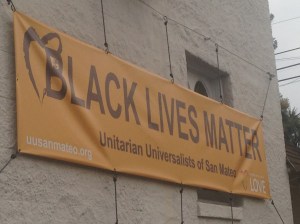
Our Black Lives Matter banner hangs outside our sanctuary, a reminder to be conscious of our complicity in the legacy of violence and hatred that is not yet overcome. We must hold in our hearts and move in our hands ALL of us here in our country who might at any time be the victims of violence of the highest order, violence inflicted by high-powered weapons that kill indiscriminately in every corner of this country: in our churches, mosques, temples and shrines…in our schools and workplaces, in our coffee houses and dance houses and our very homes.
Since the Orlando shooting on June 12th there have been 31 other mass shootings in the U.S. involving 4 or more victims, including the death of 5 in Las Vegas and 5 police officers in Dallas, Texas. More shootings. More vigils. So, what exactly do we mean by vigil?
A vigil is a SACRED kind of watchfulness, a call to be attentive and aware with devotion for the emotions that are sure to surge up within us— emotions of anger, even rage; emotions surrounding loss and shock; emotions steeped in frustration and fear. These emotions can convince us, if we are not careful, that rage justifies the kind of outrage that lashes out, repaying violence with violence, seeking a life for a life, an eye for an eye, the kind of rage that would turn the whole world into an unending whirl of violence and vengeance.
Inevitably,we must come to the question: “What WILL we do?” Because, now awakened, now alert, now vigilant…We know we are called to respond, to act, to engage in change that makes a difference.
Our first question is, “What do we need to make sure we do not do?” How do we honor the memory of those who were victimized by hate? How do we stand with those who are still victimized by hate? How do we keep from falling into the pattern of hate ourselves? Given the size and complexity of the problem, how do we remain vigilant and not acquiesce back into silence, numbness, complacency? How do we do more than pray?
We know that a culture that marginalizes and stigmatizes persons for any reason creates an environment that says violence towards those persons is acceptable because they are the “other,” that are not like us. But we who believe in a better way know that an eye for an eye only leaves us all blind.
We also know that a culture of violence such as ours also creates an environment of numbness and distance and silent complicity, which can be and has been part of what perpetuates the continuance of the dominant culture. We have now heard enough shots to know that silence is inadequate to the task of countering the culture violence. We must employ the power of love and peaceful engagement for we know that moments of silence and prayer are no longer enough. That they have never been enough…
Congresswoman Jackie Speier, our District 14 representative who, out of frustration to the impotence of her Congressional colleagues and out of vigilance and commitment to bringing real change to the culture of gun violence in our country, no longer participates in the moments of silence that have become the only response of our congress to these ceaseless mass shootings that are a plague upon our nation.
Jackie Speier
This is what our moments of silence have bought us. A silent nightclub, the only sound the frantic ringing of phones that would never be answered. Silent bodies, where there should be life and love and pride. And here, a silent Congress. Mere words cannot describe the depth of my grief and rage. Forty-nine lives lost, in the middle of Pride Month when they should have been safe and celebrated. Forty-nine families devastated by the loss of their loved ones. Forty-nine phones ringing, and ringing, and ringing. There were also frantic texts, like Eddie Justice’s final messages to his mother: “Mommy, I love you. He’s coming. I’m going to die.
“If you can hear these words without your heart breaking, if you can think of those little children gunned down in Newtown without grieving, if you can think of empty pews in Charleston without mourning, then truly you have lost your humanity.
“Hateful people like to compare LGBTQ equality to the sin-filled Biblical cities of Sodom and Gomorrah. But we in Congress are the real Sodom and Gomorrah. Are there 218 righteous members here to stand against this bloody tide? Increasingly, I doubt it.
“So I ask you today, how many lives must be destroyed before Congress acts?
Nine lives? Charleston showed us nine is not enough.
Thirteen lives? Columbine showed us that 13 is not enough.
Certainly 27 small children killed in their classrooms at Newtown? No.
The 32 lives lost at Virginia Tech? Again, not enough lives.
The more than 33,000 Americans killed each year by guns? Still not enough.
“And now 49 people have been murdered in Orlando.
“Yet even this historic tragedy hasn’t been deemed big enough, horrific enough, or insidious enough to break Congress’ silence.
“Congress is happy to debate for hours about bathrooms, but bring up the gun violence killing thousands? Absolutely not.
“Radical Islam, or home-grown American homophobia, or a toxic stew of both may have inspired the Orlando shooter. No doubt we will learn more about his disgusting motivations in the coming weeks.
“But there are simple actions we can take now, actions that would have reduced the deaths in Orlando as well as Aurora, Newtown, San Bernardino, and at Umpqua Community College…
“I urge you – I beg you – to make America better than this. We must be better than this. “ –Congresswoman Jackie Speier, California’s 14th District.
There exists among us a variety of responses to the NRA, more interested in the rights of those who sell guns than in the lives of innocent victims of gun violence. The Human Rights Campaign, the largest LGBTQ-rights organization in the country suggests that we work to limit access to all assault weapons: That we move to expand background checks: that we limit access to firearms for suspected terrorists and for people with a history of domestic abuse. Common sense. Yes! In every other “civilized” country in the world, these are understood as common-sense regulations. But, here in our country, while the NRA owns the people’s Congress, these are seen as unreasonable restrictions. This has to stop. We must rise and turn the tide towards peace and justice when it comes to public safety. The best way to honor those who were senselessly slaughtered in Orlando and everywhere else is to act, NOW. We may BEGIN with prayers and with songs and with vigils…but let’s not stop there.











 Jamie Dedes' THE POET BY DAY Webzine