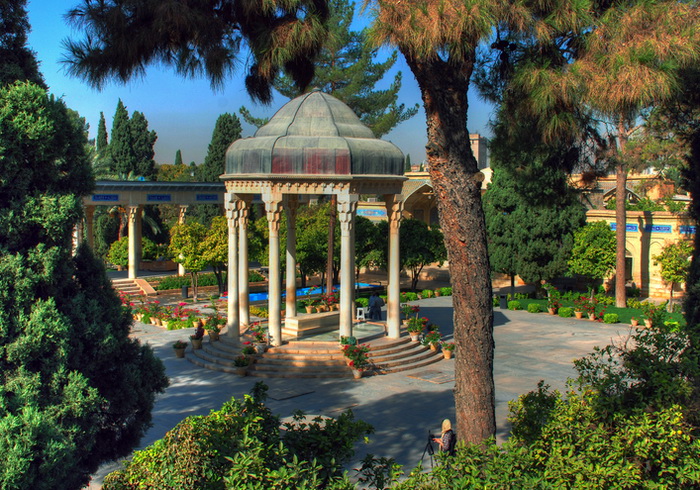
Tomb of Hafez, the Iranian poet whose poetry is regarded as a pinnacle in Persian literature and has left a considerable mark on later Western writers, most notably Goethe, Thoreau, and Emerson
“Even
After
All this time
The Sun never says to the Earth,
“You owe me.”
Look
What happens
With a love like that,
It lights the whole sky.” ― Hafiz
**********
Alone through Iran – 1144 Miles of Trust is a documentary film about Kristina Paltén, a lone Swedish woman who wanted to challenge her own and other’s prejudices against Islam by running across Iran to meet people along the way.
A wonderful heroic story: Monies for this documentary were raised through crowd funding and the film makers report they are currently in the process of editing the full movie. Here (below) is the trailer. Like the Facebook Page to stay updated about the movie.
If you are viewing this in email, you will likely have to click through to the site to view the video.
In fifth grade
my father’s secrets
start to breed under my red
confirmation dress—
dig deep in the tunnel of my inner
ear, cling to sentry hairs
on the nape of my neck—
his secrets: black bodies,
glassy eyes, squeeze
beneath my fingernails—
quiet as eggs;
they spin a red thread
that cuts me inside
out.
Over Exposed, the memoir of Terri Muuss, is at once painful and triumphant. It is an examined life that exposes the family of her childhood, the obscenities imposed on her by her father, her numbing with alcohol and drugs and her journey in therapy. All of this and yet she arrives victorious and accomplished with a healthy marriage, healthy sons and a multifaceted career, elements of which reach a hand out to those in trauma.
This is the story of how a child survived and became a woman who found herself and a writer who found her voice. The experiences of a lifetime form a collection of poems and prose vignettes that bespeak the possibilities of redemption and hold out hope and affirmation to those others whose childhoods have left them wounded. I recommend this book to everyone but, most especially, to those who have a history like Terri’s.
Lately, I feel a bull’s eye on me: on the street, the A train, in the fruit market. Men infect me with words, with smiles. Eyes snatch at breasts, tongues pin me to subway walls, mouths like a cold speculum pry open my inner ear. Their words pound, pound me, a worn head of drum. Voices divide and conquer, dividing me from myself—
Emotionally it was not the easiest book to read. I often found myself in tears.It is rewarding though, not only because its subject remains unbeaten but because the writing, pacing and organization have you moving through the pages anxious to gobble up each poem, each story, every nuance. Terri’s switches from child-voice to adult are smooth, her imagery clear and moving, her poetry well-crafted.
There are two videos in this post. If you are reading this from an email, you will have to click to this site to view the videos.
INTERVIEW
JAMIE: Am I right that your first love was acting? If so, how did you transition – or what inspired – the addition of poetry to your artistic repertoire?
TERRI: Yes, acting, theatre and directing have always been my first loves. I came to acting quite young and naturally. It will always be a huge part of who I am and how I see art in a larger sense. Much of my poetry is born out of a theatricality I possess from being onstage these many years.
That being said, poetry was always sort of waiting in the wings for me. When I was in 10th grade, my best friend Leslie was a beautiful person and poet who I admired greatly. I spent long days at her house after school as I had no inclination to go home to my own dysfunctional house. There, she read and wrote poetry in front of me and it certainly inspired me to use it as an avenue for expression. Later, during senior year, I had a teacher hand me a packet of poems by e.e. cummings, T.S. Eliot, Emily Dickinson and Langston Hughes that she thought I would enjoy. That packet sent me on a journey of reading as many poets as I could. Still, poetry was off to the side while theater took center stage.
It really wasn’t until I was faced with the trauma of my past and of putting myself together that writing became both a therapeutic tool and an artistic passion. To better understand the trauma of being sexually abused as a child, I wrote and wrote and wrote. Mostly poetry but also monologues. At the end, what I’d constructed was a one-woman show skeleton that became Anatomy of a Doll. I performed the show throughout New York City and then the country at conferences and in theaters. Even then, I didn’t identify myself as a writer. I thought of myself as a performer who just happened to use my writing as a script. When Veronica Golos (my friend, mentor and a gorgeous poet who’s won numerous awards) began taking an interest in my work and started editing it in a poetry workshop she led out of her house on the Upper West Side, I started to see myself in the context of being a poet and poetry as a vocation. I think the form of poetry works well to showcase the dissociation that comes with abuse much more than prose does. Veronica is still my editor, having worked on both Anatomy of a Doll and my book, Over Exposed.
But the biggest transition from actor to writer happened during my marriage to poet Matt Pasca. He’s always seen me as a writer and, before I even claimed that identity for myself, always pushed me to go deeper, to write more, to get better, to submit my work. Through our marriage I have grown as a writer and came to see myself as a poet.
JAMIE:It is one thing to write about painful events in life and another to share them publicly. I think you are something of a hero for doing so. Where does this core of courage come from? What is the reaction from friends and relatives?
TERRI: This is a very interesting question that I get often–the question of the courage it takes to reveal my past. Many people have said they’ve seen me as courageous because I share the truth of my childhood sexual abuse, subsequent rapes, addiction and my recovery quite publicly. I have to acknowledge that this is the way it is perceived by other people. For me, however, it’s born out of necessity and so it’s never felt or seemed like courage. I have lived my life according to the 12-step saying, “You’re only as sick as your secrets.” I know that what I keep inside me, what I feel shame about, what I try to hide, will destroy me from the inside. Giving a voice to my pain and shame and grief and mistakes gives me back my power, my joy and my life.
I’ve also grown to see that if I’m hiding the fact that I was sexually abused, I am sending myself and others the message that it was somehow my fault or that there’s something for me to be ashamed of. I’ve come to understand that what happened to me was not anything that I should be ashamed of. I was the victim so why should I be ashamed. I’ve also come to understand that the sexual abuse and the rape and the violence are a part of me but they are not the entirety of me.
Lastly, if I can help someone (with my story) to recover, let go of their shame, and move into survivorhood, then it is all more than worth it. As social worker and researcher Brene Brown states, “If you put shame in a petri dish, it needs three ingredients to grow exponentially: secrecy, silence, and judgment. If you put the same amount of shame in the petri dish and douse it with empathy, it can’t survive.” I choose let go of secrecy and to douse my shame with empathy, and empathy for the world must begin with me.
Friends and relatives have been overwhelmingly supportive, although for some of them, it took a period of adjustment and listening that gave birth to deeper understanding. I surround myself with people who are willing to be empathetic, courageous, vulnerable, and honest with both me and themselves. I consider myself very lucky to have a wide circle of supportive people in my life.
JAMIE:With two parents who are poets, do your children like poetry? Have they started writing themselves? Have they read your poetry?
TERRI: Great question! Yes! We have two boys, Rainer, 10, and Atticus, 7, and they have both had poems published. Rainer is by far the more prolific writer who really loves writing and poetry. Atticus is a drummer who dabbles in writing. They both had poems published in Skipping Stones, a journal for children ages 7-14. Rainer has also been published in Stone Soup, The Louisville Review (when he was 4), and the anthology, Holiday Word Gifts (JB Stillwater, 2011). Some of the things that Rainer writes take my breath away. It’s proof positive that as artists we are always trying to get back to that place where we were as children– where we can take risks and be playful and not worry about being judged.
JAMIE:You seem to have a gift for building a poetry community. What advice do you have for readers who might be trying to do the same?
TERRI: I’m a licensed social worker and the macro version of social work is community organizing. The first rule of community organizing is to listen to the community. Too often, people come into a community with their own expectations and demands. They try to foist onto a community what they want to see the community have. If you’re really trying to build community, through the arts or otherwise, ask questions and be willing to hear the answers. The community might not want the same things you want for them but if community is your ultimate goal, you need to let its members be your guide. Too often in the poetry community, as in other communities, people set up an event that mirrors the kind of poetry THEY want but disregard what the community is really is looking for. Finding the right venue, format and publicity are integral to success.
I would also add that it’s so important to have collaborators in any community venture. Without them, burnout is a real factor. You need to be able to share the workload, bounce ideas off of each other, and laugh together to elevate stress and keep it going!
JAMIE:You put together a lovely trailer for “Over Exposed.” How long did it take to put it together and what kind of tools did you use. Have you found it helpful in getting the word out.
TERRI: Dana Maddox did my trailer. She’s a brilliant filmmaker studying in LA right now. I came in contact with her through the mother of someone I directed in a show. We did the voiceover elements in the studio first and then she came to shoot the video at my house. It took about 10 hours of shooting and about two weeks of intense editing for her to put together the trailer. It’s not something that I could have done alone. Many people have that skill set but that’s not my wheelhouse. I can direct videos but editing is a different thing. She did an amazing job and I’m very proud of it. It certainly helps get the word out about my book. I think social media and online platforms always help books.
JAMIE: So you have to my knowledge three books out: one on poetry as therapy, the recently published anthology, and “Over Exposed.” What’s next on the agenda?
TERRI: I have two books out currently. Over Exposed is my memoir, told in both poetry and prose. Grabbing the Apple is an anthology of New York women poets that I coedited with M.J. Tenerelli. The other group you mentioned here is the Poets of Well-being (Susan Dingle, Maggie Bloomfield, Nina Yavel and I). We are all social worker-writers who are in long term recovery (we have over 100 years of sobriety between us). I was the last member to join the group and so their chapbook does not include my work. It’s absolutely worth checking out. You can find the group on Facebook. As a group, we travel to conferences and venues to showcase how writing can be a therapeutic tool for helping others overcome addiction and abuse. We facilitated a workshop at AWP in Minnesota, at the Expressive Therapies Conference in NYC and were even invited to the 2016 NASW conference in DC. Susan runs a beautiful poetry event called “Poetry Street” out in Riverhead that is a fine example of great community organizing and art as a healing method.
*****
A tidbit on the light side and apropos upcoming elections in the U.S.: Atticus and Rainer Muuss on Ellen and at The White House with the First Lady.
Over there
all that happened
(and didn’t happen)
folded
packed in mental mothballs
stories fading with licked creases
some reduced and softer versions
wonder why I preserve breaths
forced through my lungs in those days
stringed around the eye of a hurricane
circling, demonic, nameless
shaking me shameless for a day
on nights when a collective sigh stings
and I can’t tell
which tale will toll for me
and which nocturnal howl
will lift the dust
through endless times
relive slivers
on a pink tip of my tongue
afraid to bite a dreamt memory
that it might hemorrhage
bleed the night
I want a dripping whiff of that afternoon coffee
instinctively bitter, solemnity and hot
ten minutes when lonely hearts
willed an arching cease fire
and time hovered among us
long enough for my mother
to build castles in my cup
over there
the man flying his doves
on the roof across two streets
remains a blur
but the doves stirring the air
in perfect shades of unison
(I had named them after heroes long forgot)
sometimes still raise dust in my room
of their feathers’ aches and plight
I believed then
I could break away
would break away
I did one day
the doves were left to die
over there
at dusk my father played the mandolin
and my mother’s voice filled all the gaps
between our breaths –
the dam that held surpluses of war
long enough for us to shed in dreams
why do I long for hell
on nights
when I can’t sieve my sigh from the wind’s eye
and I wonder if I ever broke away
from a circle named dead doves
perhaps
scent of jasmine
still smells like home
back home in the rain
Excerpt from the 2015 collection, Rumor, reviewed and published along with an interview of Silva Merjanian HERE. Beirut is published today with the permission of the poet and is under copyright.
Thank you for sharing your love of words. Comments will appear after moderation.
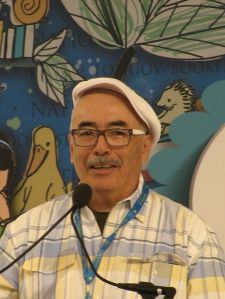
Juan Felipe Herrera (b. 1948), Mexican-American poet and writer, photo by SlowKing under GNUFDL
I posted this a few years ago here and just included it in this month’s issue of The BeZine. I’m re-posting it now because it highlights the quality and character of immigrants to the United States of America, which seems a good thing to do at this time. I’ll post this Sunday’s Poesy later today.
Juan Felipe Herrera is a Mexican-American poet and performance artist, a writer and cartoonist, a teacher and an activist.
“Many poets since the 1960s have dreamed of a new hybrid art, part oral, part written, part English, part something else: an art grounded in ethnic identity, fueled by collective pride, yet irreducibly individual too. Many poets have tried to create such an art: Herrera is one of the first to succeed.” Punk Half Panther by Stephen Burt in the New York Times
Herrara incorporates into his writing his experience of family and the life of the compesinos, migrant farm-workers.
“Into the tilted factories, the smeared taxis,
the stunted universities, into the parlor of bank notes,
in the cramped cookhouse where the dark-skinned
humans still stoop and pitch the daily lettuce bags …”
He sometimes tells stories that arise from what is for him a pivotal moment: the early school experience of trying to fit in though he had no English-language skills. He also writes stories that illustrate the problems of immigration, which often separates families.
In 2012, California Governor, Jerry Brown, named Herrera California Poet Laureate, the first Chicano poet to be so honored.
Many of us – like Juan Felipe Herrara – had fathers or grandfathers who came to the United States to make a better life for themselves and eventually for their children and future generations and who went on to make substantive contributions to this country. Sometimes we like to remember and acknowledge them for their vision, courage and hard work. Today seems like a good day to do so. The video below is charming children’s story, A Tale for Father’s Day, about Herrera’s immigrant father. Enjoy! …
Happy Fathers’ Day to all the dads and to all the moms who, for one reason or other, are both dad and mom.
Thank you for sharing your love of words. Comments will appear after moderation.






 Jamie Dedes' THE POET BY DAY Webzine