Page 67 of 131

Celebrating American She-Poets (15): Sylvia Plath, Listen to the Poet Reading “Ariel”
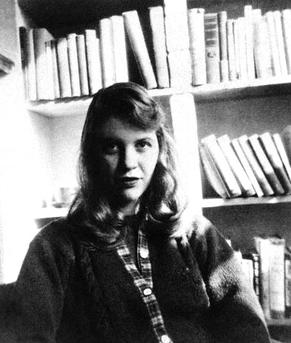
Sylvia_plath

I can never read all the books I want; I can never be all the people I want and live all the lives I want. I can never train myself in all the skills I want. And why do I want? I want to live and feel all the shades, tones and variations of mental and physical experience possible in my life. And I am horribly limited. Sylvia Plath, “The Unabridged Journals of Sylvia Plath

What a find! What a treat to hear some of “Ariel” read by its author.  So this being the soundbite world of the blogosphere, I simply give you a short bio for those who need one and leave you to the poet herself. Enjoy!

“Sylvia Plath (October 27, 1932 – February 11, 1963) was an American poet, novelist, and short-story writer. Born in Boston, Massachusetts, she studied at Smith College and Newnham College at the University of Cambridge, before receiving acclaim as a poet and writer. She was married to fellow poet Ted Hughes from 1956 until they separated in September of 1962. They lived together in the United States and then the United Kingdom, and had two children, Frieda and Nicholas. Plath was clinically depressed for most of her adult life. She died by suicide in 1963.

“Plath is credited with advancing the genre of confessional poetry and is best known for her two published collections, The Colossus and Other Poems, and Ariel. She also wrote The Bell Jar, a semi-autobiographical novel published shortly before her death. In 1982, she won a posthumous Pulitzer Prize for The Collected Poems.’ Wikipedia

“If neurotic is wanting two mutually exclusive things at one and the same time, then I’m neurotic as hell. I’ll be flying back and forth between one mutually exclusive thing and another for the rest of my days.” Sylvia Plath, “The Bell Jar”

CALL FOR SUBMISSIONS – “Books That Changed Our Lives” & “Words Dance”; POETRY EVENT – Literary Aisle, New Dehli

CALLS FOR SUBMISSIONS

Opportunity Knocks

BOOKS THAT CHANGED OUR LIVES The BeZine is open for submissions: one or two paragraphs on a book that changed your life and why. Please include a brief bio. DEADLINE May 12 bardogroup@gmail.com

WORDS DANCE PUBLISHING (I really like this one!) “artfully & carefully wrangles words that were born to dance wildly in the heart-mind matrix. Rich, edgy, raw, emotionally-charged energy balled up & waiting to whip your eyes wild; we rally together words that were written to make your heart go boom right before they slay your mind. We like Poems …” and they invite submissions. DETAILS HERE

EVENT

NEW DELHI, LITERARY AISLE & ARTISTS FOR CAUSE, MAY 15, 5 p.m. – 7 p.m. Anathm Mind Studio

13133326_1889228051303887_7581267397542843053_n

‘Artists for Cause’ at Literary Aisle, present a wonderful literary evening of spoken word poetry. Get ready to be mesmerised by words and verse. The featured poets for the evening are:

1. Dr. Ravi Dhar – A Senior management professional and one who appreciates the beauty of life in its lyrical seasons of action and stillness.

2 Dr Sakshi Chanana*- Founder, Literary Aisle and Poetess- Webs of Light

3. Raghavendra Madhu- Founder, Poetry Couture

4. Hemant Vijh- A Poetry enthusiast and writer.

There are few open mic slots avaialble. Those interested may write to us ASAP. There is a nominal registration fee of Rs 100/ per person and the collected amount would be used for the cause of helping some poor children.

P.S : Stay with us for HIgh Tea post event!

DETAILS HERE

Illustration:© Artists for Cause’ at Literary Aisle, All rights reserved; thanks to  Sakshi Chanana for sharing information. 

Dr Sakshi Chanana is one of the founder members of’ ‘Literary Aisle,’ in Delhi, which promotes a culture of reading and writing. Her poetry anthology is Webs of Light. Her poems have appeared in online journals like Muse India, Kritya, Tajmahal Review and A Few Lines Magazine. She works as an Assistant Professor of English in Delhi. Look for her in the May issue of The BeZine.

My role in society, or any artist or poet’s role, is to try and express what we all feel. Not to tell people how to feel. Not as a preacher, not as a leader, but as a reflection of us all. John Lennon

“FILL THE AIR WITH POEMS so thick even bombs can’t fall through …” (Peter Levitt)

Iraq War
Iraq War

It’s nothing new for poets to write poems against war, to write poems to raise the general consciousness of injustice, to express their pain and to speak truth to power. What is relatively new is the use of technology and social media to make it easy for poets to come together in protest as we see now with 100,000 Poets for Change (100TPC). In 2011, Michael Rothenberg, cofounder of 100TPC, put out a call for poets on Facebook and just five years later we have a huge global movement and a thriving community of poets and other creatives to stand up for peace, social justice and sustainability.

516Z7PHWT6L._SX309_BO1,204,203,200_On the eve of the Iraqi War, poet Sam Hamill received an invitation from Laura Bush to attend a White House literary salon to celebrate the works of Emily Dickinson, Langston Hughes and Walt Whitman. Hamill had just read about President Bush’s plan for the invasion and saturation bombing of Iraq that would kill innumerable civilians, a plan that did not rule out the possibility of using nuclear weapons. Hamill felt he couldn’t sit restrained among politicians and poetic aristocracy. He had to speak out.  He contacted colleagues, asking them to join with him in using this event to make a stand for peace.

Poetry readings were scheduled outside the White House and across the country on February 12, the day the event was scheduled. A website was started to collect and display antiwar poetry. Such prominent poets as Rita Dove, Peter Levitt, Lawrence Ferlinghetti, W.S. Merwin and Adrienne Rich contributed work.  Their poems and many others were collected in a print volume.  Contributions for the webstie continued to flow in for several years. The poems were screened by a team before publication. I contributed two, which were my first anti-war poems. Ultimately I think some 5,000 poems were collected. The poems are now archived in a university library.

We all know that Poets Against the War didn’t stop the invasion. Poet, peace activist and Jesuit priest, Daniel Berrigan wrote, “One is called to live nonviolently, even if the change one works for seems impossible.”  So too are we called to speak truth to power, ignorance and cruelty no matter how hopeless things seem and no matter that we may never see the fruits of our labors in our lifetime. Peace has to start somewhere and it might just as well start with us.

If you are viewing this post from email, you’ll have to click through to the site to see the video.

© 2016, Jamie Dedes; photo montage credit, Futuretrillionaire under CC BY-SA 2.0 license

Do Not Stand by My Grave and Weep

Hanoke Japanese Gardens, Saratoga, California

Do not stand by my grave and weep.
I am not there, I do not sleep.
I am a thousand winds that blow.
I am the diamond’s glint on snow.
I am the sunlight on ripening grain.
I am the gentle autumn’s rain.
When you awaken in the morning’s hush,
I am the swift uplifting rush
Of quiet birds in circled flight.
I am the soft stars that shine at night.
Do not stand at my grave and cry;
I am not there. I did not die.
Mary Elizabeth Frye (1905-2004), Poem 1932

That lovely poem (often wrongly attributed to Native American origin and tradition) reads like a prayer or a hymn. This is not surprising since true prayer and true poetry both come from Sacred Space. It was recited this past Saturday as we celebrated  the inspiring life of a dear friend who left his body shortly before his seventieth birthday and his twenty-fifth wedding anniversary. He was a nature lover and we approprately celebrated his life out-of-doors at the Hanoke Japanese Gardens. Our friend died of chronic leukemia.

Throughout the fifteen years our friend lived with dying, there was nary a complaint. Even in dying he was true to his core value, thinking of – loving – others. Among his last sentiments was the hope – the encouragement – that the lessons we’d take from his life were to live with equanimity and to live hugely, kindly and consciously.

Also read at his Celebration of Life were St. Francis’ Prayer and The Buddhist Metta (Loving Kindness) Sutra (guidance), which was written in  similiar spirit as St. Francis’ Prayer.

Lord, make me an instrument of Your peace;
Where there is hatred, let me sow love;
Where there is injury, pardon;
Where there is doubt, faith;
Where there is despair, hope;
Where there is darkness, light;
And where there is sadness, joy.

O Divine Master,
Grant that I may not so much seek
To be consoled as to console;
To be understood, as to understand;
To be loved, as to love;
For it is in giving that we receive,
It is in pardoning that we are pardoned,
And it is in dying that we are born to Eternal Life.
Amen.

– St. Francis of Assisi


This slideshow requires JavaScript.

Like many of us today, our friend combined the wisdom of several traditions to create a spiritual life that worked well for him. Raised a Catholic he took seriously the injunctions in St. Francis’ Prayer. He also valued the similar life philosophies of oneness, stewardship, non-attachment and respect for silence found in Buddhist scripture and practice and in Native American spirituality. His daily practice was Buddhist for Buddhism is indeed the master of meditative technology.

In memory of B.K.S. xo

May all sentient beings find peace.

If you are viewing this in an email, you will have to link through to the site to enjoy this beautiful and peaceful video with a Metta chant put to music. It’s sung in Pali but offers English subtitles.