Page 83 of 131

“The BeZine” – Table of Contents with Links to Features – Feb. 2016 “All God’s Creatures”

15 February 2016 (The BeZine)

photo 2-2“All God’s Creatures” … and what a menagerie we have, mostly dogs, cats and human beings … okay, a spider, a pig, a frog, a fly and a few birds.

This is a fun issue, though it has its inspirational moments too with the themed lead features by our premier essayists, Michael Watson and Priscilla Galasso; a lesson in detente from our resident cannoness, Terri Stewart; and with characteristic grace, good criter-loving book recommendations and a call for compassion from Corina Ravenscraft. Judith Westerfield is back for a visit with An Amnesty for Daddy Longlegs, a short piece with a double-edge.

Under humor, Mafia Cats (Roger McGough) and The Pig (Roald Dahl) should put smiles on your faces.

For the poetry lovers, there is quite a collection of poems in both the themed section and under “More Light.” Michael Dickel and John Anstie share themed poems.

Core team member, Joseph Hesch, offers two signature pieces – one poem, one flash fiction – and resident skeptic, James R. Cowels, tickles our brains with Life, Death, and the “Establishment Clause.”

Under art, check out Gretchen Del Rio’s beautiful spirit-animal paintings of my grand-kitty, Gypsy Rose.

Aprilia Zand is back – Hooray! – this time with a poem.

New in this issue with impressive bios and even more impressive work: Roger Allen Baut, Ann Bracken, Christi Moon and Judith Black.

You’ll enjoy a couple of true adventures in the Storytelling section with Judith Black in Turkey. She’s a funny lady.

Under best practices learn how Zena Hagerty and fellow artists turned the James Street area of Hamilton, Ontario from a rough neighborhood into an arts enclave where art crawls are held regularly, pulling the community together.

The featured interviews this month are Sharon Frye, Matt Pasca, Michael Dickel and Charlie Martin. All the interviews offer value added by virtue of vision and wisdom.

Many thanks to Michael Dickel for introducing Ann Bracken and Matt Pasca, to Naomi Baltuck for introducing Judith Black, and to Native American Girl for the music selection.

Enjoy! Let us know what you think in the comments section and with your likes. Thanks for joining with us in the celebration of life, love and art.

In the spirit of peace and community,
Jamie Dedes
Managing Editor
photo 3-2

THEME: ALL GOD’S CHILDREN

Lead Features

At the Bird Feeder, Michael Watson
All that Matters, Priscilla Galasso
Reflections on Snowy Owl and Raven, Terri Stewart
Animal Stories, Corina Ravenscraft
Campaigning for Compassion, Corina Ravenscraft
Giving Amnesty to Daddy Longlegs, Judith Westerfield

Humor

Mafia Cats, Roger McGough
The Pig, Roald Dahl
Cat v Comma, Grammerly

Poetry

A Dog’s Life, John Anstie
Snow Dog, John Anstie
Frog, Michael Dickel
Fancy Flight, Michael Dickel
Reading the Signs, Aprilia Zank

Art

The Several Faces of Gypsy Rose, art/Gretchen Del Rio, words/Jamie Dedes

MORE LIGHT

Special Feature/Best Practice

How One City’s Artists Transformed a “Rough’ Neighborhood into an Arts Enclave, Zena Hagerty

Storytelling

Welcome to Istanbul, Not Constantinople, Judith Black
Stray Dogs and Shtreimels: What Does Istanbul and Mea Shearim Have in Common?, Judith Black

Poetry

Ghost Dance, Roger Allen Baut
The Code, Ann Bracken
Transformation, Joseph Hesch
Musicman, Christi Moon
Dandelions, Christi Moon
Nyctalopia, Christi Moon

Flash Fiction

Kansas Pacific, Joseph Hesch

Essay

Life, Death, and the “Establishment Clause”, James R. Cowles

Music

Red Shift Blues, The Sweet Lowdown
Chickens Under the Washtub and Western Country, The Sweet Lowdown

Getting to Know You

Interview with Sharon Gariepy Frye, a.k.a. Sharon Frye
Interview with Matt Pasca
Educating the Teacher: Poet to Poet, Ann Bracken and Michael Dickel
Charles W. Martin and the Ever-loveable Aunt Bea

photo-1-2Connect with us …

Beguine Again, Spirtual Community and Practice

Facebook, The Bardo Group Beguines

Twitter, The Bardo Group Beguines

© 2015, photographs, Jamie Dedes, All rights reserved


Natasha Head: “Nothing Left to Loose” & “Pulse”

Natasha Head, Poet & Writer, Nova Scotia
Natasha Head

Canadian poet Natasha Head (The Tashtoo Parlour and, along with Roger Allen Baut, The Creative Nexus™) is the author of three poetry collections.


This slideshow requires JavaScript.

Natasha says she …

“has been weaving words since I was but a wee lass running with crayons and scribblers …”

… and she continues with her poems online along with Running With Crayons, her whimsical art

Natasha’s debut poetry collection was Nothing Left to Loose (Winter Goose Publishing, 2012)  It was a Pushcart Prize nominee. A year later – almost to the day – Pulse (Winter Goose Publishing, 2013) was launched, the second of her three collections. Natasha’s third collection is Birthing Inadequacy (Lulu, 2014).

Nothing Left to Lose is a collection of self-contained poems that tell the author’s personal story of everyday difficulties, disillusionment, and disappointment to which we can all relate. Ultimately it is about trial and transformation, which is the essential theme of both books.

Trapped between what was, what
is …no movement; fear
holds me motionless.

All directions equal no choice, as
fear gives way to chaos …
enslavement.

What needs to be done, I
don’t want to do, my thoughts
constant, my nightmares

real, feeling force, breaking
pressure, resisting to the point
of stagnation

Static, Natasha Head in Nothing Left to Lose

Pulse is a short epic, a narrative stream of poems that together form a modern-day odyssey of a family caught in a web of prostitution and abandonment, alcohol and drugs, delusion and deceit. When the worst happens to the young woman who is central to the story she is wrapped in silence … at first unchosen and then embraced … In this silence appears the potential for her to reinvent herself. She is being tested. Will she answer the call to transformation?

Pulse is a dramatic fiction, but I didn’t find it melodramatic or manipulative, which it could have been in hands less skilled than Natasha’s. The poems here are lucid and direct. The language is plain and mostly understated, interesting in its relative coolness juxtaposed against the girl’s grit as it unfolds.

There is nothing worse
than waiting in the dark,
no distraction,
alone.
Mother trying her best
and she
ducked low
in the furthest corner
of a forgotten closet
where she was safe to shine the flashlight
on ancient magazines
and little golden books
where she would realize
there was no such thing as fairy tales,
and princes never stayed.”

Sal, Natasha Head in Pulse

© 2016, review, Jamie Dedes, All rights reservedportrait, cover art, and poems, Natasha Head/Winter Goose Publishing, all rights reserved ~ used here with permission

it was the golden light

IMG_3096i awoke
it was the golden light
the moon camping out
casting my room
in the glow of its fire

i thought
for a moment
unsure of my place
forgetting
what city
what state
what day

seconds pass
soundless

slowly peeling away
the veil, the confusion
i melt into
the golden light
breathe myself
into sleep again
done

and done
as easily perhaps
as breathing into
eternal sleep
so frail and fragile
is this anchor
this silver thread
this castle of solitude
this just me
inside me
inside life

© 2013, poem and illustration, Jamie Dedes, All rights reserved

Celebrating American She-Poets (4): Pearl Buck “Words of Love”

I give you the books I’ve made,
Body and soul, bled and flayed.
Yet the essence they contain
In one poem is made plain,
In one poem is made clear:
On this earth, through far or near,
Without love there’s only fear.

Essence by Pearl Buck, novelist and humanitarian

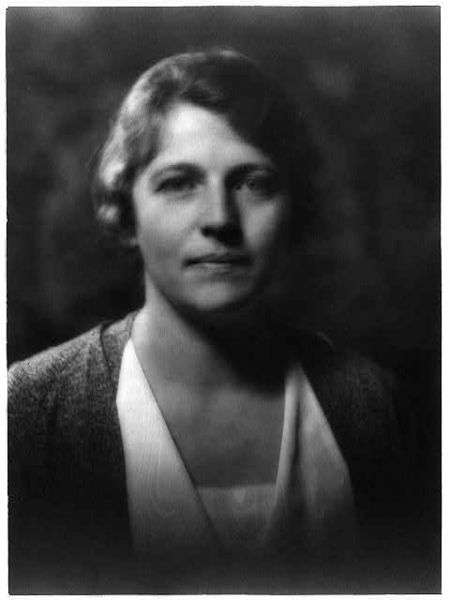
No one will think first of poetry when they think of Pearl Buck. She was primarily a novelist and memoirist. She did write poetry though and one collection was published. I consider her a sort of spiritual mother and so include her early in this ongoing Thursday series: Celebrating American She-Poets.

Pearl S. Buck (1892-1973) was born in Virginia, the daughter of Presbyterian missionaries. She grew up in China and spoke Chinese before she spoke English. Her Chinese name was Sai Zhenzhu.

Pearl Buck was a prolific writer of novels and memoir who started publishing her stories and essays in the 1920s in popular periodicals of the day: The Nation, The Chinese Recorder, Asia, and The Atlantic Monthly. Her first novel was East Wind, West Wind (John Day Company, 1930).

Of her novels, The Good Earth is the best known. It won the Pulitzer in 1932. The focus of most of her writing was China and the Chinese. When Chinese-American author Anchee Min wrote Pearl of Chinaa fictionalized account of Pearl Buck’s life, she said that she was touched by the warmth and understanding with which Ms. Buck had written about Chinese peasants and their lives.

Pearl Buck was awarded the Nobel Prize for Literature in 1938.

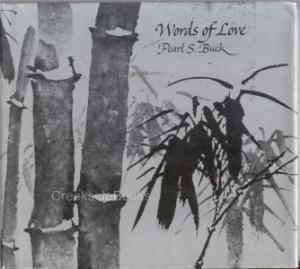
To my knowledge, there is only one small book of her poems. The collection is titled Words of Love. It is simply illustrated with Asian art by Jeanyee Wong and was published a year after Ms. Buck’s death by the John Day Company, the publishing firm run by Pearl Buck’s second husband, Richard Walsh.

I found a copy of Words of Love in a used-book store some years ago. The poem quoted above is an excerpt. In brief, eloquent, deft strokes, Ms. Buck’s poems do indeed express the themes of her novels. I can’t help but wonder whether there might be more of her poetry stored in some university archive awaiting discovery by an ambitious student or devoted biographer.

Dust-jacket, Words of Love by Pearl S. Buck.

© 2016,  Jamie Dedes, All rights reserved; illustrations are in the public domain