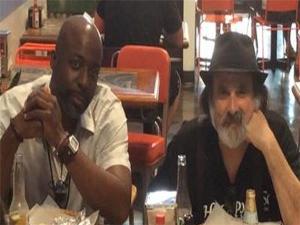
You can listen to the two-hour podcast HERE. Recommended! This post is meant as an alert and also to share my two cents.
As I write, it’s just a few hours after listening to Just My Thoughts with Graffiti Bleu on BlogTalk Radio. The show started with an exploration of What does the revolution look like? with Graffiti Blue, Michael Rothenberg, and the show’s panel and callers comprised of poets involved in 100,000 Poets for Change (100TPC).
Harkening back to Gil Scott-Heron and his poem, The Revolution Will Not Be Televised, part of the discussion was on technology and social networking and their roles in fostering peace, social justice and sustainability. When Heron wrote his poem in 1971, the means to formulate and distribute information and opinion were dominated by mainstream media and corporate interest, which were not in sympathy with the revolution Heron envisioned. Those interests are still dominant and still lack sympathy, but there’s something of a balance occurring – however imperfect – now that we plain folk have access to the tools of technology and social networking. Without social networking, we wouldn’t have 100TPC, which can happily be said to have gone viral since Michael Rothenberg put out a call on Facebook for poets to join in a global peace effort back in 2010. While each of us in the “100,000” has a relatively small “audience” together we touch many, many minds and hearts. We do have an agenda, but it doesn’t foment strife. We’re not in anyone’s pocket. That’s clean power. It’s power to …
On a personal level, one benefit of technology is that people who are homebound – as I sometimes am – can take part in change-making initiatives more actively than simply writing letters-to-the-editor or to our legislators, which is not to say we should give that up. I started a virtual 100TPC via The BeZine and with The Bardo Group Beguines so that disabled people and people who do not live near a 100TPC event would have the opportunity to have their say, to lend their support. Our 2015 commemorative page is HERE.
We need to do more than “talk.” Agreed. And I think that one of things 100TPC gives us is hope … huge hope from seeing that there are people in every nook-and-cranny of the world who share our values and priorities. This helps us to keep on keeping on with our local grassroots initiatives as well as our broader advocacy. This serves to sustain our faith and commitment.
Ultimately for me, 100TPC is about breaking down barriers, crossing boarders. It leads the way in our evolutionary journey toward a sustainable peace. In the documentary film Ten Questions for the Dalai Lama, the Dalai Lama says “we need more festivals.” In other words, if we get to know people, if we break bread with them or share a bowl of rice, we are less likely to think of them as “other.” It will be more difficult to turn around the next day and do harm. 100TPC is our festival. Once we’ve shared hearts, souls and stories through poetry, how can we marginalize anyone? How can we abandon or abuse?
Can the revolution be bloodless? The question is really “will it be?” I don’t think so. I don’t think revolutions are by their very nature “bloodless.” The psychopaths will always be with us and until we stop marginalizing people and leaving them desperate and vulnerable to tyrants, we’ll never have bloodless reform. We’ll never achieve a sustainable peace. Peace is a state that takes awareness and awareness takes growth, which is an evolutionary process. That doesn’t mean we should give up. It means that as poets we should continue to bear witness, to touch hearts, to raise consciousness and to nurture the process of growth. As poet Michael Dickel said in an interview on this site HERE: “. . . it may not be ours to see the work completed, but that does not free us from the responsibility to do the work.”
© 2016, words, Jamie Dedes, All rights reserved; photograph courtesy of Graffiti Bleu and Michael Rothenberg.
Thank you for sharing your love of words. Comments will appear after moderation.


 by Rev. Ben Meyers,
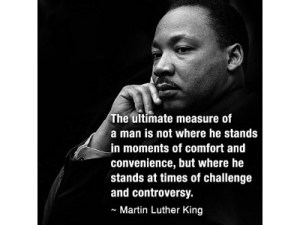
  As we celebrate Martin Luther King, Jr.’s birth today, let this be a time when, along with paying our respects to the memory of King’s life and his historic legacy, we raise our consciences from our “moments of comfort and convenience” and ask ourselves in ways never before, “Where are we standing among the current challenges and controversies that yet plague our communities, thwarting our dreams of equality and shredding the network of mutuality of which Dr. King spoke so eloquently?” It is time to know where, or even if, we stand for justice and equity and peace.
 Jabberwocky


 Jamie Dedes' THE POET BY DAY Webzine