Page 95 of 131

What have we done that people can pick up weapons and kill?

Dan and I as kids and probably the last time he was shorter than I. He stands 6'5' and I stand 5'2".
Dan and me as kids and probably the last time he was shorter than I am. He stands 6’5″ and I am 5’2″.

With all its faults – and there are many – Facebook can be a blessing. I haven’t seen my cousin Dan in almost forty years. I lost track of him, but was much delighted to find him again on Facebook last March. 

Dan and I were raised in the United States, but our family was from Lebanon. Our mothers were sisters. Our religious roots are Melchite (our grandfather’s side) and Maronite (our grandmother’s side).

My mother, Zabaida, used to tell me that in Lebanon first cousins were like brothers and sisters. Among other things this was one way she tried to understand what people meant when they talked or wrote about Jesus having brothers. I understood it as my relationship to my cousins, especially cousins Daniel and Christopher, who were brothers (Christopher died prematurely) and my most beloved relatives.  Though we haven’t seen one another in forever and we’ve walked different paths in life,  I suspect our basic values remain the same: peace, love (respect) for others and for life, and appreciation of life’s gifts. Dan has worked in many places around the world, including Algeria and Dubai. Currently he teaches Theology in the Philippines. This essay is Dan’s.

*****

What Have We Done That People Can Pick Up Weapons and Kill?

by

Fr. Daniel S. Sormani, C.S. Sp.
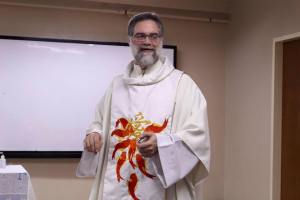
DANIEL S. SORMANI C.S. Sp.

It was one of those things you think but don’t want to say. In the horror of the carnage in Paris and the world’s reaction, it struck me how very little had been said about the terrorist attack in Beirut the day before…or the attack on a funeral in Baghdad…or so much of the other violence that shakes the world. And I felt like I couldn’t say it for fear of looking like I was somehow diminishing the horror or pain of Paris, afraid it could been seen as a lack of respect and understanding. But I wondered. And now so many people are indeed raising such questions, and others are also reacting to such questions, calling them an appalling lack of sympathy…and things have at times spiraled down to a repulsive debate of numbers and geography, rather than of lives and humanity.

When I was young, it was the last hurrah of Lebanon’s golden era when people still referred to it as the “Switzerland of the East” and the wealthy went there to bask on the beach in the morning and ski on its snow-capped mountains in the afternoon. It was the land of poets and artists, and welcomed refugees and visitors equally.

I remember all the Lebanese women with my mother at fundraisers for the Palestinian refugees. We were all kinds of Christians, Muslims, Druze and even a lone family of Lebanese-Jews who ran a shop in our neighborhood. We were just “us”, the Lebanese diaspora, the children of the Phoenicians. And if you were Syrian or Egyptian, that didn’t matter, then we simply enlarged our self-definition to being Middle Easterners. And if you were anything else, then we were “the melting pot” and loved to learn from you.

But so much interference in the internal workings of the country, so much pushing and shoving, dangling of carrots by different powers and religious groups, and finally civil war exploded in Lebanon. What we had known suddenly disappeared. There were a myriad of political parties I couldn’t keep up with, weekly fundraisers for dozens of necessary causes, a flood of refugees, some legal, some not. It should have brought us together, made us one in the struggle for peace and justice. But it didn’t.

I remember vividly the look of joy on the face of complete strangers if they heard my family speak a bit of Arabic. There would be warm introductions and everyone wanted to know everyone. Suddenly it was different. I would say something in Arabic, and the other person would immediately ask “Muslim?” I remember once in my old neighborhood I went into an Arabic music store and was taken by the album playing. Great music, but the dialect threw me a bit. I cheerfully greeted the young man behind the counter with a wish for a morning filled with goodness. He gave me an annoyed look and pointed to the veiled young woman. When he walked away the woman leaned over and whispered in Arabic, “Don’t mind my brother. It’s clear from the way you greeted him that you’re not Muslim.”

I remember in Algeria when I used the traditional Muslim greeting of peace in the market place and the stall-keeper rudely told me I had no right to say such a thing because he knew I wasn’t Muslim. To my delight, an elderly gentleman in traditional dress got angry and shouted at him, “And what should he do, wish you war and trouble instead?” He went on to greet me with great poetry and many warm blessings. Touched, I kissed him the way one kisses his favorite uncle and a few of the women, all wrapped in the white haiks of western Algeria, applauded and blessed God. This, I thought, is what family is, this is how we will conquer the darkness.

We have become our own worst enemy. Whenever we separate the world into “them” and “us”, whenever we accept blind generalizations and cease to see a unique individual before us, whenever we forget we are all victims of carefully orchestrated deceit and deception for wealth and power, the force of darkness wins. Bullets will never win this struggle, only the heart and mind will.I know political scientists and analysts can tear my thoughts to shreds. I do not claim an intellectual understanding…I am only sharing a broken heart that grieves.

A young Melchite priest once told me a story from his village in Lebanon during the war. There was intense shelling and sniper fire for almost three days. After it stopped, people went out to gather up the dead. An old man went to the church and asked the priest to offer two masses. The priest took his pen and book and asked the man to continue. The first mass, he said, was for his son whom they found shot to death in the orchard by their house. And the second mass was for the person who shot him. Startled, the young priest looked at the old man with amazement. The old man explained the obvious saying “What have we done that people can pick up weapons and kill strangers? What have we done that some poor fellow can kill my son without feeling it? We must pray for him, and ask God’s forgiveness.” When I remember that story, after all these years, I still cry.

© 2015, essay and family photographs, Daniel S. Sormani C.S. Sp., All rights reserved

This slideshow requires JavaScript.

The BeZine, Nov. 2015, Vol. 2, Issue 1, “At-risk Youth,” Table of Contents with Links

15 November 2015

paint-prints-of-youths-handsWelcome to our first issue that is focusing on at-risk youth. Our mission today in our topical section is to share stories and poems that cause us to think about youth in a different way. Who are at-risk youth? Where are they?

Often, they seem invisible to the world until they are splashed across the news in dramatic headlines. We can all remember the photos of dead children washing up on the seashore…refugees fleeing Syria. And in the US, just a few days ago, a young boy, age 8, killed a 1 year old. Why? Because he was the babysitter in charge and she would not stop crying. I am often appalled at the reactions we have to children with extreme behaviors. What skills do we expect an 8 year old to have?

Sigh.

And so, we, at The Bardo Group, have written of the children of the world that are marginalized and at-risk for a wide range of disasters. This is a special topic for me. I run the Youth Chaplaincy Coalition which provides chaplaincy and mentoring to incarcerated youth. I have included three pieces in this edition that are close to my heart. One, Eli, Eli, lama sabachthani. This poem is the first one I wrote in reaction to the stories I heard in detention. I wanted to put the parents, and God, on trial. And so I did. I wasn’t happy with the answer I received! And yet, it gave me so much hope. The second piece, an essay titled Mentoring At-Risk Youth, tells you a little more directly about who I am and what I do. Last, is the poem, A True Story. You may guess that it is a true event and you would be correct! It happened this year and it made me very angry.

St. Augustine says, ““Hope has two beautiful daughters – their names are anger and courage; anger at the way things are, and courage to see that they do not remain the way they are.”

Hope, anger and courage have driven me to move through the pain and challenge of working with these particular youth.

A small collection from people I work with that all explore what it is like to work with incarcerated youth. They are all new to the BeZine so let’s give them a resounding welcome! Justin Almeida offers an essay, Finding Life in Detention. Lisa Ashley, MDIV, has a poem, at risk youth, that names what is really at risk when you work with youth in detention—your heart is at risk!  And Natasha Burrowes drops the mic in Untitled.

Closely related to Natasha’s discussion of who is really at risk is Charles Martin’s, at risk… It is a great question. Who is really at risk when we allow our children to be the victims of poverty, crime, and other forces? Is it really just the child? Or is there something larger?

Incarcerated youth, across the board, have increased rates of trauma when compared to other youth. The ACES test (Adverse Childhood Experiences) scores incarcerated youth as having a 92 out of 100. I think I would be a bowl of jello if I had that high of a trauma score. Christina Conroy explores living through a traumatic childhood in her autobiographical poem, Legacy. Also writing autobiographically is Kimberly Wilhelmina Floria in Validating Myself. It made my heart grow two more sizes! Also cracking my heart is Jamie Dedes’ Heading Home autobiographical poem regarding suicide. Sometimes, I wish I knew what that special something is that manages to give children resiliency. Heart breaking. Or I wish I had a magic wand that would right the world’s wrongs.

Also writing from experience is Trace Lara Hentz’s essay, Angel Turned Inside. Lara was introduced to us by Team Member Michael Watson and is new to these pages. Her essay explores the tragedy that was the movement westward in the US and the use of adoption as a weapon against American Indians and First Nations. I am aware of this tragic history because of my knowledge of church history which is horrifyingly replete with church support of taking children from their families and putting them into orphanages.

Knife Notes—a Poem, from Michael Dickel, explores the relationship between the past and the future for Joe. I am especially moved by the truthful reflection of how kids who are hurting treat each other.

“It is the paramount duty of the state to make ample provision for the education of all children residing within its borders, without distinction or preference on account of race, color, caste, or sex.” That is a quote from Washington state’s constitution. Unfortunately, we simply fail our children. John Antsie’s article, Education, Common Sense … and The Future, explores two simple things regarding education-one thing to change and one thing to hope for.

One thing that the youth I work with almost unanimously face is addiction issues. Jamie Dedespiece, scag dancing, explores in vivid, concise imagery the relationship between addiction and poverty.

With “Thinking Continually of Those at Risk,” by Priscilla Galasso, you will be surprised at where she starts and where she finishes! She speaks a truth that resonates, “We can so easily provide food, shelter, and opportunity to our youth with the systems we have devised, but those systems have become mine fields where kids are sabotaged on the journey.”

Sometimes we attempt to sabotage journeys with needless judgment regarding what makes a real parent. John Nooney explores his experience of adoption and the sometimes senseless absorption of people asking, “Have you found your birth-mother?” in his essay, Some Thoughts on Adoption.

In my research of how to interrupt the school to prison pipeline, I have found two interesting statistics. One, children who miss 24+ days of Pre-K or Kindergarten are more likely to become incarcerated. And two, children who personally own five books of their own have better life outcomes than those who do not. I have also recently run across an article pointing towards the importance of librarians in achievement for children. Corina Ravenscraft points out the importance of libraries in These Hallowed Halls of Hope.” Libraries are, indeed, an oasis of peace in a concrete jungle.

One thing is trite but true, it does indeed, take a village to raise our children.

Thank you for moving through my rambling reflections with me. I hope that your heart is moved to consider how we support and work with those who are at-risk.

Shalom & Amen!
Terri Stewart

Theme: At-Risk Youth

Lead Features

Eli Eli Lama Sabachthani, Terri Stewart
Untitled, Natasha Burrowes
Validating Myself, Kimberly Wilhelmina Floria
at risk, Charles W. Martin

Poetry

Legacy, Christina Conroy
At-risk Youth, Lisa Ashley, MDIV
A True Story, Terri Stewart
Heading Home, Jamie Dedes
Knife Notes—a poem, Michael Dickel
scag dancing, Jamie Dedes

Essays/Features

Mentoring At-Risk Youth, Terri Stewart
Finding Life in Detention, Justin Almeida
Education, Common Sense … and The Future, John Antsie
These Hallowed Halls of Hope, Corina Ravenscraft
Thinking Continually of Those at Risk, Priscilla Galasso
A Teenager Who Fled Syria, NPR and World Vision
Rapid Re-Housing Best Available Crisis Intervention for Homeless Families and Youth, National Alliance to End Homelessness

Special Features: Adoption

November is National Adoption Month in the United States

Some Thoughts on Adoption and “real” parents v adoptive parents, John Nooney
Angel Turned Inside, The Fight for Native American Families, Trace Lara Hentz

General Interest

Poetry

How Can I Justify My Life If I Do Not Justify His Own?, K. A. Bryce
Second Light Network Celebrating Anthologies of Women Poets, Jamie Dedes

Photo Essay

Some Early Seasonal Cheer, Corina Ravenscraft

Photo Story

The Secret Object I Keep Hidden in My Underwear Drawer, Naomi Baltick

Essays

Deportment for the Soul, Sue Vincent

paint-prints-of-youths-hands

BIOS WITH LINKS TO OTHER WORKS BY OUR CORE TEAM AND GUEST WRITERS

FOR UPDATES AND INSPIRATION “LIKE” OUR FACEBOOK PAGE, THE BARDO GROUP/BEGUINE AGAIN

MISSION STATEMENT

Back Issues Archive
October/November 2014, First Issue
December 2014, Preparation
January 2015, The Divine Feminine
February 2015, Abundance/Lack of Abundance
March 2015, Renewal
April 2015, interNational Poetry Month
May 2015, Storytelling
June 2015, Diversity
July 2015, Imagination and the Critical Spirit
August 2015, Music
September 2015, Poverty (100TPC)
100,000 Poets for Change, 2015 Event
October 2015, Visual Arts (First Anniversary Issue)

Non-state Terror Attacks, January 1, 2013 – November 14, 2015

Note: I didn’t pull this piece together.  It was created by Michael Dickel and is posted here with his permission.  Michael’s most recent poetry collection, the chapbook War Surrounds Us (Is a Rose Press, 2015), is a moving collection, a cry for peace as is this feature.  My piece, The Poet As Witness: “War Surrounds Us,” an interview with American-Israeli Poet Michael Dickel, is HERE. J.D.

Using a Wikipedia list, even with all of its faults, provides a sobering view of terror in the world. The countries listed below were the sites of at least one and often several terror attacks in the last (almost) three years. Some of those attacks resulted only in injuries, most caused one or more death—victims and / or perpetrators. Many attacks killed dozens of people. A few, one-hundred or more. Not all of the perpetrators are from Islamic groups—many come from other “political, religious, or ideological” motivations. According to the Wikipedia site, the list of attacks that I used to find the countries:

…is a list of non-state terrorist incidents that have not been carried out by a state or its forces (see state terrorism and state-sponsored terrorism). Assassinations are listed at List of assassinated people.

Definitions of terrorism vary, so incidents listed here are restricted to those that:

              • are not approved by the legitimate authority of a recognized state
              • are illegally perpetrated against people or property
              • are done to further political, religious, or ideological objectives

Comments on the Wikipedia listing indicate that it is incomplete and may be biased. Still, I found 56 countries on the list for the three years I looked at, and I remembered the larger attacks from news reports. If it is incomplete, there could be more countries. If it is biased, there could be other countries, as well.

This list should give us all pause—not only for our world, but for the children growing up exposed to this global level of war. This is their normal world. They are at risk on so many levels. As adults, we must stop and remember the children. And we must find just solutions to the underlying causes of this violence that literally reaches every corner of the earth. 

In memoriam a black rectangle vertical next to the list of countries
In Memoriam

Non-State Terror Attacks:
Jan 1, 
2013–Nov 14, 2015

  1. Afghanistan
  2. Algeria
  3. Australia
  4. Bahrain
  5. Bangladesh
  6. Belgium
  7. Bosnia and Herzegovina
  8. Cameroon
  9. Canada
  10. Central African Republic
  11. Chad
  12. China
  13. Columbia
  14. Denmark
  15. Djibouti
  16. Egypt
  17. Ethiopia
  18. France
  19. Germany
  20. India
  21. Indonesia
  22. Iraq
  23. Israel
  24. Italy
  25. Japan
  26. Kenya
  27. Kosovo
  28. Kuwait
  29. Lebanon
  30. Libya
  31. Macedonia
  32. Madagascar
  33. Malaysia
  34. Mali
  35. Mozambique
  36. Niger
  37. Nigeria
  38. Norway
  39. Northern Ireland
  40. Pakistan
  41. Philippines
  42. Russia
  43. Saudi Arabia
  44. Somalia
  45. South Korea
  46. South Sudan
  47. Syria
  48. Tanzania
  49. Thailand
  50. Tunisia
  51. Tunisia
  52. Turkey
  53. Ukraine
  54. United Kingdom
  55. United States
  56. Yemen

Source

From Americans Against Islamaphobia
http://on.fb.me/1kVA7zP

Second Light Network of Women Poets: Celebrating Anthologies of Women’s Poetry

They thought death was worth it, but I Have a self to recover, a queen. Is she dead, is she sleeping? Where has she been, With her lion-red body, her wings of glass?

They thought death was worth it, but I
Have a self to recover, a queen
Is she dead, is she sleeping?
Where has she been,
With her lion-red body, her wings of glass?
excerpt from “Stings” by Sylvia Plath

*** ANTHOLOGY “HER WINGS OF GLASS” ***
 
“I’m completely wowed … the most important anthology for decades,” John Killick
 
“tremendously inspiring,” Moniza Alvi  

“an amazing anthology,” Pauline Stainer
 
“It’s a magnificent anthology (and I’m not just saying this because my mother’s face peers at me from the cover!),” Adam Horovitz
 
“I’m impressed,” Anne Stevenson

Second Light Network of Women Poets (SLN) does many wonderful things for women poets of a certain age, but among the loveliest is the production of poetry anthologies. SLN’s latest anthology is Her Wings of Glass, the title taken from Sylvia Plath’s poem Stings in which she uses the life in the hive as metaphor for her own life and feelings.

When we consider all the elements of an apiary with its oddly flipped sexual structure, the momentary life of the parthenogenic queen juxtaposed against the leisurely life of drifting drones, we appreciate the brilliance of Plath’s using the apiary as an allegory for her relationship with her husband and her conflicted feelings about domesticity and motherhood.  The bee community makes for an apt illustration of Plath’s poetic self (queen), her domestic self (drudge), her distaste for other women willing to be drudges, to sacrifice themselves.  The poem is intensely personal, has elements of tenderness but ends fiercely. (FYI: You can view photographs of Plath’s worksheets HERE.)

It’s easy to appreciate just why the women of the ’60s were so enamored of Sylvia Plath, why she is still appreciated for both her observations and her craft.  It’s also easy to understand why a reference to Plath’s work would make such a good title for a collection of poetry by contemporary women poets. The anthology, like the poets, poetry and the work in ARTEMISpoetry (biannual magazine) represent a cross-section of A-list poets and a range of themes, subjects and styles.

ARTEMISpoetry, Issue 14
Issue 14

There’s a good piece by Anne Stewart on Her Wings of Glass in the May 2015 issue of ARTEMISpoetry, which focuses on anthologies. Due to the very nature of SLN, many are the poets and poems that might be overlooked by other press as not in line with mainstream literary standard. I deem this an advantage indeed and wish more publishers would take note.

Petronella Gives a Reading c Kate Folley
Petronella Gives a Reading (c) Kate Foley

In addition to celebrating poetry anthologies, the current issue also featured Alison Brackenbury, the award-winning author of eight collections, and Jemma Borg in an interesting piece by Kay Syrad: The Illuminated World, A Dialogue Between Science and Poetry.   Jemma studied evolutionary genetics and worked as a tech editor among other jobs. She stands at the intersection of science and poetry.

“I tend now to think of science and poetry in some kind opposition because they are such different systems of thought in terms of the philosophical roots and development, but essentially it is this love of what is unknown that is common to both and which forms my motivation as an individual: how can we, and indeed is it possible to, understand this world we are embedded in.”

Susan Wicks selected the poetry shared  in this issue, which included these two:

Gift from my Daughter

A pink bag with lime-green flowers
in silk floated
like a lotus as she carried it
down the ward.

We fizzed with giggles over
the contents,
cream laced with sandalwood
and lavender,
lip-salve with lemon,
little bottles steeped in mint
and nutmeg,
a Morpheus spray
to enchant the pillow with sleep.

Outside, the weather slashed its tail
of water-scales
and hail,
and we unpacked the orient,
distilled these gardens from the east.

Isobel Thrilling

Where lies the blame?

Things in their quiet think no harm,
light probes, passes, leaves unmoved
knife, whip, Kalashnikov.

Stone voices grate, shingle shifts,
things in unquiet hands drip blood
the birds no longer sing.

Shadows touch, move on, abandon
farmhouse, barn and empty field
the bees have gone.

Jenna Plewes

The homage to Anne Cluysenaar in this issue was warm and appreciative and the thoughts of several poets who knew her were included. I find this sort of acknowledgement and loyalty touching and asked for permission to include Alison Mace’s poem in this blog post. Alison said that we need to read Anne’s Diary Poems to fully appreciate her poem, but I took it at face value and warmed to it, though I haven’t read Touching Distances: Diary Poems.  I like Alison’s poem for the gentle way it shows how one poet and her work and life were valued.

from LIVES OF THE POETS
ANNE CLUYSENAAR 1936-2014

Alison Mace writes: Since Anne Cluysenaar’s appalling and untimely death, I have meant to write about her, a poem if possible. Anne came, when she could, to our monthly NaCOT poetry-writing group at William and Juliet Ayot’s house near Chepstow. We were so lucky to have her. Her contributions were memorable and heart-warming, both of her own work – several of the Diary Poems that became Touching Distances – and in the help she gave the rest of us with our own poems.

.
Anne

‘Wise’ comes first to mind,
then ‘kind’,
and then so many more.
Heartsore,
we count the ways she was:
capable, nurturing,
loving her cob, her cat,
at home with hens and hay,
Mozart and Henry Vaughan;
happy to teach, to learn –
learned indeed – at ease
combining earth with wit,
abstruse with everyday –
and ours: muse, mentor, friend,
bringing her poetry
for us, wanting our own:
probing, encouraging –
all with her gentle smile.

And so it shatters sense
that such a life should end
with terror, suddenness
and wanton violence –
a bleak atrocity.
The distance we would touch
that our intensest thoughts
might wing to her
has widened beyond reach,
leaving us at a loss,
empty, and blank, and still
heartsore.

– Alison Mace

So, another altogether enjoyable read. Another issue to return to with pleasure.

All things SLN may be found HERE including gatherings and classes, remote – or as we in the U.S. would say “distance” – classes, coaching, contests, books, magazine, samplings of poetry and introductions to poets.  Much appreciation to SLN Founder Dilys Wood and to Myra Schneider and Anne Stewart and all the other women for their work, their poetry, and their commitment to women and poetry. Second Light Network of Women Poets is based in London and most of the members are in the UK, but membership is not geographically restricted. Of note: Anne Stewart has a site – poetry p f – which makes it easy to pay membership fees and to order books, ARTEMISpoetry, poem cards and other goodies.

Congratulations to Myra Schneider: Goulash from her collection Circling the Core (Enitharmon Press, 2008) was recently featured on Anthony Wilson‘s Famous Lifesaving Poems. We’ve featured it in The BeZine and are all fans.  Bravo, Myra! Here it is on the Lifesaving Poems site. Contact Myra for Circling the Core and other books.

Poems, cartoon, cover art are published here with permission of the publishers and authors.

© 2015, article, Jamie Dedes, All rights reserved; cover art, Second Light Live; poems and cartoon as indicated above.