Time To Use Your Writing Skills to Advocate for Feeding the Hungry
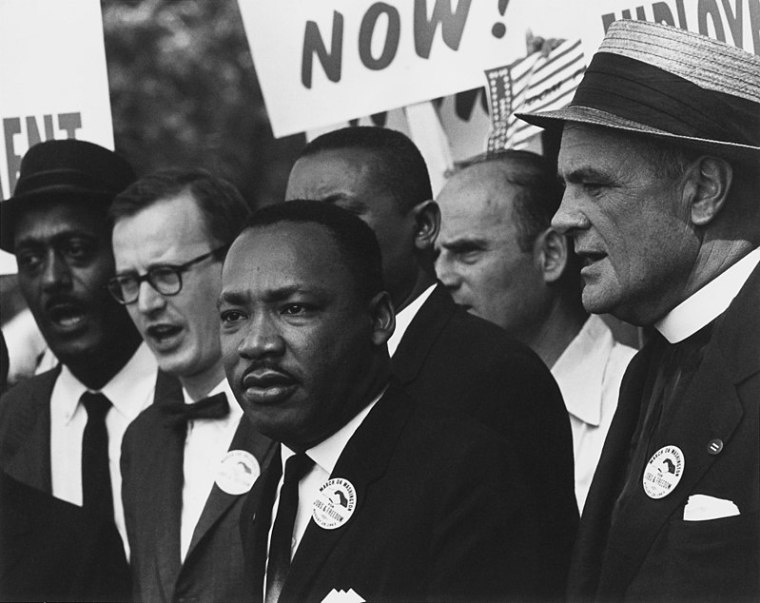
Martin Luther King (center), one of many 20th century political figures who considered it important to fight hunger: “When I die, don’t build a monument to me. Don’t bestow me degrees from great universities. Just clothe the naked. Say that I tried to house the homeless. Let people say that I tried to feed the hungry. / Public Domain Photograph

*

“There are people in the world so hungry, that God cannot appear to them except in the form of bread.”  Mahatma Gandhi

“For I was hungered, and ye gave me meat: I was thirsty, and ye gave me drink: I was a stranger, and ye took me in . . . Matthew 


For several reasons, I’m not particularly a fan of dairy products; however, just like  you, I’m sure, I am appalled to read about the dairy and produce that is being destroyed during the pandemic because it can no longer be delivered to restaurants, hotels, and schools. Destroyed! – while people go hungry in the U.S. and around the world.  

I do recognize that supply chains are a challenge and the packaging for consumer consumption requires different factory production operations and equipment from  those used for commercial distribution. Nonetheless, this issue is not insurmountable. Apparently Publix has done the job with milk and produce in its region. We need more to step forward and address this unconscionable situation throughout the United States.

If we have time – and in lockdown, I’m sure we do, it would be a good thing to use our writing skills to advocate conscientious distribution of food via letters to the editor, letters to legislations (national, regional, and local), letters to corporate farming, local family farms, and food production companies. Now would be the perfect time to publish blog posts and to write feature articles, creative nonfiction, and poems that highlight hunger and food production and distribution issues and solutions. 

Announcement from Publix:

More than 150,000 pounds of produce, 43,500 gallons of milk to be donated to Feeding America food banks during the first week of the initiative

LAKELAND, Fla., April 22, 2020 — Publix announced today a new initiative to purchase fresh produce and milk to assist farmers impacted by the coronavirus pandemic. Publix will donate these products directly to Feeding America member food banks in its operating area. The initiative will support Florida produce farmers, southeastern dairy farmers and the growing number of families looking to Feeding America for fresh fruits, vegetables and milk during the coronavirus pandemic. Kicking off today, the initiative is expected to run for several weeks.

“As a food retailer, we have the unique opportunity to bridge the gap between the needs of families and farmers impacted by the coronavirus pandemic,” said Publix CEO Todd Jones. “In this time of uncertainty, we are grateful to be able to help Florida’s produce farmers, southeastern dairies and families in our communities.”

According to Feeding America, an estimated 17.1 million additional people will experience food insecurity due to school closures and rising unemployment during the pandemic.

“As we respond to the coronavirus pandemic, Publix understands that more families are turning to us to help put food, especially fresh produce and milk, on their tables,” said Feeding South Florida President & CEO Paco Velez. “We’re grateful to Publix for not only supporting growers, but also for their years of support of Feeding South Florida.”

With numerous reports of farmers discarding produce and milk that isn’t being sold — mostly as a result of school, restaurant and hotel closures — Publix hopes to address the needs of both the farming community and its local partner food banks through this initiative.

“We are thrilled about Publix’s initiative to buy additional milk from Southeast Milk for processing and donation to Feeding America member food banks,” said Southeast Milk Inc. President Joe Wright. “It’s a win-win for our farmers who are feeling the impact of decreased demand and the families who are in need of nutrient rich milk during this pandemic.”

“Like so many others right now, Florida farmers are in a time of need. We are humbled Publix is purchasing additional fresh vegetables from us and other local farms to donate to food banks throughout the Southeast,” said Pero Family Farms Food Co. CEO Peter F. Pero IV. “Thank you to Publix, the participating food banks and their volunteers for making this initiative possible for those less fortunate while supporting local farms.”

“In addition to providing much needed produce and milk to food banks, this initiative provides financial support to farmers during this challenging time,” Publix’s Jones said. “We’re honored to be able to work with these groups and do good together for our communities.”

Throughout the company’s history, Publix has supported organizations working toward alleviating hunger in our neighborhoods. Since 2009, Publix has donated more than $2 billion in food to people in need and has pledged an additional $2 billion in food donations over the next 10 years.

Publix Super Markets Charities recently made donations totaling $2 million to support Feeding America member food banks during the pandemic.

RELATED:


Jamie Dedes:

Your donation HERE helps to fund the ongoing mission of The Poet by Day in support of poets and writers, freedom of artistic expression, and human rights.

Poetry rocks the world!


FEEL THE BERN

For Peace, Sustainability, Social Justice

Maintain the movement.

“Democracy is not a spectator sport.” Bernie Sanders


“Every pair of eyes facing you has probably experienced something you could not endure.”  Lucille Clifton

Giving Thanks: An Invitation to Awareness

A Vegan Gratitude Day Dinner, Leek and Bean Cassoulet
Keeping It Kind: A Vegan Gratitude Day Dinner, Leek and Bean Cassoulet
For Gratitude Day in 2010, Awyn (Jottings) wrote the piece posted below. It has remained with me since then and I asked Awyn for permission to publish it here. Awyn and I met thanks to Sam Hamill’s Poets Against War initiative to which we both contributed. She included two of my anti-war poems in “Salamander Cove,”  her poetry magazine, where I was honored to keep company with such lights as Sherman Alexie and Robert Peake. Wow! The magazine was paused in 2012 but is expected back this December. Awyn (Annie Wyndham) is a former human rights worker and an accomplished poet and writer of conscience. Her poems have appeared in “Burlington Poetry Review,” “Spoonful” (Cambridge’s Stone Soup poetry venue) and other literary publications. You can sample Awyn’s poetry on her blog. J.D.

Here’s Awyn:

Happy Thanksgiving! — to all those who celebrate this special holiday.

Last year on Thanksgiving, I itemized all the things for which I was thankful. Here it is that time again, one year later and that still all holds true but no special dinner has been planned. Canada celebrated its Thanksgiving Day in October and it’s nowhere near as big a holiday here as it is in the U.S.

In the U.S., for many Thanksgiving means not only a big family dinner but watching the annual parade or football game on TV, big sales on Black Friday the day after, and the horrendous traffic back for those who came in from out of town. All part of the tradition.

We have plenty of big, sit-down dinners here with my mate’s family, but my fondly remembered American Thanksgivings are now a thing of the past. I don’t know any Americans here, my mate’s not that crazy about pumpkin pie, and I’m a vegetarian, so there’d be no turkey. Turkey is traditional but I’ve had many an untraditional version, with calamari or tofu or soup.  It was still a thanks-giving.  My kids are hundreds of miles away and none of us can afford to visit at this time. Hence no big family Thanksgiving get-together celebration this year. We will share our good wishes over the telephone. As for spectator parade-watching or sports broadcasts or Black Friday shopping, none of that interests me. In that, I guess you could say I’m untraditional. Pumpkin pie, however, is non-negotiable. You absolutely cannot have Thanksgiving without pumpkin pie. It just doesn’t compute.

The most interesting Thanksgiving I ever heard about was from the wife of a former colleague who volunteered at a local soup kitchen. She told me that one Thanksgiving, to raise awareness of all the people who were starving in the world, some organization whose name I can no longer remember invited people to attend a big sit-down Thanksgiving dinner, for $15 per person, proceeds to go towards world hunger.

When you arrived, you were asked to pick your entry ticket out of a box. There were three kinds of tickets.

If you got a green ticket, you would be served the full dinner, with all the trimmings–and be allowed seconds on desert.

If you got a yellow ticket, you would be served what starving people in third-world countries sometimes get to eat–a child-sized helping of rice or thin, watery soup–and nothing else.

And if you got a white ticket–you’d get nothing at all.

So imagine you’re at this banquet and you get the full meal, with all the trimmings, and you’re sitting next to someone who got nothing. Would you turn and give half of what you have to that person? What if you’re one of the unlucky ones who got the thin, watery soup? Or worse, the empty plate. Would you quietly sip your water and listen to your stomach growl, hoping the people next to you might offer to give you some of theirs?

I’m sure a lot of sharing went around, probably immediately, after the initial surprise (and perhaps discomfort) wore off. Giving money to a charity, for which you get a sit-down dinner, is one thing; being invited to dinner and served an empty plate and having it suddenly sink in what real deprivation is like, is quite another. (Well, the invitation did say the theme was Awareness.)  But how uncomfortable to have to sit in front of an empty plate all evening long while others are eating. That glass of water can only go so far.

I went without  lunch yesterday–not by choice.  I simply forgot.  I was working on something and the hours flew and I suddenly realized it was getting dark outside and all I’d had to eat the whole day long was a cup of coffee at 6 a.m.  My stomach began reminding me it hadn’t been fed.  Loudly.  No problem.  I could open my refrigerator or reach for something in the cupboard and solve the problem, instantly.

But what if I couldn’t?  What if, for whatever reason,there was none to be had and no more food would be forthcoming for another day. Another two days. Maybe even a whole week. How would I deal with that?  Certainly, after a day or two, lack of food would make me woozy, lightheaded … lethargic, even.   I’d probably lose weight.  Temporarily fasting is one thing. Starvation, however, is quite another.

73577339_078c9d9d1b

I think that’s what the organizers of that unusual Thanksgiving dinner wanted to convey–that life is not fair.  Some of us get to sit down every evening to a good meal, Every Single Night.  Some can only afford to buy food meant for animals.  Some get somebody else‘s leftovers, fished out of a trash can.  And some get nothing at all.

So many things to be thankful for this holiday.   Awareness–however received–is one of them.

© 2010, Annie Wyndham, All rights reserved; cassoulet photograph courtesy of SarahJane Veganheathen via Flickr under CC A – SA 2.0 generic license; little girl courtesy of Filipe Moreira via Flickr under CC A-SA 2.0 generic license; the sketch that says it all is Awyn’s

Conversations on Poverty and Homelessness (Part 2) ~ The BeZine, 100,000 Poets for Change

On our 2015 Facebook Page for 100,000 Poets for Change, we’ve been discussing poverty and homelessness.  I’m sharing some of the conversation there.  If you’d like to join us on Facebook, please let us know.  All are welcome. For the September 2015 issue of The BeZine, we’ll be exploring poverty and on September 26, we’ll hold our virtual event and we invite reader participation.  Instructions will be in our blog that day.  Links to everyone’s work will be collected and posted as a Page and also incorporated into a PDF that will be archived at 100,000 Poets (writers, artists, photographers, musicians and friends) for Change; i.e., peace and sustainability. 

image

This conversation was started on our The BeZine 100TPC 2015 Facebook Group Page by Michael Dickel (Fragments of Michael Dickel):

It’s only a little more than a month until 100 Thousand Poets for Change—Fifth Anniversary—26 September! Time to start some provocations…

Just to get us thinking abou the Poverty Theme next month—this was posted in a FB group, “Philosophy,” a while back but just appeared in my timeline.

The question I have is, does the standing man reach into his pocket because of empathy? Does he see that the beggar could be him? Or is it narcissism, that he sees an extension of himself (rather than seeing the person himself as separate)? Is he only giving b/c it is another version of himself (white male)? Would he reach into his pocket if he saw the Other?

I don’t ask these questions to be cynical, but because I think the cartoon suggests all of this and possibly more. Who do we see when we see poverty? Who do we help? Who do we wonder why they are not “making something” of their lives (as one commenter on the posted photo said he would ask “himself”—the beggar self—in this situation)?

Jamie asked me to take the lead for the poverty-100TPC page, if I understood correctly, so consider this a first provocation. I hope to put out a couple of more in the next couple of weeks.

Are they prompts? Inspiration? Irritants? I like the idea of provoking thoughts, creativity, ideas. So I call them provocations. Mainly, just use what generates something for you, ignore the rest or all if you’ve got your own excitement rolling.

– Michael Dickel

Some of the discussion that resulted from Michael’s prompt follows:

“Would he reach into his pocket if he saw the Other?” Heartbreaking that we even have to ask. And we know the artist’s perspective, he is not seeing the other.” Terri Stewart (Beguine Again)

“I’d like to think in the spiritual sense he’s seeing himself but that is wishful thinking, eh? Jamie Dedes (The Poet by Day)

“The ‘but for the grace of God, go I’ response. Maybe. I was more cynical…I was seeing the ego. Ego demands giving to look good. Ugh. I’ve been doing justice work too long.” Terri Stewart

“I think the cartoon suggest all of this—the empathy of “there but for the Grace of God” likely the intent of the artist. The ego the reflection in the mirror, and possibly also intent? Who knows, I guess about intent… and that sense of I will help those like me. And what about those not like me? Terri Stewart

The drawing is provocative. And privileged. And as such, regardless of intent, draws attention to our own privilege, those like me anyway, white male, sitting at my expensive computer writing on FaceBook, drinking good coffee, and not worrying about where my next meal will come from, just whether I can afford to install central AC.” Michael Dickel

What are YOUR thoughts? Please feel free to share them below.

The August issue of The BeZine will be published online on August 15. The theme for August is music.