Page 2 of 3

POETRY ON THE BIG SCREEN: “It is difficult to have the heart to write a poem.”
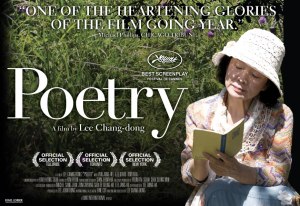
Poetry_WebBase

“The apricot throws itself on the ground. It is crushed and trampled for its next life.”  Yang Mija “sees” while walking through an orchard and takes notes in her poetry notebook

Poetry  (2009), the second movie suggestion for a holiday break movie, is a Korean movie with English subtitles. It speaks quietly about life and art, devastation and redemption. Like the most refined poetry, it is nuanced, honest and dramatic without being melodramatic or manipulative. It is a spare work, whittled down to essentials. It whispers. It never shouts.  Its pacing is leisurely and thoughtful. There is no suggestive music here to help you grasp the story’s progression. There are no stars who’ve been nipped, tucked, brushed, trussed and boosted. These people are real. They could be me or you or a next-door neighbor.  The story could be anyone’s story anywhere in the world. Indeed, Director Lee Chang-dong got the basic idea for the screenplay from news reports..

… this story was finally born from a combination of different elements: the sexual assault case, the suicide of a girl, and the lady in her 60s writing a poem.” Lee Chang-dong

Yoon Jeong-hee stars in the leading role (Yang Mija) and it is the lean script (though the movie is over two hours long) and Jeon-hee’s exquisitely understated acting that transfix us. Watch her face. Watch her body movements.  These also are a kind of poetry.

“I’m quite a poet. I do like flowers and say odd things.” Yang Mija

Yang Mija is a sixty-six year-old grandmother charged with the care of a teenaged grandson, Jongwook – or Wook – whose mother is divorced and living in Busan. Wook is lazy and ungrateful and shows no respect for his grandmother or sensitivity to her age and her loneliness.

“You’re sprouting a mustache but acting like a child.” Yang Mija to Wook

Wook is part of a gang of male friends, fellow students, who over the course of six months repeatedly rape a young woman who subsequently drowns herself. News of this comes coincident with Yang Mija’s diagnosis of Alzheimer’s disease and her first poetry class. It is her poetry classes and effort to write a poem that provide the through-line for this story.

“The most important thing is seeing.” the poetry instructor to the class on the first day

img1-lgWe walk alongside Yang Mija as she struggles with these multiple challenges – not without some humor – and sorts through her emotions regarding her grandson’s actions, her sympathy for the drowned girl, and the desire of other parents to hide the boys’ culpability by buying off the drowned girl’s mother. While Yang Mija may be suffering the early stages of memory loss, she hasn’t lost her moral compass.

As she moves from one experience to the next, Yang Mija questions: How do you write a poem? Where does the poetry come from? When she decides her grandson must face the consequences of his actions, she is finally able to write her poem.

Agnes’s Song

How is it over there?
How lonely is it?
Is it still glowing red at sunset?
Are the birds still singing on
the way to the forest?

Can you receive the letter
I dared not send?
Can I convey the confession
I dared not make?
Will time pass and roses fade?

Now it is time to say goodbye,
Like the wind that lingers
And then goes, just like shadows.

To promises that never came,
To the love sealed till the end,
To the grass kissing my weary ankles,
and to the tiny footsteps following me,
It is time to say goodbye.

Now as darkness falls
will a candle be lit again?
Here I pray nobody shall cry
and for you to know
how deeply I loved you.

The long wait in the middle
of a hot summer day.
An old path resembling my father’s face.
Even the lonesome wild flower
shyly turning away.

How deeply I loved.
How my heart fluttered at
hearing your faint song.
I bless you
before crossing the black river
with my soul’s last breath.

I am beginning to dream…
A bright sunny morning again I awake,
blinded by the light and meet you
standing by me.

– Yang Mija

“It is not difficult to write a poem. It is difficult to have the heart to write a poem.” the poetry instructor on the last day of class. Yang Meja is not in attendance but has left a bouquet of flowers and her poem.

You can stream Poetry on Amazon, if you are interested. It’s quite a memorable film.

© 2016, review, Jamie Dedes, All rights reserved; Photographs, poem, quotes courtesy of and property of the filmmaker and used here under fair use.

THE WORDPLAY SHOP: books, tools and supplies for poets, writers and readers

LITERATURE AND FICTION oo Editor’s Picks oo Award Winners oo NY Times Best Sellers

POETRY ON THE BIG SCREEN: The tragic love of John Keats and Franny Brawne

Medallion portrati of John Keats (1795-1821), English Romanic Poet
Medallion portrait of John Keats (1795-1821), English Romantic Poet

It’s that time of year again – kick back time between Christmas and the new year – a good time to revisit old movies and see new ones.  

Bright Star  is based on the tragic love of the quiet and reserved Romance poet, John Keats, and the vivacious Franny Brawne. Their alliance was destined to be cut short by his death at twenty-four of TB. Bright Star is not just another Regency drama. From the costumes, to the changing of the seasons that were a beautiful and meaningful backdrop to the story, to the world-class cast and script (Jane Campion wrote the script and directed the movie), it is about as nearly perfect as any movie can hope to be.

The title of the movie is taken from Keat’s poem Bright Star:

Bright star, would I were stedfast as thou art—
…..Not in lone splendour hung aloft the night
And watching, with eternal lids apart,
…..Like nature’s patient, sleepless Eremite,
The moving waters at their priestlike task
…..Of pure ablution round earth’s human shores,
Or gazing on the new soft-fallen mask
…..Of snow upon the mountains and the moors—
No—yet still stedfast, still unchangeable,
…..Pillow’d upon my fair love’s ripening breast,
To feel for ever its soft fall and swell,
…..Awake for ever in a sweet unrest,
Still, still to hear her tender-taken breath,
And so live ever—or else swoon to death.

– John Keats

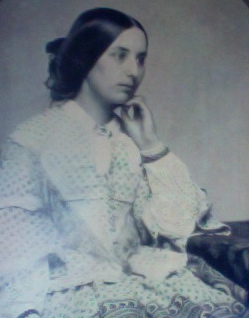
Francis (Fanny) Brawne Lindon (1800-1865
Francis (Fanny) Brawne London (1800-1865)

Abby Cornish plays Fanny Brawne in a performance both understated and charming.  Brawne came from a rather straightened background. At sixteen she is savvy and spunky and falls in love with that raw intensity most of us bring to first love. The story is told from Brawne’s perspective.

Ben Whishaw does a splendid job portraying the sensitive Keats. His recitation of Ode to a Nightingale, which is played as the closing credits run is itself worth the time and expense of admission.

Keats and Brawne were separated when a group of the poet’s friends pooled their resources to send him to Italy. Their hope was that the balmy climate would restore him and prolong his life. Keats, however, knew he would die in Italy. So did Brawne. That circumstance leads to a long and tender good-bye. Lying on a bed in Keats’ room, face to face, they recite La Belle Dame sans Merci to each other. Exquisite!

If you haven’t seen Bright Star, put it on your to-watch list.  I don’t think you will be disappointed.

Here is Ben Whitsaw’s exquisite rendering of La Belle Dame sans Merci. If you are reading this post in an email, you’ll have to link through to the site to view the video.

Photos ~ John Keats by di Gieovanni Dall’Orto from Keats’ headstone under attribution license via Wikipedia; Franny Brawne, an ambrotype taken circa 1850 and in the public domain.

THE WORDPLAY SHOP: books, tools and supplies for poets, writers and readers

LITERATURE AND FICTION oo Editor’s Picks oo Award Winners oo NY Times Best Sellers

ONE WOBBLIE’S LIFE … Joe Hill, labor activist and songwriter

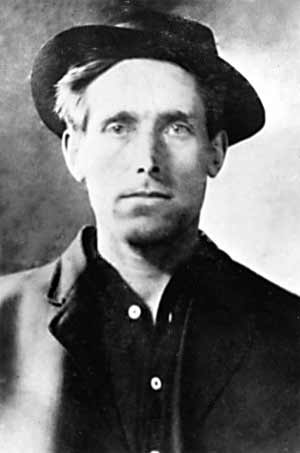
Joe Hill (1879-1915), born Joel Emmanuel Hägglund, Swedish-American labor activist, song writer, and member of the Industrial Workers of the World (the "Wobblies")
Joe Hill (1879-1915), born Joel Emmanuel Hägglund, Swedish-American labor activist, song writer, and member of the Industrial Workers of the World (the “Wobblies”)

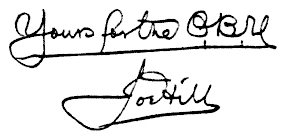
Joe_Hill_yours_for_the_OBU_signature

14102547_1594148474212895_5858254350681929101_n

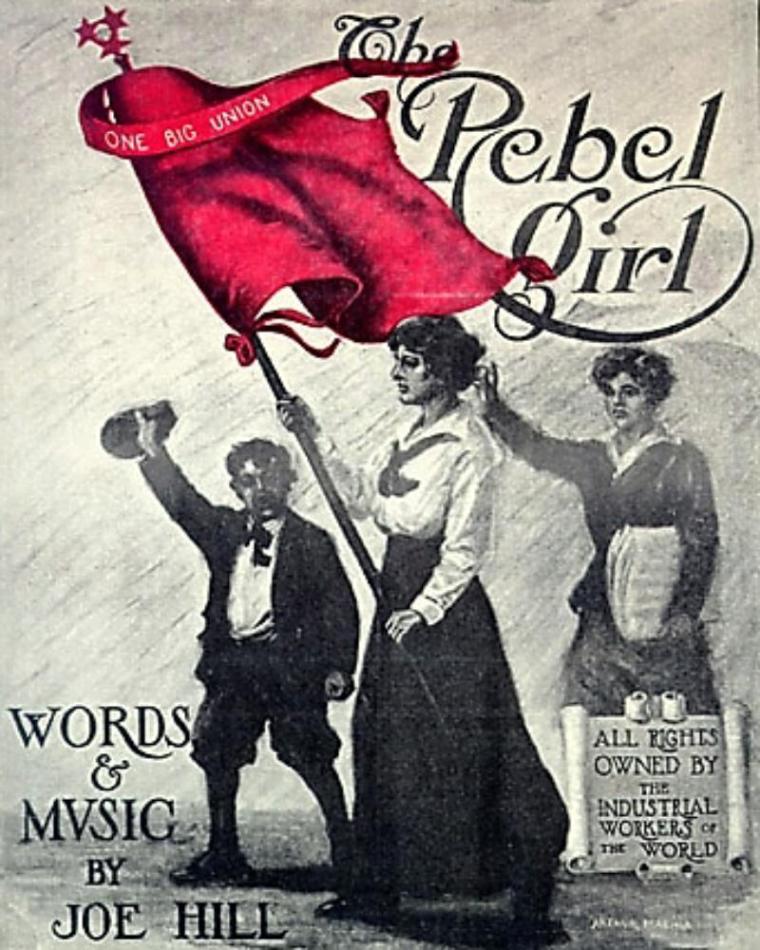
Hill wrote "The Rebel Girl," which was inspired by Elizabeth Gurley Flynn , founder of the American Civil Liberties Union
Hill wrote “The Rebel Girl,” which was inspired by Elizabeth Gurley Flynn , founder of the American Civil Liberties Union

Music – the sister art to poetry – is always an engaging subject and labor rights and history are – or should be –  of serious interest for those of us in the 99%. Hence what a delight to learn that HamiltonSeen, a Canadian film production company, is in the process of exploring the life, work and relevance of Swedish-American labor activist and songwriter, Joe Hill.  In this interview, Zena Hagerty, producer and musician, explains …

JAMIE: How did the project Who Was Joe Hill get started?

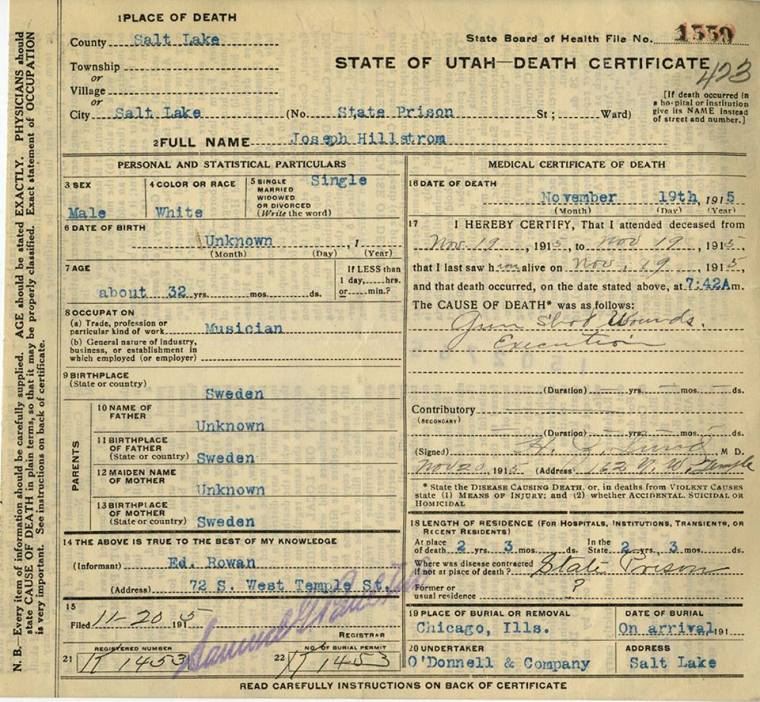
ZENA: After finishing our film Harperman: A Dissident Serenade (releasing online in September), we felt  strongly about showcasing the strength that music has in protest and in political movements. There is a power in voices that rise together. Joe Hill was an early American musical hero who brought about real change in the Union Movement and who died under terrible and strange circumstances in front of a firing squad.

JAMIE: How many shows and what kind of content? Why should people be interested and how is Joe Hill’s life and work relevant to our times?

ZENA: We’re going to be creating twelve episodes that explore who Joe was, what shines forward to today from his life, his music, and his legacy, and we’re going to take a hard look at whether many of the same battles for freedom that were being fought in his time are still being fought today. The plan is to speak to the musicians who carry forward his spirit and use their thoughts and words to draw a picture of now through the lens of Joe Hill.

JAMIE: What do you hope to accomplish?

ZENA: Our mission (yes, it’s that important) with every film or series is to shed illumination from a new perspective on a topic that points to the very heart of who we are as human beings. Now, that sounds intense, but what it really means is that in our work we seek to find the emotional core, to enable viewers to connect to the importance of the subject matter.

JAMIE: When is the release scheduled?

ZENA: Our release schedule is very dependent on budget at this point, with a goal of series’ completion by second quarter of 2017. It should be sold for television by that point. We’d love to see it as a weekly series over three months with an online or Netflix release to follow.

If you are reading this post from email and want to view this trailer, you’ll probably have to link through to the site to do so.

HamiltonSeen:
13654276_10153802715988367_831849348003444984_n
Producer Zena Hagerty
has a long history of community engagement and involvement in the arts scenes of Hamilton and San Francisco and seeks to further strengthen the human spirit with her work. Zena has broad experience in media, including recording albums, performing her own music, radio broadcasting, graphic design, and many others. As director of Sublimatus as a band, an art gallery, and an entity that inspires the creative spirit within all, Zena honed a skillset that includes the ability to drive and complete large projects with expansive intentions.

Director Cody Lanktree is most inspired by dialogue created by the connection between time, beauty, and our personal truths. In the six years since HamiltonSeen’s inception, Cody has guided the company from small commercial production to whiteboxing partnerships with major marketing firms, and finally to the creation of documentaries focused on community and social issues. His vision is one that will not stop at less than fundamentally changing and challenging perspectives and the world.

Jessica Sovie is a journalism student at Mohawk College and intern with HamiltonSeen. As the project lead for The Soapbox, Jessica provides direction, insight, camera operation, and editing skills that are creating a platform for the voice of the public. She is a purebred eccentric, supporter of music and of the arts, and aims to be a champion of the underdog and underrepresented through the use and continuous growth of her skillset.

Photo credits: Joe Hill’s photograph,”The Rebel Girl,” Joe Hill’s signature and death certificate are in public domain; Zena Hagerty’s photograph is hers and under copyright.

Hafez and … LATE BREAKING NEWS: New documentary film, “Alone Through Iran, 1444 Miles of Trust”

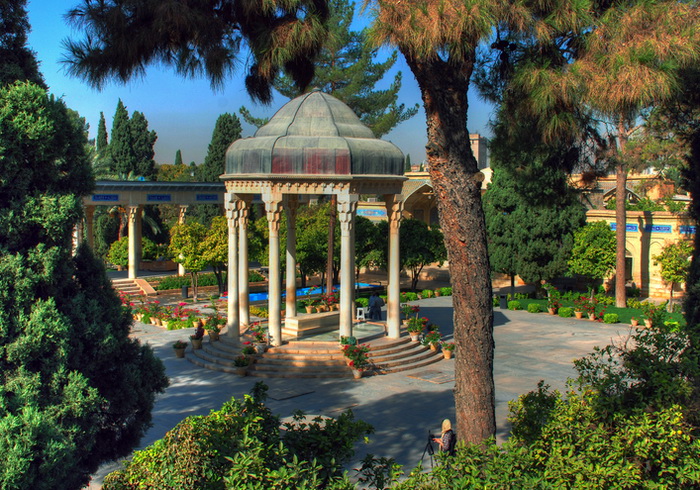
Tomb of Hafez, the popular Iranian poet whose works are regarded as a pinnacle in Persian literature and have left a considerable mark on later Western writers, most notably Goethe, Thoreau, and Emerson
Tomb of Hafez, the Iranian poet whose poetry is regarded as a pinnacle in Persian literature and has left a considerable mark on later Western writers, most notably Goethe, Thoreau, and Emerson

“Even
After
All this time
The Sun never says to the Earth,

“You owe me.”

Look
What happens
With a love like that,
It lights the whole sky.”
― Hafiz

**********

Alone through Iran – 1144 Miles of Trust is a documentary film about Kristina Paltén, a lone Swedish woman who wanted to challenge her own and other’s prejudices against Islam by running across Iran to meet people along the way.

A wonderful heroic story: Monies for this documentary were raised through crowd funding and the film makers report they are currently in the process of editing the full movie. Here (below) is the trailer. Like the Facebook Page to stay updated about the movie.

If you are viewing this in email, you will likely have to click through to the site to view the video.

Photo credit: Amir Hussain Zolfaghary under CC BY-SA 3.0