Page 22 of 26

What have we done that people can pick up weapons and kill?

Dan and I as kids and probably the last time he was shorter than I. He stands 6'5' and I stand 5'2".
Dan and me as kids and probably the last time he was shorter than I am. He stands 6’5″ and I am 5’2″.

With all its faults – and there are many – Facebook can be a blessing. I haven’t seen my cousin Dan in almost forty years. I lost track of him, but was much delighted to find him again on Facebook last March. 

Dan and I were raised in the United States, but our family was from Lebanon. Our mothers were sisters. Our religious roots are Melchite (our grandfather’s side) and Maronite (our grandmother’s side).

My mother, Zabaida, used to tell me that in Lebanon first cousins were like brothers and sisters. Among other things this was one way she tried to understand what people meant when they talked or wrote about Jesus having brothers. I understood it as my relationship to my cousins, especially cousins Daniel and Christopher, who were brothers (Christopher died prematurely) and my most beloved relatives.  Though we haven’t seen one another in forever and we’ve walked different paths in life,  I suspect our basic values remain the same: peace, love (respect) for others and for life, and appreciation of life’s gifts. Dan has worked in many places around the world, including Algeria and Dubai. Currently he teaches Theology in the Philippines. This essay is Dan’s.

*****

What Have We Done That People Can Pick Up Weapons and Kill?

by

Fr. Daniel S. Sormani, C.S. Sp.
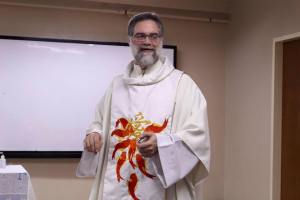
DANIEL S. SORMANI C.S. Sp.

It was one of those things you think but don’t want to say. In the horror of the carnage in Paris and the world’s reaction, it struck me how very little had been said about the terrorist attack in Beirut the day before…or the attack on a funeral in Baghdad…or so much of the other violence that shakes the world. And I felt like I couldn’t say it for fear of looking like I was somehow diminishing the horror or pain of Paris, afraid it could been seen as a lack of respect and understanding. But I wondered. And now so many people are indeed raising such questions, and others are also reacting to such questions, calling them an appalling lack of sympathy…and things have at times spiraled down to a repulsive debate of numbers and geography, rather than of lives and humanity.

When I was young, it was the last hurrah of Lebanon’s golden era when people still referred to it as the “Switzerland of the East” and the wealthy went there to bask on the beach in the morning and ski on its snow-capped mountains in the afternoon. It was the land of poets and artists, and welcomed refugees and visitors equally.

I remember all the Lebanese women with my mother at fundraisers for the Palestinian refugees. We were all kinds of Christians, Muslims, Druze and even a lone family of Lebanese-Jews who ran a shop in our neighborhood. We were just “us”, the Lebanese diaspora, the children of the Phoenicians. And if you were Syrian or Egyptian, that didn’t matter, then we simply enlarged our self-definition to being Middle Easterners. And if you were anything else, then we were “the melting pot” and loved to learn from you.

But so much interference in the internal workings of the country, so much pushing and shoving, dangling of carrots by different powers and religious groups, and finally civil war exploded in Lebanon. What we had known suddenly disappeared. There were a myriad of political parties I couldn’t keep up with, weekly fundraisers for dozens of necessary causes, a flood of refugees, some legal, some not. It should have brought us together, made us one in the struggle for peace and justice. But it didn’t.

I remember vividly the look of joy on the face of complete strangers if they heard my family speak a bit of Arabic. There would be warm introductions and everyone wanted to know everyone. Suddenly it was different. I would say something in Arabic, and the other person would immediately ask “Muslim?” I remember once in my old neighborhood I went into an Arabic music store and was taken by the album playing. Great music, but the dialect threw me a bit. I cheerfully greeted the young man behind the counter with a wish for a morning filled with goodness. He gave me an annoyed look and pointed to the veiled young woman. When he walked away the woman leaned over and whispered in Arabic, “Don’t mind my brother. It’s clear from the way you greeted him that you’re not Muslim.”

I remember in Algeria when I used the traditional Muslim greeting of peace in the market place and the stall-keeper rudely told me I had no right to say such a thing because he knew I wasn’t Muslim. To my delight, an elderly gentleman in traditional dress got angry and shouted at him, “And what should he do, wish you war and trouble instead?” He went on to greet me with great poetry and many warm blessings. Touched, I kissed him the way one kisses his favorite uncle and a few of the women, all wrapped in the white haiks of western Algeria, applauded and blessed God. This, I thought, is what family is, this is how we will conquer the darkness.

We have become our own worst enemy. Whenever we separate the world into “them” and “us”, whenever we accept blind generalizations and cease to see a unique individual before us, whenever we forget we are all victims of carefully orchestrated deceit and deception for wealth and power, the force of darkness wins. Bullets will never win this struggle, only the heart and mind will.I know political scientists and analysts can tear my thoughts to shreds. I do not claim an intellectual understanding…I am only sharing a broken heart that grieves.

A young Melchite priest once told me a story from his village in Lebanon during the war. There was intense shelling and sniper fire for almost three days. After it stopped, people went out to gather up the dead. An old man went to the church and asked the priest to offer two masses. The priest took his pen and book and asked the man to continue. The first mass, he said, was for his son whom they found shot to death in the orchard by their house. And the second mass was for the person who shot him. Startled, the young priest looked at the old man with amazement. The old man explained the obvious saying “What have we done that people can pick up weapons and kill strangers? What have we done that some poor fellow can kill my son without feeling it? We must pray for him, and ask God’s forgiveness.” When I remember that story, after all these years, I still cry.

© 2015, essay and family photographs, Daniel S. Sormani C.S. Sp., All rights reserved

This slideshow requires JavaScript.

Non-state Terror Attacks, January 1, 2013 – November 14, 2015

Note: I didn’t pull this piece together.  It was created by Michael Dickel and is posted here with his permission.  Michael’s most recent poetry collection, the chapbook War Surrounds Us (Is a Rose Press, 2015), is a moving collection, a cry for peace as is this feature.  My piece, The Poet As Witness: “War Surrounds Us,” an interview with American-Israeli Poet Michael Dickel, is HERE. J.D.

Using a Wikipedia list, even with all of its faults, provides a sobering view of terror in the world. The countries listed below were the sites of at least one and often several terror attacks in the last (almost) three years. Some of those attacks resulted only in injuries, most caused one or more death—victims and / or perpetrators. Many attacks killed dozens of people. A few, one-hundred or more. Not all of the perpetrators are from Islamic groups—many come from other “political, religious, or ideological” motivations. According to the Wikipedia site, the list of attacks that I used to find the countries:

…is a list of non-state terrorist incidents that have not been carried out by a state or its forces (see state terrorism and state-sponsored terrorism). Assassinations are listed at List of assassinated people.

Definitions of terrorism vary, so incidents listed here are restricted to those that:

              • are not approved by the legitimate authority of a recognized state
              • are illegally perpetrated against people or property
              • are done to further political, religious, or ideological objectives

Comments on the Wikipedia listing indicate that it is incomplete and may be biased. Still, I found 56 countries on the list for the three years I looked at, and I remembered the larger attacks from news reports. If it is incomplete, there could be more countries. If it is biased, there could be other countries, as well.

This list should give us all pause—not only for our world, but for the children growing up exposed to this global level of war. This is their normal world. They are at risk on so many levels. As adults, we must stop and remember the children. And we must find just solutions to the underlying causes of this violence that literally reaches every corner of the earth. 

In memoriam a black rectangle vertical next to the list of countries
In Memoriam

Non-State Terror Attacks:
Jan 1, 
2013–Nov 14, 2015

  1. Afghanistan
  2. Algeria
  3. Australia
  4. Bahrain
  5. Bangladesh
  6. Belgium
  7. Bosnia and Herzegovina
  8. Cameroon
  9. Canada
  10. Central African Republic
  11. Chad
  12. China
  13. Columbia
  14. Denmark
  15. Djibouti
  16. Egypt
  17. Ethiopia
  18. France
  19. Germany
  20. India
  21. Indonesia
  22. Iraq
  23. Israel
  24. Italy
  25. Japan
  26. Kenya
  27. Kosovo
  28. Kuwait
  29. Lebanon
  30. Libya
  31. Macedonia
  32. Madagascar
  33. Malaysia
  34. Mali
  35. Mozambique
  36. Niger
  37. Nigeria
  38. Norway
  39. Northern Ireland
  40. Pakistan
  41. Philippines
  42. Russia
  43. Saudi Arabia
  44. Somalia
  45. South Korea
  46. South Sudan
  47. Syria
  48. Tanzania
  49. Thailand
  50. Tunisia
  51. Tunisia
  52. Turkey
  53. Ukraine
  54. United Kingdom
  55. United States
  56. Yemen

Source

From Americans Against Islamaphobia
http://on.fb.me/1kVA7zP

UBUNTU ~ “I am because we are.”

11181885_441791312677441_2393581714028886668_n

Nadira Cotticollan (Dreaming through Twilight) from Kannur, India shared this with us on Facebook. I’m just in love with the idea of it. Wouldn’t it be a joy if people the world over adopted this phrase and philosophy?  How civilized (and more practical) this value is than our Western individuality and winner-takes-all values. Something to think about, especially in the light of current events and history.

The Xhosa (pronounced with a click for the “X” and then “hosa”) are a Bantu people (related to Swazi and Zulu) from South Africa. I know this because I was “introduced” to them by a visiting priest many years ago.  From him I know that the Xhosa – like many peoples around the world – are suffering the social fallout that results from colonialism, segregation/apartheid and corporate greed. Their society is rife with poverty and nutritional deficiencies, crime and broken families. Shame on us.

I am because we are. xo

Let us remember that.

This illustration may be copyrighted.  I’ve been unable to find its origin.

The Mission …

Hand of Fire, Hand of Creation<br/>Moshe Dekel (age 5)
Hand of Fire, Hand of Creation by Moshe Dekel (age 5)

Reblogged from: The BeZine blog, 26 September 2015.  This is our mission for our 100TPC event, which is still open to submission from you. Much appreciation to Michael Dickel for this and for MCing the day …

Welcome to the 5th year of 100,000 Poets (Musicians, Artists, Mimes…) for Change, and the 2015 edition of The BeZine Online 100TPC Event! If you’ve done this before and you know the score, skip to the comments or Mister Linky at the bottom of the post and begin. If you are wondering, hey, what are you folks up to then check out some serious non-fiction here:

Our mission here today as poets, writers, artists, photographers, musicians and friends is a sort-of fission for change—a burning with and expression of the desire for peace, environmental and economic sustainability, social justice, inclusion, equity and opportunity for all. We seek through our art to do a bit of old-fashioned consciousness raising, to stimulate thought and action leading to the kind of change that is sustainable, compassionate and just, and to engage in the important theme of the issues facing humanity today—but all with a goal to alleviate suffering and foster peace. We don’t want to just “talk about it,” we want words, art and music that help us take action in some way for positive change wherever we are in our lives, in our world.

We see a complex inter-woven relationship between peace, sustainability, and social justice. We all recognize that when people are marginalized and disenfranchised, when they are effectively barred from opportunities for education and viable employment, when they can’t feed themselves or their families or are used as slave labor, there will inevitably be a backlash, and we’re seeing that now in violent conflicts, wars and dislocation. Climatologists have also linked climate change, with its severe weather changes and recent droughts, to the rise violence in the world, and even contributing to inequities in areas – like Syria – where a severe drought destabilized food production and the economy, contributing to the unrest that led to the civil war, according to one study.

Jerusalem in an unprecedented dust storm that engulged much of the Mideast, linked by one climate scientist to the Syrian civial war and ISIS conflict
Jerusalem in an unprecedented dust storm that engulfed much of the Mideast, linked by one climate scientist to the Syrian civil war and ISIS conflict

There are too many people living on the streets and in refugee camps, too many whose lives are at subsistence level, too many children who die before the age of five (as many as four a minute dying from hunger, according to one reliable study—more info), too many youth walking through life with no education, no jobs and no hope. It can’t end well…

Syrian refugee camp, photo: The Telegraph
Syrian refugee camp
photo: The Telegraph

More than anything, our mission is a call to action, a call to work in your own communities where ever you are in the world, and to focus on the pressing local issues that contribute to conflict, injustice, and unsustainable economic and environmental practices. The kind of change we need may well have to be from the ground up, all of us working together to create peaceful, sustainable and just cultures that nurture the best in all the peoples of this world.

Poverty and homelessness are evergreen issues historically, but issues also embedded in social and political complexity. They benefit the rich, whose economic system keeps most of the rest of us as, at best, “wage slaves,” and all too many of us in poverty, without enough to provide for basic needs or housing (including the “working poor,” who hold low-paying jobs while CEOs are paid record-breaking salaries and bonuses in the global capitalist system). We are united in our cries against the structures of injustice, where the rich act as demigods and demagogues. We have to ask of what use will all their riches be in the face of this inconceivable suffering and the inevitable backlash from the marginalized and disenfranchised. We need fairness, not greed.

So, with this mission in mind, and with the complexity of the interrelationships of social justice, sustainability and peace as a framework, we focus on hunger and poverty, two basic issues and major threads in the system of inequality and injustice that need addressing throughout the world.

We look forward to what you have to share, whether the form is poetry, essay, fiction, art, photography, documentary, music, or hybrids of any of these—and we want to engage in an ongoing conversation through your comments on all of the above as you not only share your own work here today but visit and enjoy the work of others, supporting one another with your “likes” and comments, starting or entering into dialogues with writers, artists and musicians throughout the world and online viewers, readers, listeners.

Think globally, act locally, form community.

—Michael Dickel, Jerusalem (with G. Jamie Dedes, California, USA)

DIRECTIONS FOR PARTICIPATION

Share links to your relevant work or that of others in a comment The BeZine blog post HERE or by using Mister Linky below. To use Mister Linky, just click on the graphic. (Note: If you are sharing someone else’s work, please use your name in Mister Linky, so we can credit you as the contributor—we will give the author / artist name in the comments, from the link when we post the link in a comment.)

You may leave your links or works in the comment section of The BeZine post HERE. If you are sharing the work of another poet or artist, however, please only use a link and not the work itself.

In addition to sharing, we encourage you to visit others and make connections and conversation. To visit the links, click on Mister Linky (the Mister Linky graphic above) and then on the links you see there. (Some Mister Linky-links can be viewed in the comments section after we re-post them.)

28 September 2015 note: In addition to what you’ll find through Mister Linky, you’ll see that there are many many pieces in the comments section or links to them.  We haven’t tallied everything yet, but we think we’re approaching 75 or 80 works.  J.D.

Thank you! 

All links will be collected into a dedicated Page here at The BeZine and also archived at 100TPC.

Thank you for your participation. Let the conversation begin …