Page 140 of 183

PARCHED BLUE MIDNIGHT, a poem

pluie-sur-la-fenetre

A drizzle, not wild rain
No drenching torrents
No puddles forming under
the palm and the birch
No soaking the dry brown earth
while I sit cozy inside
No squall, friend of solitude
to embrace the writing itch, just
a parched blue midnight
an effete sprinkle in the air
Nothing to stir the pen
or green the lawns

This must have been the poetic equivilant of a rain dance. Right after I wrote it we had a soaking downpour.

© 2016, poem, Jamie Dedes; photo courtesy of axelle b, PublicDomainPictures.net


THERE ARE MEN TOO GENTLE TO LIVE AMONG WOLVES, James Kavanaugh and his poetry

41bfrbx142l-_sx303_bo1204203200_

Finally unafraid to be free,
Ready to surrender all the illusions of
recognition and external securities,
Living off the sky and earth like soaring
eagles and braying burros . . .

The iconoclast poet, Dr. James Kavanaugh, first gained fame when he wrote A Modern Priest Looks at His Outdated Church. It was published in 1967.

“It is one of the most moving human documents I have ever read! In an earlier day the author would have been burned at the stake.” Dr. Carl Rogers

In this best-selling book the author called for Church reforms on its positions such as birth control, divorce, premarital sex and celibacy for priests. It says a lot about the man that he had the courage to speak his truth and ultimately to leave the Church.

A Modern Priest Looks at His Outdated Church is worth your time as an exploration of ideas and ideals and difficult decisions. It seeks to dig the historically accurate from under dust of mythology.

Encouraged by family, teachers and tradition to become a priest, Kavanaugh entered the seminary when he was fourteen. He served as a priest for nine years and, when he left the Church – which he did love – it was to honor the depth and breath of his values and to strike out on an adventure to free his soul and find his own vision of God.

We searchers are ambitious only for life itself, for everything beautiful it provides.” James Kavanaugh in There Are Men Too Gentle to Live Among Wolves

I believe Dr. Kavanaugh wrote four nonfiction titles, one children’s book, two novels … but the bulk of his work was poetry.

Dr. Kavanaugh’s first collection of poetry was There Are Men Too Gentle to Live Among Wolves. That book’s eponymous poem is below and it reminds us of ourselves and so many we know.  It’s a healing and compassionate read. Someone understood!

The second poem here is the complete poem that was refered to and quoted in part in yesterday’s post by Rev. Ben Meyers in Notions of God. 

James Kavanaugh died in 2009.  His wife and family continue to keep his legacy alive at jameskavanaugh.org where you can read more about him and his work and purchase all of his books, proceeds to charity.

If you have not yet read Kavanaugh, do. His work is frank, profound, accessible, finely crafted and recommended without reservation.

THERE ARE MEN TOO GENTLE TO LIVE AMONG WOLVES

There are men too gentle to live among wolves
Who prey upon them with IBM eyes
And sell their hearts and guts for martinis at noon.
There are men too gentle for a savage world
Who dream instead of snow and children and Halloween
And wonder if the leaves will change their color soon.

There are men too gentle to live among wolves
Who anoint them for burial with greedy claws
And murder them for a merchant’s profit and gain.
There are men too gentle for a corporate world
Who dream instead of candied apples and ferris wheels
And pause to hear the distant whistle of a train.

There are men too gentle to live among wolves
Who devour them with eager appetite and search
For other men to prey upon and suck their childhood dry.
There are men too gentle for an accountant’s world
Who dream instead of Easter eggs and fragrant grass
And search for beauty in the mystery of the sky.

There are men too gentle to live among wolves
Who toss them like a lost and wounded dove.
Such gentle men are lonely in a merchant’s world,
Unless they have a gentle one to love.

– James Kavanaugh

My Easy God is Gone

I have lost my easy God – the one whose name
I knew since childhood.
I knew his temper, his sullen outrage,
his ritual forgiveness.
I knew the strength of his arm, the sound
of his insistent voice.
His beard bristling, his lips full and red
with moisture at the moustache,
His eyes clear and piercing, too blue
to understand all,
His face too unwrinkled to feel my
child’s pain.
He was a good God – so he told me –
a long suffering and manageable one.
I knelt at his feet and kissed them.
I felt the smooth countenance of his forgiveness.

I never told him how he frightened me,
How he followed me as a child,
When I played with friends or begged
for candy on Halloween.
He was a predictable God, I was the
unpredictable one.
He was unchanging, omnipotent, all-seeing,
I was volatile and helpless.

He taught me to thank him for the concern
which gave me no chance to breathe,
For the love which demanded only love in
return – and obedience.
He made pain sensible and patience possible
and the future foreseeable.
He, the mysterious, took all mystery away,
corroded my imagination,
Controlled the stars and would not let
them speak for themselves.

Now he haunts me seldom: some fierce
umbilical is broken,
I live with my own fragile hopes and
sudden rising despair.
Now I do not weep for my sins; I have
learned to love them.
And to know that they are the wounds that
make love real.
His face eludes me; his voice, with all
its pity, does not ring in my ear.
His maxims memorized in boyhood do not
make fruitless and pointless my experience.
I walk alone, but not so terrified as when
he held my hand.

I do not splash in the blood of his son
nor hear the crunch of nails or thorns
piercing protesting flesh.
I am a boy again – I whose boyhood was
turned to manhood in a brutal myth.
Now wine is only wine with drops that do
not taste of blood.
The bread I eat has too much pride for transubstantiation,
I, too – and together the bread and I embrace,
Each grateful to be what we are, each loving
from our own reality.
Now the bread is warm in my mouth and
I am warm in its mouth as well.

Now my easy God is gone – he knew too
much to be real,
He talked too much to listen, he knew
my words before I spoke.
But I knew his answers as well – computerized
and turned to dogma.
His stamp was on my soul, his law locked
cross-like on my heart,
His imperatives tattooed on my breast, his
aloofness canonized in ritual.

Now he is gone – my easy, stuffy God – God,
the father – master, the mother – whiner, the
Dull, whoring God who offered love bought
by an infant’s fear.
Now the world is mine with all its pain and
warmth, with its every color and sound;
The setting sun is my priest with the ocean for its alter.
The rising sun redeems me with rolling
waves warmed in its arms.
A dog barks and I weep to be alive, a
cat studies me and my job is boundless.
I lie on the grass and boy-like, search the sky.
The clouds do not turn to angels, the winds
do not whisper of heaven or hell.

Perhaps I have no God – what does it matter?
I have beauty and joy and transcending loneliness,
I have the beginning of love – as beautiful as it
is feeble – as free as it is human.
I have the mountains that whisper secrets
held before men could speak,
I have the oceans that belches life on
the beach and caresses it in the sand,
I have a friend who smiles when he sees
me, who weeps when he hears my pain,
I have a future of wonder.
I have no past – the steps have disappeared
the wind has blown them away.

I stand in the Heavens and on earth, I
feel the breeze in my hair,
I can drink to the North Star and shout
on a bar stool,
I can feel the teeth of a hangover, the
joy of laziness,
The flush of my own rudeness, the surge of
my own ineptitude.
And I can know my own gentleness as well
my wonder, my nobility.
I sense the call of creation, I feel its
swelling in my hands.
I can lust and love, eat and drink, sleep
and rise,
But my easy God is gone – and in his stead
The mystery of loneliness and love!

– James Kavanaugh 

© poems Steven J. Nash Publishing

LATE BREAKING NEWS: “RESIST” live and virtual events and “Artemis Poetry” calls for submissions

“On January 15, 2017, poets around the U.S., in cities, towns and villages, will gather on the steps of their local city hall to read poetry against the coming dictatorship of Trump.”

15253540_10153871288971612_1728300874287005039_n

Organized by Alan Kaufman and Michael Rothenberg.

Alan Kaufman is the Editor of The Outlaw Bible of American Poetry

“Outlaw poets” is a term of endearment used in reference to poets whose work is featured in the Outlaw Bible. The following is a partial list of the characteristics of such poets:

  • anti-authoritarian personality;
  • anti-Vietnam war activists known for their anti-war rhymes (many poets write about Vietnam who are by no means outlaw poets).
  • Elder poets that gained notoriety via unconventional forms
  • Poets deliberately not included in most academic curriculums
  • Often inspirational to or inspired by the so-called “Beat” movement in American poetry during the mid-20th century

and

Michael Rothenberg is co-founder (with Terri Carrion) of 100 Thousand Poets For Change. He is an American poet, songwriter, editor, and active environmentalist who recently moved to Florida from the San Francisco Bay area. Born in Miami Beach, Florida, Rothenberg received his Bachelor of Arts in English at the University of North Carolina at Chapel Hill. In 1993 he received his MA in Poetics at New College of California. In 1989, Rothenberg and artist Nancy Davis began Big Bridge Press, a fine print literary press, publishing works by Jim Harrison, Joanne Kyger, Allen Ginsberg, Philip Whalen and others. Rothenberg is editor of Big Bridge, a webzine of poetry. Rothenberg is also co-editor and co-founder of Jack Magazine

It’s probable that The BeZine January 15, 2017 issue will be devoted to this event. Save the date for both live and virtual events and prepare to submit your poems. Let them be both truthful and artistic . . .

Tell all the Truth but tell it slant —
Success in Circuit lies
Too bright for our infirm Delight
The Truth’s superb surprise


As Lightning to the Children eased
With explanation kind
The Truth must dazzle gradually
Or every man be blind — Emily Dickinson

Δ

The latest issue of ARTEMISpoetry (UK) just landed in the USA with its usual rich assortment of essays, book reviews, art, announcements and – Yes! – of course, a wealth of good poems. (Apologies for not getting a better photograph of the cover.) ARTEMISpoetry is the bi-annual journal (November and May) of the Second Light Network and published under its Second Light Publications imprint. The poetry is by women forty-plus or better. The poems are for everyone. You can order this issue and others through Anne Stewart‘s poetry p f and/or sign up for membershipMembership includes a journal subscription.

fullsizerender

CALLS FOR SUBMISSIONS

Opportunity Knocks

Poetry Deadlines: Issue 18, February 28, 2017 and Issue 19, August 31, 2017. “Women poets only, of any age. Unpublished poetry only and not out in submission elsewhere.  Strict limit: max 4 poems; the total number of lines in all should not exceed 200 lines (i.e. you could send a poem of 200 lines and this would restrict your submission to just one poem).  Two copies, A4 paper only [U.S. standard letter paper – 8 1/2 x 11 is the closest we have in the US to A4], typed or neatly handwritten.  Each numbered sheet to bear the poet’s contact details (name, address, telephone, e-mail). Send to ARTEMISpoetry, ATTN.: Dilys Wood, 3 Springfield Close, East Preston, West Sussex, BN162 SZ.”

Response by April 30 for Issue 18 and October 31 for Issue 19.  Kate Foley is the poetry editor for Issue 18.

Artwork – Black and white photographs or line-art sketches are welcome for submission. Four max.

For new and emerging writers, Second Light also offers “remote” – i.e., distance – workshops.  Check out the website for details.

Δ

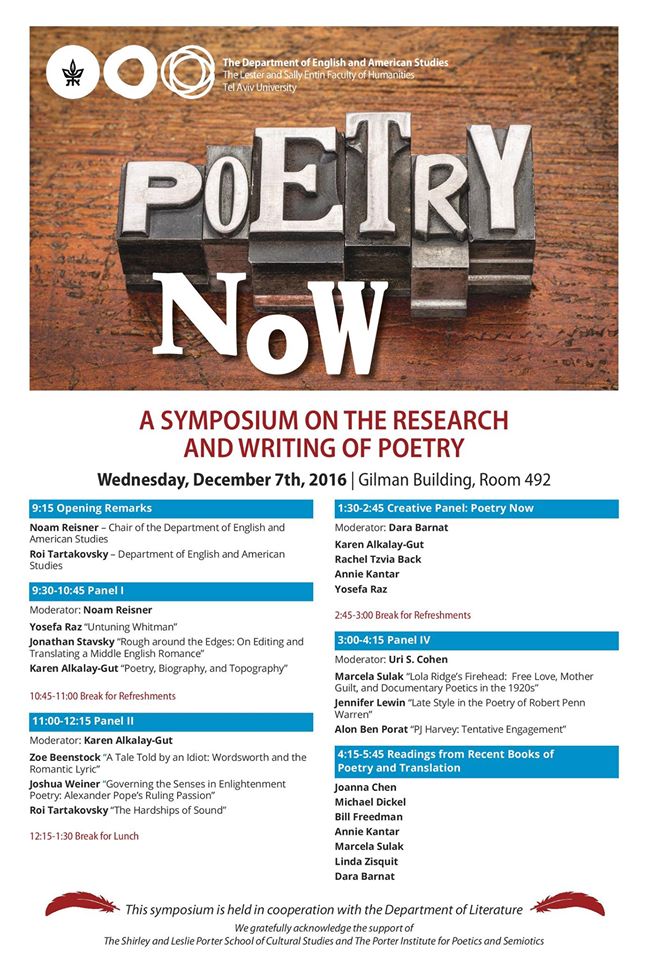
HEADS-UP: December 7, 2016,

Poetry Now @ The Department of English and American Studies, The Lester and Sally Entin Faculty of Humanities, Tel Aviv University

Our own Michael Dickel is a featured.15289246_10154375245428557_1972176959953952764_o

“My Joy Is Like Spring” … The poetry of Thich Nhat Hanh

img_1745

ZEN MASTER THICH NHAT HANH (his students call him Thãy) is a revered spiritual leader, a poet and a peace activist.  Martin Luther King called him an apostle of peace and nonviolence and suggested Thãy for a Nobel Prize, which Thāy never received.

Thāy is sometimes called the other Dalai Lama.  His key teaching is that, through mindfulness, we can learn to live peacefully in the present moment.

The featured poem (below), Please Call Me by My True Names, moves us to compassion. It reflects the Buddhist concept of interdependent coexistence for which Thāy coined the term “interbeing.”  In it he seeks to remind us that we are one with each other and with nature. His poetry is gentle and his word-pictures and pacing tend to sooth and heal. His many published works include several poetry collections.

Thãy lives in Plum Village in France, where he is recuperating from a stroke.

Thích Nhất Hạnh (Nguyen Xuan Bao) b. October 11, 1926). Vietnamese Buddhist monk and peace activist. He coined the term "Engaged Buddhism"
Thích Nhất Hạnh (Nguyen Xuan Bao) b. October 11, 1926. Vietnamese Buddhist monk and peace activist.

Please Call Me by My True Names

Don’t say that I will depart tomorrow—
even today I am still arriving.

Look deeply: every second I am arriving
to be a bud on a Spring branch,
to be a tiny bird, with still-fragile wings,
learning to sing in my new nest,
to be a caterpillar in the heart of a flower,
to be a jewel hiding itself in a stone.

I still arrive, in order to laugh and to cry,
to fear and to hope.
The rhythm of my heart is the birth and death
of all that is alive.

I am a mayfly metamorphosing
on the surface of the river.
And I am the bird
that swoops down to swallow the mayfly.

I am a frog swimming happily
in the clear water of a pond.
And I am the grass-snake
that silently feeds itself on the frog.

I am the child in Uganda, all skin and bones,
my legs as thin bamboo sticks.
And I am the arms merchant,
selling deadly weapons to Uganda.

I am the twelve-year-old girl,
refugee on a small boat,
who throws herself into the ocean
after being raped by a sea pirate.
And I am the pirate,
my heart not yet capable
of seeing and loving.

I am a member of the politburo,
with plenty of power in my hands.
And I am the man who has to pay
his “debt of blood” to, my people,
dying slowly in a forced labor camp.

My joy is like Spring, so warm
it makes flowers bloom all over the Earth.
My pain is like a river of tears,
so vast it fills the four oceans.

Please call me by my true names,
so I can hear all my cries and laughter at once,
so I can see that my joy and pain are one.
Please call me by my true names,
so I can wake up
and the door of my heart
could be left open,
the door of compassion.

– Thich Nhat Hanh

Poem from Being Peace by Thich Nhat Hanh

Thāy’s photo courtesy of Duc (pixiduc) under CC BY SA 2.0