Page 4 of 10

A THEODICY OF LOVE

UU San Mateo
UU San Mateo

Editorial Note: In discussion with other members of the congregation to which I belong, I learned that folks would like our minister’s sermons posted to the new church website, which I am helping to build and which may take a couple of months. (Learning curve!) I’m posting Ben’s sermons here for my fellow congregants. For other readers who might be interested or curious, I’ve put Ben’s bio and a short explanation of Unitarian Universalism below the sermon. J.D.

Unitarian Universalism: A Theodicy of Love*, by the Rev. Ben Meyers, Unitarian Universalists of San Mateo, Sermon 12/11/16

A THEODICY OF LOVE

by

Rev. Benjamin Walker Meyers

“A college student once told me how he asked questions about God in his childhood church and the leaders did not know how to answer. He decided that God must not be real.
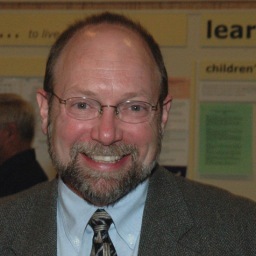
Rev. Ben Meyers of San Mateo, California

A woman told me that all she knew about God was the passages that her mother would quote from Leviticus and Romans—passages meant to shame her for being a lesbian.

My neighbors’ parents survived years in a concentration camp during the Holocaust. He could never fully answer:  How could there be a God who would allow this to happen to my family and millions of others?

I feel confident that these or similar wounds are real for many of us in this room and I would never encourage someone to ignore such wounds.” (SM*)”

“Western theologians have a concept for how we human beings make sense of the evil which we experience and which exists in the world. The word is THEODICY. Theodicy asks and tries to answer eternal questions as: “Why does evil exist and what is its origin? How can a good Ultimate/God/Source allow for needless and undeserved suffering and pain? How shall WE face the real complexities of life, which include destructive emotions and impulses, wrong and harmful choices, and the inevitable reality of sickness and death? The rabbi Harold Kushner famously addressed this in the question that is also the title of his book: ‘Why Bad Things Happen To Good People.’

“Consider this famous and challenging koan from the Zen Buddhist tradition:

Once, when the great teacher Dongshan was washing his bowls with his pupils by the river, two large crows contended over a squirming frog for their meal. Another monk nearby asked, rhetorically, “Why does it come to this?” Dongshan said, “It is only for YOUR benefit, Honored One.”

“‘Dongshan’s answer is shocking. Pain and suffering is “for your benefit, Honored One.’ The ancient Chinese is vague enough that his response is often translated to mean: ‘It is because of you, Honored One!’

“Wait…that doesn’t seem fair! How could it be because of ME when it’s been going on for eons and ages before I even got here?

“Of course, that “Honored One” doesn’t refer just to the individuated monk, although it includes him, and you, and me, and all of us.

“It refers to the Honored ONENESS of all who partake in the gift of life. It refers to the completeness of being…you know…the Great Big Idea/Thing/Verb/Word that has been going on for eons. It pertains to the notion of God and this idea of evil, what we think about it…and how we respond.” (CB*)

Before I go further, let me just make it clear, that, whether we have a direct understanding of God or not, we all have the right to a religious life, to developing our spiritual growth.  That is why I am a Unitarian Universalist minister, because I know that religious life is bigger than any one scripture, any one culture and certainly bigger than any one word.

“So, consider this: Almost all of us, even if we DON’T believe in G*D, have a mental image of what that word means. It might be a mysterious figure in heaven keeping track of good and bad behavior (but, I’m wagering, probably not…)

It might be an image from scripture, or art: the caring shepherd, or the voice in a whirlwind. It might be a feeling, based upon a direct experience: the lifting of burdens, the gentle touch of love, or the pricking of conscience.

Our word/picture/idea might be quite abstract: Great Spirit, Higher Power, Holy Source of All Being, Nature, Science, Love.

We may believe our image of God exists, and so we are theists, or doesn’t exist, and so we are atheists, OR…is not possible to know, and so we are agnostics…but, we ALL have a picture/idea/words for God in our minds.

For some, the description of God is beyond words. For instance, Orthodox Jews, do not use the word G-o-d. When speaking aloud, they use a description like, Adonai, ‘the holy one,’ and when writing, they write G _ d. Or, YHWH (yod-hay-vod-hay), which is sometimes referred to as Yah-Weh, although, written without vowels, it remains a word that signifies more than a mere word can signify—and that we can never completely understand the nature of…it is, in essence, a sign of humility before the great “I AM.”

Then, why use the word “God” at all, (you might be asking) if it is such a slippery thing as to need warnings and explanations?

Well…I believe it is because without words, we can’t even think, much less communicate. An example of this phenomenon is found in an isolated culture of hunter-gathers in New Zealand that uses the same word for the colors BLUE and GREEN. Because of this, they have great difficulty when presented with the task of sorting blue and green objects by color.

They are born with eyes like ours, capable of seeing blue and green as different colors. But without words for the different colors, they don’t really “see” them. It is the same for us. As difficult as this word G-_-D is, if we don’t use it (or an understandable substitute), we’ll not be able to think about a part of our lives that most people intuit as existing.

If the word God is spoiled beyond redemption for us, we can substitute other words, such as Goddess, Higher Power, Spirit of Life, Great Spirit, the Divine, Holy One, Whom-It-May-Concern, or ‘whatever’, even. Some people use the word Goddess in conversation, as in: “We’ll have to leave that up to the Goddess.” This is not simply a matter of cherishing the feminine connotations of the word, which are often lacking in our “god” words; it is also a way of alerting listeners to the possibility that theological creativity is allowed in our conversations.

It is so very important to remember that our images of God, while useful and necessary, are at best only partial truths and will lead us astray and divided if taken too literally or set too concretely in our minds.

And again, the same is true if the word/concept/image is too vague.

We must each find the definitions, images, and poetry that make sense to us if we are to participate in the critical issues of our times. So we must remain open to the many ways G*D is thought about by many religious people in the world…and they are many:

  • Including pagan ideas of divinity, in which “God” is the sum total of everything, material and immaterial, in our universe, so EVERYTHING is holy, even things we might think are not good, such as the lightning that strikes our favorite tree…
  • Or, the notion of a Higher Power used in 12-step programs such as Alcoholics Anonymous, in an attempt to bring spirituality into a meaningful place in people’s recoveries, without entangling people in theological arguments…
  • Or, the God present in Liberation Theology, which desires that each person have the maximum possible opportunity for a fully human life, beyond the oppression of poverty and tyranny. This is a God who sides with the poor and oppressed wherever they are found and nudges people toward acting for justice and making peace and equity real in the lives of all.
  • Or, the Humanist belief that the highest and the best we can know in this world is HUMANITY, with our grand ideals, marvelous minds, and great creative potential. Humanists say that divinity is within the human being and nowhere else. Most humanists don’t really like to use the word GOD, but they still have a theology, which is a theory or a belief about the highest and best, of which we are a part. (CR*)

And, then there is a movement in the liberal religious circles of Process Theology, which considers how God is a force that is ever-present, that evolves, grows, mourns and even suffers losses. It teaches that God can honor all that we know to be true…about modern science, about protecting the earth, and the right to equality for all people—no matter their orientation, culture, beliefs or practices. It is like the Unfinished God: not a force that controls the world like a puppet on a string, but rather a God who is and has the power to call us toward Love, in partnership with God—even as part of God. It is the notion that God only has our hands to do good in the world.

That is it. Without our partnership, without our agreement, God is powerless. If we do not respond to the call and walk in the ways of Love, God is waiting and calling and waiting and calling.

These are just some of the images and understandings of divinity which can be found within Unitarian Universalism. In our poetry and songs and in what we consider as scripture: Each representing a wide theology beyond mere acceptance. It helps with our desire to learn how we can all get along, both within and beyond these walls.

How can we talk to each other when the meanings behind our words seem so different? We do that by being always mindfully challenged and aware that our images and understandings are at best approximations of an infinite truth that simply cannot be captured by finite beings.

When we remember that fact, and strive to live and ENGAGE in it, beyond comfortable complacency, apathy, or worse, a disrespect of other’s beliefs, OUR faith and our regard for persons with visions and words that differ from ours is NOT a grudging tolerance, but an open-hearted curiosity about yet another way of understanding the God, the universe, and everything.

I believe this is what the Reverend Dr. Martin Luther King, Jr. spoke of when he said:It is not where we stand in moments of comfort and convenience, but where we stand at times of challenge and controversy that marks the ultimate measure of a person and a people.”

These words represent and inspire me to take risks for the sake of promoting and extending this partnership with ‘all Gods who are love.’

In closing you may be wondering, ‘What do I mean by God?’OK, That’s fair. For me, God is Love—all acts of Love are the stuff of God and all acts of bigotry and violence have nothing to do with God. I believe in striving to live in service to all Gods who are love—and this is a powerful God for it is the power of many lives, working together to bring more love and life and justice into the world. It empowers to me to believe in a power at work in the universe. It is the power of our capacity to return to JOY, once our sorrow and grief have been honored, in times of loss;It is the power of our audacity to live with hope, again and again, even within the legacy of despair and hopelessness that has been with us always in the shape of injustice and bondage of all kinds.

My God is the power of our courage to stand in resistance to hate. For my friends, in the days in which we live, Resistance is what love looks like in the presence of hate.This power, I believe, works through human hands, but it was not made by human hands—we are a part of the universe—we are not its most important part, but an important part all the same. This power is creative, sustaining, and transforming and we can trust this power with our lives. It will sustain us whenever we take a stand on the side of love;
whenever we take a stand for peace and justice; whenever we take a risk for its sake. Trust in that power. We are, together, held by this power. And it will not let us go, as long as we hold on to one another, O Honored Ones. Amen. —

*Acknowledgements to the Rev. Susan .Maginn, the Rev. Chris Bell and the Rev. Christine Robinson for inspiration and some content, where noted

13095886_10153410525720997_4513143742898577448_nREV. BEN MEYERS was born into a family with a Catholic father and a Baptist mother. He grew up in the Disciples of Christ Church, but hung out with friends from other progressive religions. During his childhood and youth, he was engaged in exploring various world religions and active in social movements during the 1980’s. He later discovered he was a UU while attending the UU Fellowship in Chico. Rev. Ben was ordained in 1995. He has a: BMusic from California State Univ., Sacramento, 1990 and a MDiv, Starr King School for the Ministry, 1994,  He is the devoted and much appreciated minister of UUSM, where he provides inspiration, spiritual guidance and also leadership in grassroots social justice initiatives and interfaith collaborations. Rev. Ben is a gifted singer and musician.

colorsplasheffectUNITARIAN UNIVERSALISM (UU) is a noncreedal liberal religion characterized by a “free and responsible search for truth and meaning.”  UUs are unified by their shared search for spiritual growth. The roots of UU are in liberal Christianity, specifically Unitarianism and Universalism, traditions that express a deep regard for intellectual freedom and inclusive love (respect) for the diverse ways in which people seek to understand life and spirit. UU Members seek inspiration and derive insight from all major world religions. The beliefs of individual Unitarian Universalists range widely, including atheism, agnosticism, pantheism, deism, Judaism, Islam, Christianity (including Eastern and Roman Catholicism), neopaganism, Hinduism, Buddhism, Daoism, Humanism, and many more.

© sermon and personal photographs, Ben Meyers, 2016, please feel free to share the sermon with attribution to Ben and link to the Unitarian Universalists of San Mateo.; 

THERE ARE MEN TOO GENTLE TO LIVE AMONG WOLVES, James Kavanaugh and his poetry

41bfrbx142l-_sx303_bo1204203200_

Finally unafraid to be free,
Ready to surrender all the illusions of
recognition and external securities,
Living off the sky and earth like soaring
eagles and braying burros . . .

The iconoclast poet, Dr. James Kavanaugh, first gained fame when he wrote A Modern Priest Looks at His Outdated Church. It was published in 1967.

“It is one of the most moving human documents I have ever read! In an earlier day the author would have been burned at the stake.” Dr. Carl Rogers

In this best-selling book the author called for Church reforms on its positions such as birth control, divorce, premarital sex and celibacy for priests. It says a lot about the man that he had the courage to speak his truth and ultimately to leave the Church.

A Modern Priest Looks at His Outdated Church is worth your time as an exploration of ideas and ideals and difficult decisions. It seeks to dig the historically accurate from under dust of mythology.

Encouraged by family, teachers and tradition to become a priest, Kavanaugh entered the seminary when he was fourteen. He served as a priest for nine years and, when he left the Church – which he did love – it was to honor the depth and breath of his values and to strike out on an adventure to free his soul and find his own vision of God.

We searchers are ambitious only for life itself, for everything beautiful it provides.” James Kavanaugh in There Are Men Too Gentle to Live Among Wolves

I believe Dr. Kavanaugh wrote four nonfiction titles, one children’s book, two novels … but the bulk of his work was poetry.

Dr. Kavanaugh’s first collection of poetry was There Are Men Too Gentle to Live Among Wolves. That book’s eponymous poem is below and it reminds us of ourselves and so many we know.  It’s a healing and compassionate read. Someone understood!

The second poem here is the complete poem that was refered to and quoted in part in yesterday’s post by Rev. Ben Meyers in Notions of God. 

James Kavanaugh died in 2009.  His wife and family continue to keep his legacy alive at jameskavanaugh.org where you can read more about him and his work and purchase all of his books, proceeds to charity.

If you have not yet read Kavanaugh, do. His work is frank, profound, accessible, finely crafted and recommended without reservation.

THERE ARE MEN TOO GENTLE TO LIVE AMONG WOLVES

There are men too gentle to live among wolves
Who prey upon them with IBM eyes
And sell their hearts and guts for martinis at noon.
There are men too gentle for a savage world
Who dream instead of snow and children and Halloween
And wonder if the leaves will change their color soon.

There are men too gentle to live among wolves
Who anoint them for burial with greedy claws
And murder them for a merchant’s profit and gain.
There are men too gentle for a corporate world
Who dream instead of candied apples and ferris wheels
And pause to hear the distant whistle of a train.

There are men too gentle to live among wolves
Who devour them with eager appetite and search
For other men to prey upon and suck their childhood dry.
There are men too gentle for an accountant’s world
Who dream instead of Easter eggs and fragrant grass
And search for beauty in the mystery of the sky.

There are men too gentle to live among wolves
Who toss them like a lost and wounded dove.
Such gentle men are lonely in a merchant’s world,
Unless they have a gentle one to love.

– James Kavanaugh

My Easy God is Gone

I have lost my easy God – the one whose name
I knew since childhood.
I knew his temper, his sullen outrage,
his ritual forgiveness.
I knew the strength of his arm, the sound
of his insistent voice.
His beard bristling, his lips full and red
with moisture at the moustache,
His eyes clear and piercing, too blue
to understand all,
His face too unwrinkled to feel my
child’s pain.
He was a good God – so he told me –
a long suffering and manageable one.
I knelt at his feet and kissed them.
I felt the smooth countenance of his forgiveness.

I never told him how he frightened me,
How he followed me as a child,
When I played with friends or begged
for candy on Halloween.
He was a predictable God, I was the
unpredictable one.
He was unchanging, omnipotent, all-seeing,
I was volatile and helpless.

He taught me to thank him for the concern
which gave me no chance to breathe,
For the love which demanded only love in
return – and obedience.
He made pain sensible and patience possible
and the future foreseeable.
He, the mysterious, took all mystery away,
corroded my imagination,
Controlled the stars and would not let
them speak for themselves.

Now he haunts me seldom: some fierce
umbilical is broken,
I live with my own fragile hopes and
sudden rising despair.
Now I do not weep for my sins; I have
learned to love them.
And to know that they are the wounds that
make love real.
His face eludes me; his voice, with all
its pity, does not ring in my ear.
His maxims memorized in boyhood do not
make fruitless and pointless my experience.
I walk alone, but not so terrified as when
he held my hand.

I do not splash in the blood of his son
nor hear the crunch of nails or thorns
piercing protesting flesh.
I am a boy again – I whose boyhood was
turned to manhood in a brutal myth.
Now wine is only wine with drops that do
not taste of blood.
The bread I eat has too much pride for transubstantiation,
I, too – and together the bread and I embrace,
Each grateful to be what we are, each loving
from our own reality.
Now the bread is warm in my mouth and
I am warm in its mouth as well.

Now my easy God is gone – he knew too
much to be real,
He talked too much to listen, he knew
my words before I spoke.
But I knew his answers as well – computerized
and turned to dogma.
His stamp was on my soul, his law locked
cross-like on my heart,
His imperatives tattooed on my breast, his
aloofness canonized in ritual.

Now he is gone – my easy, stuffy God – God,
the father – master, the mother – whiner, the
Dull, whoring God who offered love bought
by an infant’s fear.
Now the world is mine with all its pain and
warmth, with its every color and sound;
The setting sun is my priest with the ocean for its alter.
The rising sun redeems me with rolling
waves warmed in its arms.
A dog barks and I weep to be alive, a
cat studies me and my job is boundless.
I lie on the grass and boy-like, search the sky.
The clouds do not turn to angels, the winds
do not whisper of heaven or hell.

Perhaps I have no God – what does it matter?
I have beauty and joy and transcending loneliness,
I have the beginning of love – as beautiful as it
is feeble – as free as it is human.
I have the mountains that whisper secrets
held before men could speak,
I have the oceans that belches life on
the beach and caresses it in the sand,
I have a friend who smiles when he sees
me, who weeps when he hears my pain,
I have a future of wonder.
I have no past – the steps have disappeared
the wind has blown them away.

I stand in the Heavens and on earth, I
feel the breeze in my hair,
I can drink to the North Star and shout
on a bar stool,
I can feel the teeth of a hangover, the
joy of laziness,
The flush of my own rudeness, the surge of
my own ineptitude.
And I can know my own gentleness as well
my wonder, my nobility.
I sense the call of creation, I feel its
swelling in my hands.
I can lust and love, eat and drink, sleep
and rise,
But my easy God is gone – and in his stead
The mystery of loneliness and love!

– James Kavanaugh 

© poems Steven J. Nash Publishing

NOTIONS OF GOD … your Wednesday Writing Prompt

Swan (Hansa, हंस) is the symbol for Brahman-Atman in Hindu iconography. Brahman (/brəhmən/; ब्रह्मन्) connotes the highest Universal Principle, the Ultimate Reality in the universe.

WEDNESDAY WRITING PROMPT: Well, it’s December and as noted yesterday the month is dense with the religious holy days. That would be joy to some and disgruntlement to others.  Wherever you stand in your thinking about God and by whatever name you call yourself and your vision of God, I thought it might be fun and interesting to write poems or essays about the nature of the Ineffible and why you do or why you don’t believe in God.

Often there is a temptation to view the other guy’s religion as superstition. Today let us write with deference for the diverse ways people try to make moral, spiritual and intellectual sense of a world in which illness, violence, despair, loneliness and death are as prevalent as hope, friendship, reason and birth.

If you’d like to share what you’ve written, just put the link to the piece in the comments below. Today I’ve stollen Ben Meyers’ Sunday sermon as a jumping-off point. Enjoy the read and enjoy your writing adventure. J.D.

SOME NOTIONS OF GOD

by

Rev. Benjamin Meyers

Rev. Ben Meyers of San Mateo, California
Rev. Ben Meyers of the Unitarian Universalists of San Mateo, California

One of the hazards of being a minister, I have found, is that when people I don’t know well discover that I am a minister – at some social function or party I attend or if I become a captive audience on a flight to somewhere – they will proudly proclaim to me “Oh, I don’t believe in God.”

Usually I respond with a nod and a simple “Un hum,” because sometimes their only purpose in saying this to me as a “reverend” is to shock or somehow upset me. But, if I sense they are sincere about wanting a genuine spiritual dialogue, I might say something like, “Un hum…. Well, tell me about this God in which you don’t believe?” I then listen carefully to their responses and ask questions about why and how and so forth. What generally unfolds is a story about events in their lives that led them to their assertion about the God in which they don’t believe.

Michelangelo's Creation of Adam
Michelangelo’s Creation of Adam

When I have taken the time for such theological dialogue, nine times out of ten, I will eventually say something like: “Yes, I see. And you know what? I don’t believe in that God either (meaning, that old, outworn, dysfunctional, bearded, peeping-tom-in-the-sky God.) Vis-a-vis THAT God we are both atheists!”

Then I’ll suggest that now that we’ve discovered what it is we don’t believe when it comes to God, we can explore just what it is we might believe about God that would be positive, creative, healing, relational liberating and helpful. We’ll discover a kind of practical theology for ourselves.

The truly amazing and delightful and rewarding thing is that, again, nine times out of ten, IF that self-proclaimed atheist and I work together in authentic dialogue, we usually find and articulate a God-concept that we can both agree with or at least discover that our differing ideas of God are in sympathetic, parallel and supportive relationship to one another without anyone getting hurt.

There are so many creative, spirit-enriching ways for us to think about God, but getting there often means revisiting old notions about God that no longer fit our reality or experience. This work is critical to do if we are to mature spiritually as human beings.

Here’s a poem by the American writer, James Kavanaugh, entitled, “My Easy God is Dead”, which is a great expression of what I’m saying. He writes:

“I have lost my easy God—
the one whose name I knew since childhood.
He was a good God…
He was a predictable God…
He made pain sensible
and patience possible
and the future foreseeable…
Now he haunts me seldom,
some fierce umbilical is broken…
now) I live with my own fragile hopes
and sudden rising despair…
my easy God is gone—
and in his stead,
the mystery of loneliness and love!”

– ©James Kavanaugh estate

For some of us, God is, as the old Universalists put it, love, simply love—a powerful spirit of goodness, warmth, mercy and justice that lives in people and the world. For others, God is expressed as a ‘life force’ or ‘creative spirit’ or ‘higher power’ or ‘supreme intelligence’ or ‘infinite ground of being’ that animates creation making life and purpose possible. For others, God is an ‘unknowable mystery’ that utterly defies definition or description. For some of us, God is simply a concept that is of absolutely no spiritual usefulness or practical relevance—in fact, it is viewed as a source of conflict and divisiveness and not considered helpful at all.

Personally and professionally, I don’t believe a God-concept is essential or necessary for people to live lives that reflect compassion, goodness and gratitude. But, there’s no getting around the persistence of the notion of God that has permeated and continues to occupy our minds and hearts and which represents—even in its ineffableness—what I call “The BIG idea.” Our theological nuances about God are endless, and this theological diversity is (to me at least) more beautiful than it is confusing or indulgent. For I believe that God is, above all else, a radically personal reality, rightfully different for each one of us as we experience our lives in our own idiosyncratic ways.

The philosopher, Ludwig Wittgenstein, was wise to declare that religion belongs to the “realm of the inexpressible.” And many Unitarian Universalist ministers attending seminary at Starr King School in the late eighties and early nineties had an incomparable New Testament professor by the name of Marcus Borg, who was so convinced of the utter subjectivity of God that he proclaimed passionately that it was absolute folly and foolishness to even attempt to share our own ideas and experience about God to others, so much so, that he wrote several books on the subject.

In one of them he implored: “Be content to know your own God–and for God’s sake–don’t try to transfer or argue it to someone else…We each must discover our own sense of life’s ultimate sacredness, not try to fit others’ into your own.”

And yet, while I agree with good professor Borg – blessed be his name – that talking about God with our clumsy, imprecise words is, by its very nature, an often subjective and slippery thing to do. I nonetheless believe, as did he by virtue of his writings on the subject, that there is great spiritual value when each of us humbly share what God does (and does not) mean to us, individually. Without such respectful sharing of our own ideas about our experiences and notions of God, how will we ever be able to mature and deepen our theological understandings and spiritual sensitivities and find the common ground that unites us, despite theological differences?

To avoid them is to invite and perpetuate distance, rather than connection. It is easier to embrace our differences and practice acceptance of one another when our differences are made known to us. It is a sign of spiritual growth and maturity to be able to do so. And, given the times in which we live, we need, now more than ever, to clarify and to promote the value of acceptance which is the cornerstone of deep faith and practice. If we can’t or don’t do so, how will we be able to foster the kind of civility and acceptance and search for common ground that is required of us as a world, a nation, a community … as people of faith?

This was the purpose and intention behind the meeting I attended this past Wednesday, from noon to 2pm, with twenty-four other religious leaders from various faith traditions. We agreed to gather and address this topic: “Leading in Difficult Times: Conversations Among Faith Leaders.”

img_0888

Present were spiritual leaders representing Muslims and Jews, Catholics and Protestants, Buddhists and Unitarian Universalists. We were of various ages and gender-identities, ethnicities and physical abilities and what brought us together was a desire to know and to trust one another so that we could more effectively lead our people…beyond the complacencies of our unique faith communities…and to seek and FIND our common values… around which we might rally a response to the climate of hatred and violence and the wave of dangers that we collectively face…in the greater world, our own nation, in our community, our congregations and our own hearts…to counter our fears and our uncertainties and our distrust about the future.

How do we lead in difficult times unlike any other we have ever faced? We know, as clergy leaders, that to be effective in these ‘interesting times’, we must acknowledge our differences and put them aside in order to stand firm against the attack on the values we hold in common, which are shared and which are central to each of our faith traditions. It was a most remarkable session.

In circles of eight, we shared our stories. We shared our concerns and our fears. But more importantly we shared our values and that which lifts us above our fears so that we may lead beyond them and be emboldened and strengthened in solidarity with our shared purpose.

From a Buddhist minister, I learned of the fear that exists in his community that history may well repeat itself as people in our county are suddenly whisked away and interred in camps as potential enemies of the state, just as so many Japanese-Americans were during World War II. They are willing to stand with our immigrant and Muslim neighbors to ensure this does not happen again and they invited us to do the same.

My Jewish colleagues expressed concern against the quiet acquiescence and acceptance of the erosion of rights of citizens as one line in the sand after another is allowed to be crossed, just as they were in Nazi Germany until the seemingly impossible became possible. They wondered at what point would we stand together to counter the hate speech that precedes the horrors of violence?

A Latina priest from a predominantly Hispanic Episcopal church fears the scapegoating against immigrants and the very real prospect that families will be destroyed and family members ‘disappear’ without a word or trace. And how any knock on the door might mean deportation without due process or warning. She wondered aloud how it would be possible for people, “made in the same likeness of God” to be capable of oppressing “the very presence God” found in those they persecute.

Another colleague realized that we can no longer afford the luxury of believing ourselves separate from one another. They noted that, before 11/9, there seemed to be so many different causes and issues to be concerned about: Islamophobia, Misogyny, Homophobia, anti-Immigration hate and the degradation of our environment….and now we are forced to see that all of these are related and connected that, in the words of John Muir . . .

“When we try to pick out anything by itself, we find it hitched to everything else in the universe.”

In the end, in my mind, we all became one faith, one people. What a moment and in the end, we made a covenant, a promise, to one another that if any ONE of us sent out a plead for help or solidarity, that we would ALL do our utmost to show up and to bring our congregations with us. It was the most deeply moving multi-faith meeting I had ever attended. There was great solidarity among us, solidarity beyond our notions of difference in theology, or culture, or practice. We affirmed one another as one. It was almost the best meeting I attended that day.

But from that meeting I came here…to Beck Hall, where our Justice Ministry Team Leaders had organized a gathering of another 25 of us to address essentially the same questions: What do we do now? How do we, as a spiritual community put our faith to action? How do we embody our mission to transform ourselves and the world in a post-11/9 world?

We began by listening to one another, by naming our fears and concerns and also giving voice to our shared values. We then organized into four areas for action: Immigration Response, Multi-Faith partnerships, Environmental Justice and Racial Justice. We came away with concrete steps to bring these issues into the life of this congregation…so that we may live out our values and stand together on the side of love – within the capacity and ability of each of us to do so – STAY TUNED. Don’t go anywhere…like Canada…yet.

All of this is by way of prefacing the sharing, however briefly, of my own notions of God, and what God (as I experience it in my everyday life) means to me. I offer my elusive understanding of God not (I assure you) to “set you straight once and for all” on the question of God. We are, after all, Unitarian Universalists who understand truth and reality as mysterious and many splendored things. I share what God means to me in the hope that my understanding might stimulate you in your own thinking and feeling about this most fundamental of religious concepts.

Most essentially, and I reserve the right to come back and revisit this subject often, or today, God, to me is a participatory phenomenon….a relational reality….a living process that needs us to exist if it is going to achieve its fullest and finest reality and power.

I believe God comes to life when we, I, become more loving, just, and giving. I like what Dorothee Soelle said …

“To believe in God means to take sides with life and to end our alliance with death. It means to stop killing and wanting to kill, and to do battle with apathy which is so akin to killing. To take sides with life and experience how we can transcend ourselves is a process that has many names and faces. Religion is one of those names. Religion can mean the radical and wholehearted attempt to take sides with life.”

If you or I don’t “take sides with life” —in our little corners of the globe, with the people near us—if we fail to bring our best and most loving gifts to the world of need, then God’s spirit is absent. If, for example, you stand faithfully by someone’s death bed, holding their hand and soothing their brow—it is your presence, your physical embrace, tentative and imperfect as they are—that are the only way that dying person is to know solace and grace and love. It is utterly without self-importance that I tell you that I deeply believe God needs me (and you) if God is to be at all. To me, the most beautiful theological thought of all is that there is a holy spirit breathing through life which WELCOMES AND ENCOURAGES our energies and gifts….the God that haunts and blesses me quietly welcomes my most passionate and loving participation in the creation of life.

This idea of god as a relational process is hardly new. The Jewish theologian Martin Buber described God as an active verb that comes to birth best in the loving “I-Thou” encounter, that mysterious arching of energy and affection, that can spark between human beings. And even more recently, the relatively new school of theology called “Process Theology” proclaims, basically, that God is a verb—a living process of justice, love, compassion and creation. The process theologians believe the God does not exist as some abstract, supernatural, heavenly personality far removed from us, but rather is a living process that invites us in ever-fuller partnership with everything that breathes, cares and grows. As a recent rock opera put it in “The Song of Three Children,” “God is not a she, God is not a he, God is not an it or a maybe. God is a moving, loving, doing, knowing, growing mystery.”

Its a hard thought to hold, isn’t it, that God (or at least one dimension of God) is a verb, a process of noble becoming rather than an actual cosmic being. The God I know and depend on for spiritual wholeness is both a presence and a process. My God is an open, available, holy spirit…a good and gracious spirit astir in-my world, which guides my heart to action, which welcomes my frail, little contributions of beauty and blessing, of service and love. If we human beings awaken to the holy powers and processes that are everywhere around and within us, then we participate in that holiness, and that participation blesses, fills and saves us.

My old, easy, predictable Gods are dead. But the creation in which I live is astir with sacredness and grace. I believe there is a Holy Spirit of Life that blesses and nurtures all who are open to its power and purpose. Name it whatever you will, describe it in whatever words work for you—but both savor and serve life’s irrepressible, unmistakable holiness.

In closing: Dag Hammarskjold had it right when he said …

“God does not die on the day we cease to believe in a personal deity….but we die on the day when our lives cease to be illumined by a steady radiance–renewed daily–of the wonder, the source of which is beyond all reason.”

Amen.

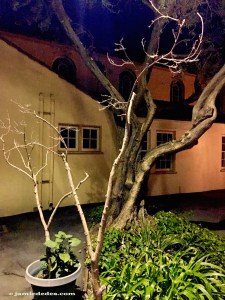
© 2016, sermon and portait, Benjamin Meyers, All rights reserved; photo credits  ~ Swan by mozzercork under CC BY 2.0 license; photograph of Michelangelo’s Creation of Adam, public domain;  Tree in Church Courtyard at Night, Jamie Dedes, All rights reserved

Based loosely on a Sermon By Scott Alexander, entitled “Which God Don’t You Believe In?, with acknowledgements and thanks.

An Editorial by UU Minister, Ben Meyers: SHOTS HEARD, HEARTS BROKEN, VIGILS HELD

Rev. Ben Meyers of San Mateo, California

There’s something happening here,
What it is aint exactly clear.
There’s a man with a gun over there,
Tellin’ me I’ve got to beware …
I think it’s time we stop, Children, What’s that sound?
Everybody look what’s goin’ down …
Stephen Stills (Crosby, Stills & Nash)

UU San Mateo
Unitarian Universalists (UU) of San Mateo, CA

On June 12, 49 people were murdered at the Pulse Nightclub in Orlando, Florida and 53 were injured and hospitalized, four critically. People of good conscience gathered and mourned with victims and families at vigils held across the country and around the world. We grieved for lives lost. We grieved another mass shooting, the largest in U.S. history.

Congregational Church
Congregational Church, San Mateo, CA

Here in San Mateo, we joined in a interfaith vigil held at the Congregational Church. We joined in sadness, shock and solidarity, both for Orlando, and for those in our own community, our country, our world who are of a minority sexual orientation: gay men, lesbians, bisexual persons, transgender persons, persons uncertain of their gender identity or sexual orientation, victims of senseless hate in some quarters.

The community we must hold vigil for in our hearts is even larger. It includes all our Muslim brothers and sisters here and around the world who have and will suffer from the kind of religious bigotry that cannot separate the actions of one radically disturbed individual from the peace- loving behaviors of millions of religious people.


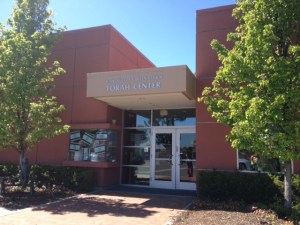
Torah Center, Peninsula Temple Sholom, Burlingame, CA

Recently, Unitarian Universalists of San Mateo (UUSM) joined over 200 people and broke the month long period of daily fasting for Muslims known as Ramadan. The event, which I had never participated in before, was made even more remarkable to me because of its location. It was not held in a Mosque or even a Muslim Cultural Center, rather, it was hosted, and well attended, by the Jewish congregation of Peninsula Temple Shalom, in Burlingame. Muslims and Jews, Christians, UUs and others came together to learn more about this most holy ritual of Islam, and to stand against the violence of Islamaphobia and hate, which currently, the majority of U.S. citizens embrace and promote.

We hold vigil for people, especially black and brown people, who continue to be the targets of racial profiling and the oppression and violence that comes with it. Acts of systemic hatred and violence which we can not even imagine but which they face every day just because of the color of their skin.

Here, in this religious community, we are striving to embody and live out a life-long vigilance to building the beloved community that the Rev. Dr. Martin Luther King, Jr. spoke of when he encouraged all people of good conscience, especially white people of privilege and power, to look at and dismantle the pervasiveness of white supremacy, lessons learned at a tender age and never truly unlearned without a committed effort and willingness to change and be changed—from the inside-out.

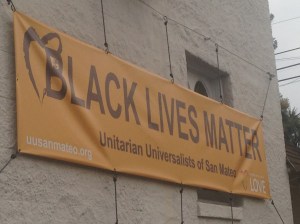
IMG_4365Our Black Lives Matter banner hangs outside our sanctuary, a reminder to be conscious of our complicity in the legacy of violence and hatred that is not yet overcome. We must hold in our hearts and move in our hands ALL of us here in our country who might at any time be the victims of violence of the highest order, violence inflicted by high-powered weapons that kill indiscriminately in every corner of this country: in our churches, mosques, temples and shrines…in our schools and workplaces, in our coffee houses and dance houses and our very homes.

Since the Orlando shooting on June 12th there have been 31 other mass shootings in the U.S. involving 4 or more victims, including the death of 5 in Las Vegas and 5 police officers in Dallas, Texas. More shootings. More vigils. So, what exactly do we mean by vigil?

A vigil is a SACRED kind of watchfulness, a call to be attentive and aware with devotion for the emotions that are sure to surge up within us— emotions of anger, even rage; emotions surrounding loss and shock; emotions steeped in frustration and fear. These emotions can convince us, if we are not careful, that rage justifies the kind of outrage that lashes out, repaying violence with violence, seeking a life for a life, an eye for an eye, the kind of rage that would turn the whole world into an unending whirl of violence and vengeance.

Inevitably,we must come to the question: “What WILL we do?” Because, now awakened, now alert, now vigilant…We know we are called to respond, to act, to engage in change that makes a difference.

Our first question is, “What do we need to make sure we do not do?” How do we honor the memory of those who were victimized by hate? How do we stand with those who are still victimized by hate? How do we keep from falling into the pattern of hate ourselves? Given the size and complexity of the problem, how do we remain vigilant and not acquiesce back into silence, numbness, complacency? How do we do more than pray?

We know that a culture that marginalizes and stigmatizes persons for any reason creates an environment that says violence towards those persons is acceptable because they are the “other,” that are not like us. But we who believe in a better way know that an eye for an eye only leaves us all blind.

We also know that a culture of violence such as ours also creates an environment of numbness and distance and silent complicity, which can be and has been part of what perpetuates the continuance of the dominant culture. We have now heard enough shots to know that silence is inadequate to the task of countering the culture violence. We must employ the power of love and peaceful engagement for we know that moments of silence and prayer are no longer enough. That they have never been enough…

Congresswoman Jackie Speier, our District 14 representative who, out of frustration to the impotence of her Congressional colleagues and out of vigilance and commitment to bringing real change to the culture of gun violence in our country, no longer participates in the moments of silence that have become the only response of our congress to these ceaseless mass shootings that are a plague upon our nation.

Jackie Speier
Jackie Speier

This is what our moments of silence have bought us. A silent nightclub, the only sound the frantic ringing of phones that would never be answered. Silent bodies, where there should be life and love and pride. And here, a silent Congress. Mere words cannot describe the depth of my grief and rage. Forty-nine lives lost, in the middle of Pride Month when they should have been safe and celebrated. Forty-nine families devastated by the loss of their loved ones. Forty-nine phones ringing, and ringing, and ringing. There were also frantic texts, like Eddie Justice’s final messages to his mother: “Mommy, I love you. He’s coming. I’m going to die.

“If you can hear these words without your heart breaking, if you can think of those little children gunned down in Newtown without grieving, if you can think of empty pews in Charleston without mourning, then truly you have lost your humanity.

“Hateful people like to compare LGBTQ equality to the sin-filled Biblical cities of Sodom and Gomorrah. But we in Congress are the real Sodom and Gomorrah. Are there 218 righteous members here to stand against this bloody tide? Increasingly, I doubt it.

“So I ask you today, how many lives must be destroyed before Congress acts?

Nine lives? Charleston showed us nine is not enough.

Thirteen lives? Columbine showed us that 13 is not enough.

Certainly 27 small children killed in their classrooms at Newtown? No.

The 32 lives lost at Virginia Tech? Again, not enough lives.

The more than 33,000 Americans killed each year by guns? Still not enough.

“And now 49 people have been murdered in Orlando.

“Yet even this historic tragedy hasn’t been deemed big enough, horrific enough, or insidious enough to break Congress’ silence.

“Congress is happy to debate for hours about bathrooms, but bring up the gun violence killing thousands? Absolutely not.

“Radical Islam, or home-grown American homophobia, or a toxic stew of both may have inspired the Orlando shooter. No doubt we will learn more about his disgusting motivations in the coming weeks.

“But there are simple actions we can take now, actions that would have reduced the deaths in Orlando as well as Aurora, Newtown, San Bernardino, and at Umpqua Community College…

“I urge you – I beg you – to make America better than this. We must be better than this. “ –Congresswoman Jackie Speier, California’s 14th District.

There exists among us a variety of responses to the NRA, more interested in the rights of those who sell guns than in the lives of innocent victims of gun violence.  The Human Rights Campaign, the largest LGBTQ-rights organization in the country suggests that we work to limit access to all assault weapons: That we move to expand background checks: that we limit access to firearms for suspected terrorists and for people with a history of domestic abuse. Common sense. Yes! In every other “civilized” country in the world, these are understood as common-sense regulations. But, here in our country, while the NRA owns the people’s Congress, these are seen as unreasonable restrictions. This has to stop. We must rise and turn the tide towards peace and justice when it comes to public safety. The best way to honor those who were senselessly slaughtered in Orlando and everywhere else is to act, NOW. We may BEGIN with prayers and with songs and with vigils…but let’s not stop there.

We can do better. We are better than this.

Amen.

May it be so.

– Rev. Ben Meyers

Essay posted under CC NoDerivatives (nd) license. You may copy, distribute, display only original copies of this work with attribution; © portrait, Ben Meyers; Jackie Spear’s portrait is her official one; UUSM photograph is in the public domain; Temple Sholom courtesy of PTseducation under CC SA-BY 3.0, other photographs, Jamie Dedes