Page 33 of 38

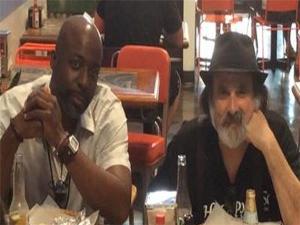
In Conversation: Poet/Musician Graffiti Bleu & Michael Rothenberg, cofounder of the global peace initiative, 100,000 Poets for Change
810919_RJ8dSr1y

You can listen to the two-hour podcast HERE. Recommended! This post is meant as an alert and also to share my two cents.

As I write, it’s just a few hours after listening to Just My Thoughts with Graffiti Bleu on BlogTalk Radio. The show started with an exploration of What does the revolution look like? with Graffiti Blue, Michael Rothenberg, and the show’s panel and callers comprised of poets involved in 100,000 Poets for Change (100TPC).

Harkening back to Gil Scott-Heron and his poem, The Revolution Will Not Be Televised,  part of the discussion was on technology and social networking and their roles in fostering peace, social justice and sustainability. When Heron wrote his poem in 1971, the means to formulate and distribute information and opinion were dominated by mainstream media and corporate interest, which were not in sympathy with the revolution Heron envisioned. Those interests are still dominant and still lack sympathy, but there’s something of a balance occurring – however imperfect – now that we plain folk have access to the tools of technology and social networking. Without social networking, we wouldn’t have 100TPC, which can happily be said to have gone viral since Michael Rothenberg put out a call on Facebook for poets to join in a global peace effort back in 2010. While each of us in the “100,000” has a relatively small “audience” together we touch many, many minds and hearts. We do have an agenda, but it doesn’t foment strife. We’re not in anyone’s pocket. That’s clean power. It’s power to …

On a personal level, one benefit of technology is that people who are homebound – as I sometimes am – can take part in change-making initiatives more actively than simply writing letters-to-the-editor or to our legislators, which is not to say we should give that up. I started a virtual 100TPC via The BeZine and with The Bardo Group Beguines so that disabled people and people who do not live near a 100TPC event would have the opportunity to have their say, to lend their support. Our 2015 commemorative page is HERE.

We need to do more than “talk.”  Agreed. And I think that one of things 100TPC gives us is hope … huge hope from seeing that there are people in every nook-and-cranny of the world who share our values and priorities. This helps us to keep on keeping on with our local grassroots initiatives as well as our broader advocacy. This serves to sustain our faith and commitment.

Ultimately for me, 100TPC is about breaking down barriers, crossing boarders. It leads the way in our evolutionary journey toward a sustainable peace. In the documentary film Ten Questions for the Dalai Lamathe Dalai Lama says “we need more festivals.”  In other words, if we get to know people, if we break bread with them or share a bowl of rice, we are less likely to think of them as “other.”  It will be more difficult to turn around the next day and do harm.  100TPC is our festival. Once we’ve shared hearts, souls and stories through poetry, how can we marginalize anyone? How can we abandon or abuse?

Can the revolution be bloodless? The question is really “will it be?” I don’t think so. I don’t think revolutions are by their very nature “bloodless.” The psychopaths will always be with us and until we stop marginalizing people and leaving them desperate and vulnerable to tyrants, we’ll never have bloodless reform. We’ll never achieve a sustainable peace. Peace is a state that takes awareness and awareness takes growth, which is an evolutionary process.  That doesn’t mean we should give up. It means that as poets we should continue to bear witness, to touch hearts, to raise consciousness and to nurture the process of growth. As poet Michael Dickel said in an interview on this site HERE: “. . . it may not be ours to see the work completed, but that does not free us from the responsibility to do the work.”

© 2016, words, Jamie Dedes, All rights reserved; photograph courtesy of Graffiti Bleu and Michael Rothenberg.

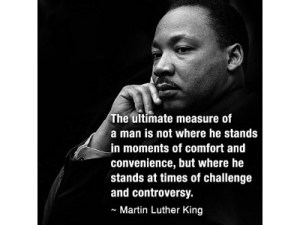
In his steps … Martin Luther King, Jr., a legacy

2016015699419aee083by Rev. Ben Meyers, Unitarian Universalists of San Mateo (UUSM), CA

This past Saturday (January 16), in the North Central Neighborhood of San Mateo, the children in the county school system gathered at the Martin Luther King, Jr. Community Center to listen and support the poets, essayists, and artists who participated in this year’s (the 31st annual) event. Afterward, everyone was invited to gather at UUSM, to celebrate the children and to honor Martin Luther King, Jr. and his legacy with activities, music and buffet.

In most communities across the country, the practice of inviting school-age children to ponder King’s legacy and its impact on the American culture and society is fast becoming a standard practice and tradition. This year’s MLK contest topic encourages an exploration of other leaders who were influenced by King’s message of hope, unity, enfranchisement, and peace. It is right that the “next” generation engage in the continuance of King’s impact because we live in a time when those ideas are daily challenged by continued despair, disparity, and violence. We can yet ask, “Where do we go from here?”

FullSizeRender-1As we celebrate Martin Luther King, Jr.’s birth today, let this be a time when, along with paying our respects to the memory of King’s life and his historic legacy, we raise our consciences from our “moments of comfort and convenience” and ask ourselves in ways never before, “Where are we standing among the current challenges and controversies that yet plague our communities, thwarting our dreams of equality and shredding the network of mutuality of which Dr. King spoke so eloquently?” It is time to know where, or even if, we stand for justice and equity and peace.
If we do not like the answer to our inquiry, let us have the courage and the audacity to move ourselves from our comfort and complacency to a place more inconveniently situated, and stand tall.

© Rev. Ben Meyers, all rights reserved

a story of faith, hope and love

IMG_1955I feel almost inclined to start this story with “once upon a time” since it feels that we began our adventure so long ago.  I started The Bardo Group (though it wasn’t titled that way to begin with) in 2011 as a way to encourage a sort of world without borders by having people from different cultures and religions come together to show what’s in their hearts and in doing so to demonstrate that with all our differences we have much in common: our dreams and hopes, our plans for children and grandchildren, our love of family, friends and the spiritual traditions we’ve chosen or into which we were born  . . . not to mention our love of sacred space as it is expressed in the arts and our concerns for peace, social justice and sustainability.

At one point I decided that it would be nice to have a sort of virtual Sunday service and invited Terri Stewart, a Methodist Minister, to be our “Sunday Chaplain.”  In 2008 she founded Beguine Again, an interfaith platform for clerics and spiritual teachers to offer daily solace and inspiration. I felt comfortable inviting Terri in because she didn’t want to convert anyone and seemed to appreciate the beauty and wisdom of traditions other than her own. She even incorporated the wisdom of other traditions in her rituals and writings. Terri supported our mission. She didn’t appear threatened by different opinions or beliefs.

A little over a year ago, I suggested we might throw our two efforts together, Beguine Again and The Bardo Group. I hoped that would ensure the continuation of the The Bardo Group and the wise, beautiful and valued work and ideals of our core team and guests, a group of earnest and talented poets, writers, story-tellers, essayists, artists, photographers and musicians.  Each is a strong advocate for a better – fair, peaceful and sustainable – world. Together they are a powerhouse.

Okay, yes!  I’m a bit biased.  I’ve only met one of our group in person and only talked by phone with Terri,  but I’ve read everyone’s work – their emails, messages, books, blogs and FB posts for years now.  We’ve been through deaths in families, births and birthdays, graduations, illness and recovery, major relocations, wars and gunfire, triumphs and failures. Two of our original contributors have died. I feel that our core team and our guests might be my next-door neighbors instead of residing in  Romania, England, Algeria, the Philippines, Israel, India, Greece, Bulgaria, the United States and other countries I’ve probably forgotten. We’ve featured work by people ranging in age – as near as I can guess – from 19 to nearly 90. They’ve been Muslims, Christians, Jews, Hindus, Buddhists, atheists and agnostics. The growth of our readership is slow but steady, loyal and just as diverse as our core team and guests.

So what did we do to facilitate this merger: At Beguine Again daily posts continued. That team joined The Bardo Group. We stopped posting daily on The Bardo Group site and started The BeZine, a monthly online publication with a fresh theme for each issue. Terri got a grant to establish a community website from the Pacific Northwest United Methodist Church. The website has been over a year in the works. Today, we unveil it.

footer-logo

The site is designed to be a spiritual networking community.  Though it is an extended ministry of the Lake Washington United Methodist Church, this effort remains both interfaith and a labor of love.

The site is supported by donations, membership (paid membership is optional) and a generous grant from Pacific Northwest United Methodist Church, which funded the design and development of the site. The grant from the church ends on December 31, 2015. Donations and membership fees will support the cost of technical assistance, web hosting and so forth. Should there be any excess funds they will go to the Youth Chaplaincy Coalition, a Seattle nonprofit (also interfaith) founded by Terri under the aegis of the church. Coalition members provide assistance to incarcerated youth. No income is earned by anyone associated with Beguine Again, The Bardo Group, The BeZine or the Youth Chaplaincy Coalition.  All are labors of love.

The BeZine can still be conveniently and easily accessed either directly HERE or through BeguineAgain if you choose to become a member of the community.

Please check out the site. Any questions? Let us know … and do let us know what you think. Please be patient too.  The tech gremlins are still working behind the scenes.

A note on the name: Beguine Again.  The original Beguine community was a Christian lay order in Europe that was active between the 13th and 16th century.  Terri chose the name “Because they worked outside the religious structure and were a safe place for vulnerable people.”

© 2015, article and photograph, Jamie Dedes; Beguine Again logo, copyright Beguine Again

What have we done that people can pick up weapons and kill?

Dan and I as kids and probably the last time he was shorter than I. He stands 6'5' and I stand 5'2".
Dan and me as kids and probably the last time he was shorter than I am. He stands 6’5″ and I am 5’2″.

With all its faults – and there are many – Facebook can be a blessing. I haven’t seen my cousin Dan in almost forty years. I lost track of him, but was much delighted to find him again on Facebook last March. 

Dan and I were raised in the United States, but our family was from Lebanon. Our mothers were sisters. Our religious roots are Melchite (our grandfather’s side) and Maronite (our grandmother’s side).

My mother, Zabaida, used to tell me that in Lebanon first cousins were like brothers and sisters. Among other things this was one way she tried to understand what people meant when they talked or wrote about Jesus having brothers. I understood it as my relationship to my cousins, especially cousins Daniel and Christopher, who were brothers (Christopher died prematurely) and my most beloved relatives.  Though we haven’t seen one another in forever and we’ve walked different paths in life,  I suspect our basic values remain the same: peace, love (respect) for others and for life, and appreciation of life’s gifts. Dan has worked in many places around the world, including Algeria and Dubai. Currently he teaches Theology in the Philippines. This essay is Dan’s.

*****

What Have We Done That People Can Pick Up Weapons and Kill?

by

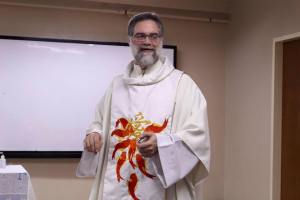
Fr. Daniel S. Sormani, C.S. Sp.

DANIEL S. SORMANI C.S. Sp.

It was one of those things you think but don’t want to say. In the horror of the carnage in Paris and the world’s reaction, it struck me how very little had been said about the terrorist attack in Beirut the day before…or the attack on a funeral in Baghdad…or so much of the other violence that shakes the world. And I felt like I couldn’t say it for fear of looking like I was somehow diminishing the horror or pain of Paris, afraid it could been seen as a lack of respect and understanding. But I wondered. And now so many people are indeed raising such questions, and others are also reacting to such questions, calling them an appalling lack of sympathy…and things have at times spiraled down to a repulsive debate of numbers and geography, rather than of lives and humanity.

When I was young, it was the last hurrah of Lebanon’s golden era when people still referred to it as the “Switzerland of the East” and the wealthy went there to bask on the beach in the morning and ski on its snow-capped mountains in the afternoon. It was the land of poets and artists, and welcomed refugees and visitors equally.

I remember all the Lebanese women with my mother at fundraisers for the Palestinian refugees. We were all kinds of Christians, Muslims, Druze and even a lone family of Lebanese-Jews who ran a shop in our neighborhood. We were just “us”, the Lebanese diaspora, the children of the Phoenicians. And if you were Syrian or Egyptian, that didn’t matter, then we simply enlarged our self-definition to being Middle Easterners. And if you were anything else, then we were “the melting pot” and loved to learn from you.

But so much interference in the internal workings of the country, so much pushing and shoving, dangling of carrots by different powers and religious groups, and finally civil war exploded in Lebanon. What we had known suddenly disappeared. There were a myriad of political parties I couldn’t keep up with, weekly fundraisers for dozens of necessary causes, a flood of refugees, some legal, some not. It should have brought us together, made us one in the struggle for peace and justice. But it didn’t.

I remember vividly the look of joy on the face of complete strangers if they heard my family speak a bit of Arabic. There would be warm introductions and everyone wanted to know everyone. Suddenly it was different. I would say something in Arabic, and the other person would immediately ask “Muslim?” I remember once in my old neighborhood I went into an Arabic music store and was taken by the album playing. Great music, but the dialect threw me a bit. I cheerfully greeted the young man behind the counter with a wish for a morning filled with goodness. He gave me an annoyed look and pointed to the veiled young woman. When he walked away the woman leaned over and whispered in Arabic, “Don’t mind my brother. It’s clear from the way you greeted him that you’re not Muslim.”

I remember in Algeria when I used the traditional Muslim greeting of peace in the market place and the stall-keeper rudely told me I had no right to say such a thing because he knew I wasn’t Muslim. To my delight, an elderly gentleman in traditional dress got angry and shouted at him, “And what should he do, wish you war and trouble instead?” He went on to greet me with great poetry and many warm blessings. Touched, I kissed him the way one kisses his favorite uncle and a few of the women, all wrapped in the white haiks of western Algeria, applauded and blessed God. This, I thought, is what family is, this is how we will conquer the darkness.

We have become our own worst enemy. Whenever we separate the world into “them” and “us”, whenever we accept blind generalizations and cease to see a unique individual before us, whenever we forget we are all victims of carefully orchestrated deceit and deception for wealth and power, the force of darkness wins. Bullets will never win this struggle, only the heart and mind will.I know political scientists and analysts can tear my thoughts to shreds. I do not claim an intellectual understanding…I am only sharing a broken heart that grieves.

A young Melchite priest once told me a story from his village in Lebanon during the war. There was intense shelling and sniper fire for almost three days. After it stopped, people went out to gather up the dead. An old man went to the church and asked the priest to offer two masses. The priest took his pen and book and asked the man to continue. The first mass, he said, was for his son whom they found shot to death in the orchard by their house. And the second mass was for the person who shot him. Startled, the young priest looked at the old man with amazement. The old man explained the obvious saying “What have we done that people can pick up weapons and kill strangers? What have we done that some poor fellow can kill my son without feeling it? We must pray for him, and ask God’s forgiveness.” When I remember that story, after all these years, I still cry.

© 2015, essay and family photographs, Daniel S. Sormani C.S. Sp., All rights reserved

This slideshow requires JavaScript.