Page 8 of 38

Part 1 of 3: Zimbabwean Poet in Exile: Award-Winning Mbizo Chirasha, A Life on the Run, Interview
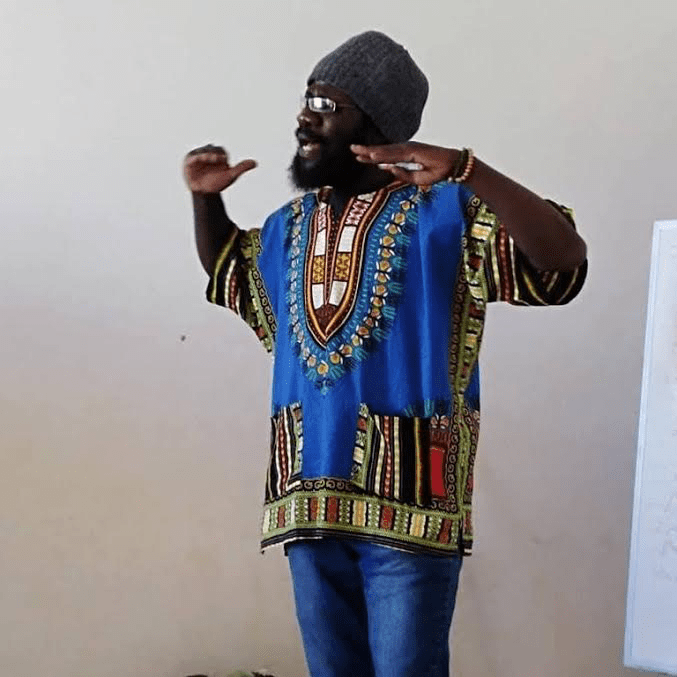
Mbizo Chirasha

“Mother Africa survived the trauma of clanging chains of captivity during slave trade, shackles of colonialism, and winced from beatings of hard bolt nut clenched fists of apartheid. Children and grandchildren of Mother Africa watched helplessly her sorrowful dance to the acoustics of sufferance. Still, Africa remains resilient … smashing punches from kindred’s of neocolonialism: global village, digital revolution and consumerism. Mama Africa’s groin is ripped apart by her triplets: totalitarian regimes, economic malaise and moral decadence. Today Mother Africa of pyramids, Africa of Nefertiti , Africa of Lumumba, Africa of Mandela, Africa of Kambarage , Africa of Lithium , Africa of diamond and Africa of uranium wallow in murky waters of poverty, chronic civil wars, and deadly epidemics.” Mbizo Chirasha, Editor, Brave Voices Poetry Journal.


Orthographic map of Africa courtesy of Martin23230 C BY-SA 3.0

When I was a junior in high school (circa 1966), our civics/history teacher said that Africa was a continent of much promise because of its diverse populations, its biodiversity, mineral resources, endless beauty, and its arts and wisdom traditions. She was right, of course. As a consequence, we spent several months of that school year studying the promise of Africa and its peoples.

For years after, Africa haunted me: Mosi-oa-Tunya, birds hitching rides on giraffeswhite rhinos, the rhythms of kebero drums and the swing-and-sway of folk dance, the injera, the wat, and the niter kibby.  But our teacher’s great vision of Africa’s promise was largely unfulfilled. Blame it on the fall-out from old-and-new waves of colonialism, apartheid, and corporate land-grab and land-rape. What could have been a place of hope and high expectation is rife with turmoil, poverty, and suffering. It is a place where poets who speak out against violent despots and greedy kleptocrats put themselves at great risk in doing so. Today, I have the pleasure of featuring Mbizo Chirasha, one such poet. He is dedicated to gender equity, environmental justice, and human rights and he is on the run . / J.D.
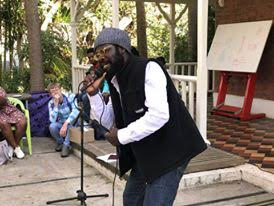
INTERVIEW

JAMIE: What were the events in your life that lead you to socially engaged poetry?

MBIZO: My father was a storyteller, an African traditionalist, a
singer and a village griot. I grew up listening to the sound of the
wind of the drum. Ritual and ancestral ceremonies were the norm
and usually accompanied  by spiritual song, dance, drum and chants. I
was introduced to words at a  tender age and more over to
sounds of chirruping birds, syntactic over night hooting of owls,
the rhythmic dove cooos, the dance and the smile of white moon. I am a
grandchild of African proverb.

I am a child of war. I was born during the Zimbabwean struggle for independence.
My ears sedimented to the clap of gun shots  and the thunder of death, the
thud of grenades, and heave of the Pungwe River’s songs. I read Achebe, Ngugi,
Marechera, Hamutyineyi, Neto, Senghor, Miriam Ba, Tsodzo, Chiundura Moyo, Makari,
Soyinka and more in my early teens. I became a school griot when I was seven.

JAMIE: Why is your life at risk?

MBIZO: I write the truth to any form of leadership: cultural, social and
political, My literary arts activism and my human rights and arts for
justice activities put me at risk.

I write feature articles that speak against dictatorship, injustice
and tyranny. Political leadership in Zimbabwe does not like the truth.
They want praise, which I think is a bad sign. We have violent goons
among leaders who thrive on silencing writers, artists, activists and
human rights defenders.

I am the Founder of the Zimbabwean We Want Poetry campaign, a global
literary activism campaign that exposed and is exposing political rot, poor
governance and corruption in Zimbabwe specifically and in greater Africa.

That campaign has led to the founding of the Brave Voices POETRY JOURNAL
and the Freedom Voices Poetry Writing competition. This in turn has lead to the
publication of more than 10,000 poems on various social media platforms.

My poetry in books and  journals is critical to fighting systems that oppress masses,
systems that violate human rights, systems that loot the economy and subject
masses to abject poverty .

My latest poetry collection, A Letter to the President, the title itself does not sit well with politicians, zealots, and charlatans who survive on political and economic strife, but the collection is a must  read.
It never mentions names but it speaks truth against injustice, corruption, violence and expediency and it got me in trouble: death threats, tailing, and haunting after the grand launch.

I don’t hesitate to write the truth. We have suffered under dictatorial leadership in Zimbabwe. We want the new leadership to reform and to refrain
from abductions, corruption, violence and looting. We need the purpose to live, to belong and to love our beautiful country. We want political violence
stopped. The abduction of artists and activists must stop.

JAMIE: What is the status of your situation now?

MBIZO: Exile has never been good but resilience is key. In exile you are both foreign to yourself and foreign to the land.  Accommodation, security, resources, communication, and other foundations of personal welfare and trust become first priorities and they are not easy to come by because one is not in his usual haven. The stalking is constant and exhausting. You sleep with an open eye or walk with your eyes above your shoulders.

JAMIE: You put in an application to ICORN* in 2017. What was the response?

MBIZO: I am not happy because the reply was really bad, I don’t know whether
they want you to loose a leg, a hand, or to die for them to accept your application
to be safe.

* International Cities of Refugee Network; ICORN’s mission is “protecting and promoting writers and artists at risk.”  I’ve read Mbizo’s paperwork. Responses to Mbizo’s 2017 application for assistance repeatedly indicate that his paperwork is in process but no action has been taken by ICORN on Mbizo’s behalf over the two years since he filed for safe haven.

JAMIE: What organizations have come forward to help you?

MBIZO: The main  and major organization that have stood by me since 2017
are the following
a)      PEN GERMANY 2017
b)      EU-AFRICA DEFEND DEFENDERS FUND
c)      ANDREAS WEILAND( WRITER/TRANSLATOR)
d)      ELKE LANGE- SPAIN /GERMANY
e)      INTERNATIONAL HUMAN RIGHTS ARTS FESTIVAL/THOMAS BLOCK
f)      FREEMAN CHARI OF DIASPORA FUNDS
g)      TRACY YVONNE BREAZILE
h)      HADAA SENDOO FROM MONGOLIA
i)      MICHALE DICKEL- WRITER IN ISRAEL

JAMIE: What is your plan now and how can we as part of the greater poetry community assist?

MBIZO: I continue with writing for justice, human rights, the truth, and with activism and literary activism. In this moment of madness, trials and hardships, poets must unite. Help me lobby resources, lobby institutions that offer assistance to writers-at-risk: PEN, UN Human Rights, Writers Centres, and Artists for Justice Centres for safety retreat.

We must all keep writing for truth, justice, and  good governance.

Editor’s note:  I want to get a letter-writing campaign going for Mbizo to help him attain safe haven. More on that in Part 3 on Monday.  Tomorrow (Sunday), you’ll have the opportunity to read four of Mbizo’s poems.  Stay with us in solidarity for free-and-open civil discourse, social justice and responsible governance. May all sentient beings find peace. 

© 2019, introductory text, Jamie Dedes; photos and interview text, Mbizo Chirasha

RELATED:

MBIZO CHIRASHA is a recipient of PEN Deutschland Exiled Writer Grant (2017), Literary Arts Projects Curator, Writer in Residence, Blogs Publisher, Arts for Human Rights/Peace Activism Catalyst, Social Media Publicist and Internationally Anthologized Writer, 2017 African Partner of the International Human Rights Arts Festival Exiled in Africa Program in New York. 2017 Grantee of the EU- Horn of Africa Defend Human Rights Defenders Protection Fund. Resident Curator of 100 Thousand Poets for Peace-Zimbabwe, Originator of Zimbabwe We Want Poetry Movement. He has published a collection of poetry, Good Morning President, and co-created another one Whispering Woes of Ganges and Zembezi with Indian poet Sweta Vikram.


Jamie Dedes. I’m a freelance writer, poet, content editor, and blogger. I also manage The BeZine and its associated activities and The Poet by Day jamiededes.com, an info hub for writers meant to encourage good but lesser-known poets, women and minority poets, outsider artists, and artists just finding their voices in maturity. The Poet by Day is dedicated to supporting freedom of artistic expression and human rights and encourages activist poetry.  Email thepoetbyday@gmail.com for permissions, commissions, or assignment

About / Testimonials / Disclosure / Facebook / Medium

Recent poems and short stories: How 100,000 Poets Are Fostering Peace, Justice, and Sustainability, YOPP! * The Damask Garden, In a Woman’s Voice, August 11, 2019 / This short story is dedicated to all refugees. That would be one in every 113 people. * Five poems, Spirit of Nature, Opa Anthology of Poetry, 2019 * From the Small Beginning, Entropy Magazine (Enclave, #Final Poems), July 2019 * Over His Morning Coffee, Front Porch Review, July 2019 * Three poems, Our Poetry Archive, September 2019


“Every pair of eyes facing you has probably experienced something you could not endure.”  Lucille Clifton

“On Living” and “Letters from a Man in Solitary,” poems by Nâzım Hikmet

“It’s this way:
being captured is beside the point
the point is not to surrender.
Nâzım Hikmet, Poems of Nazım Hikmet


On Living

Living is no laughing matter:
You must take it seriously.
So much so and to such a degree
that, for example, your hands tied
behind your back,
your back to the wall
or else in a laboratory
in your white coat and safety glasses,
you can die for people –
even for people whose faces you’ve
never seen,
even though you know living
is the most real, most beautiful
thing.
I mean, you must take living so
seriously
that even at seventy, for example, you’ll
plant olive trees –
and not for your children, either,
but because, although you fear death you
don’t believe it,
because living, I mean, weighs heavier.

Nâzım Hikmet, Poems of Nâzım Hikmet

Letters from a Man In Solitary 

1
I carved your name on my watchband
with my fingernail.
Where I am, you know,
I don’t have a pearl-handled jackknife
(they won’t give me anything sharp)
or a plane tree with its head in the clouds.
Trees may grow in the yard,
but I’m not allowed
to see the sky overhead…
How many others are in this place?
I don’t know.
I’m alone far from them,
they’re all together far from me.
To talk anyone besides myself
is forbidden.
So I talk to myself.
But I find my conversation so boring,
my dear wife, that I sing songs.
And what do you know,
that awful, always off-key voice of mine
touches me so
that my heart breaks.
And just like the barefoot orphan
lost in the snow
in those old sad stories, my heart
— with moist blue eyes
and a little red runny rose —
wants to snuggle up in your arms.
It doesn’t make me blush
that right now
I’m this weak,
this selfish,
this human simply.
No doubt my state can be explained
physiologically, psychologically, etc.
Or maybe it’s
this barred window,
this earthen jug,
these four walls,
which for months have kept me from hearing
another human voice.

It’s five o’clock, my dear.
Outside,
with its dryness,
eerie whispers,
mud roof,
and lame, skinny horse
standing motionless in infinity
— I mean, it’s enough to drive the man inside crazy with grief —
outside, with all its machinery and all its art,
a plains night comes down red on treeless space.

Again today, night will fall in no time.
A light will circle the lame, skinny horse.
And the treeless space, in this hopeless landscape
stretched out before me like the body of a hard man,
will suddenly be filled with stars.
We’ll reach the inevitable end once more,
which is to say the stage is set
again today for an elaborate nostalgia.
Me,
the man inside,
once more I’ll exhibit my customary talent,
and singing an old-fashioned lament
in the reedy voice of my childhood,
once more, by God, it will crush my unhappy heart
to hear you inside my head,
so far
away, as if I were watching you
in a smoky, broken mirror…

2
It’s spring outside, my dear wife, spring.
Outside on the plain, suddenly the smell
of fresh earth, birds singing, etc.
It’s spring, my dear wife,
the plain outside sparkles…
And inside the bed comes alive with bugs,
the water jug no longer freezes,
and in the morning sun floods the concrete…
The sun–
every day till noon now
it comes and goes
from me, flashing off
and on…
And as the day turns to afternoon, shadows climb the walls,
the glass of the barred window catches fire,
and it’s night outside,
a cloudless spring night…
And inside this is spring’s darkest hour.
In short, the demon called freedom,
with its glittering scales and fiery eyes,
possesses the man inside
especially in spring…
I know this from experience, my dear wife,
from experience…

3
Sunday today.
Today they took me out in the sun for the first time.
And I just stood there, struck for the first time in my life
by how far away the sky is,
how blue
and how wide.
Then I respectfully sat down on the earth.
I leaned back against the wall.
For a moment no trap to fall into,
no struggle, no freedom, no wife.
Only earth, sun, and me…
I am happy.

Trans. by Randy Blasing and Mutlu Konuk (1993) / Poem Hunter

RELATED:

Nâzım Hikmet

Nâzım Hikmet / courtesy of Bundesarchiv Bild 183-14809-0004, Berlin, Schriftsteller-Besuch.jpg under CC BY-SA 3.0 de

Nâzım Hikmet (1902 – 1963) was a Turkish poet, playwright, novelist, screenwriter, director and memoirist. He was acclaimed for the “lyrical flow of his statements”.  Since he was a revolutionary in his time, he seemed a good poet to present today, the day we celebrate Global 100,000 Poets and Friends for Change and The BeZine Virtual 100TPC. (Join us HERE and share your work. Read that of others.)

Additionally, he has always fascinated me, not only because of his poetry and the way he spent his life, but because he was born in the same time and place as my father, someone I barely knew.  I feel a bit like I get a glimpse at the times and culture into which my father was born when I read Hikmet.

Described as a “romantic communist” and “romantic revolutionary”, he was repeatedly arrested for his political beliefs and spent much of his adult life in prison or in exile. His poetry has been translated into more than fifty languages.

Despite writing his first poems in syllabic meter, Nazım Hikmet distinguished himself from the “syllabic poets” in concept. With the development of his poetic conception, the narrow forms of syllabic verse became too limiting for his style and he set out to seek new forms for his poems.

He was influenced by the young Soviet poets who advocated Futurism. On his return to Turkey, he became the charismatic leader of the Turkish avant-garde, producing streams of innovative poems, plays and film scripts. Breaking the boundaries of syllabic meter, he changed his form and began writing in free verse, which harmonized with the rich vocal properties of the Turkish language.

He has been compared by Turkish and non-Turkish men of letters to such figures as Federico García Lorca, Louis Aragon, Vladimir Mayakovsky, Faiz Ahmed Faiz and Pablo Neruda. Although Ran’s work bears a resemblance to these poets and owes them occasional debts of form and stylistic device, his literary personality is unique in terms of the synthesis he made of iconoclasm and lyricism, of ideology and poetic diction.[5]:19

Many of his poems have been set to music by the Turkish composer Zülfü Livaneli. A part of his work has been translated into Greek by Yiannis Ritsos, and some of these translations have been arranged by the Greek composers Manos Loizos and Thanos Mikroutsikos.

Because of his political views his works were banned in Turkey from 1938 to 1965.

Nazim Hikmet was awarded the International Peace Prize in 1950.


Jamie Dedes. I’m a freelance writer, poet, content editor, and blogger. I also manage The BeZine and its associated activities and The Poet by Day jamiededes.com, an info hub for writers meant to encourage good but lesser-known poets, women and minority poets, outsider artists, and artists just finding their voices in maturity. The Poet by Day is dedicated to supporting freedom of artistic expression and human rights.  Email thepoetbyday@gmail.com for permissions, commissions, or assignments.

About / Testimonials / Disclosure / Facebook

Recent and Upcoming in Digital Publications Poets Advocate for Peace, Justice, and Sustainability, How 100,000 Poets Are Fostering Peace, Justice, and Sustainability, YOPP! * The Damask Garden, In a Woman’s Voice, August 11, 2019 / This short story is dedicated to all refugees. That would be one in every 113 people. * Five poems, Spirit of Nature, Opa Anthology of Poetry, 2019 * From the Small Beginning, Entropy Magazine (Enclave, #Final Poems), July 2019 * Over His Morning Coffee, Front Porch Review, July 2019 * Three poems, Our Poetry Archive, September 2019


“Every pair of eyes facing you has probably experienced something you could not endure.”  Lucille Clifton

National Banned Books Week (Sept. 22-28) Focus on the Right to Read in the Nation’s Prisons

Photo courtesy of George Hodan, Public Domain Pictures.net

“Literature Locked Up” will engage authors, readers, and policymakers to support an end to prison book bans nationwide.”


America’s prison system implements that largest book ban in the United States. This year, as part of national Banned Books Week (Sept. 22 – 28), the free expression and literary organization PEN America will launch a weeklong initiative to shed light on the practice of banning books in the nation’s prisons and jails. “Literature Locked Up: Banned Books Week 2019” will feature events across the country, online activities, and public education to highlight restrictions of the right to read for the 2.2 million people currently incarcerated in the United States.

“With all of our societal focus on how to make the criminal justice system more just and less self-defeating, vindicating the right to read in prison is an obvious and essential step,” said Suzanne Nossel, CEO of PEN America. “Yet tens of thousands of books are banned in prisons. Systems ban access to everything from classics including Alice Walker’s The Color Purple and Toni Morrison’s Paradise, to coloring and self-help books. These restrictions are stunningly arbitrary and defeat the ability of incarcerated people to learn, explore, and envision a future. We call on states and the federal government to lift these pointless bans and uphold the freedom to read.”

Increasingly, state and federal prisons are dramatically restricting book deliveries or shutting them down entirely. The federal Bureau of Prisons recently attempted to institute an unexplained 30 percent markup on books ordered by or for incarcerated readers, ultimately rescinding that idea under public pressure. Texas’ Department of Criminal Justice has banned over 15,000 books from its prison system, including books by Alice Walker, John Grisham, Michelle Alexander, Jenna Bush Hager, Frederick Douglass, and Bob Dole. Throughout Banned Books Week, PEN America and its members will highlight this injustice and call for reform.

As part of “Literature Locked Up,” PEN America has launched a national petition drive urging the House and Senate Judiciary Committees to convene hearings on book banning in the nation’s prisons. The organization is coordinating with bookstores and other partners across the country to highlight book bans, including events in Oklahoma, Michigan, Illinois, and Texas. And alongside the Dramatists Legal Fund, PEN America will co-present Banned Together, a series of performances across the country of shows that have been censored or challenged on the American stage.

“Banning books is a serious threat to free inquiry and free expression,” said award-winning author and PEN America board member Dinaw Mengestu. “We’re calling on state prison systems across the country to review their policies and, where possible, rescind arbitrary book bans. And we’re asking members of Congress to review book restriction practices at the federal level. Oftentimes all that stands between prisoners and a transformative work of literature are arbitrary decisions made by wardens and prison mailrooms. It just shouldn’t be that way.”

PEN America has long been at the forefront of supporting the right of incarcerated people to create and access literature, including mentoring, honoring, and finding audiences for writers currently in prison through the Prison and Justice Writing Program. Many of those writers will be featured in a series of public readings co-sponsored by PEN America and The Poetry Project. That series, BREAK OUT, will include dozens of public readings events for the month of September.

Read more about the “Literature Locked Up: Banned Books Week 2019” project; see events related to the initiative; and follow our social channels to get live updates as more events are added to the calendar. You can also listen to a playlist of banned songs assembled by PEN America’s Artists at Risk Connection.

Putting the “active” in activism: An interview with activist writer and blogger Kella Hanna-Wayne

The longest running peace vigil in U.S. history, started  in 1981. White House Peace Vigil, Lafayette Square, Washington, D.C. The peace vigil was started by activists Thomas and Concepcion Picciotto.  / Photo courtesy of moi 84 under CC BY-SA 3.0 license

“There may be times when we are powerless to prevent injustice, but there must never be a time when we fail to protest.”  Elie Wiesel


Toward the end of June this year I was introduced to Kella Hanna-Wayne’s (Yopp) work via a Facebook link shared by my colleague and friend, Michael Dickel, which he in turn received from his daughter. I subsequently included info on Kella and her post HERE. That’s the way the world moves these days. Though technology and social networking are mixed blessings in some respects, they’re effective tools for people like Kella and I who have work to which we are committed but deal everyday with serious physical disabilities that constrain (in my case prohibit) activity outside the home.

The link of which I speak was to a  post in which Kella provided some well-considered guidelines and resources for protesting the migrant travesties on the U.S. Southern Border. As I investigated Kella’s site, I was impressed with her thoroughness and clarity. I wrote to her about doing an interview on The Poet by Day for our activist poets, writers, and friends. She agreed. Here it is. Read on. / J.D.


JAMIE: Kella, you have taken on such a range of causes, all of them important, critical. Not everyone can do that. I hear people talk about “compassion burnout,” which is understandable but irritating. It’s a luxury oppressed people don’t have. I usually respond with “pick a cause. Pick one cause and focus on that.” What’s your advice?

KELLA: I think all of us, including activists, can agree that social justice is simply overwhelming. There are so many causes, there’s so much to learn about every cause, and to make things even more complicated, the needs of each cause are constantly progressing and changing. It’s a lot to keep up with.

But one of the fundamental ideas behind my blog is that there are a basic set of guidelines that you can follow that will help you understand any source of oppression. Instead of learning about male privilege, and then white privilege, and then financial privilege, why not learn how the concept of privilege works so that you can apply it to any new cause you learn about? There are so many challenges marginalized groups face that they have in common with one another: microaggressions, oppressive language, policing of their emotions/bodies, even difficulty accessing medical care. I think that if you learn the functionality of the oppressive systems that are at work and all the basic components of social justice, it enables you to support these groups of people much more effectively and thoroughly than if you were trying to learn one cause at a time from scratch.

I also think that even if you do choose to focus primarily on one cause, it’s important to be aware of the basics of the other ones because social justice issues are all inextricably connected to each other and ignoring the way intersectionality impacts the problems that we’re tackling tends to leave holes in our solutions.

JAMIE: What then are the steps activists can take to minimize burnout?

KELLA: No matter how narrow your focus, social justice issues are far bigger than any one person can solve. Because activism has to be a collective effort, I think it’s really important to recognize that completely fixing the problem is an impossible standard to hold yourself to. You are one piece in a much larger effort to create change. Even when you are focusing on what is within your personal power, you have to be realistic about what you can actually accomplish. If there are 20 different tasks that you could do as an activist and each one is individually within your ability to do, it’s likely doing all 20 of them is not. You have to choose what it is that you are going to do.

To make that choice, I recommend focusing on forms of activism that…

  • Are sustainable so that you can continue to do them over time
  • Are empowering to you so that you feel motivated to continue
  • Aren’t deeply upsetting or draining in such a way that the cost of the task is greater than the positive impact the action has
  • Feel right to you.

Which forms of activism meet those criteria is going to be different for everyone. For example, I believe that calling your representatives is an effective way to impact the future of our country but I find making phone calls incredibly anxiety-inducing and I have to spend a lot of energy to get myself to make one. That’s not a good use of my resources. On the other hand, writing comes easily to me, I find it rewarding, and it’s something that a lot of other people can’t contribute. I can accomplish way more by writing on behalf of activism than I could if I were using the same amount of resources to make phone calls. Whenever I feel the push to do more for a cause, I re-center on the importance of my writing and how much I’m offering in the work I already do.

A philosophy I carry around with me wherever I go is that everyone has something of value to offer. You have to find what your offering is.

JAMIE:  Tell us about Yopp Academy.

KELLA: Yopp Academy is a section of my blog that focuses on educational material. It’s where I’m outlining that basic set of social justice guidelines I mentioned earlier.

To distinguish the amount of prior knowledge that’s needed to understand a given article, I used a college-style course numbering system, so articles are sorted into 100 level, 200 level, 300 level, etc. If you’re brand new to social justice, you start with the 100 level articles and work your way up. It really does function like a set of college courses in that articles of higher levels directly reference ideas from the level 100 articles, so the more of them you read together, the better your understanding will be of the subject as a whole.

The articles I have published currently only go up to level 300 because I’ve been putting my focus on establishing all the basic concepts before adding more advanced stuff. I’m currently working on a lesson plan of over 40 educational articles to serve as a foundation of knowledge which you can use regardless of your level of involvement with activism, which will include higher-level articles in the future.

JAMIE: Tell us about your Facebook debates.

KELLA: I’ve always had a lot of friends on facebook who are into social justice and some of them have such large friends list that anytime they posted something controversial, it would spark a discussion/debate. I started jumping into these discussions and offering my opinion and I got a reputation for being good at explaining basic social justice concepts to people who weren’t familiar with them and for clearly outlining the problems in someone else’s argument.

I used Facebook debates to practice my writing, increase my own understanding of social justice, it introduced me to a bunch of other amazing people that cared about the same things, and because managing my disability/mental illnesses made traditional activism prohibitive, it gave me a way to be involved in causes I cared about. Spending so much time arguing with people who I disagreed with also gave me a lot of insight into the places people were most likely to have holes in their understanding of our social systems which in turn has really informed the content and the structure of my blog. I often say the reason I started a blog in the first place was that I got tired of writing out the same explanations/arguments over and over again, and just wanted to write out the article once to link to every time I came across the same issue again.

I know I differ from a lot of people in that I believe debates on social media, even the “unproductive” ones, are an important branch of activism. Not only do they spread information to larger audiences of people (while only 10 people might be commenting, 1,000 could be reading the comments) but they serve as a means of socializing bigots to understand that their bigotry will be met with hassle and frustration rather than easy acceptance like they’re used to. I think that practice has a lot more power than people think it does.

JAMIE:  So many people – like you and me – live with chronic, even catastrophic, illness. What can these illnesses teach us about social justice and advocacy?

KELLA: If you hold a conference for activism regarding chronic illness but you organize it in a similar way that you would any other business conference, your collection of speakers, organizers, and attendants are likely to be mostly healthy people rather than chronically ill people. If it’s energy-intensive to leave your house/travel, if you need frequent breaks or a special housing set up, if you have extensive food restrictions or you need to hire a carer to accompany you, it’s going to be very difficult, resource costly, and risky to go to a conference that healthy people can attend with ease. Even in attempting to center the chronically ill, if you organize from the perspective of a healthy person, you will leave chronically ill out of their own activism. That’s because the default systems that we have in place for most aspects of society make it very difficult for chronically ill people to participate let alone succeed.

Anytime you design a solution for the social issues chronically ill people face, you have to start by adapting your mindset and prioritizing accommodation of an experience that you’re not familiar with, or you’ll fail at your advocacy from the beginning.

And this idea is not at all exclusive to chronic illness. You see the same problem with white people organizing on behalf of people of color, cis people organizing for trans people, abled people organizing for disabled people, etc. You have to go in understanding that in order for your advocacy to be successful, you have to dismantle the relevant oppressive systems that are within your scope of power and create new systems, a new foundation before you attempt to build any kind of structure on top.

JAMIE: Your site is about eighteen months old as we work on this post. What are the goals for the next couple of years?

KELLA: I’m still very much working out what my ideal version of Yopp would be or what I want it to accomplish but so far, my concrete plans are:

  • Switch over to a new, more modern and accessible website
  • Finish writing the basic building blocks for Yopp Academy (all 40 of them!!)
  • Build up my Patreon supporter base– my first goal is $800 a month
  • Acquire enough sponsorships that I can publish up to 4 times a month

© 2019, Kella Hanna-Wayne

Kella Hanna-Wayne

KELLA HANNA-WAYNE (Yopp) is a disabled, chronically/mentally ill freelance writer who is the editor, publisher, and main writer for Yopp, a social justice blog dedicated to civil rights education, elevating voices of marginalized people, and reducing oppression; and for GlutenFreeNom.Com, a resource for learning the basics of gluten-free cooking and baking. Her work has been published in Ms. Magazine blog, Multiamory, Architrave Press and is forthcoming in a chapter of the book Twice Exceptional (2e) Beyond Learning Disabilities: Gifted Persons with Physical Disabilities. For fun, Kella organizes and DJ’s an argentine tango dancing event, bakes gluten-free masterpieces, sings loudly along with pop music, and makes cat noises. You can find her on Facebook, Twitter, Patreon, Medium, and Instagram.


ABOUT 

Jamie Dedes. I’m a Lebanese-American freelance writer, poet, content editor, blogger and the mother of a world-class actor and mother-in-law of a stellar writer/photographer. No grandchildren, but my grandkitty, Dahlia, rocks big time. I am hopelessly in love with nature and all her creatures. In another lifetime, I was a columnist, a publicist, and an associate editor to a regional employment publication. I’ve had to reinvent myself to accommodate scarred lungs, pulmonary hypertension, right-sided heart failure, connective tissue disease, and a rare managed but incurable blood cancer. The gift in this is time for my primary love: literature. I study/read/write from a comfy bed where I’ve carved out a busy life writing feature articles, short stories, and poetry and managing The BeZine and its associated activities and The Poet by Day jamiededes.com, an info hub for writers meant to encourage good but lesser-known poets, women and minority poets, outsider artists, and artists just finding their voices in maturity. The Poet by Day is dedicated to supporting freedom of artistic expression and human rights.  Email thepoetbyday@gmail.com for permissions, commissions, or assignments.

Testimonials / Disclosure / Facebook

Recent and Upcoming in Digital Publications * The Damask Garden, In a Woman’s Voice, August 11, 2019 / This short story is dedicated to all refugees. That would be one in every 113 people. * Five poems, Spirit of Nature, Opa Anthology of Poetry, 2019 * From the Small Beginning, Entropy Magazine (Enclave, #Final Poems), July 2019 * Over His Morning Coffee, Front Porch Review, July 2019 * Three poems, Our Poetry Archive, September 2019


“Every pair of eyes facing you has probably experienced something you could not endure.”  Lucille Clifton