Page 19 of 91

Six poems by Gary Lundy with illustrations by Michael Dickel

DESCRIPTION A CONVERSATION OUTSIDE
ORDINARY HEADLINE BREATHS


Re-published with permission from Meta/ Phor(e) /Play (originally here)


description fools the eyes into believing 

what’s seen and what remains unrelated. time an error sign warning. nothing falls loudly in snowfall. pronouns lock up favor in a room filled with promises. the most beautiful numbered in group of tens. synthesis sewn into bunches of colored thread. to list brings forth a kind of living. tongue tied along with arms and legs. to find a modicum of stability. happiness a terrorist slogan. unless children playing. the anonymity that accompanies sorrow. never trails in the fresh snow covering. bound backwards in an unintentional circuitous pleasures. enlighten in a beyond what’s meant. intention a rousing crowd noises.

Description
Digital landscape from photographs
©2019 Michael Dickel

a conversation moves across the boundaries of years

no. those interruptions are part of it. how abstraction innervates the painting. when sets of eyes follow from several heights and distances. why imagine their clothing marked by unexamined biology. or agreed upon genitalia. not everyone stands the same height. or the strength of mobility weakens. how an other coughs and pukes in the alley. privacy a construct of entitlement. they already. get over it. as the lover refuses birthed name. notorious in a broad circle of strangers. the gun used in a high school shooting belongs to someone. carries with it the fatality of not looking back. according to community standards. which is another private property sign. who but those intimates will even stop to grieve. and the hot water’s off once again.

Conversation
Digital landscape from photographs
©2019 Michael Dickel

outside an actual frame of reference

a serious question then. what to do with the excessive immediacy inundating consciousness. as easy as turning on and skimming surfaces. locked within screen time. along side an apparent necessity to for once gain notoriety. be finally seen. how simply breathing exercises little in the way of memorable. of more importance is being noticed by an unexpected glance. how not to be impressed by such a shocking occurrence. flattery imbibes a momentary elevated sensibility. or when hiding under books to avoid gunfire. often there’s a thoughtless need to protect others. concern then reverts to counter intuitive action. walk out. displace. argue over semantics. over noun and pronoun choices. volume as sound resists capture and redistribution.

Outside
Digital landscape from photographs
©2019 Michael Dickel

on an ordinary any other day

the intimacy of a shared cigarette or gin on rocks. lock lips within narrow boundaries. again indentation separates one body from another. impossible to get close enough to be a part of individual insights. and the rising sound of surrounding voices turn into a storm of thunder. and violence. quite naturally possessions belong to the outside others. heavy base lines a snow speckled fence. guaranteed to keep what’s original outside the boundaries demarcating one from another. or the many flooding the town violently. arguing about every perceived errancy. waiting word from someone for days. then forgetting that time itself companions. repetition may be a sure sign of pleasurable moments entwined.

Ordinary
Digital landscape from photographs
©2019 Michael Dickel

headlines useful only to reduce the size of turmoil

bodies dumped in a winter ocean. color barriers and marching drums. dozens of missed opportunities vanish in the ether. beauty is when faced reflection. some appear so comfortable in their bodies. while many others resist the encampment of pronouns. lighten the barriers to authenticity. stiffening neck in refusal. while rubbish shredded an alley away. break out into flailing body parts. such rapid departures within a single cellular event. all the while identities reside within frequent arguments. arms and legs painted red swelling. held in the collective unexamined violence. among the fear of hurt feelings. of pronouncing certainties.

Headline
Digital landscape from photographs
©2019 Michael Dickel

breaths gloss over frames of reference

when temperature is below zero chill grows customary. even when framed otherwise transparent entitlement rules. few see themselves as inherently wrong. through fault lines another image unfolds. pronouns aren’t a recognized sport. yet listen to the bullying exchange. threat level perceived as high for the one committed to thought of how it’s always been. not on our watch the chorus disrupts. have gun will travel bravely. synchronized blame game. where tickets are distributed freely. whether sought after or not. the negative rising to a height witnessed as governing. actions retreat into a darkened room. where light cannot penetrate. deep in the refuse of the closed minded. where choice of colors might have liberated. each contradiction its own typo.

Breaths
Digital landscape from photographs
©2019 Michael Dickel

gary lundy
photo by Kaylen Krebsbach ©2018

gary lundy’s poems have appeared most recently in Cutbank: Weekly Flash Prose & Prose PoetrySetu: Western Voices Special Edition, Alexandria Quarterly, Incidia, and Spider Mirror. his most recent collection, each room echoes absence, was released by FootHills Publishing (2018). his most recent chapbook, at | with (free PDF download), was published by Locofo Chaps (2017). gary is a retired English Professor and queer living in Missoula, Montana.


CELEBRATING AMERICAN SHE-POETS (36): Effie Waller Smith, Bachelor Girl

She does not shirk, but does her work,
Amid the world’s fast hustling whirl,
And come what may, she’s here to stay,
The self-supporting “bachelor girl.”

– Effie Waller Smith in New Daughters of Africa: An International Anthology of Writing by Women of African Descen, Margaret Busby


Effie Waller Smith (1879 – 1960) was an African-American poet of the late nineteenth and early twentieth century. She was smart, independent, and ahead of her time. Her collections are:  Songs of the Month (1904), Rhymes From the Cumberland (1904), and Rosemary and Pansies (1909). Her work was featured in local newspapers and in some of the major publications of the day.

Effie Waller was born to former slaves in the rural mountain community of Chloe Creek in Pike County, Kentucky, on a farm located a few miles from Pikeville.Her father, Frank Waller, migrated to the East Kentucky mountains sometime after the Civil War, having spent most of his early life as a laborer on a Virginia plantation. Her mother, Sibbie Ratliff, was born and raised in East Kentucky and met Frank Waller in the early 1870s. Effie was the third of four children.

Frank Waller was a blacksmith and a real estate speculator. Chloe Creek, the area in which the Wallers lived, was unusual for the time. It was racially integrated. The Wallers were responsible, hard-working, and clean-living.  Frank and Sibbie, realizing the limits of their own educations, were determined that their children would receive a quality education and Effie and her siblings were educated at Kentucky Normal School for Colored Persons in Frankfort, the capitol of Kentucky. Effie subsequently taught in Kentucky and Tennessee.

Effie Waller Smith’s work is worth reading. Unfortunately, the charges on Amazon and Alibris are outrageous and her work is not included in The Gutenberg Project, where you’d be able to download it for free. You might try connecting with Steve at Scholar and Poet Books, EB and Scholar and Poet Books, Abe Books  to see what he has at what price. You can find a few of her poems around on the Internet. Her poems The “Bachelor Girl and The Cuban Cause are included in New Daughters of Africa: An International Anthology of Writing by Women of African Descent, Margaret Busby. The “Bachelor Girl” is also posted on Literary Ladies HERE. I clipped Apple Sauce and Chicken Fried (posted below the video) from Poem Hunter.

With a nod to Wikipedia; Illustration: Public Domain

It you are reading this post from an email subscription, it’s likely you’ll have to link through to the site to view this video of Effie’s life and work.

Apple Sauce and Chicken Fried

You may talk about the knowledge
Which our farmers’ girls have gained
From cooking-schools and cook-books,
(Where all modern cooks are trained):
But I would rather know just how,
(Though vainly I have tried)
To prepare, as mother used to,
Apple sauce and chicken fried.

Our modern cooks know how to fix
Their dainty dishes rare,
But, friend, just let me tell you what!-
None of them can compare
With what my mother used to fix,
And for which I’ve often cried,
When I was but a little tot,-
Apple sauce and chicken fried.

Chicken a la Française,
And also fricassee,
Served with some new fangled sauce
Is plenty good for me,
Till I get to thinking of the home
Where once I used to ‘bide,
And where I used to eat,- um, my!
Apple sauce and chicken fried.

We always had it once a week,
Sometimes we had it twice;
And I have even known the time
When we have had it thrice.
Our good, yet jolly pastor,
During his circuit’s ride
With us once each week gave grateful thanks
For apple sauce and chicken fried.

Why, it seems like I can smell it,
And even taste it, too,
And see it with my natural eyes,
Though of course it can’t be true;
And it seems like I’m a child again,
Standing by mother’s side,
Pulling at her dress and asking
For apple sauce and chicken fried.

– Effie Waller Smith


ABOUT

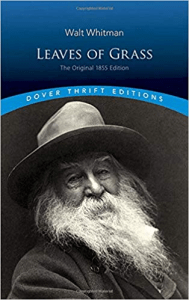
Library to Display Whitman Collections, Host 200th Birthday Party, Open House and Film Screening

Walt Whitman (1819 – 1892) as photographed by Mathew Brady / Public Domain

“This is what you shall do; Love the earth and sun and the animals, despise riches, give alms to every one that asks, stand up for the stupid and crazy, devote your income and labor to others, hate tyrants, argue not concerning God, have patience and indulgence toward the people, take off your hat to nothing known or unknown or to any man or number of men, go freely with powerful uneducated persons and with the young and with the mothers of families, read these leaves in the open air every season of every year of your life, re-examine all you have been told at school or church or in any book, dismiss whatever insults your own soul, and your very flesh shall be a great poem and have the richest fluency not only in its words but in the silent lines of its lips and face and between the lashes of your eyes and in every motion and joint of your body.” Walt Whitman


My apologies to the people with email subscriptions for accidentally hitting the publish button before this was properly completed. 

The Library of Congress will celebrate the 200th anniversary of American poet and change-maker Walt Whitman’s birthday with a series of exhibits, public programs and a digital crowdsourcing campaign to showcase the Library’s unparalleled collections of Whitman’s writings and artifacts.

The Library’s Whitman Bicentennial series will be part of the citywide Walt Whitman 200 Festival and other commemorations in the Mid-Atlantic where Whitman spent most of his life. He spent about ten years living and writing in Washington. During the Civil War, he volunteered in military hospitals in the city to offer emotional support to wounded soldiers.

Whitman worked as a schoolteacher, printer, newspaper editor, journalist, carpenter, freelance writer and civil servant, but he is best known as one of America’s most famous poets – and as a poet of democracy.

The Library holds the most extensive array of Whitman and Whitman-related collections in the world, including manuscripts, rare books, prints and photographs. Collection items range from handwritten drafts of poems and early prose writings to rare editions of Leaves of Grass, Whitman’s eyeglasses and walking stick and the most famous studio portraits taken in his lifetime. The manuscript collections are digitized and available online, as are many photographs.

The Whitman Bicentennial series is part of a year-long initiative in 2019 inviting visitors to Explore America’s Change-makers.
___

By the People Crowdsourcing Campaign
April 24 – June

The Library’s crowdsourcing initiative “By the People” will launch a campaign April 24 to enlist the public to help transcribe several thousand pages of Whitman’s writings and papers to make them more searchable and accessible online. Documents selected for transcription will include samples of Whitman’s poetry, prose and correspondence, including versions of poems such as “Oh Captain! My Captain!” and fragments of poems Whitman published in more finished form in “Leaves of Grass.”

This is also a special opportunity for teachers and students to engage with Whitman’s creative process. Drafts and portions of his poems at various stages of composition reveal his active, creative mind, as well as his innovative ways of seeing the world and wordsmithing poetic expressions.

The Library will collaborate with the National Council of Teachers of English to host a Transcribe-a-Thon webinar on April 24 at 4 p.m. Eastern time. The one-hour event will bring together experts from the Library, NCTE and educators to discuss how students can analyze, transcribe, review and tag the Whitman papers. Registration is open to all and available here.
___

Whitman Bicentennial Display
May 16 – Aug. 15

To mark the 200th anniversary of Whitman’s birth, the Library will display poetry, images and ephemera from Whitman’s life in the Thomas Jefferson Building. Five cases will display Whitman’s handwritten drafts, published poems, original letters, portraits and other rarely seen materials.

The display will retrace Whitman’s life, from his birthplace on Long Island, New York, his rise as an American poet, his life in Washington – including his intimate relationship with Peter Doyle, his care for Civil War soldiers and his admiration for Abraham Lincoln – his hands-on involvement with the design and publication of his poetry collection “Leaves of Grass” and pop culture references to Whitman and his legacy. It was “Leaves of Grass,” his break-through work of free verse celebrating democracy, sexuality, human potential, universalism and the natural world, that would earn Whitman worldwide fame.
___

Whitman in Culpeper
Thursday, May 23 at 7:30 p.m. at Packard Campus Theater, Culpeper, Virginia.

For two months in early 1864, Walt Whitman resided in Culpeper, Virginia, while serving as a volunteer in the Army of the Potomac’s nearby field hospitals. Despite the ravages the war had visited upon the area, Whitman described Culpeper as “one of the pleasantest towns in Virginia.”

Local historian Bud Hall will present a talk at the Library’s Packard Campus Theater in Culpeper about Whitman’s time in the area, followed by a screening of “Shenandoah” (Universal, 1965). Jimmy Stewart stars as a Virginia farmer intent on keeping his family out of the Civil War, but with the battles being fought almost literally on his doorstep, struggles to maintain his neutrality.
___

Happy Birthday Walt! – Digitized Walt Whitman Collections from the Manuscript Division
Thursday, May 30, 1 p.m. to 2 p.m.

Manuscript Division historian Barbara Bair will host a webinar highlighting the content and research use of three digitized manuscript collections: the Walt Whitman Collection of miscellaneous manuscripts; the Charles Feinberg collection of Walt Whitman Papers; and the Thomas Harned collection of Walt Whitman Papers. She will also discuss programs celebrating Whitman’s birthday at the Library of Congress. More information is available here.
___

Walt Whitman’s Birthday Party
Saturday, June 1, 10 a.m. to 4 p.m.

The Young Readers Center will host a day for families that will celebrate Whitman and his legacy on June 1 in the Thomas Jefferson Building. Activities will include an author talk from 10 a.m. to 11 a.m., featuring author Robert Burleigh and illustrator Sterling Hundley discussing their book “O Captain, My Captain: Walt Whitman, Abraham Lincoln and the Civil War;” a birthday party for Whitman at 11 a.m.; and a book signing at 11:15 a.m. A Whitman butterfly maker activity and handouts of “Walt Whitman’s Guide to Nature Walking” will be available all day from 10 a.m. to 4 p.m.

From 1 p.m. to 4 p.m., visiting families are also invited to join in the Library’s crowdsourcing initiative “By the People” and help transcribe selections from Whitman’s writings and papers to make them more searchable and accessible online.
___

Walt Whitman Open House
Monday, June 3, from 2:30 p.m. to 5 p.m.

The Library of Congress will present a Walt Whitman Open House display in Room 119 of the Thomas Jefferson Building, supplementing the ongoing Whitman Bicentennial Display with even more treasures from the Library’s collections. The Open House will feature a special array of rarely seen Walt Whitman collection items from the Manuscript, Rare Book, Music, and Prints and Photographs divisions, as well as Serials and General Collections. The display will include items pertaining to Whitman’s time in Washington, but also other materials from throughout his life, including the walking cane given to him by nature writer John Burroughs, draft poems, artistic renderings of Whitman and rare editions of “Leaves of Grass.”

As part of the celebration, the Library’s Poetry and Literature Center will host a special showing of the new documentary short film “Walt Whitman: Citizen Poet,” directed by Haydn Reiss and Zinc Films and produced in association with the Poetry Foundation. Filmed in part at the Library of Congress, “Walt Whitman: Citizen Poet” features Poets Laureate Tracy K. Smith and Robert Hass, among other poets, discussing Whitman’s life, poetry and legacy.

A reading of Whitman’s poems from his Washington years will follow at the Folger Shakespeare Library that evening.
___

The Library of Congress is inviting visitors to Explore America’s Changemakers in 2019 through a series of exhibitions, events and programs. Exhibitions drawing from the Library’s collections will explore the fight for women’s suffrage, Rosa Parks’ groundbreaking role in civil rights history and artists’ responses to major issues of the day. Other events throughout the year will explore changemakers through music, performances and public programs.

This crowdsourcing initiative “By the People” reflects advancement toward a goal in the Library’s new user-centered strategic plan: to expand access, making unique collections, experts and services available when, where and how users need them. Learn more about the Library’s five-year plan at loc.gov/strategic-plan/.

The Library of Congress is the world’s largest library, offering access to the creative record of the United States – and extensive materials from around the world – both on-site and online. It is the main research arm of the U.S. Congress and the home of the U.S. Copyright Office.  Explore collections, reference services and other programs and plan a visit at loc.gov, access the official site for U.S. federal legislative information at congress.gov and register creative works of authorship at copyright.gov.

This feature is courtesy of the Library of Congress and Wikipedia


ABOUT

CELEBRATING AMERICAN SHE-POETS (#35): Joan Leotta, playing with words on page

“Now each square’s

a pathway back to childhood”


Quilt

Sitting on my couch,

I snuggle under a quilt

made from Grandma’s coats.

Each square’s cut from a day

we went out together

to shop, to lunch, or church.

I would lean against her

in car, streetcar or taxi

when I was weary of it all.

Grandma would hug me,

pull me close— my cheek

against each season’s coat,

comforting me.

Now each square’s

a pathway back to childhood

when my cheek

on grandma’s coat

could quiet the discord of a

too busy world.

© Joan Leotta

Quilt was fist published by the North Carolina Silver Arts Group where it won the state’s Bronze Medal for Poetry in 2017

Pie by Another Name

A few over-ripe

peaches in the fruit bin

beg to be sliced

into the succor

of a single crust

laid onto a flat pan.

Then, from the bowl

where I dusted slices

with cornstarch,

brown sugar,

I lay the peaches

on the crust and

overlay all with pats

of sweet butter.

My baker-trained fingers

seek to shape all into

pie formation,

but I’m left with a

flat pastry whose

edges I twist to hold

in peachy goodness, then

bake, this oddly-shaped

concoction.

Leftover baked peaches in

misshapen dough—

much better

when called,

galette.

© Joan Leotta

Illustration “Starting a New Quilt” courtesy of Anna under CC BY 2.0 license

JOAN LEOTTA  (What Editors Want You to Know, Joan Leotta’s Encouraging Words through pen and performance-interviews with Editors) has been playing with words on page and stage since childhood. She performs regularly for children and adults and writes for both audiences as well–poetry, essays, short fiction, novels, picture books, and magazine and newspaper articles. Her poetry has been published or is forthcoming in Writing in a Woman’s Voice, Silver Birch, Postcard Poems and Prose, The Ekphrastic Review and Creative Inspirations. She delights in finding beauty in the ordinary
and in imagining the story behind a work of art. When not at computer or on stage, you can find her with family, walking the beach, or in the kitchen.
Author, Story Performer
“Encouraging words through Pen and Performance”
Giulia Goes to War, Letters from Korea, A Bowl of Rice, Secrets of the Heart historical fiction in Legacy of Honor Series; Simply a Smile--collection of Short Stories; WHOOSH! Picture book from THEAQ; Download a mini-chapbook of Joan’s poems HERE. Connect with Joan on Facebook HERE. Joan’s Amazon Page HERE.

ABOUT