U.S. Poet Laureate Tracy K. Smith will soon bring the power of poetry to listeners across the globe as host of a weekday podcast and radio feature titled The Slowdown. ThIs five-minute program encourages listeners to make a daily space for poetry in an increasingly busy and chaotic world.
“Poetry isn’t an escape or even a luxury,” Smith said. “I’d argue it’s a necessity, a means of living more deeply with reality.”
The celebrated poet will read works by writers from around the country and the world and explore how poetry helps us better understand life, history, art, science and more. The show will debut on podcast platforms in November; it will be made available to public radio stations nationwide early next year.
“I’m excited to continue the work I’ve done as poet laureate in celebrating poems and the conversations they foster. And thanks to technology’s ability to collapse the distance between people—to give you the feeling that there is one person out there speaking directly and only to you— geography is no longer a barrier to participation,” Smith said. “I think this is a perfect medium for talking about the very real and natural ways that poems speak to the daily experience of being alive.”
American Poet Tracy K. Smith (b. 1972)
TRACY K. SMITH is serving her secon term as Poet Laureate of the United States, and author of three acclaimed books of poetry: The Body’s Question, winner of the Cave Canem Poetry Prize; Duende, winner of the James Laughlin Award of the Academy of American Poets and an Essence Literary Award; and, most recently, Life on Mars, winner of the 2012 Pulitzer Prize, a New York Times Notable Book, a New York Times Book Review Editors’ Choice, and a New Yorker, Library Journal, and Publishers Weekly Best Book of the Year. Her memoir, Ordinary Light, was a finalist for the National Book Award. Other honors include a Wallace Stegner Fellowship, a Rona Jaffe Foundation Writers’ Award, a Whiting Writers’ Award, and an Academy of American Poets Fellowship. A professor of creative writing at Princeton University, she lives in Princeton with her family. Photo and bio from Tracy’s Amazon page HERE.
The Slowdown program is funded by the Poetry Foundation, the Chicago-based independent literary organization and publisher of Poetry magazine, and the support of the Library of Congress Poetry and Literature Center, The Slowdown is produced by American Public Media (APM) and will launch on podcast platforms on November 26. The Slowdown will be made available for broadcast on public radio stations across the United States beginning January 14.
Listen to a trailer for The Slowdown and subscribe here.
Listeners can find The Slowdown on Apple Podcasts and all podcast platforms beginning November 26. Public radio broadcasting details for The Slowdown will be announced this winter.
Poet and writer, I was once columnist and associate editor of a regional employment publication. I currently run this site, The Poet by Day, an information hub for poets and writers. I am the managing editor of The BeZine published by The Bardo Group Beguines (originally The Bardo Group), a virtual arts collective I founded. I am a weekly contributor to Beguine Again, a site showcasing spiritual writers. My work is featured in a variety of publications and on sites, including: Levure littéraure, Ramingo’s Porch, Vita Brevis Literature,Compass Rose, Connotation Press, The Bar None Group, Salamander Cove, Second Light, I Am Not a Silent Poet, Meta / Phor(e) /Play, and California Woman. My poetry was recently read byNorthern California actor Richard Lingua for Poetry Woodshed, Belfast Community Radio. I was featured in a lengthy interview on the Creative Nexus Radio Show where I was dubbed “Poetry Champion.”
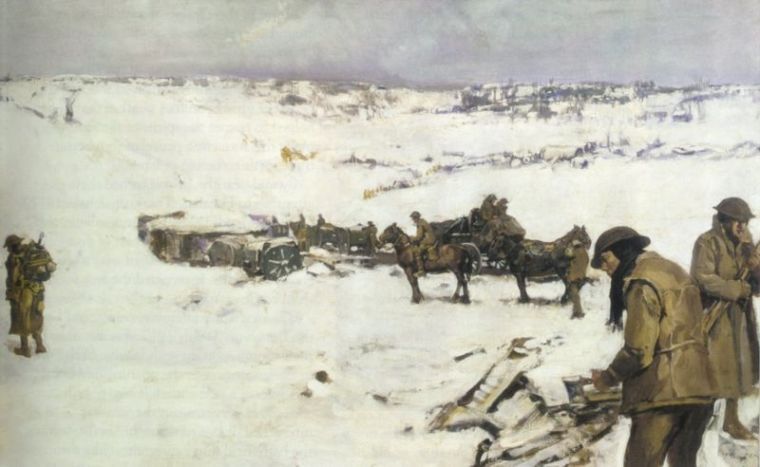
Mametz, Western Front, a winter scene, painting by Frank Crozier / Public Domain Photograph
“It was the seventh of November, 1918. The war was finally over. Maybe it would be declared a holiday and named War’s End Day or something equally hopeful and wrong. Wars would break out again. Violence was part of human nature as much as love and generosity.” Claire Holden Rothman, The Heart Specialist
New York Times, Nov. 11, 1918, Public Domain Photograph
Tomorrow is the 100th Anniversary of the end of World War 1, “the war to end all wars.”
The poet bearing witness is Alan Seeger (1888-1916), an American. He died at the Battle of the Somme (a.k.a. the Somme Offensive) on July 4, 1916. He was serving in the French Foreign Legion.
Rendezvous With Death is probably his most well-known poem. I’ve included that along with Ode in Memory of the American Volunteers Fallen for France, which Seeger wrote and was to read on May 30, 1916 as part of an American Decoration Day (now Memorial Day) event in front of a statue of Layfayette and Washington in Paris. His leave to go to the event was inadvertently written for Independance Day not Decoration Day. The gathering went on without Seeger or his Ode. Seeger was upset but decided to look forward to a visit to Paris on July 4th, which turned out to be the date of his rendezvous with death.
It is said that Alan Seeger’s imagery was influenced by time spent in Mexico in his youth. He is the brother of Charles Seeger (1886-1979), a composer, teacher, folklorist, pacifist and father of Pete Seeger, Peggy Seeger, and Mike Seeger, all folk singers.
Rendezvous with Death
I have a rendezvous with Death
At some disputed barricade,
When Spring comes back with rustling shade
And apple-blossoms fill the air—
I have a rendezvous with Death
When Spring brings back blue days and fair.
It may be he shall take my hand
And lead me into his dark land
And close my eyes and quench my breath—
It may be I shall pass him still.
I have a rendezvous with Death
On some scarred slope of battered hill,
When Spring comes round again this year
And the first meadow-flowers appear.
God knows ’twere better to be deep
Pillowed in silk and scented down,
Where love throbs out in blissful sleep,
Pulse nigh to pulse, and breath to breath,
Where hushed awakenings are dear . . .
But I’ve a rendezvous with Death
At midnight in some flaming town,
When Spring trips north again this year,
And I to my pledged word am true,
I shall not fail that rendezvous.
– Alan Seeger
Ode in Memory of the American Volunteers Fallen for France
I
Ay, it is fitting on this holiday,
Commemorative of our soldier dead,
When — with sweet flowers of our New England May
Hiding the lichened stones by fifty years made gray —
Their graves in every town are garlanded,
That pious tribute should be given too
To our intrepid few
Obscurely fallen here beyond the seas.
Those to preserve their country’s greatness died;
But by the death of these
Something that we can look upon with pride
Has been achieved, nor wholly unreplied
Can sneerers triumph in the charge they make
That from a war where Freedom was at stake
America withheld and, daunted, stood aside.
II
Be they remembered here with each reviving spring,
Not only that in May, when life is loveliest,
Around Neuville-Saint-Vaast and the disputed crest
Of Vimy, they, superb, unfaltering,
In that fine onslaught that no fire could halt,
Parted impetuous to their first assault;
But that they brought fresh hearts and springlike too
To that high mission, and ’tis meet to strew
With twigs of lilac and spring’s earliest rose
The cenotaph of those
Who in the cause that history most endears
Fell in the sunny morn and flower of their young years.
III
Yet sought they neither recompense nor praise,
Nor to be mentioned in another breath
Than their blue coated comrades whose great days
It was their pride to share — ay, share even to the death!
Nay, rather, France, to you they rendered thanks
(Seeing they came for honor, not for gain),
Who, opening to them your glorious ranks,
Gave them that grand occasion to excel,
That chance to live the life most free from stain
And that rare privilege of dying well.
IV
O friends! I know not since that war began
From which no people nobly stands aloof
If in all moments we have given proof
Of virtues that were thought American.
I know not if in all things done and said
All has been well and good,
Or if each one of us can hold his head
As proudly as he should,
Or, from the pattern of those mighty dead
Whose shades our country venerates to-day,
If we’ve not somewhat fallen and somewhat gone astray.
But you to whom our land’s good name is dear,
If there be any here
Who wonder if her manhood be decreased,
Relaxed its sinews and its blood less red
Than that at Shiloh and Antietam shed,
Be proud of these, have joy in this at least,
And cry: “Now heaven be praised
That in that hour that most imperilled her,
Menaced her liberty who foremost raised
Europe’s bright flag of freedom, some there were
Who, not unmindful of the antique debt,
Came back the generous path of Lafayette;
And when of a most formidable foe
She checked each onset, arduous to stem —
Foiled and frustrated them —
On those red fields where blow with furious blow
Was countered, whether the gigantic fray
Rolled by the Meuse or at the Bois Sabot,
Accents of ours were in the fierce melee;
And on those furthest rims of hallowed ground
Where the forlorn, the gallant charge expires,
When the slain bugler has long ceased to sound,
And on the tangled wires
The last wild rally staggers, crumbles, stops,
Withered beneath the shrapnel’s iron showers: —
Now heaven be thanked, we gave a few brave drops;
Now heaven be thanked, a few brave drops were ours.”
V
There, holding still, in frozen steadfastness,
Their bayonets toward the beckoning frontiers,
They lie — our comrades — lie among their peers,
Clad in the glory of fallen warriors,
Grim clusters under thorny trellises,
Dry, furthest foam upon disastrous shores,
Leaves that made last year beautiful, still strewn
Even as they fell, unchanged, beneath the changing moon;
And earth in her divine indifference
Rolls on, and many paltry things and mean
Prate to be heard and caper to be seen.
But they are silent, calm; their eloquence
Is that incomparable attitude;
No human presences their witness are,
But summer clouds and sunset crimson-hued,
And showers and night winds and the northern star.
Nay, even our salutations seem profane,
Opposed to their Elysian quietude;
Our salutations calling from afar,
From our ignobler plane
And undistinction of our lesser parts:
Hail, brothers, and farewell; you are twice blest, brave hearts.
Double your glory is who perished thus,
For you have died for France and vindicated us.
Poet and writer, I was once columnist and the associate editor of a regional employment publication. Currently I run this site, The Poet by Day, an information hub for poets and writers. I am the managing editor of The BeZine published by The Bardo Group Beguines (originally The Bardo Group), a virtual arts collective I founded. I am a weekly contributor to Beguine Again, a site showcasing spiritual writers.
My work is featured in a variety of publications and on sites, including: Levure littéraure, Ramingo’s Porch, Vita Brevis Literature,Compass Rose, Connotation Press, The River Journal,The Bar None Group, Salamander Cove, Second Light, I Am Not a Silent Poet, Meta / Phor(e) /Play, and California Woman
Thank you for sharing your love of words. Comments will appear after moderation.
Jamal Khashoggi,Saudi journalist, Global Opinions columnist for the Washington Post, and former editor-in-chief of Al-Arab News Channel. Photo: Khashoggi offers remarks during POMED’s “Mohammed bin Salman’s Saudi Arabia: A Deeper Look”. March 21, 2018, Project on Middle East Democracy (POMED), Washington, DC. / Courtesy of April Brady / POMED – Mohammed bin Salman’s Saudi Arabia: A Deeper Look under CC BY 2.0 license
“It was painful for me several years ago when several friends were arrested. I said nothing. I didn’t want to lose my job or my freedom. I worried about my family. I have made a different choice now. I have left my home, my family and my job, and I am raising my voice. To do otherwise would betray those who languish in prison.” Jamal Khashoggi
Pen America announced last Friday that more than 100 writers, journalists, artists, and activists are calling on the United Nations to initiate an independent investigation into the disappearance and apparent murder of journalist Jamal Khashoggi. Marking a month since his disappearance and on the International Day to End Impunity for Crimes Against Journalists, the writers and artists issued an open letter demanding that those responsible be brought to justice.
Literary and artistic luminaries and leading journalists, including J.K. Rowling, Bob Woodward, Meryl Streep, Zadie Smith, Margaret Atwood, Arundhati Roy, Patrick Stewart, Chimamanda Adichie, Tom Stoppard, and Mario Vargas Llosa, have signed a letter calling on António Guterres, Secretary-General of the United Nations, to launch a thorough and independent investigation into the disappearance and apparent murder of Jamal Khashoggi in order to uncover the truth and lay the groundwork for those responsible to be held accountable.
The letter reads: “The violent murder of a prominent journalist and commentator on foreign soil is a grave violation of human rights and a disturbing escalation of the crackdown on dissent in Saudi Arabia, whose government in recent years has jailed numerous writers, journalists, human rights advocates, and lawyers in a sweeping assault on free expression and association. It is also yet another data point in a global trend that has seen an increasing number of journalists imprisoned and murdered for their work. As writers and journalists ourselves, we fear the potential chilling effect of this trend, at a moment when the work of all those who would speak and expose the truth has never been more important.”
The letter also cites the UN Plan of Action on the Safety of Journalists and the Issue of Impunity, endorsed in 2012, which states that attacks on journalists “[deprive] society as a whole of their journalistic contribution and [result] in a wider impact on press freedom where a climate of intimidation and violence leads to self censorship.”
“The murder of Jamal Khashoggi was intended not just to silence one man, but to intimidate and suppress voices of dissent across borders,” said Summer Lopez, Senior Director of Free Expression Programs. “As such, it poses a threat not just to journalists, and not just to critics of the Saudi government, but to all those who would stand up for human rights and for the truth. China and Russia have already demonstrated a willingness to engage in extra-territorial and extra-judicial attacks on their critics; with Saudi Arabia joining that list, the threat to free expression globally is grave. In the face of such a vile and dangerous act, it is critical that the international community respond with fortitude and clarity in defense of journalists, and in defense of freedom of expression as a whole. The United Nations must lead that charge.”
Since Khashoggi’s disappearance, the Turkish government has repeatedly claimed to have evidence he was tortured, murdered, and dismembered inside the Saudi consulate in Istanbul. Although Saudi authorities denied any knowledge of his whereabouts for two weeks after his disappearance, they subsequently admitted he had been killed inside the consulate, but offered an implausible explanation, suggesting that an attempt to detain Khashoggi went awry. Turkey and Saudi Arabia both claim to be investigating the case.
Jamal Khashoggi began his journalism career as a correspondent for the Saudi Gazette newspaper. Although once close to the inner circles of the Saudi royal family, he was gradually subjected to rigorous censorship by Saudi authorities. Concerned about his safety in Saudi Arabia following a crackdown on free expression that began in 2016 under the new Crown Prince, he went into self-imposed exile and moved to the United States in 2017. That September, he began reporting for the Washington Post as a columnist, where he continued to do so until his disappearance. On September 28, Khashoggi made his first trip to the Saudi consulate in Istanbul, Turkey, in order to inquire about the acquisition of documents needed for his second marriage. He disappeared on October 2, after returning to the building based on instructions provided to him.
PEN America Washington Director Thomas O. Melia spoke at a memorial service for Jamal Khashoggi in Washington, D. C. on Friday, November 2. More information is available here.
PEN America stands at the intersection of literature and human rights to protect open expression in the United States and worldwide. It champions the freedom to write, recognizing the power of the word to transform the world. Its stated mission is to unite writers and their allies to celebrate creative expression and defend the liberties that make it possible. pen.org
Poet and writer, I was once columnist and the associate editor of a regional employment publication. Currently I run this site, The Poet by Day, an information hub for poets and writers. I am the managing editor of The BeZine published by The Bardo Group Beguines (originally The Bardo Group), a virtual arts collective I founded. I am a weekly contributor to Beguine Again, a site showcasing spiritual writers.
My work is featured in a variety of publications and on sites, including: Levure littéraure, Ramingo’s Porch, Vita Brevis Literature,Compass Rose, Connotation Press, The River Journal,The Bar None Group, Salamander Cove, Second Light, I Am Not a Silent Poet, Meta / Phor(e) /Play, and California Woman
Thank you for sharing your love of words. Comments will appear after moderation.
Travers in the role of Titania in a production of A Midsummer Night’s Dream, c. 1924
Some of us say we write from the heart, some from spirit. P. L. Travers, OBE(1899-1996, Australian national, British citizen), actress, poet and the conjuror of Mary Poppins, wrote in a Parabola* article that
I sit down inside my abdomen and brood and brood until I figure out how I feel about it.”
I noted the quotation above but I don’t remember the exact context of the piece. I think it was Tavers’ way of talking about the exploration of a painful childhood, one out of which she created a children’s classic. She once told a friend that the people and the objects of her early life were like a spindle around which she wove the threads of her imagination. That worked for her as a writer and for us as readers. In using her childhood to create characters and stories, she gave us a gift that ranks with those given to us by J.M. Barrie, L. Frank Baum, C.S. Lewis and Lewis Carroll.
Of course art-making isn’t therapy, but I often think artists don’t need to be quite so loath to admit some relationship between art-making and therapy.” Short-story writer, Deborah Eisenberg, Paris Review Interview #218, 2016
Travers’ why of writing was – at least in part – to heal and to imagine the childhood she would have liked.
Ultimately, we write for many reasons: to recover, to find closure or completion, to find meaning and understanding and to cherish the gifts of life. I relish life through writing. When I write a poem about an experience or observation, it’s often a way to savor it, prolong or relive the pleasure or heal the wound. It’s a way to live hugely. On the other hand, sometimes I use fiction to reframe experience. I think most people would agree that we also write to have our say and – in the spirit of Joseph Conrad – to help the reader see. That may sound to some like colossal chutzpah, but we all have something to say. We all have a perspective to share.
No matter where our writing comes from or why we write, we have to get the job done. For many of us the muse is a fairly consistent companion. For others it’s a struggle to connect. Either way, we develop habits, disciplines, and rituals to court the muse. It is often as though there is a sort of magical thinking or personal superstition in play. We must sit in this chair at this desk or at this cafe or we simply can’t write. Perhaps that’s why well-known and prolific writers are always being asked how, when and where they write, just another way of saying, “How do you court the muse?” The answers writers give can reveal demons, superstitions, irritation with the question, or even a tongue firmly in cheek. The “tips” or “rules” can be wise, cool, pragmatic, quirky, absurd or disagreeable. You may end up feeling affirmed, acquiring a useful tool, or finding yourself entertained.
Henry Miller‘spolicy was to work on one project at a time. Some will disagree with that. I do. I think many of us find one activity feeds another, that our multiple projects or different artistic outlets form a rich diet for the muse and make us more productive. I have a writer friend who says, “suum cuique” . . . to each his own . . . though to the old Romans that phrase was about justice (may each get their due), not about writing rituals. But the point is made.
John Steinbeck’s tips are pragmatic, born of a long, intense and consistent experience. In the fall of 1968, Steinbeck was actually too ill for a standard interview and one was pieced together from the East of Eden diaries (Journal of a Novel) and from some letters, which were later collected and published in one book. The tips have been widely published and were also included in Steinbeck’s Paris Review, The Art of Fiction** interview. [The Paris Review Interviews are required reading for writers and poets.] Steinbeck’s second tip is “Write freely and as rapidly as possible and throw the whole thing on paper. Never correct or rewrite until the whole thing is down. Rewrite in process is usually found to be an excuse for not going on. It also interferes with flow and rhythm which can only come from a kind of unconscious association with the material.” This is consistent with the philosophy and structure of NaNoWriMo. You write, write, write all month and don’t do your rewrites, editing and proofing until after that.
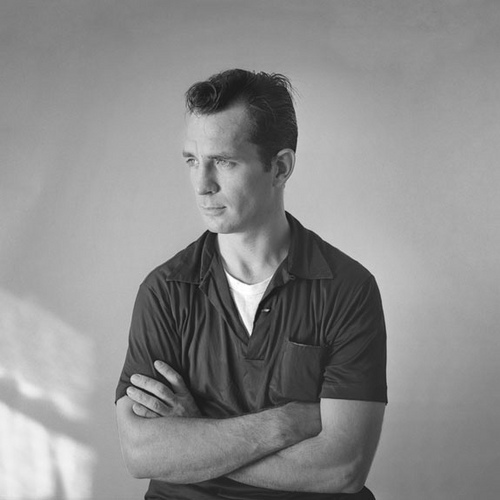
Jack Kerouac’s famous thirty tips are … well, they’re Jack … quirky … but useful … You can check them out HERE on the Gotham Writers’ Workshop site.
Jack Kerouac (1922-1969), American poet and novelist
The best tip I ever got was to “listen to and feel, see and smell the world around you.” Inspiration is everywhere: in the air and its scents, in the conversations you overhear, in your self-talk and memories, in the arguments with your spouse and the aroma of dinner cooking. It’s in the coo of the mourning dove, in the feel of your child’s hand in yours, in your own hopes and dreams and the life experiences and observations others share with you. Inspiration is in the news and in history. Be open to everything without exception. Nora Ephron constantly reminded those around her that everything “is copy.” We might say that everything holds the seed of a story, a character, or a scene.
Some of my most profitable lessons came from my high school English teacher, Sister Francis of Assisi, C.S.J. who encouraged my early writing. Sometimes I imagine her leaning over my desk and I hear her whispering …
What is it you really want to say?
Is this word appropriate? It is accurate?
What is your theme?
Does this really have to rhyme? Be cautious of rhyming.
Is this artfully dramatic or is it bad melodrama?
Is that lyrical or flowery?”
Read and read some more:
What writers do you enjoy most? Why? What can you learn from reading their work?
What novels do you dislike? Why? What can you learn from your reaction?
Reorder and rename the everyday. In truth the ordinary is often extraordinary and it’s your job to recognise and illustrate this.
Practically speaking, the muse is probably most responsive to the simple act of gluing the seats of our pants to our chairs and staying there until the job is done. Perhaps the muse is not fickle. Perhaps to be constant she requires our constancy.
Tips, tricks and rules are helpful and can be inspiring, but take them under advisement. In the end, the best magic for courting the muse is the magic that works for you ….
Work calmly, joyously, recklessly on whatever is in hand”. Henry Miller
* Parabola is a magazine of The Society for the Study of Myth and Tradition. P.L. Travers was one of the founders.
** The Paris Review, The Art of Fictioninterviews from 1953 through 2016 are freely posted online.
Poet and writer, I was once columnist and the associate editor of a regional employment publication. Currently I run this site, The Poet by Day, an information hub for poets and writers. I am the managing editor of The BeZine published by The Bardo Group Beguines (originally The Bardo Group), a virtual arts collective I founded. I am a weekly contributor to Beguine Again, a site showcasing spiritual writers.
My work is featured in a variety of publications and on sites, including: Levure littéraure, Ramingo’s Porch, Vita Brevis Literature,Compass Rose, Connotation Press, The River Journal,The Bar None Group, Salamander Cove, Second Light, I Am Not a Silent Poet, Meta / Phor(e) /Play, and California Woman
Thank you for sharing your love of words. Comments will appear after moderation.
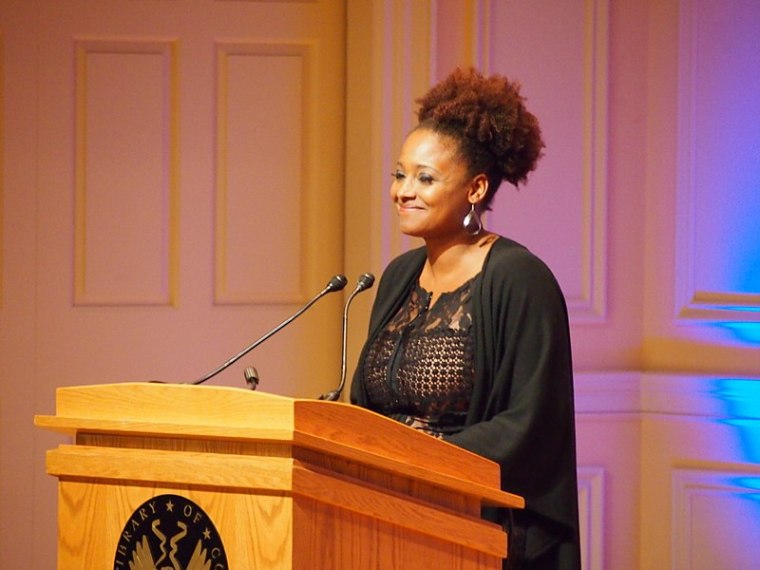

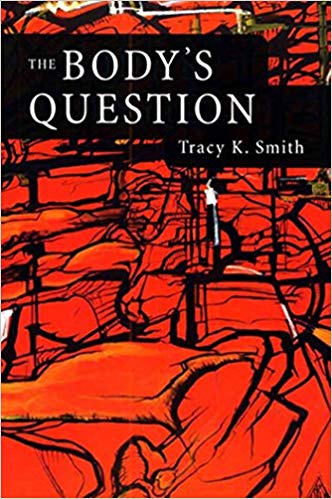 TRACY K. SMITH is serving her secon term as Poet Laureate of the United States, and author of three acclaimed books of poetry: The Body’s Question, winner of the Cave Canem Poetry Prize; Duende, winner of the James Laughlin Award of the Academy of American Poets and an Essence Literary Award; and, most recently, Life on Mars, winner of the 2012 Pulitzer Prize, a New York Times Notable Book, a New York Times Book Review Editors’ Choice, and a New Yorker, Library Journal, and Publishers Weekly Best Book of the Year. Her memoir, Ordinary Light, was a finalist for the National Book Award. Other honors include a Wallace Stegner Fellowship, a Rona Jaffe Foundation Writers’ Award, a Whiting Writers’ Award, and an Academy of American Poets Fellowship. A professor of creative writing at Princeton University, she lives in Princeton with her family. Photo and bio from Tracy’s Amazon page HERE.




 Jamie Dedes' THE POET BY DAY Webzine