Page 3 of 91

VIVIENNE, THE POET (Part 1): The Song of Joy and Pain (from my perspective), by poet Mike Stone

                      You deem me rude
To come and pierce your solitude. I know
More than you dream, how precious are your thoughts,
Guarded and unperceived. You see, dear heart,
We are but one. You are the child I was,
I am the poet grown that you will be.
Vivienne Stone, excerpt from Related (July 13, 1948)
….

“I never saw my mother’s book of poetry until a couple years ago (2018). I don’t remember seeing any of her poems or seeing her in the act of writing.” Mike Stone 


Editor’s Note: The photographs here belong to Mike and his family.  Please be respectful.  Note also that Mike’s mom changed the spelling of her name from Vivian to Vivienne, hence the discrepancy between the narrative and the name on the book and the header photograph. / J.D.

These are the dry facts of my life relating to my mother and her hand-written leather-bound book of poetry, The Song of Joy and Pain. The facts form a triangle in my mind: my father, my mother, and my stepmother.

My father and mother eloped and got married young. Dad was nineteen. Mom was eighteen. I was born nine months and twelve days later. My sister, Victoria, was born four-and-a-half years after me.

At this point, I must state that I have no factual memories of my mother prior to the age of thirteen. I have memories. They just aren’t factual; that is, whatever I might have remembered from personal experience had been supplanted by a collage of other people’s narratives and the few physical documents I happened to come across.

It has been said that we see only what we expect to see. I believe that the memories that we’ve experienced directly are replaced by parts of narratives that are associated with those experiences. Those narratives come to us from the people we trust.

Victoria and Mike
Victoria and Mike

Dad divorced Mom when I was seven years old. Victoria was three. This was when the narratives started. Dad’s narrative went like this: Mom was an unfit mother. She was hysterical. She beat me with a pancake turner. This was why he divorced her and sued for custody of my sister and me. She wrote “poetry” (deprecatingly said) and held poetry “salons” in which she would sit on the floor in a circle of “poetry” admirers. Dad hated these salons.

I never saw my mother’s book of poetry until a couple years ago (2018). I don’t remember seeing any of her poems or seeing her in the act of writing.
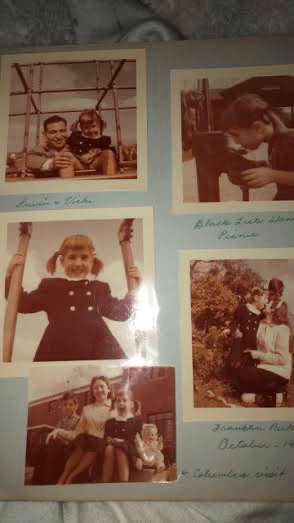
Dad remarried two years later. I was encouraged to call my stepmother “Mom”, although it was a few months before I felt able to do so. A new narrative began: our mother had never loved us. After a while, after calling my stepmother “Mom”, I began referring to my birthmother as “my biological mother” to avoid confusion when discussing her. As time went on, I just called my birthmother by her first name, “Vivian”.

Vivian remarried a year or so after the divorce. Her husband (Irv) was a psychiatrist. They visited my sister and me twice a year. Eventually, Irv was called up to the Army and they were transferred to Panama for three years. A few months before they were to be rotated Stateside, they adopted two infants, Lisa and Chris.

Three days before they were to fly back home, Vivian was killed in a freak pedestrian accident. I was fourteen when we received a letter informing us of her death.

Six years ago (2014), Lisa contacted my sister and me on Facebook. Although she was only an infant when Vivian was killed and had no direct memories of her, she had heard many stories about Vivian from Irv and also from friends of the family in Panama and America who knew Vivian and knew her history with my father, my sister, and me. The narratives Lisa had heard contradicted the narratives on which I was raised: Vivian had loved my sister and me very much. Dad’s family had been against the marriage and had forced my father to divorce Vivian or he would not receive any financial support from them. Vivian was unwilling to give up custody of us. Dad’s parents had Vivian committed to an insane asylum until she agreed to sign the divorce papers.

Lisa told my sister and me that Irv had sent her two hand-written leather-bound books of Vivian’s poetry, which were word-for-word copies of each other. Lisa had read Vivian’s poetry and it was clear to her from Vivian’s poems how much she had loved us.

Narratives against narratives. The ground shook under my feet. My childhood memories crashed and lay in ruins. I couldn’t imagine any possible motive for Lisa to lie about Vivian’s past, but I could imagine a few possible motives for my father and stepmother to lie to us.

Dad passed away in 2010. By 2017 our stepmother suffered from vascular dementia. We placed her in a 24/7 nursing care facility. She passed away in October 2019.
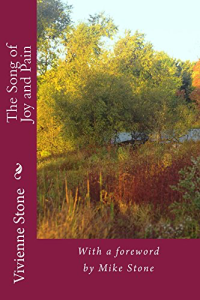
Vivienne Stone’s collection is available through Amazon in paperback, Kindle, and Kindle Unlimited

How did I come into possession of my mother’s poetry collection?
Lisa had told my sister and me that she would be happy to give us one of the hand-written copies of our mother’s poetry. She sent the book to Victoria since Lisa lived in New York state and Victoria lived in Connecticut. I live in Israel. We didn’t trust the international postal carriers to get such a precious book to me in Israel, so the next time I went to Columbus Ohio to visit our stepmother in 2018, Victoria mailed the book to my cousin in Columbus who handed it to me when I arrived.

What did I think of her poems?
I love poetry, both the writing and reading of poetry; however, I’m very demanding of the poets and poetry that I read. Poets must be authentic in their expression. They must be brilliant. Poems must leap with originality. They must surprise me. I have scant patience for less-than-brilliant poets. My only rule in writing is that I write what I’d like to read.

Before I opened our mother’s book of poetry, I trembled in fear of what I was about to read. I was afraid that I would be disappointed, that her poetry would be just “poetry”, as Dad had described in deprecation.

I opened her book and read the first poem and then the next, and the next. Her poetry exceeded my wildest expectations. Her poems were beautiful; they were brilliant; and they were authentic. She wrote poems about everything and everyone around her, and how she felt about them. She wrote about how she loved my father as only a poet can love. She wrote of the betrayal she felt when Dad told her he was divorcing her. She wrote of the despair and loneliness she felt. She wrote about her thoughts of suicide.

How did I feel about her poems?
I believed every word my mother wrote. A poet who is authentic does not lie. If you must lie in a poem you write, then what is the point of writing the poem? The authentic poet needs to reveal his soul. Perhaps that is the difference between a poet and a wordsmith. A wordsmith connects one word to another, considering rhyme and meter, showing off his or her knowledge and vocabulary. A poet’s soul needs to peek out of his or her poetry.

Therefore, the truth about our mother and us cracked and crumbled the narratives of my childhood memories. I feel freed of my shackles. I feel empty though. I know my childhood memories are false, but her poems cannot replace my memories because I have no memories to replace.

I transcribed our mother’s poetry into digital form, using a script font reminiscent of her handwriting. There were fifty-four poems in all. I added a foreword and, at the end, poems that I had written about her, to her. It was a labor of love for me.

How did I feel?
I felt that my father had thrown away a goddess worth more than all the wealth his family had threatened to withhold from him. He should have stood up to his parents and protected his wife who had loved him with the purest of innocence. That is what I would have done if I had been in his shoes. I felt that my father had lied to us, to me, because he was ashamed of what he had done. I felt that our stepmother had lied to us because she had wanted us to love her instead of our mother.

In what ways did her poetry change me?
Her poetry made me return to my childhood to love and cherish her, retrospectively. In doing so, I’ve grown to love the little boy that I was once. Now, I am seventy-three years old. It’s about time.

© 2020, Mike Stone

RELATED:

MIKE STONE (Uncollected Works) is a regular participant in The Poet by Day, Wednesday Writing Prompt. We are always delighted with the opportunity to read  and share his work.  Mike was born in Columbus Ohio, USA, in 1947 and was graduated from Ohio State University with a BA in Psychology. He served in both the US Army and the Israeli Defense Forces. He’s been writing poetry since he was a student at OSU and supports his writing habit by working as a computer networking security consultant. He moved to Israel in 1978 and lives in Raanana. He is married and has three sons and seven grandchildren. Mike’s Amazon Page is HERE. His work is recommended without reservation.

New York City Must Include Writers in Its Support for the Arts

Photograph of Central Park Lake (NYC) courtesy of Nkon21 under CC BY-SA 4.0

“The City Council has already shown an incredible commitment to ensuring the broader artistic economy is supported during this disastrous time,” said PEN America’s COO Dru Menaker. “But we’re alarmed that writers have not been explicitly included in calls for support . . . “


A citywide coalition of literary arts organizations sent a letter to the New York City Council insisting that council members consider writers and literary arts organizations as a vital part of the city’s artistic infrastructure in its upcoming budget. The letter asks that the council ensure writers and the organizations that support them are included in any relief package designed to revive the arts community amid the coronavirus crisis.

“In times of national crisis, we have long turned to writers for inspiration, understanding, comfort, and enlightenment. Writers who call New York City home have helped this country and the world make sense of global depression, war, and the societal impact of racism, inequity, and hatred,” the letter reads. “Our city cannot afford to let this literary legacy lapse by ignoring the needs of our writers at this critical juncture.”

The letter – addressed to council members Van Bramer, Gjonaj, Moya, Cumbo, and Borelli of the Committee on Cultural Affairs, Libraries, and International Intergroup Relations – says that the impacts of the coronavirus crisis on the arts has been clear, and the City Council has already called on the mayor to ensure federal relief funds are directed in part to artists or arts organizations. But those calls have omitted novelists, nonfiction authors, poets, essayists, playwrights, translators, and other writers. Writers have lost significant income, facing canceled speaking engagements, declines in book sales, loss of teaching, and publishers failing to pay royalties and advances, creating acute financial need.

“The City Council has already shown an incredible commitment to ensuring the broader artistic economy is supported during this disastrous time,” said PEN America’s COO Dru Menaker. “But we’re alarmed that writers have not been explicitly included in calls for support. PEN America, as a literary organization but also as a membership organization representing nearly 3,000 writers across the city, believes that the City Council can do the right thing here. Writers, now more than ever, are essential to the life of the city. And their livelihoods are imperiled by the loss of part time and gig work that often keeps writers financially afloat.”

The letter calls on the city council to include writers as part of the artistic community, as well as the organizations that showcase and support them. That means an explicit mention of writers and writers’ organizations in any legislative language relative to supporting the arts. The letter calls on the Council to provide tax credits to city-based businesses to support literary arts organizations, relief for commercial rents, and a project that would remunerate writers to document the impacts of the pandemic on New York City.

“We hope our representatives in the Council will address the financial and health needs of those who provide the City with its essential services, including our first responders and healthcare professionals, and that they continue to fund programs that provide the sick, homeless, disabled, the undocumented, and marginalized communities and youth with the care and attention they need,” the letter says. “But as you contemplate ensuring how best to use relief funds to shore up the arts, we call upon you to recognize the vital role the literary community writers and the literary organization that showcase and support their work will play in bearing witness to these troubled times.”

This post is courtesy of PEN America.

PEN America runs the Writers Emergency Fund, designed to support writers who are most directly impacted by the COVID-19 crisis. Read more about that fund here.

PEN America stands at the intersection of literature and human rights to protect open expression in the United States and worldwide. It champions the freedom to write, recognizing the power of the word to transform the world. Its mission is to unite writers and their allies to celebrate creative expression and defend the liberties that make it possible.


Jamie Dedes:

Your donation HERE helps to fund the ongoing mission of The Poet by Day in support of poets and writers, freedom of artistic expression, and human rights.

Poetry rocks the world!


FEEL THE BERN

For Peace, Sustainability, Social Justice

Maintain the movement.

“Democracy is not a spectator sport.” Bernie Sanders


“Every pair of eyes facing you has probably experienced something you could not endure.”  Lucille Clifton

Miguel Piñero: poet, playwright, actor, and the cofounder of Nuyorican Poets Café with Miguel Algarín, Pedro Pietri

  • His poetry and the plays are so fraught with the things that aggravated and influenced him and ultimately made his life successful. He took this form and infused it with an urban, Latin lifeblood that had never been used in poetry before. He was remarkable as a writer in terms of never really self-editing himself or censoring himself.
  • I happen to feel that [Piñero] was a romantic character and there was something about his love for land that was very wonderful, the way he held Puerto Rico, that elusive homeland in the foreground of his thoughts and writing. For all of us who are uprooted and thrown into this city, to keep a semblance of that is always so dignified. That would make it perhaps a bit nostalgic for me because people like that don’t seem to be around anymore.


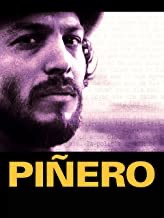
I spent the better part of yesterday responding to submissions to The BeZine and setting up International Poetry Month blog posts for our special series, which I am collaborating on with Michael Dickel. When I was through I decided to watch the acclaimed movie, Piñero, which I’ve been wanting to see for some time. I’m streaming through Amazon. So far, so good.  Benjamin Bratt’s performance is stellar. I’ve taken a break to share this with you.

Miguel Piñero was an award-winning poet, playwright, actor, and a leading member of the Nuyorican literary movement. He was inducted posthumously into the New York Writers Hall of Fame in 2013.

Piñero was born on December 19, 1946, in Gurabo, Puerto Rico. In 1950 he moved with his parents and sister to Loisaida (the Lower East Side) in New York City. When his father abandoned the family, his mother moved her children into a basement, applied for and received welfare.

Piñero would steal food to feed his mother and siblings. Thus the criminal convictions came early in his life. The first time when he was eleven years old. He was sent to the Juvenile Detention Center in the Bronx, New York, and to Otisville State Training School for Boys. He joined a street gang called “The Dragons” when he was 13; when he was 14, he was hustling in the streets of Manhattan. Over time he was drawn heavily to alcohol and drugs and died prematurely – aged 41 – on June 16, 1988 from cirrhosis. 

Eventually, Piñero moved to Brooklyn, where he and three other friends committed robberies, until they were caught at a jewelry store. Piñero was sent to Rikers Island prison in 1964.  In 1972, he was incarcerated in Sing Sing prison for second-degree armed robbery. His first literary work was Black Woman with a Blonde Wig On. Marvin Felix Camillo, the director of The Family, an acting troupe made up of ex-cons, submitted the poem to a contest, which it won.

While serving time in prison, Piñero wrote the play Short Eyes as part of the inmates’ playwriting workshop. Reviewer Mel Gussow came to see it, and due to his review in the New York Times, the director of the Theater at Riverside Church invited Piñero to present the play there.

“The theatre is the only thing that belongs to the people.” Miguel Piñero.

When Piñero left Sing Sing on parole in 1973, he was able to present Short Eyes with The Family. The title comes from “short heist”, the prison slang term for child molestation. Puerto Ricans could not pronounce the ‘h’ so it became “short eyes.” The play is a drama based on his experiences in prison and portrays how a house of detention populated primarily by black and Latino inmates is affected by the incarceration there of a white pedophile. Pedophiles are considered the lowest form of prison life. After all, the prisoners have siblings and children for whom they have concerns.

In 1974, Short Eyes was presented at Riverside Church in Manhattan. Theater impresario Joseph Papp (played in the movie by Mandy Patinkin) saw the play and was impressed. Papp moved the production to Broadway.

The play was nominated for six Tony Awards. It won the New York Drama Critics Circle Award and an Obie Award for the “best play of the year”. The play catapulted Piñero to literary fame. Short Eyes was published in book form by the editorial house Hill & Wang. It was the first play written by a Puerto Rican to be put on Broadway. This initial success was followed by: Sideshow(1974), The Guntower (1976), The Sun Always Shines for the Cool (1976),Eulogy for a Small-Time Thief (1977), and Playland Blues (1980).

The following excerpt from the movie serves as an intro to it and to Piñero’s work if you are not familiar with him.  Also recommended is Outlaw, The Collected Works of Miguel Piñero

This post is complied from the following sources: Wikipedia, Poetry Foundation, Outlaw:The Complete Works of Miguel Piñero, and the movie Piñero.


Jamie Dedes:

Your donation HERE helps to fund the ongoing mission of The Poet by Day in support of poets and writers, freedom of artistic expression, and human rights.

Poetry rocks the world!


FEEL THE BERN

For Peace, Sustainability, Social Justice

The Poet by Day officially endorses Bernie Sanders for President.

The New New Deal

“Democracy is not a spectator sport.” Bernie Sanders


“Every pair of eyes facing you has probably experienced something you could not endure.”  Lucille Clifton

Speaking in Poetic Tongues: A Salute to Women Activist Poets from Womawords Literary Press

Courtesy of Levi Guzman, Unsplash

“The heart of a women is like an  ocean, thus she must be proffered a free platform to express concerns, to speak rights, to voice against wrongs, to sing experiences and more.” Mbizo Chirasha


Originally published in Cultural Weekly, this is Mbizo Chirasha’s acknowledgement of some of the activist poets featured by Womawords Literary Press, which is dedicated to giving space to the voices of women and girls. I am touched to be counted among them and to be included in Mbizo’s feature here. Womawords Literary Press is also the co-host of The BeZine‘s International Poetry Month April 2020 series of daily poetic offerings in celebration of the month beginning on April 1.  / J.D.

Speaking in poetic tongues is an homage to the evangelists of resistance and poetic prophetesses. The women poet wordslingers wielding their pen weaponry to unchain the world from the pressing yoke of stereotypes and the hard granite rock sufferance perpetuated by unrepentant moral morons.

as we stand the ground of one another’s battles
where peace would be evolutionary and
the unholy alliance of wealth and fear-mongering
might burn itself out, find its way into justice,
but here we are, once again, in thrall to the
sociopaths, they have us bloodied and bound ~
their eyes are the aged face of clockwork orange,
numb to the obscenities of maim and murder …

© Jamie Dedes

10407495_241199596069948_6788451264468926644_n

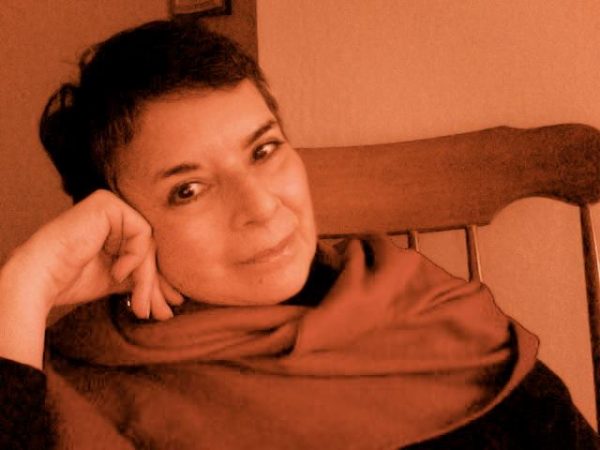
The griot in JAMIE DEDES is dared–daring. The tone as accompanied with the hard- rock verbiage is sarcastic but riotous. Racists are jabbed by defiant swords of satire. Poetry Spaces are poetry washed into oxy-moronic fields of peace. Corrupt landlords, warlords and tyrants are roasted by flames of metaphor. Dedes irony exorcise political demons and rattles the grip of economic dare-devils. Jamie Dedes is a Lebanese-American writer and activist. In another lifetime, she was a columnist, a publicist, and an associate editor to a regional employment publication. She’s had to reinvent herself to accommodate chronic and catastrophic illness, which has her home-bound, often bed-bound. The gift in this is time for literature, her primary passion, and social justice advocacy, her primary mission.


America is a blessing; it is blessed with the gift of word evangelist. It is the land of abundant literary arts culture talent. TRACY YVONNE BREAZILE‘s double edged razor sharp cutting poesy scythes against weeds of earthly stereotypes of political barbarism. Unsparingly ,the razor sharp tip of her poetic machete slice through Africa in quest for the freedom of her earth mates “Zimbabweans,” writhing under the heavy yoke of unbridled corruption as they suffocate from toxic, choking and command politics.

I gather my confusion and stutter my truths,
As you unleash your lightning bolt into the thicket,
Crashing into the night with a raging fire,
I dance with the embers ‘till morning light,
While you devise an avalanche to extinguish the fire,
You dropped your mask and it tumbled to the ground,
In the dust of the avalanche, beneath the rubble of your pedestal,
I will leave you there to mind your mazes,

© Tracy Yvonne Breazile

TRACY YVONNE BREAZILE is a Mentor in Residence of the Zimbabwe We Want Poetry Campaign Projects–Brave Voices Poetry Journal, Word Guerrillas Café and WOMAWORDS Literary Press.


I hear the poetic giggles echoing from beyond century hills reverberating foothills of Kirinyaga Mountains. Nancy Ndeke is an African prophetess, her to poetic tongues echo the foothills of Kirinyaga mountain, her writings are pregnant with African emotion and spiritual resonance. She writes of her kindred, WOMEN with a bold spirit and an aura of sisterly stubbornness. Her pen jives on page leaves like a rock rabbit dancing to earthly acoustics of wind, tree branches and discordant village songs. Ndeke’s poetry is the tenor of deep but soft flowing river, the rhythm abound is undeniably scintillating. You need a calabash of fresh spring water to wash down the poetry dinner of realism, metaphor and satire.

……………Is less of the individual, and
More of the community, meeting as equals,
At the intersection of connectedness
The hubris,
That rules empires with iron tanks and nuclear weapons
The feel good notion,
That sets colors apart in racism,
Are months that blow evil dust on the arena of life’s rainbow
There is no joy whatsoever
In fear, in anger
With greed, with bigotry,
Peace flees,

© Nancy Ndeke

86729051_134122381175525_94237037082705920_n
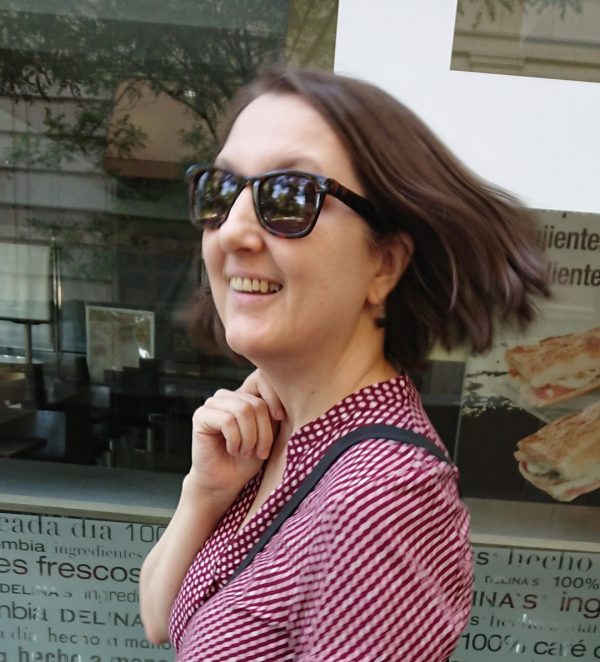
NANCY NDEKE is a Poet of international acclaim. Her writings and poetry are featured in several collections, anthologies and publications around the globe including the American magazine Wild Fire, Save Africa Anthology, world Federation of Poets in MEXICO.


The Armenian spirit HOKIS returns the echo with indomitable metaphoric incantations. Here poetry walks confidently in the spirit land. Hokis is the Founder and Senior Editor of Headline Poetry and Art Magazine. She believes in supporting a range of voices at various stages of their craft for this is the most impactful design of grassroots revolutions. She envisions Headline as a platform that exemplifies the beliefs that all poetry is political and reflection is essential to effectively reshape conversations and culture—for writers and readers alike.

the let loose moments
of garbled wrappers and stenched bottles
drizzled over our bedside table
like syrup on empty caloried
memories.

© Hokis

hokis-main-photo


Again, We walk through the holy sands of Cape Verde to harvest voices of souls dead and walking. GLORIA SOPHIA is a deep, versatile and powerful Cape Verde-an poet with three published books and some more contributions in a number of anthologies. The poet is a creative began. She cultivates her creativity with determination and the required zeal. It is very critical to give poets, like Sofia creative spaces suitable platforms for purposes of growing them into literary stardom.

gloria-sofia-cartaz-0

Sun explodes in the sky
Burning the moon
Destroying the eternal blue
Germinates in my womb
Star packed with music It hurts everything
Swollen mother
Wrapped stomach
Blushing breasts
My undulating body

© Gloria Sophia


Nordic Europe have its on share of poetic prophets. Wisdom is not sold but served in cafes, restaurants, galleries and bookshops. DOLORES MEDEN is a versatile and a genius poet who mastered the power of art and the versatility that is found languages. She writes her poetry and translates them herself. She infuses her writings with visual artist’s drawings to bring about to the reader historical references of art, humanity and just life. ALLUSION is one great element of literature and most reader respect reference, history and currency

To read is resistance
to stupidity
to ignorance
to the unhealthy
relationships
you once
escaped from.

© Dolores Menden

doloresmeden_1-1

Meden was born in Sweden by Croatian parents and have lived there all her life. A graduate of Bachelor of Arts in History of Religion. She also studied some languages, mostly Slovene and Chinese.


MIRO60

The sun rises from the East and its rays bathe the world. The earth becomes beautiful and creative abundance is gathered to heal the world. MIROSLAVA PANAYOTIVA is one great poet of national and international repute in Bulgaria .Her themes are diverse from nature to confessional poetry, her style unique and her diction versatile. Her verses carry scintillating rhythm.

In the grass of the night,
in the sleeping mystery,
in the expiring pencil
to the blue notebook,
I outline the sunset

© Miroslava Panyotova

MIROSLAVA PANAYOTOVA graduated from the Plovdiv University majoring in Bulgarian philology. Her whole lot of poems, stories, tales, aphorisms, essays, criticisms, translations, articles and interviews in periodicals and collections.

© 2020, introductory text, Mbizo Chirasha; poets poems and photographs are under their own copyright.

Womawords Literary Press is a complex of efforts, the heart-child initiated and curated by Zimbabwean poet activist in exile Mbizo Chirasha (Mbizo, The Black Poet).  You can read an interview of Mbizo on Womawords and the opportunities offered there to women HERE.


Jamie Dedes:

Your donation HERE helps to fund the ongoing mission of The Poet by Day in support of poets and writers, freedom of artistic expression, and human rights.

Poetry rocks the world!


FEEL THE BERN

For Peace, Sustainability, Social Justice

The Poet by Day officially endorses Bernie Sanders for President.

The New New Deal

“Democracy is not a spectator sport.” Bernie Sanders


“Every pair of eyes facing you has probably experienced something you could not endure.”  Lucille Clifton