Page 43 of 91

LINE-UP FOR YESTERDAY… Celebrating the 117th Season of Major League Baseball with Ogden Nash

Federic Ogden Nash (1902-1971), American Poet of light verse, unconvential rhymes, author, lyricist and pianist

major_league_baseball-svgWho better to celebrate the beginning of the 117th Major League Baseball season in the U.S. than poet Ogden Nash? He was an American poet known for the unconventional and humourous expressed in rhymed poems. He made strategic use of misspellings and puns or twists on famous poems or sayings. One of my faves pokes fun at Joyce Kilmer’s Trees.  “I think that I shall never see/ A poem as lovely as a tree.” v. Ogden’s version, which switches “billboard” for “poem”  … “Indeed, unless the billboards fall / I’ll never see a tree at all.”

Nash was a prodigious baseball fan and wrote Line-Up for Yesterday, an alphabetical listing of prominent players he admired. It was published in Sport magazine in 1949.

A is for Alex
The great Alexander;
More Goose eggs he pitched
Than a popular gander.

B is for Bresnahan
Back of the plate;
The Cubs were his love,
and McGraw his hate.

C is for Cobb,
Who grew spikes and not corn,
And made all the basemen
Wish they weren’t born.

D is for Dean,
The grammatical Diz,
When the asked, Who’s the tops?
Said correctly, I is.

E is for Evers,
His jaw in advance;
Never afraid
To Tinker with Chance.

F is for Fordham
And Frankie and Frisch;
I wish he were back
With the Giants, I wish.

G is for Gehrig,
The Pride of the Stadium;
His record pure gold,
His courage, pure radium.

H is for Hornsby;
When pitching to Rog,
The pitcher would pitch,
Then the pitcher would dodge.

I is for Me,
Not a hard-hitting man,
But an outstanding all-time
Incurable fan.

J is for Johnson
The Big Train in his prime
Was so fast he could throw
Three strikes at a time.

K is for Keeler,
As fresh as green paint,
The fastest and mostest
To hit where they ain’t.

L is for Lajoie
Whom Clevelanders love,
Napoleon himself,
With glue in his glove.

M is for Matty,
Who carried a charm
In the form of an extra
brain in his arm.

N is for Newsom,
Bobo’s favorite kin.
You ask how he’s here,
He talked himself in.

O is for Ott
Of the restless right foot.
When he leaned on the pellet,
The pellet stayed put.

P is for Plank,
The arm of the A’s;
When he tangled with Matty
Games lasted for days.

Q is for Don Quixote
Cornelius Mack;
Neither Yankees nor years
Can halt his attack.

R is for Ruth.
To tell you the truth,
There’s just no more to be said,
Just R is for Ruth.

S is for Speaker,
Swift center-field tender,
When the ball saw him coming,
It yelled, “I surrender.”

T is for Terry
The Giant from Memphis
Whose .400 average
You can’t overemphis.

U would be ‘Ubell
if Carl were a cockney;
We say Hubbell and Baseball
Like Football and Rockne.

V is for Vance
The Dodger’s very own Dazzy;
None of his rivals
Could throw as fast as he.

W, Wagner,
The bowlegged beauty;
Short was closed to all traffic
With Honus on duty.

X is the first
of two x’s in Foxx
Who was right behind Ruth
with his powerful soxx.

Y is for Young
The magnificent Cy;
People battled against him,
But I never knew why.

Z is for Zenith
The summit of fame.
These men are up there.
These men are the game.

-Ogden Nash

THE WORDPlaY SHOP: books, tools and supplies for poets, writers and readers

Poetry as Prayer … a little inspiration from Robert Lax …

Everything that exists
can turn to prayer;
even the water,
even the air.

– Robert Lax
A Song For Our Lady

If you are viewing this post from an email subscription, you’ll likely have to link through to watch the two short videos included today.

“And in the beginning was love. Love made a sphere: all things grew within it; the sphere then encompassed beginnings and endings, beginning and end. Love had a compass whose whirling dance traced out a sphere of love in the void: in the center thereof rose a fountain.”

– Robert Lax
from his renown poem, Circus in the Sun (about the circus of creation), it was read at Lax’s funeral in New York


“I think it’s a metaphysical concept
starting with Aristotle and flowering in St. Thomas
that God is pure act and that there is no potentía in him
…. Almost everything else in the universe is potentía,
it’s on its way to being pure act”

An excellent – award wining – biography – of Lax

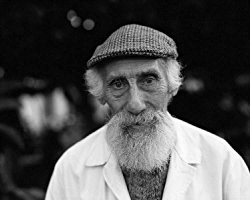
Robert Lax (1915 – 2000) was an American poet who converted from Judaism to Catholicism. He has been called “saint,” “mystic, “one of the great enigmas of American poetry, “a pilgrim” and “a prophet.” His poems where innocent, ecstatic and even whimsical. Over time they became more and more minimalist … one simple word or strings of sounds stretched into long narrow word-cascades that sometimes stopped here and there to puddle.

“Robert Lax’s poems [prove] yet again that the gift to be simple is the gift to be free, that less is more, and that least may sometimes be most.”—John Ashbery

Photo credit: Lax’s Amazon author’s page.

In addition to his poetry, Robert Lax is know for his friendship with the writer, poet and Trapist monk, Thomas Merton, also a convert to Catholicism.

Lax went to school with John Berryman and was mentor to Jack Kerouac. He was friends with and appreciated by the Beats and one of my fave writers, James Agee (A Death in the Family and – with photographer Walker Evens – Let Us Now Praise Men). Denise Levertove and e.e. commings numbered among Lax’s friends as well. He was also close to the artist Ad Reinhart.

In 1962 Lax began his travels in Greece, settling into life as a hermit on the island of Patmos, seen by many as a sacred space. Patmos is the alleged site of the vision of and writing of the Christian Bible’s Book of Revelation. Because of that connection, the island is a destination for Christian pilgrimage.

Although Robert Lax lived quietly in Patmos and did nothing to promote his poetry or himself, people – including the Beats and other poets – came to visit him. He always welcomed his visitors and purposeful or accidental students. He was mentor to more than a few.

If poetry as prayer is a topic of interest, you could do worse than to explore Lax’s life and work. A light read and good introduction to this poet is The Way of the Dreamcatcher: Spirit Lessons with Robert Lax.  It was written by San Francisco writer, S.T. Georgiou (Greek Orthodox), who went to Patmos in search of some spiritual answers. As good fortune would have it, he met Robert Lax, became friends with him and visited often with him on several trips back to Patmos.  Subsequently, after Lax’s death, Georgiou wrote The Way of the Dreamcatcher, a book about this adventure in friendship, mentoring, the sacred and poetry.

Robert Lax received the National Council of the Arts Award in 1969.

Books by Robert Lax include:


“because yes – he likes to ‘write’ – but to ‘do’ – to do a particular thing – perhaps on paper (perhaps on canvas – perhaps in stone – perhaps, perhaps in a musical score) – a thing that will stand, a thing that will bear (that will sustain) repeated contemplation: a thing that will sustain long contemplation, and that will (in a ‘deep’ enough way) reward the beholder.”  Robert Lax, Love Had a Compass: Journals and Poetry

“I read. I travel. I become.” Homage to Derek Walcott

Saint Lucian poet, Derek Walcott (1930-2017)  Nobel Prize in Literature 1992; picture taken at his honorary dinner, Amsterdam, May 20th 2008

“… the truest writers are those who see language not as a linguistic process but as a living element…” Derek Walcott

Derek Walcott died this morning at the age of 87 after gifting the world with some of its finest poetry.

There is much in Derek Walcott’s life and work that is worth noting but for those who self-publish or are considering doing so, Walcott was a part of that long tradition. In his late teens he self-published his first works – 25 Poems (1948) and Epitaph for the Young: XII Cantos (1949) – with money borrowed from his mother, a school teacher and principal. He sold copies to friends and recouped the costs. I’m sure that if he was a teen today he’d be blogging his poems.

Bill Moyers once interviewed Walcott …

” . . .about the United States’ discomfort with its role as an empire and the difference between the American dream and the “black man’s dream.” The Caribbean-born writer also speaks of poets’ obsession with language and truth telling, and the “divine discontent” at the heart of all art.”

The reason I remembered this long-ago interview is that as a first-generation American I appreciated what he had to say about the motivations behind immigration to the States, about the ideals we have that are valued even though we fall far short of living up to them. I searched for and found the transcript online this afternoon and mention it here because I think some of what Walcott said is relevant to current struggles. Link HERE to read the transcript.

Photo courtesy of Bert Nienhuis under CC BY-SA 2.0 license.

RELATED:

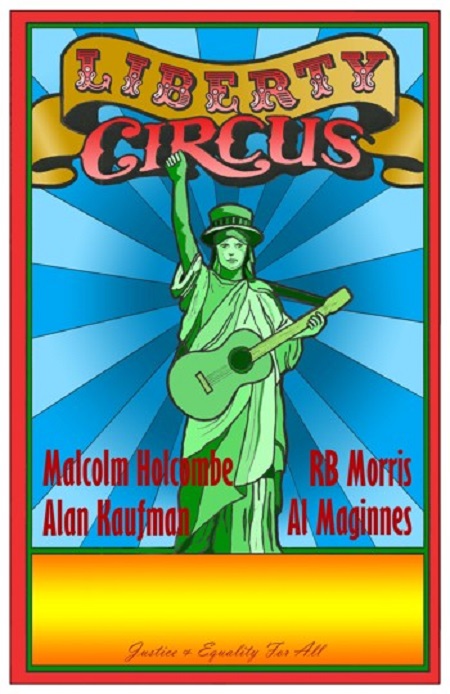
Liberty Circus … A Rogue Band of Outlaw Songwriters and Poets

The Liberty Circus are Malcolm Holcombe, Al Maginnes, RB Morris and Alan Kaufman: a rogue band of outlaw songwriters and poets who have thrown in to criss-cross the land in a performing celebration of good old democratic open-heartedness. They say that “A lion’s share from the proceeds of our shows will directly benefit organizations working with immigrants and refugees. Along the way we’ll invite local performers to our stages and grow our Liberty Circus into a big national family of love and support for Lady Liberty’s tired, poor masses yearning to breathe free.” Follow them on Facebook HERE.  A worthy project that promises to be fun.

Thanks to Alan for the heads-up on this. Alan Kaufman – “citizen poet” with five published volumes including The Outlaw Bible of American Poetry has been featured here before and was also featured in The BeZine.