Page 45 of 91

CELEBRATING AMERICAN SHE-POETS (29): Emma Lazarus and Liberty Lighting the World … “I lift my lamp beside the golden door.”

Emma Lazarus, 1849 - 1887
Emma Lazarus, 1849 – 1887

In a letter to Emma Lazarus about Alide, an episode of Goethe’s Life. the Russian novelist Turgenev wrote  “An author who writes as you do is not a pupil in art anymore; he is not far from being himself a master.”

 “Emma Lazarus is a new name to us in American poetry, but ‘Admetus’ is not the work of a ‘prentice-hand’; few recent volumes of verse compare favorably with the spirit and musical expression of these genuine effusions of Emma Lazarus.” The Boston Transcript, c 1871

“What Emma Lazarus might have accomplished, had she been spared, it is idle and even ungrateful to speculate. What she did accomplish has real and peculiar significance. It is the privilege of a favored few that every fact and circumstance of their individuality shall add lustre and value to what they achieve. To be born a Jewess was a distinction to Emma Lazarus, and she in turn conferred distinction upon her race.” Josephine Lazarus, Emma’s elder sister who gather her poems together and published them in two volumes, The Poems of Emma Lazarus, 1881

“Until we are all free, we are none of us free.” Emma Lazarus

EMMA LAZARUS, poet, writer and activist, was by all accounts shy and she died at thirty-nine years, much too young. Nonetheless she accomplished a lot in addition to that for which she is most well-known, The New Colossus, the sonnet that is on the pedestal of the Statue of Liberty (Liberty Enlightening the World) in New York Harbor, having been installed there in 1903.

Unveiling of the Statue of Liberty Enlightening the World (1886) by Edward Moran. Oil on canvas. The J. Clarence Davies Collection, Museum of the City of New York.

“The copper statue, designed by Frédéric Auguste Bartholdi, a French sculptor, was built by Gustave Eiffel and dedicated on October 28, 1886. It was a gift to the United States from the people of France. The statue is of a robed female figure representing Libertas, the Roman goddess, who bears a torch and a ]a tablet evoking the law upon which is inscribed the date of the American Declaration of Independence, July 4, 1776. A broken chain lies at her feet. The statue is an icon of freedom and of the United States, and was a welcoming sight to immigrants arriving from abroad.” [Wikipedia]

In fact Lady Liberty greeted my own father and maternal grandparents and their children as they entered the harbor just as she probably did for the families of those reading here today. Their children and grandchildren learned the poem by heart in school. I suspect the majority of us took the ideals expressed as our own.

The bronze plaque inscribed with Emma Lazarus' poem, The New Colassus.
The bronze plaque inscribed with Emma Lazarus’ poem, The New Colossus.

A hymn to America, the “Mother of Exiles,” The New Colossus, was written to raise money for the construction of the pedestal for the Statue of Liberty.

The New Colossus – 1883

Not like the brazen giant of Greek fame,
With conquering limbs astride from land to land;
Here at our sea-washed, sunset gates shall stand
A mighty woman with a torch, whose flame
Is the imprisoned lightning, and her name
Mother of Exiles. From her beacon-hand
Glows world-wide welcome; her mild eyes command
The air-bridged harbor that twin cities frame.
“Keep, ancient lands, your storied pomp!” cries she
With silent lips. “Give me your tired, your poor,
Your huddled masses yearning to breathe free,
The wretched refuse of your teeming shore.
Send these, the homeless, tempest-tossed to me,
I lift my lamp beside the golden door!”

– Emma Lazarus

Emma came from a large Sephardic-Ashkenazi family, the father’s side from Germany and the mother’s side from Portugal. Her maternal great-grandmother was also a poet.  Emma’s first book of poems was published by her father when she was fourteen and apparently showed much promise. She continued to write poetry and eventually wrote a five-act play, a novel and a short-story as well.  She was a linguist, editing and translating works from the German, notably those of Goethe and Heinrich Heine. She wrote fourteen essays entitled Letters to the Hebrews. She was a forerunner in advocating a Jewish homeland, predating Theodore Herzi. She was friends with and an admirer of the American political economist, Henry George, who was instrumental in the birth of several reform movements of the Progressive Era. Essentially, George believed that workers should own the value of what they create, while the land should be held in common. Ralph Waldo Emerson was both friend and mentor.

Emma Lazarus received many posthumous awards. The Emma Lazarus Statue of Liberty Award is sponsored by the American Jewish Historical Society (New York and Massachusetts) and P.S. 268 in Brooklyn is named for her.

Life and Art

Not while the fever of the blood is strong,
The heart throbs loud, the eyes are veiled, no less
With passion than with tears, the Muse shall bless
The poet-sould to help and soothe with song.
Not then she bids his trembling lips express
The aching gladness, the voluptuous pain.
Life is his poem then; flesh, sense, and brain
One full-stringed lyre attuned to happiness.
But when the dream is done, the pulses fail,
The day’s illusion, with the day’s sun set,
He, lonely in the twilight, sees the pale
Divine Consoler, featured like Regret,
Enter and clasp his hand and kiss his brow.
Then his lips ope to sing–as mine do now.

– Emma Lazarus

RELATED


SILENCING OF THE LAMBS, a poem by British poet and Renaissance man, John Anstie


img_2357

Silencing The Lambs

Lo a thin veneer
divides the good from the bad
you know what you are

ruling precedent
with blind consensus will yield
a dumbing of the sheep

and who was it said
only the meek inherit
this is not the time

this is not the time
for humility and lambs
must stand up and grow

maybe there was life
once upon a distant time
when we were wise

when we were wise
before the window led to
pleonexia

yield to avarice
and the common cause ends in
weakened hearts and souls

weakened hearts and souls
lost in things and will be found
only as we die

only as we die
can we find truth and renew
a desire for life

a desire for life
but not material things
will need great courage

we’ll need great courage
whilst tyranny is seeking
obedient lambs

by silencing the lambs
sociopathy will win
and life will perish

… but will life perish?
Maybe, maybe not. Dare we
sit and wait and see?

– John Anstie

© 2017, poem and portrait, John Anstie, All rights reserved

John Anstie
John Anstie

JOHN ANSTIE (My Poetry Library and 42) ~ is a British singer, musician, poet and contributing writer to The BeZine. John self-describes as a “Family man, Grandfather, Occasional Musician, Singer, Amateur photographer and Film-maker, Apple-MAC user, Implementation Manager, and Engineer”.

John has participated in d’Verse Poet’s Pub and is a player in New World Creative Union as well as a being a ‘spoken-voice’ participant in Roger Allen Baut’s excellent ‘Blue Sky Highway’ radio broadcasts. He’s been blogging since the beginning of 2011. He is also a member of The Poetry Society (UK).

product_thumbnail-3-phpRecent publications are anthologies resulting from online collaborations among two international groups of amateur and professional poets. One of these is The Grass Roots Poetry Group (Petrichor Rising*). The other group is d’Verse Poet Pub, in which John’s poetry also appears in The d’Verse Anthology:Voices of Contemporary World Poetry, produced and edited by Frank Watson.

*The proceeds from Petrichor Rising go to UNICEF. The back story on this book and its poets is featured in Pretricor Rising and how the Twitterverse Birthed friendships that in Turn Birthed a Poetry Collection.

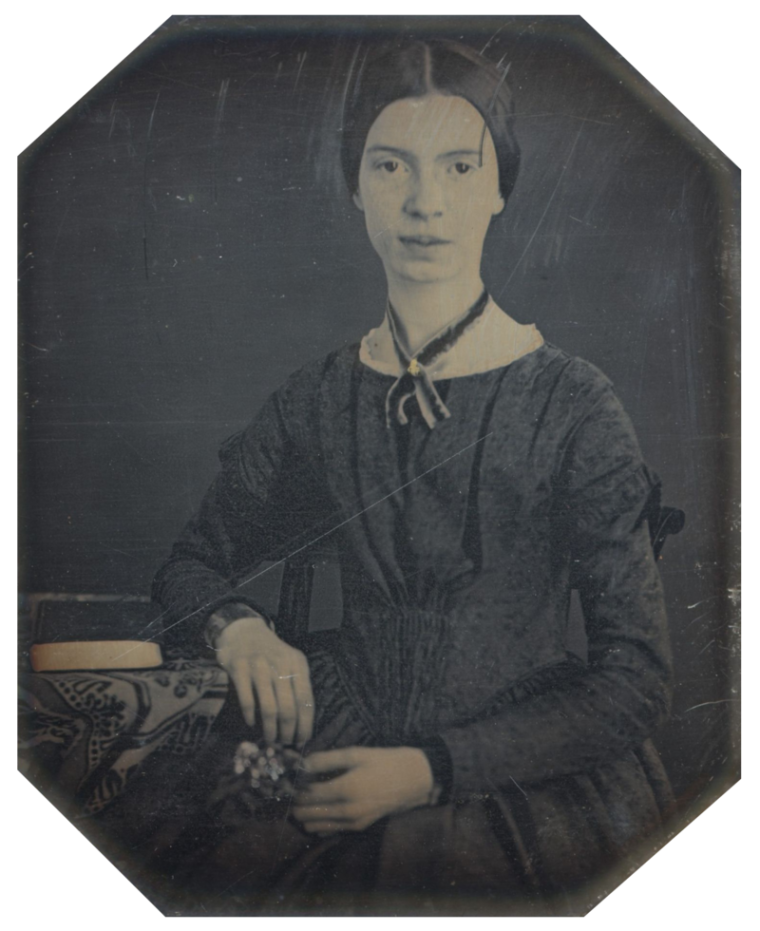
CELEBRATING AMERICAN SHE-POETS (28): Emily Dickinson … to find that phosphorescence, that light within

Emily Dickinson at sixteen years o age
Emily Dickinson at sixteen years, 1846

“PHOSPHORESCENCE. Now there’s a word to lift your hat to… to find that phosphorescence, that light within, that’s the genius behind poetry.” Emily Dickinson

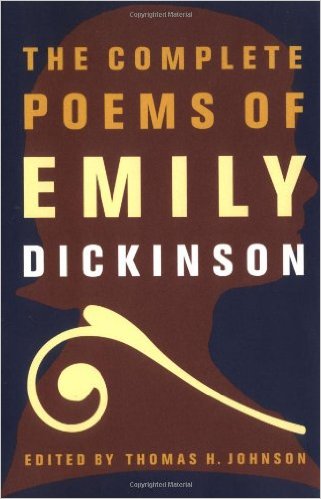
41rt1zipr5l-_sx319_bo1204203200_Emily Dickinson was famously reclusive and wrote 1,775 poems, few of which were published during her lifetime. When her opus was finally published posthumously, it wasn’t well received. Today, however, she is considered one of the most significant of American poets. The Complete Poems of Emily Dickinson is my favorite collection. The poems are organized chronologically, allowing us to see her development from teen years into the darker poetry of her maturity.

“Nature” is what we see—
The Hill—the Afternoon—
Squirrel—Eclipse— the Bumble bee—
Nay—Nature is Heaven—
Nature is what we hear—
The Bobolink—the Sea—
Thunder—the Cricket—
Nay—Nature is Harmony—
Nature is what we know—
Yet have no art to say—
So impotent Our Wisdom is
To her Simplicity.

– Emily Dickinson

Apart from reading Emily Dickinson’s poetry, I can’t think of a better way to celebrate her and her work then to see William Luce’s one-woman play, The Belle of Amherst, starring Julie Harris.  It’s available to watch on YouTube and it’s a must if you are a lover of poetry and theatre and looking for some budget-wise charm this coming weekend. Order dinner in, set out the candles and wine … and Enjoy!

The play follows Emily Dickinson at the family home in Amherst, Massachusetts. It incorporates Dickinson’s work, diaries, and letters in a reenactment of her life with her relatives, friends and acquaintances. It’s engaging and often wry … as is the poet herself.

The original Broadway production, directed by Charles Nelson Reilly and starring Julie Harris, opened on April 28, 1976 at the Longacre Theatre. It ran for 116 performances. A Wall Street Journal reviewer wrote . . .

“With her technical ability and her emotional range, Miss Harris can convey profound inner turmoil at the same time that she displays irrepressible gaiety of spirit.”

Harris won a Tony Award for Best Actress in a Play, earned a Drama Desk Award nomination for a Unique Theatrical Experience, and won a Grammy Award for Best Spoken Word Recording. She appeared in a televised PBS production and toured the country with the play for a number of years. [sources: Wikipedia and NY Times]

Luce and Harris collaborated on other wonderful plays including Bronté.  A broadway playwright, Luce also wrote Barrymore, which with family I was fortunate enough to see on stage starring Christopher Plummer many years ago. That was a bit of heaven.  Luce wrote Lucifer’s Child based on the writing of Karen Blixen (Isak Dinesen), Lillian about Lillian Hellman and Zelda, which became The Last Flapperabout Zelda Fitzgerald. If script writing is one of your interests, you could probably do worse than reading a few of  Luce’s plays.

51hlj5jhdkl-_sx329_bo1204203200_


The recommended read for this week is Robert Pinsky’s Singing School, Learning to Write (and Read) Poetry. No rules or recipes here just learning by studying the pros. Charming. Fun.

In making your Amazon purchase through links from this site, you help to support its maintenance.

The WordPlay Shop offers books and other tools especially selected for poets and writers.

THE WORDPLAY SHOP: books, tools and supplies for poets, writers and readers

LITERATURE AND FICTION oo Editor’s Picks oo Award Winners oo NY Times Best Sellers

I Didn’t Apologize to the Well … Palestinian Peace Poet, Mahmoud Darwish

Palestian Poet, Mahmoud Darwish (1941-2008)
Palestinian Poet, Mahmoud Darwish (1941-2008)

With the largest number of migrants the world has ever seen – 244 million in 2015 – people who are displaced by exile, violence, poverty and environmental issues resulting from climate change, it’s hard not to think of poets like Darwish who lived or live large portions of their lives in exile from their homelands.

“. . . he says I am from there, I am from here, but I am neither there nor here. I have two names which meet and part… I have two languages, but I have long forgotten— which is the language of my dreams” Mahmoud Darwish’s farewell to Edward Said (1935-2003), professor of literature at Columbia University, a public intellectual and founder of the field of postcolonial studies. Said was educated in the Western Cannon. He was a Palestinian-American born in Mandatory Palestine and a citizen of the United States through his father, Wadie Saïd, a WW 1 U.S. Army Veteran

Born in Mandated Palestine, Mahmoud Darwish has been called a poet of peace in times of war. He was a regarded as the Palestinian national poet. Darwish used Palestine as a metaphor for the loss of Eden, birth and resurrection and he wrote of the anguish of dispossession and exile. He has been described as incarnating and reflecting “the tradition of the political poet in Islam, the man of action whose action is poetry.”

You can hear the lovely lilt of Arabic even in the English translations of this internationally know and recognized award winning poet. His awards included the Ibn Sina Prize, the Lotus prize from the Union of Afro-Asian Writers, France’s Knight of Arts and Belles Lettres medal, and the Prize for Cultural Freedom from the Lannan Foundation.

I didn’t apologize to the well as I passed by it.
I borrowed a cloud from an ancient pine and squeezed it
like an orange. I waited for a mythical white deer.
I instructed my heart in patience: Be neutral, as though
you were not a part of me. Here, good shepherds
stood on air and invented the flute and enticed
mountain partridges into their traps. Here, I saddled
a horse for flight to my personal planets, and flew.
And here, a fortuneteller told me: Beware of asphalt roads
and automobiles, ride on your sigh. Here, I loosened
my shadow and waited. I selected the smallest stone
and stood wakefully by it. I broke apart a myth
and got broken myself. I circled the well until
I flew out of myself to what I’m not. And a voice
from deep in the well spoke to me: This grave
is not yours. And so I apologized. I read verses
from the wise Qur’an and said to the anonymous presence
in the well: Peace be with you and the day
you were killed in the land of peace and with the day
you’ll rise from the well’s darkness
and live…

– Mahmoud Darwish

Darwish has many published collections, which are available through his Amazon page.

Photo credit: Mahmoud Darwish at University of Bethlehem in 2006 by Amer Shomali under CC BY-SA licence.


51hlj5jhdkl-_sx329_bo1204203200_The recommended read for this week is Robert Pinsky’s Singing School, Learning to Write (and Read) Poetry. No rules or recipes here just learning by studying the pros. Charming. Fun.

In making your Amazon purchase through links from this site, you help to support its maintenance.

The WordPlay Shop offers books and other tools especially selected for poets and writers.

THE WORDPLAY SHOP: books, tools and supplies for poets, writers and readers

LITERATURE AND FICTION oo Editor’s Picks oo Award Winners oo NY Times Best Sellers