Page 50 of 91

HEADS-UP ROCHESTER, NY … “READING THE WORLD” With Hélène Cardona & Dennis Maloney
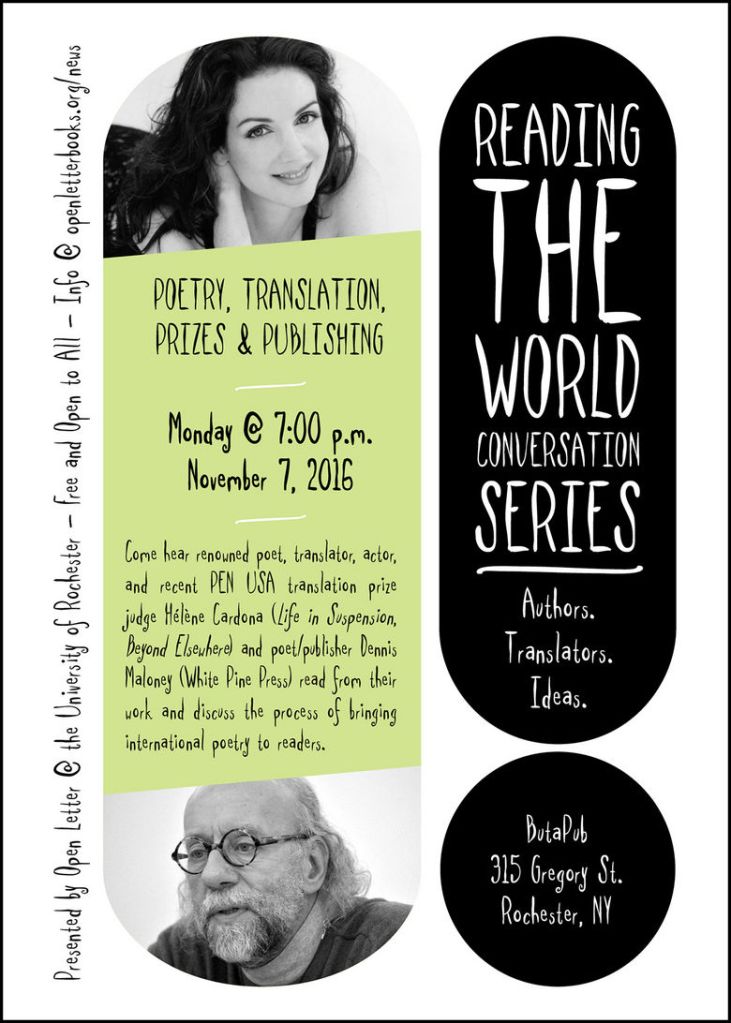
rtwcs_2016_cardona_handbill-bigThe French Embassy in the United States and Open Letter, the publishing arm (literature in translation) of University of Rochester in New York that sponsors “Reading the World,” announce their invitation to listen to renowned poet, translator, actress, and recent PEN USA translation prize judge Hélène Cardona (Life in Suspension, Salmon Poetry, 2016 and Beyond Elsewhere, White Pine Press, 2016).  Poet and publisher Dennis Maloney (White Pine Press) will also present.  The poets will read from their work and discuss the process of bringing international poetry to readers.

This event, free and open to the public, is scheduled for November 7 at 7 p.m. at ButaPub, 315 Gregory St, Rochester, New York 14620. Food and refreshments will be available. 

Hélène Cardona‘s recent books include the Award-Winning Dreaming My Animal Selves (Salmon Poetry, 2013) and the Hemingway Grant recipient Beyond Elsewhere (White Pine Press, 2016). She also translated Walt Whitman’s Civil War Writings for the Iowa International Writing Program’s WhitmanWeb. Her poetry collections have been translated into thirteen languages, including Romanian, Italian, Arabic, Macedonian, Serbian, Chinese, Spanish, Korean, and Hindi.  Hélène also co-edits Fulcrum: An Anthology of Poetry and Aesthetics, is Co-International Editor of Plume and contributes articles to numerous literary journals and magazines including The BeZine.

Book reviews, poetry samples and an interview with Hélène are scheduled for November 24 in the Poet by Day’s popular series Celebrating American She-Poets, which will resume then.

Dennis Maloney is a poet and translator. A number of volumes of his poetry collections have been published including The Map Is Not the Territory: Poems & Translations (Unicorn Press, 1990) and Just Enough (Palisade Press, 2009). His book Listening to Tao Yuan Ming was recently published by Glass Lyre Press. A bilingual German/English volume, Empty Cup will appear in Germany in 2017. His works of translation include: The Stones of Chile by Pablo Neruda, The Landscape of Castile by Antonio Machado, Between the Floating Mist:Poems of Ryokan, and the The Poet and the Sea by Juan Ramon Jimenez. He is also the editor and publisher of the widely respected White Pine Press in Buffalo, NY. Dennis divides his time between Buffalo, NY and Big Sur, CA

Making world literature available in English is crucial to opening our cultural borders, and its availability plays a vital role in maintaining a healthy and vibrant book culture. Open Letter strives to cultivate an audience for these works by helping readers discover imaginative, stunning works of fiction and poetry and by creating a constellation of international writing that is engaging, stimulating, and enduring.” Open Letter

Facebook Event

TECHNIQUE v. SPONTANEITY IN THE ARTS

unknown

There is a dangerous half-truth that has always haunted the practice and the appreciation of the arts: too much technique will inhibit creativity. Despite constant evidence that too little technique will inhibit it worse, the idea never quite dies, because it is politically too attractive. Young women are usually less susceptible, but young men are often pleased to think their creative activities would flourish best if they could spend more time getting up late in the morning and taking a longer nap during the afternoon. Hence the continuing popularity of Blake’s emphasis on just letting art happen, without too much sweat.” Clive James, Poetry Notebook, Reflections on the Language of Intensity

My current read: a thoughtful book delivered with the characteristic taste, wit and insight of Clive James, Australian cultural critic, poet, lyricist, memoirist and essayist.  The book is a collection of essays and “interludes” on poetry, poets, practice and technique.

Included in Clive James’ impressive opus are books of poetry: Poem of the Year (verse diary) and a collection of four mock-heroic poems, The Fate of Feisty Fark in the Land of Media: a moral poem and other collections.

Time with Clive James is always time well spent.

RELATED:

Clive James.com

Bill Moyes talks with cultural critic, Clive James

I’m going out like a meteor …

img_5835“I want to live the rest of my life, however long or short, with as much sweetness as I can decently manage, loving all the people I love, and doing as much as I can of the work I still have to do. I am going to write fire until it comes out of my ears, my eyes, my noseholes–everywhere. Until it’s every breath I breathe. I’m going to go out like a fucking meteor!” Audre Lorde

RELATED FEATURE:

Celebrating American She-Poets (10): Audre Lorde, “My mother had two faces and a frying pot.”

DANGEROUS POETS

stand-up_facebook2

“There are worse crimes than burning books. One of them is not reading them.” Joseph Brodsky

Well life happened – as it usually does until it doesn’t – and I missed Banned Book Week, September 25- October 1 – but it’s never too late to ponder banning and the unreason that often leads to it. One of the more humorous examples is:

How Not to Have to Dry the Dishes

If you have to dry the dishes
(Such an awful boring chore)
If you have to dry the dishes
(‘Stead of going to the store)
If you have to dry the dishes
And you drop one on the floor
Maybe they won’t let you
Dry the dishes anymore

– Shel Silverstein from A Light in the Attic (Harper Collins, 1981)

I wouldn’t blame you if you are surprised to think that a work by the recipient of a Golden Globe Award, an Academy Award and two Grammy Awards would be banned. Consider also that Shel Silverstein’s books have been translated into thirty languages and have sold over twenty-million copies. He may have written for children but adults are enamoured of his writing too. So why was A Light in the Attic banned? According to Cunningham Elementary School in Wisconsin, Shel’s book would encourage children to break dishes in order to avoid having to dry them. Apparently some people are missing a funny bone.

Ginsberg’s Howl was famously condemned as obscenity. Publisher Lawrence Ferlighetti and City Light’s Bookstore Manager Shig Murao were arrested, Ferlighetti for publishing obscene literature and Murao for selling it.  There was a protracted and very public trial. Ultimately, it was determined that the book was protected under Freedom of Speech. The judge also pronounced the book “not obscene.” Here is a clip Howl, a movie about the trial. James Franco plays Allen Ginsberg.

If you are reading this post from an email subscription, you’ll likely have to click through to the site to view the video.

Not too long ago we celebrated the life and work of Gwendolyn Brooks.  In this video she reads her poem We Real Cool and explains why some chose to ban it …

320px-ovid_ars_amatoria_1644

Walt Whitman’s Leaves of Grass was withdrawn from libraries for “explicit language. Six poems from Les Fleurs du mal by French poet Charles Baudelaire were considered an insult to public decency.  Baudelaire and his publisher were fined and the poems suppressed. The Roman poet Ovid’s Ars Amatoria – essentially a relationship guide in a series of three books compossed in elegiac couplets – was considered “licentious.”  Some speculate that Ovid was banished from Rome for it.

Some poets suffer worse than banishment, banning and fines.  PEN America reports HERE (scroll down) on writers and poets around the world who are on trial, imprisoned or murdered for the perspectives revealed in their work. Such poets often remind us of social injustices that remain simmering but unaddressed in a back corner of our minds. They create awareness of current injustices and inspire us to act. They call on us to hold ourselves and the powerful to account, often pointing out the ways in which we are complicit. That these poets and their work are found so threatening is a testimony to the power of words. There’s some solace in that.

© 2016, Jamie Dedes; illustration in the public domain