Page 52 of 91

Langston’s Reminder, Langston’s Place
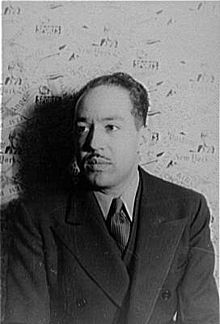
Langston Hughes (1902-1967), poet, novelist, playwright, columnist and social activist

LET AMERICA BE AMERICA AGAIN

Let America be America again.
Let it be the dream it used to be.
Let it be the pioneer on the plain
Seeking a home where he himself is free.

(America never was America to me.)

Let America be the dream the dreamers dreamed—
Let it be that great strong land of love
Where never kings connive nor tyrants scheme
That any man be crushed by one above.

(It never was America to me.)

O, let my land be a land where Liberty
Is crowned with no false patriotic wreath,
But opportunity is real, and life is free,
Equality is in the air we breathe.

(There’s never been equality for me,
Nor freedom in this “homeland of the free.”)

Say, who are you that mumbles in the dark?
And who are you that draws your veil across the stars?

I am the poor white, fooled and pushed apart,
I am the black man bearing slavery’s scars.
I am the red man driven from the land,
I am the immigrant clutching the hope I seek—
And finding only the same old stupid plan
Of dog eat dog, of mighty crush the weak.

I am the young man, full of strength and hope,
Tangled in that ancient endless chain
Of profit, power, gain, of grab the land!
Of grab the gold! Of grab the ways of satisfying need!
Of work the men! Of take the pay!
Of owning everything for one’s own greed!

I am the farmer, bondsman to the soil.
I am the worker sold to the machine.
I am the black man, servant to you all.
I am the people, humble, hungry, mean—
Hungry yet today despite the dream.
Beaten yet today—O, Pioneers!
I am the man who never got ahead,
The poorest worker bartered through the years.

Yet I’m the one who dreamt our basic dream
In the Old World while still a serf of kings,
Who dreamt a dream so strong, so brave, so true,
That even yet its mighty daring sings
In every brick and stone, in every furrow turned
That’s made America the land it has become.
O, I’m the man who sailed those early seas
In search of what I meant to be my home—
For I’m the one who left dark Ireland’s shore,
And Poland’s plain, and England’s grassy lea,
And torn from Black Africa’s strand I came
To build a “homeland of the free.”

The free?

Who said the free? Not me?
Surely not me? The millions on relief today?
The millions shot down when we strike?
The millions who have nothing for our pay?
For all the dreams we’ve dreamed
And all the songs we’ve sung
And all the hopes we’ve held
And all the flags we’ve hung,
The millions who have nothing for our pay—
Except the dream that’s almost dead today.

O, let America be America again—
The land that never has been yet—
And yet must be—the land where every man is free.
The land that’s mine—the poor man’s, Indian’s, Negro’s, ME—
Who made America,
Whose sweat and blood, whose faith and pain,
Whose hand at the foundry, whose plow in the rain,
Must bring back our mighty dream again.

Sure, call me any ugly name you choose—
The steel of freedom does not stain.
From those who live like leeches on the people’s lives,
We must take back our land again,
America!

O, yes,
I say it plain,
America never was America to me,
And yet I swear this oath—
America will be!

Out of the rack and ruin of our gangster death,
The abuse and rot of graft, and stealth, and lies,
We, the people, must redeem
The land, the mines, the plants, the rivers.
The mountains and the endless plain—
All, all the stretch of these great green states—
And make America again

– Langston Hughes

It seems a lot of us could do with a re-read of Langston Hughes’ poem, “Let America Be America Again” … I love this country but it never was and is not now a good time had by all. Let’s work together and continue to make it and the world better place (i.e., safe, respectful, diverse, and equitable). Let’s not go back(ward) again. J.D.

Δ
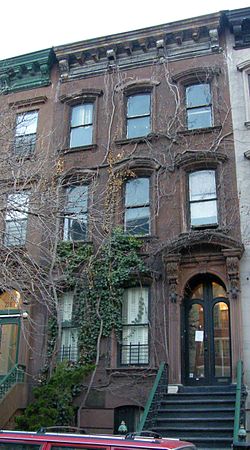
Langston Houghs' House in Harlem
Langston Hughes’ House in Harlem

Misery

Misery is when you heard
on the radio that the neighborhood
you live in is a slum but
you always thought it was home.

– Langston Hughes

“Langston Hughes House is a historic home located in Harlem, New York, New York. It is an Italianate style dwelling built in 1869. It is a three story with basement, rowhouse faced in brownstone and measuring 20 feet wide and 45 feet deep. Noted African American poet and author Langston Hughes (1902-1967) occupied the top floor as his workroom from 1947 to 1967. It was listed on the National Register of Historic Places in 1982.” [Wikipedia]

I, Too, Arts Collective

Harlem-based writer, Renee Watson, just initiated an Indigogo campaign to raise the money to rent Langston’s house and turn it into a cultural center, “for emerging and established artists in Harlem to create, connect, and showcase work…” MORE

If you are reading this from an email subscription, it’s likely that you will have to link through to the site to view the video …

According to Renee, the “I, Too, Arts Collective” is a non-profit organization committed to nurturing voices from underrepresented communities in the creative arts. Our first major project is to provide a space for emerging and established artists in Harlem to create, connect, and showcase work. Our goal is to lease and renovate the brownstone where Langston Hughes lived in Harlem as a way to not only preserve his legacy but also to build on it and impact young poets and artists.”

Photo credits: Langston Hughes’ photograph is from the Carl Van Vetchten collection of the U.S. Library of Congress Prints and Photograph Division id# cph.3a42821 and is in the public domain; the photograph of his house is courtesy of Americasroof under CC BY 3.0 license

“Embarrassed” – British Poet, Hollie McNish, delivers a rhymed and reasoned defense of breastfeeding in public

Hollie Poetry a.k.a. Hollie McNish, poet, author and spoken word artist

“Born in Reading to Glaswegian parents, Hollie studied French and German at King’s College, Cambridge, before earning a master’s degree in Development Economics.Hollie won the UK Slam Poetry Competition in 2009 and went on to finish 3rd in the global Slam Du Monde contest. A collection of her poems, Papers was published by Greenwich Exchange in 2012.

“A number of Hollie’s YouTube videos have gone viral and her account currently has over 3.9 million views.McNish’s first album, Versus, was released in September 2014 under the pseudonym Hollie Poetry, she was the first poet to record an album at Abbey Road Studios.Hollie has collaborated with Kate Tempest and George the Poet and they have appeared on stage with her during her 2015 tour. McNish received major national airplay on the BBC, first in January 2015 on Huw Stephens BBC Radio 1 show and then in May 2015 on BBC Radio 1Xtra in as part of a spoken word event.” Wikipedia

Embarrassed

I thought it was okay, I could understand the reasons
They said, “There might
be a man or a nervous child
seeing this small piece of flesh that they
weren’t quite expecting.”
So I whispered and tip-toed with nervous discretion
But after six months of her life sat sitting on lids,
sipping on milk, nostrils sniffing on piss
Trying not to bang her head on toilet roll dispensers
I wonder whether these public loo feeds offend her
‘Cause I’m getting tired of discretion and being polite
As my baby’s first sips are drowned drenched in shite
I spent the first feeding months of her beautiful life
Feeling nervous and awkward and wanting everything right
Surrounded by family ‘til I stepped out the house
It took me eight weeks to get the confidence to go into town
Now, the comments around me cut like a knife
As I rush into toilet cubicles
feeling nothing like nice
Because I’m giving her milk that’s not in a bottle
Which in the cocaine generation white powder would topple
I see pyramids, sales pitches, across our green globe
And female breasts–banned–unless they’re out just for show
And the more I go out, the more I can’t stand it
I walk into town, feel I’m surrounded by bandits
‘Cause in this country of billboards, covered in tits
And family newsagent magazines full of it
WH Smith top shelf’s out for men
Why don’t you complain about them then?
In this country of billboards, covered in tits
And family newsagent magazines full of it
W.H. Smith top shelves out for men
I’m getting embarrassed in case
a small flash of flesh might offend
And I’m not trying to parade it
I don’t want to make a show
But when I’m told I’d be better just staying at home
And when another friend
I know is thrown off a bus
And another mother told to get out of a pub
Even my grandma said that maybe I was sexing it up
And I’m sure the milk-makers love all this fuss
All the cussing, and worry, and looks of disgust
As another mother turns from nipples to powder
Ashamed or embarrassed by the comments around her
And as I hold her head up and pull my cartie across
And she sips on that liquor made from everyone’s God
I think, For God’s sake, Jesus drank it
So did Siddhartha, Muhammad, and Moses
And both of their fathers
Ganesh, and Shiva and Brigit and Buddha
And I’m sure they weren’t doing it sniffing on piss
As their mothers sat embarrassed sitting on cold toilet lids
In a country of billboards covered in tits
In a country of low-cut tops cleavage and skin
In a country of clothed bags and recycling bins
And as I desperately try to take all of this in
I hold her head up, I can’t get my head round the anger
Towards us and not to the sound of lorries
Off-loading formula milk
Into countries dripping in filth
In towns where breasts are oases of life
Now dried up in two-for-one offers enticed by labels, and gold standard rights
Claiming that breast milk is healthier, powdered and white
Packaged marketed and branded and sold at a price
That nothing is free in this money-fueled life
Which is fine if you need it or prefer to use bottles
Where water is clean and bacteria boiled
But in towns where they drown in pollution and sewage
Bottled kids die and they know that they do it
In towns where pennies are savored like sweets
We’re now paying for one thing that’s always been free
In towns empty of hospital beds, babies die,
Diarrhea-fueled, that breastmilk would end
So no more will I sit on these cold toilet lids
No matter how embarrassed I feel as she sips
Because in this country of billboards, covered in tits
I think we should try to get used to this

© Hollie McNish

She’s good. I’m so delighted to find her. Hollie’s website, Hollie on Amazon U.S. and on Amazon U.K.

Photo credit: Andrew Lih under CC BY-SA 3.0 license

CELEBRATING AMERICAN SHE-POETS (25): Olympian Alexi Pappas, draws attention to the art of the poem

Olympic_rings_without_rims.svg

So many of us are enchanted by Alexi Pappas, the Greek-American, poet, film-maker and Olympic champion. She’s not only wholesome, bright-spirited and hard-working, she’s a talent who, by virtue of interest and ethnic heritage,  links the historic roots of the Olympics with the modern event . . . and she’s drawing attention to our primary love, poetry. This is altogether a lovely package.

Scary Things

The thing about scary things
like spiders
is that they do not scare me
nearly as much
as the things I want the most.

The want things creep and stay
live in my mind–
a much harder place to reach and find
cannot be killed
will grow instead
unlike the spider in my bed
the scary want inside my head
is not afraid
and will not flee
rather than boo
says come and get me.

– Alexi Pappas

We couldn’t let this week go by without acknowledging Alexi Pappas, who has dual citizenship – U.S. and Greece. She explains here why she chose to run for Greece, but she was born in the States and her hometown is Alameda, California.

RELATED
Road to Rio is paved with poetry for runner Alexi Pappas, PBS Broadcasting
This Olympian — and poet — on her love for “freedom within boundaries”, PBS Broadcasting
Alexi Pappas, Wikipedia
Alexi Pappas, Dartmouth University Big Green (Sports)

SELF-PITY AND SELF-AGGRANDIZEMENT, the snares of writing from one’s own biography

IMG_0689 (1)What feeds our imagination: the lives of others or our own lives? My impulse is to say a healthy dollop of each, but it is always interesting to see what someone else has to say.  Poet Nikki Giovanni says,

I want to be clear about this. If you wrote from experience, you’d get maybe one book, maybe three poems. Writers write from empathy.”

51ZfrreZciL._SX332_BO1,204,203,200_

In contrast the Dominica-born British novelist Jean Rhys wrote five stunning novels milked from her own life. Autobiographic elements are even in Wide Sargasso Sea, Rhys’ post-colonial drama in which travesties of racial inequality, patriarchy, displacement and assimilation are themes. This book, a much-lauded prequel to Charlotte Brontë’s Jane Eyre, evolved from Rhys’ dissatisfaction with Brontë’s treatment of Antoinette Cosway, from Rhys’ own life experience of rejection and emotional turmoil, and from her observation of and distress with how the people of Dominica were viewed and treated by colonizers.  The book is her (re)vision of Antoinette Cosway, a Creole heiress, married for her money to an unnamed English gentleman who changed her name and pronounced her mad. Antoinette does not fit in with the Europeans or the Jamaicans. In her own life Jean Rhys never felt that she fit in.

Jean Rhys was an astute self-observer, scrupulously honest.  She worked hard to avoid both self-pity and self-aggrandizement or congratulation. If you’ve read her work you know she largely succeeded.

In one of Rhys journals she imagines herself in court:

It is in myself.

What is?

All. Good evil, love, hate, life, death, beauty, ugliness.

And in everyone?

I do not know everyone. I only know myself.

And others?

I do not know them. I see them as trees walking.

Counsel for the Prosecution: There you are!  Didn’t take long, did it?

Clearly Jean Rhys felt her own life was what she knew best, the podium from which she could speak. She did what she felt called to do, what was natural for her. By being careful and conscious she avoided the pitfalls of self-pity and self-aggrandizement. Certainly to one degree or another writing is therapy. Most of us agree on that. At its best, however, it doesn’t read that way.

© 2016, Jamie Dedes