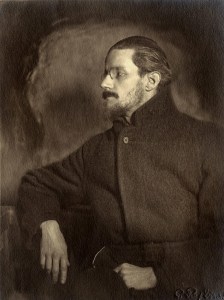
“The life of an artist … differs from the lives of other persons in that its events are becoming artistic sources even as they command his present attention. Instead of allowing each day, pushed back by the next, to lapse into imprecise memory, he shapes again the experiences, which have shaped him. He is at once the captive and the liberator.” Richard Ellmann in James Joyce(Recommended)
American literary critic Richard Ellmann (1918-1987) was also an excellent biographer and wrote about Joyce, Wilde and Yeats. As far as I know, all three books are still in publication.
Joyce photo is in the public domain.
Thank you for sharing your love of words. Comments will appear after moderation.
Dominican-American Julia Alvarez (b. 1950), novelist, essayist, poet, educator, a prominent critically and commercially successful Latina
“Even I, childless one, intend to write
New Yorker fiction in the Cheever style
but all my stories tell where I came from.”
Family Tree
It’s always a special pleasure to explore the work of those who dance on the hyphen, who don’t quite fit here or there and have to make something new out of their life circumstance. Unique qualities of clarity and color seem to come from the richness inspired by bilingual skills and from that uncomfortable hyphenated place with its singular view. It leads as it must for any observant person to the rigorous exploration of the human condition and of cultural and gender-based stereotypes.
” … definitely, still, there is a glass ceiling in terms of female novelists. If we have a female character, she might be engaging in something monumental but she’s also changing the diapers and doing the cooking, still doing things which get it called a woman’s novel. You know, a man’s novel is universal; a woman’s novel is for women.”
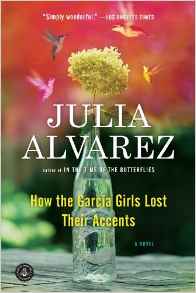
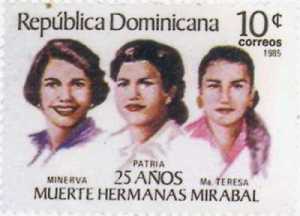
From the hyphen the Dominican-American Julia Alvarez birthed her first gift to us, How the Garcia Girls Lost Their Accents(Algonquin Books, 1991), a semi-autobiographical young adult work followed three years later with In the Time of the Butterflies (Algonquin Books, 1994). The first book gave us the immigrant experience. The second established Julia as a writer who wanted to go a step beyond to bring to light and bare witness to the events – tragic, liberating and inspiring – of las hermanas Mirabal (the sisters Mirabal), known as Las Miraposas, the Butterflies. They were four sisters at the heart of the fight against the rule of the Dominican despot, Rafael Leonidas Truillo. He had three of the four sisters murdered along with some 50,000 other Dominicans and Haitians.
It’s not surprising that Julia Alvarez chose to write about Las Mariposas. She was born in New York in 1950 when her parents first attempted to establish themselves in the U.S., but she lived her early years in the Dominican Republic. She lived there until she was ten years old when her family was forced to leave the country after Julia’s father participated in a failed attempt to overthrow Truillo.
I think that one of the reasons I began as a poet, and poetry was my first love, in English, was because … I especially like cadenced, rhymed poetry, and poetry in English was a way of still speaking Spanish. Because it made language more musical, more cadenced…rhyme, of course, because every other word in Spanish rhymes with an “a” or an “o” ending, so there was a way in which, to me, English poetry was a way to speak Spanish in English.
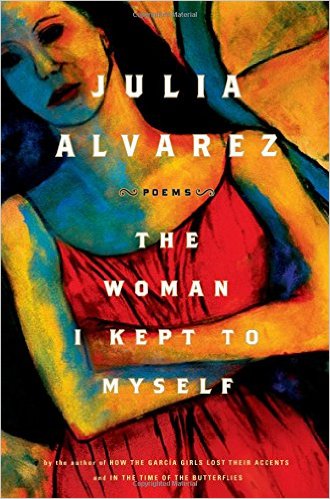
Over the past twenty-five years, Julia Alvarez prolific pen has poured out fiction for adults and young adults, collections of essays and, of course, poetry. The Woman I Kept to Myself(Algonquin, 2004) is a collection in which she explores her life from the perspective of middle age …
We learn through what we love to love the world —
which might be all that we are here to do.
Meditation
There are seventy-five poems, each composed of three ten-line stanzas, a consistency that has inspired some mixed reviews. I find this style rather sophisticated and it lends cohesiveness to the work, which is certainly a celebration of the quotidian. Sometimes the conclusions are what is to be expected … nothing exciting, just life as usual; something accepted, not fought against. There’s a certain virtue in that.
We make our art
out of ourselves and what we make makes us.
Tom
Nigerian poet, novelist, professor and critic, Chinua Achebe (1930-2013)
CHINUA ACHEBE was a Nigerian poet and novelist. His first novel Things Fall Apart(1958) is his major work and is said to be the most widely read book in modern African literature. He is considered the founding father of African literature in English.
Listen to a short interview with Achebe‘s daughter in pop-out player on BBC’s Witness. Published in 1958, Things Fall Apart “was set in pre-colonial rural Nigeria and examines how the arrival of foreigners – imposing their own traditions – led to tensions within the Igbo society. The book revolutionised African culture, and began a whole new genre of world literature. Witness radio program hears from Achebe’s youngest daughter, Nwando Achebe.”
Refugee Mother and Child Poem
No Madonna and Child could touch
that picture of a mother’s tenderness
for a son she soon would have to forget.
The air was heavy with odours
of diarrhoea of unwashed children
with washed-out ribs and dried-up
bottoms struggling in laboured
steps behind blown empty bellies. Most
mothers there had long ceased
to care but not this one; she held
a ghost smile between her teeth
and in her eyes the ghost of a mother’s
pride as she combed the rust-coloured
hair left on his skull and then –
singing in her eyes – began carefully
to part it… In another life this
would have been a little daily
act of no consequence before his
breakfast and school; now she
“PHOSPHORESCENCE. Now there’s a word to lift your hat to… to find that phosphorescence, that light within, that’s the genius behind poetry.” Emily Dickinson
If you are a lover of poetry and theatre and looking for some budget-wise charm this weekend, order some Chinese food, set out the candles and wine, and stream William Luce‘s one-woman bio-play on Emily Dickinson, The Belle of Amherst, with Julie Harris. I don’t see it on iTunes, but it is on Amazon Instant Video.
Based on the life of poet Emily Dickinson from 1830 to 1886, the play is set in the family home in Amherst, Massachusetts. It incorporates her work, diaries, and letters in a reenactment of her life with family, close friends, and acquaintances. Enchanting and often funny.
After one preview, the original Broadway production, directed by Charles Nelson Reilly and starring Julie Harris, opened on April 28, 1976 at the Longacre Theatre. It ran for 116 performances. A Wall Street Journal reviewer wrote
With her technical ability and her emotional range, Miss Harris can convey profound inner turmoil at the same time that she displays irrepressible gaiety of spirit.”
In The Belle of Amherst Harris portrays fifteen characters and won a Tony Award for Best Actress in a Play, earned a Drama Desk Award nomination for Unique Theatrical Experience, and won a Grammy Award for Best Spoken Word Recording. She appeared in a televised PBS production and toured the country with the play for a number of years [sources: Wikipedia and NY Times]
Luce and Harris collaborated on other wonderful plays including Bronté. A broadway playwright, Luce also wrote Barrymore, which with family I was fortunate enough to see on stage starring Christopher Plummer many years ago. That was a bit of heaven. Luce wrote Lucifer’s Child based on the writing of Karen Blixen (Isak Dinesen), Lillian about Lillian Hellman and Zelda, which became The Last Flapper, about Zelda Fitzgerald. If script writing is one of your interests, you could probably do worse than reading a few of Luce’s plays.





 Jamie Dedes' THE POET BY DAY Webzine