Page 57 of 91

JUAN FELIPE HERRERA: From limited-English speaker and Migrant Farm-Worker to United States Poet Laureate

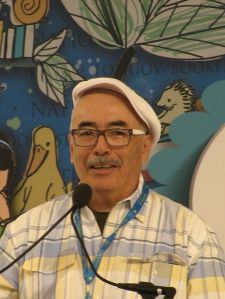
U. S. Poet Laureate, Juan Felipe Herrera (b. 1948)

A year ago this month, the United States Library of Congress announced the appointment of former California Poet Laureate (2012-2014), Juan Felipe Herrera, to the position of national poet laureate, the highest honor awared to poets in these United States.

Herrera’s body of work is a reflection of the Mexican-American experience and is also representative of much that immigrants and migrants the world over have in common including the efforts and adjustments made along a path often leading to distinguished contributions to their communities and adoptive countries.

In announcing the appointment, James H. Billington – Librarian of Congress (1987-2015) – said of Herrera …

I see in Herrera’s poems the work of an American original—work that takes the sublimity and largesse of  Leaves of Grass and expands upon it,” Billington said. “His poems engage in a serious sense of play—in language and in image—that I feel gives them enduring power. I see how they champion voices, traditions and histories, as well as a cultural perspective, which is a vital part of our larger American identity.”

Herrera is the first Hispanic poet to serve in the position. Herrera said …

This is a mega-honor for me, for my family and my parents who came up north before and after the Mexican Revolution of 1910—the honor is bigger than me. I want to take everything I have in me, weave it, merge it with the beauty that is in the Library of Congress, all the resources, the guidance of the staff and departments, and launch it with the heart-shaped dreams of the people. It is a miracle of many of us coming together.”
61WsQ5uGMTL._SX401_BO1,204,203,200_

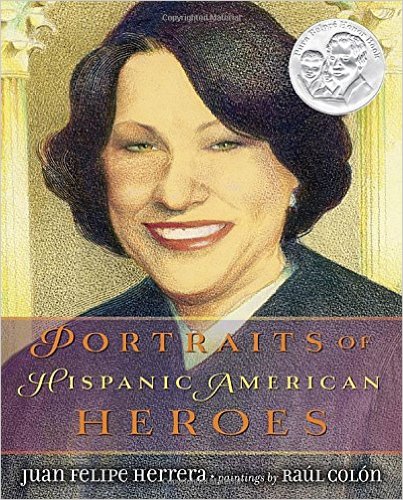
Herrera has authored some twenty-eight books of poetry, novels for young adults and collections for children, including Portraits of Hispanic American Heroes (Dial Books,2014), a picture book showcasing inspirational Hispanic and Latino Americans.

Herrera was born in Fowler, California, in 1948. As the son of migrant farm workers, he moved around often, living in tents and trailers along the road in Southern California. He attended school in a variety of small towns from San Francisco to San Diego. In 1972 he was graduated from the University of California, Los Angeles (UCLA) with a bachelor’s degree in social anthropology. He then attended Stanford University, where he received a master’s degree in social anthropology. In 1990 he received a Masters of Fine Arts at the University of Iowa Writers’ Workshop.

books-noted-juan-felipe-herreras-half-world-light-new-and-selected-poems

Enter the Void

Sit on the embankment,
a dust fleece, there is a tidal wave ahead of me.

It will never reach me. I live underground, under the Dead Sea,
under the benevolent rocks and forearms and
mortar shells and slender naked red green
torsos, black,
so much black.
en route:

this could be a train, listen:
it derails into a could.

excerpt on the conflict in the West Bank from Half the World Is Light, New and Collected Poems (University of Arizona Press, 2008)

Herrera has published over a dozen poetry collections, including Half the World in Light: New and Selected Poems , which received the National Book Critics Circle Award and the International Latino Book Award. He is also a celebrated young adult and children’s book author. His honors include the Américas Award for both Cinnamon Girl: letters found inside a cereal box and Crashboomlove: A Novel in Verse, as well as the Independent Publisher Book Award for Featherless / Desplumado, the Ezra Jack Keats Award for Calling the Doves  and the Pura Belpré Author Honor Award for Portraits of Hispanic American Heroes and for Laughing Out Loud, I Fly.

For his poetry, Herrera has received two Latino Hall of Fame Poetry Awards, a PEN USA National Poetry Award, the PEN Oakland / Josephine Miles Award, a PEN / Beyond Margins Award, and fellowships from the Guggenheim Foundation, the National Endowment for the Arts, the Bread Loaf Writers’ Conference, and the Stanford University Chicano Fellows.

Herrera has served as the chair of the Chicano and Latin American Studies Department at California State University, Fresno. He has held the Tomas Rivera Endowed Chair in the Creative Writing Department at the University of California, Riverside, where he taught until retiring last year. He is currently a visiting professor in the Department of American Ethnic Studies at the University of Washington, Seattle. Appointed in 2011, he serves as a chancellor for the Academy of American Poets.

Juan Felipe Herrera’s Poet Laureate Project is La Casa De Colores or “the House of Colors” …

a house for all voices. In this house we will feed the hearth and heart of our communities with creativity and imagination. And we will stand together in times of struggle and joy. The website includes two features:

“La Familia (The Family) is an opportunity for you to contribute to an epic poem of all our voices and styles and experiences that will run the span of my Laureateship. By contributing to La Familia, you will be part of my family—and all our words will be seen and our voices be heard, throughout the nation and beyond.

“El Jardín (The Garden) is a special place where I will share my experiences with curators at the Library of Congress. Peek into the Library’s wealth of materials, such as: Pablo Neruda’s “España en el Corazón,” given to him by soldiers—the pages made out of their clothes turned to pulp; a letter the folksong pioneer Woody Guthrie wrote on the back of a dust jacket to Alan Lomax; a silkscreen by Yolanda M. López, on the courage of “Mujeres Trabajadoras”—women workers. I hope you will be as inspired by them as I am, and you can take the treasures of El Jardín with you—in heart and with pen.”

Herrera will begin serving his second term as U.S. Poet Laureate this September. His Amazon page is HERE.


CELEBRATING AMERICAN SHE-POETS (20): Terri Muuss, Over Exposed

American She-Poet, Terri Muss

41GZoJ9eI3L._SX322_BO1,204,203,200_

SCARLET LETTER

In fifth grade
my father’s secrets
start to breed under my red
confirmation dress—
dig deep in the tunnel of my inner
ear, cling to sentry hairs
on the nape of my neck—

his secrets: black bodies,
glassy eyes, squeeze
beneath my fingernails—
quiet as eggs;
they spin a red thread
that cuts me inside
out.

Over Exposed, the memoir of Terri Muuss, is at once painful and triumphant. It is an examined life that exposes the family of her childhood, the obscenities imposed on her by her father, her numbing with alcohol and drugs and her journey in therapy. All of this and yet she arrives victorious and accomplished with a healthy marriage, healthy sons and a multifaceted career, elements of which reach a hand out to those in trauma.

This is the story of how a child survived and became a woman who found herself and a writer who found her voice. The experiences of a lifetime form a collection of poems and prose vignettes that bespeak the possibilities of redemption and hold out hope and affirmation to those others whose childhoods have left them wounded. I recommend this book to everyone but, most especially, to those who have a history like Terri’s.

Lately, I feel a bull’s eye on me: on the street, the A train, in the fruit market. Men infect me with words, with smiles. Eyes snatch at breasts, tongues pin me to subway walls, mouths like a cold speculum pry open my inner ear. Their words pound, pound me, a worn head of drum. Voices divide and conquer, dividing me from myself—

Emotionally it was not the easiest book to read. I often found myself in tears.It is rewarding though, not only because its subject remains unbeaten but because the writing, pacing and organization have you moving through the pages anxious to gobble up each poem, each story, every nuance. Terri’s switches from child-voice to adult are smooth, her imagery clear and moving, her poetry well-crafted.

13550802017232

There are two videos in this post. If you are reading this from an email, you will have to click to this site to view the videos.

INTERVIEW

JAMIE: Am I right that your first love was acting? If so, how did you transition – or what inspired – the addition of poetry to your artistic repertoire?

TERRI: Yes, acting, theatre and directing have always been my first loves. I came to acting quite young and naturally. It will always be a huge part of who I am and how I see art in a larger sense. Much of my poetry is born out of a theatricality I possess from being onstage these many years.

That being said, poetry was always sort of waiting in the wings for me. When I was in 10th grade, my best friend Leslie was a beautiful person and poet who I admired greatly. I spent long days at her house after school as I had no inclination to go home to my own dysfunctional house. There, she read and wrote poetry in front of me and it certainly inspired me to use it as an avenue for expression. Later, during senior year, I had a teacher hand me a packet of poems by e.e. cummings, T.S. Eliot, Emily Dickinson and Langston Hughes that she thought I would enjoy. That packet sent me on a journey of reading as many poets as I could. Still, poetry was off to the side while theater took center stage.

It really wasn’t until I was faced with the trauma of my past and of putting myself together that writing became both a therapeutic tool and an artistic passion. To better understand the trauma of being sexually abused as a child, I wrote and wrote and wrote. Mostly poetry but also monologues. At the end, what I’d constructed was a one-woman show skeleton that became Anatomy of a Doll. I performed the show throughout New York City and then the country at conferences and in theaters. Even then, I didn’t identify myself as a writer. I thought of myself as a performer who just happened to use my writing as a script. When Veronica Golos (my friend, mentor and a gorgeous poet who’s won numerous awards) began taking an interest in my work and started editing it in a poetry workshop she led out of her house on the Upper West Side, I started to see myself in the context of being a poet and poetry as a vocation. I think the form of poetry works well to showcase the dissociation that comes with abuse much more than prose does. Veronica is still my editor, having worked on both Anatomy of a Doll and my book, Over Exposed.

But the biggest transition from actor to writer happened during my marriage to poet Matt Pasca. He’s always seen me as a writer and, before I even claimed that identity for myself, always pushed me to go deeper, to write more, to get better, to submit my work. Through our marriage I have grown as a writer and came to see myself as a poet.

JAMIE: It is one thing to write about painful events in life and another to share them publicly. I think you are something of a hero for doing so. Where does this core of courage come from? What is the reaction from friends and relatives?

TERRI: This is a very interesting question that I get often–the question of the courage it takes to reveal my past. Many people have said they’ve seen me as courageous because I share the truth of my childhood sexual abuse, subsequent rapes, addiction and my recovery quite publicly. I have to acknowledge that this is the way it is perceived by other people. For me, however, it’s born out of necessity and so it’s never felt or seemed like courage. I have lived my life according to the 12-step saying, “You’re only as sick as your secrets.” I know that what I keep inside me, what I feel shame about, what I try to hide, will destroy me from the inside. Giving a voice to my pain and shame and grief and mistakes gives me back my power, my joy and my life.

I’ve also grown to see that if I’m hiding the fact that I was sexually abused, I am sending myself and others the message that it was somehow my fault or that there’s something for me to be ashamed of. I’ve come to understand that what happened to me was not anything that I should be ashamed of. I was the victim so why should I be ashamed. I’ve also come to understand that the sexual abuse and the rape and the violence are a part of me but they are not the entirety of me.

Lastly, if I can help someone (with my story) to recover, let go of their shame, and move into survivorhood, then it is all more than worth it. As social worker and researcher Brene Brown states, “If you put shame in a petri dish, it needs three ingredients to grow exponentially: secrecy, silence, and judgment. If you put the same amount of shame in the petri dish and douse it with empathy, it can’t survive.” I choose let go of secrecy and to douse my shame with empathy, and empathy for the world must begin with me.

Friends and relatives have been overwhelmingly supportive, although for some of them, it took a period of adjustment and listening that gave birth to deeper understanding. I surround myself with people who are willing to be empathetic, courageous, vulnerable, and honest with both me and themselves. I consider myself very lucky to have a wide circle of supportive people in my life.

JAMIE: With two parents who are poets, do your children like poetry? Have they started writing themselves? Have they read your poetry?

TERRI: Great question! Yes! We have two boys, Rainer, 10, and Atticus, 7, and they have both had poems published. Rainer is by far the more prolific writer who really loves writing and poetry. Atticus is a drummer who dabbles in writing. They both had poems published in Skipping Stones, a journal for children ages 7-14. Rainer has also been published in Stone Soup, The Louisville Review (when he was 4), and the anthology, Holiday Word Gifts (JB Stillwater, 2011). Some of the things that Rainer writes take my breath away. It’s proof positive that as artists we are always trying to get back to that place where we were as children– where we can take risks and be playful and not worry about being judged.

JAMIE: You seem to have a gift for building a poetry community. What advice do you have for readers who might be trying to do the same?

TERRI: I’m a licensed social worker and the macro version of social work is community organizing. The first rule of community organizing is to listen to the community. Too often, people come into a community with their own expectations and demands. They try to foist onto a community what they want to see the community have. If you’re really trying to build community, through the arts or otherwise, ask questions and be willing to hear the answers. The community might not want the same things you want for them but if community is your ultimate goal, you need to let its members be your guide. Too often in the poetry community, as in other communities, people set up an event that mirrors the kind of poetry THEY want but disregard what the community is really is looking for. Finding the right venue, format and publicity are integral to success.

I would also add that it’s so important to have collaborators in any community venture. Without them, burnout is a real factor. You need to be able to share the workload, bounce ideas off of each other, and laugh together to elevate stress and keep it going!

JAMIE: You put together a lovely trailer for “Over Exposed.” How long did it take to put it together and what kind of tools did you use. Have you found it helpful in getting the word out.

TERRI: Dana Maddox did my trailer. She’s a brilliant filmmaker studying in LA right now. I came in contact with her through the mother of someone I directed in a show. We did the voiceover elements in the studio first and then she came to shoot the video at my house. It took about 10 hours of shooting and about two weeks of intense editing for her to put together the trailer. It’s not something that I could have done alone. Many people have that skill set but that’s not my wheelhouse. I can direct videos but editing is a different thing. She did an amazing job and I’m very proud of it. It certainly helps get the word out about my book. I think social media and online platforms always help books.

JAMIE:  So you have to my knowledge three books out: one on poetry as therapy, the recently published anthology, and “Over Exposed.” What’s next on the agenda?

TERRI: I have two books out currently. Over Exposed is my memoir, told in both poetry and prose. Grabbing the Apple is an anthology of New York women poets that I coedited with M.J. Tenerelli. The other group you mentioned here is the Poets of Well-being (Susan Dingle, Maggie Bloomfield, Nina Yavel and I). We are all social worker-writers who are in long term recovery (we have over 100 years of sobriety between us). I was the last member to join the group and so their chapbook does not include my work. It’s absolutely worth checking out. You can find the group on Facebook. As a group, we travel to conferences and venues to showcase how writing can be a therapeutic tool for helping others overcome addiction and abuse. We facilitated a workshop at AWP in Minnesota, at the Expressive Therapies Conference in NYC and were even invited to the 2016 NASW conference in DC. Susan runs a beautiful poetry event called “Poetry Street” out in Riverhead that is a fine example of great community organizing and art as a healing method.

*****

A tidbit on the light side and apropos upcoming elections in the U.S.: Atticus and Rainer Muuss on Ellen and at The White House with the First Lady.

©2016, portrait, poems, bookcover art and interview responses, Terri Muuss, All rights reserved

Happy Father’s Day with Mexican-American Poet and former California Poet Laureate, Juan Felipe Herrera … the immigrant experience

Juan Felipe Herrara (b. 1948), American poet and writer, photo by SlowKing
Juan Felipe Herrera (b. 1948), Mexican-American poet and writer, photo by SlowKing under GNUFDL

I posted this a few years ago here and just included it in this month’s issue of The BeZine.  I’m re-posting it now because it highlights the quality and character of immigrants to the United States of America, which seems a good thing to do at this time. I’ll post this Sunday’s Poesy later today. 

Juan Felipe Herrera is a Mexican-American poet and performance artist, a writer and cartoonist, a teacher and an activist.

“Many poets since the 1960s have dreamed of a new hybrid art, part oral, part written, part English, part something else: an art grounded in ethnic identity, fueled by collective pride, yet irreducibly individual too. Many poets have tried to create such an art: Herrera is one of the first to succeed.”  Punk Half Panther by Stephen Burt in the New York Times

Herrara incorporates into his writing his experience of family and the life of the compesinos, migrant farm-workers.

“Into the tilted factories, the smeared taxis,
the stunted universities, into the parlor of bank notes,
in the cramped cookhouse where the dark-skinned
humans still stoop and pitch the daily lettuce bags …”

He sometimes tells stories that arise from what is for him a pivotal moment: the early school experience of trying to fit in though he had no English-language skills. He also writes stories that illustrate the problems of immigration, which often separates families.

In 2012, California Governor, Jerry Brown, named Herrera California Poet Laureate, the first Chicano poet to be so honored.

Many of us – like Juan Felipe Herrara – had fathers or grandfathers who came to the United States to make a better life for themselves and eventually for their children and future generations and who went on to make substantive contributions to this country. Sometimes we like to remember and acknowledge them for their vision, courage and hard work. Today seems like a good day to do so. The video below is charming children’s story, A Tale for Father’s Day, about Herrera’s immigrant father. Enjoy!

Happy Fathers’ Day to all the dads and to all the moms who, for one reason or other, are both dad and mom.

“GRABBING THE APPLE” … or how a regional (New York) anthology of women poets was created and successfully launched

51UKv1yazEL._SX322_BO1,204,203,200_

Thanks to poet, writer and anthologist, M. J. Tenerelli, for sharing this story with us today.

Several years ago I did a show for the Northport Arts Coalition highlighting the work of well established women poets. I thought at that time that pulling together a collection of passionate, local women’s voices in a book of poetry would be a wonderful thing to do. There were so many talented women I knew on the New York circuit, giving profoundly moving performances, sharing really fine work. Two years ago my friend and co-editor, Terri Muuss, suggested that we get together and produce what became Grabbing the Apple, and anthology of New York women poets. And so a two-year project began.

The idea behind the book was to share what we believed was the unique voice of the New York woman, informed by place as well as a particular confidence, savvy, and passion. Terri and I wanted the book to serve as a conduit for these women, allowing them to define themselves as opposed to the traditional definitions existing in male-created literature, including the bible. Eve from Eve’s perspective.

First we needed a title. We wanted something that reflected the concept of women defining themselves. We turned to the original story of creation in the bible, where the mother of us all begins the downfall of man by plucking an apple from a tree. With Grabbing the Apple, we believed we had a title that turned that creation story upside down. Yes, the first woman, embraced wisdom, and that did not make her a monster but rather a heroine and a role model. The poets in the book define themselves and the lives and concerns of women, forcefully and without shame. We felt the anthology’s title embodied that. And of course “Apple” brings to mind New York.

Call for Submissions: We used social media, college websites and word of mouth to solicit submissions. We emailed the women poets we personally knew. The amount of work that poured in amazed us. I think the concept of the book really spoke to these writers, and they wanted to be heard. We culled 47 pieces from hundreds of submissions. It wasn’t easy. With the help of poet Matt Pasca, Terri’s husband, we instituted a blind process. Matt oversaw the email submission box, and printed out the poems for us, minus the writers’ names. Terri and I both had complete copies of the submissions to read through and consider. I don’t think we understood at the time just how long it would take to come up with a book we were satisfied with–to do right by the poets and the idea behind the book.

Reading and Selecting: I spent a lot of time with the work. As a mother with a full-time job, I spent many lunch hours in my car, and on the couch after work, reading poetry. It was far from a chore. The work energized me, moved me, and surprised me again and again. I started to feel honored to be stewarding these pieces into publication. It was often hard to choose what to accept and what to leave behind. Terri was also reading and considering. We each had a form to work with, where we gave each poem, identified only by number, a yes, no, or maybe. Then we would meet to compare our opinions.

In pizza restaurants, cafes, and often in Terri’s spacious living room, we would have “Apple” meetings. Often we agreed on what needed to go into the book. But not always. Sometimes one or the other of us would make a strong case for a poem we were passionate about. There were negotiations. It was never contentious. We respect each other as writers and editors, and are good friends. So we really listened to what the other had to say. It worked. We came up with a manuscript we could both stand behind. When it came to our own work, I picked a poem of Terri’s that I thought was perfect for the book, and Terri chose a piece that I had done. The next step was to create an order for the poems.

Terri suggested dividing the book into three parts, “Eden,” “The Fall,” and “After the Garden.” I loved the idea, but worried the poems we had wouldn’t lend themselves to the categories. It turned out to be needless worry. Whether loosely or specifically, each poem fits under one of the headings. I remember one night crawling around on Terri’s living room floor with the work spread out in front of us, moving poems around like puzzle pieces into each of the three sections. Again, there was a lot of consideration and some negotiating, but in the end we had groupings that made us both happy. We high fived each other and then celebrated with brownies! We had our poems and we had an order. We weren’t quite done though.

Finalizing and Publishing: We were our own proofreaders. There were a hundred plus pages to pour over. We wanted to get everything right. This took time, and in the end there were a few mistakes but we did our best. We proofed alone and together. We sent the manuscript to the publisher, corrected galleys, and up to the day before publication were still proofing! While we had input into the layout and design, it was the artist Janine DiNatale who created and did the layout for the front and back covers, and the publisher, J.B. Stillwater, who provided the beautiful finished book. I remember cradling the first copy sent to us and feeling like a proud mother. The final step was to get the collection out into the world.

Our initial book launch was at Cyrus Chai, in Bay Shore, New York. So many of the poets in the book came to read. For me, this was the defining moment. The poems I’d been living with for so long came to life. The electricity, love, and sisterhood in the room were palpable. The words sang. We’d accomplished what we set out to do, with more launches planned throughout the Summer.

© 2015, article and portrait (below), Mary Jane Tenerell;  bookcover art © Muuss and Tenerelli, All rights reserved

Grabbing the Apple is on Amazon where you can have a peek inside and sample a poem or two.

M. J. Tennerelli
M. J. Tennerelli

M.J. Tenerelli is a poet and a legal writer. She has worked as an editor of trade magazines and text books for the cosmetology, cosmetics and fragrance industries in New York City. She writes legal briefs for a Social Security Disability law firm and hosts a monthly poetry reading for the Northport Arts Coalition in Northport, NY. Her poetry has appeared in several anthologies, including Cat’s Breath and Estrellas En El Fuego, both by Rogue Scholars Press. Her poems have been published in a number of print and electronic journals, including The Feminist Wire; Poetry Bay; Alaska Quarterly Review; The Improper Hamptonian; Zuzu’s Petals; The Mom Egg; Blue Fifth Review; Poetry Kit; Poetry Super Highway; Big City Lit; American Muse and Parameter. She is a former editor of the art and literary magazine The Wormwood Press. She is the co-editor of the recently published poetry anthology Grabbing the Apple.