Page 59 of 91

WRITING YOUR SELF, Transforming Personal Material with John Killick & Myra Schneider
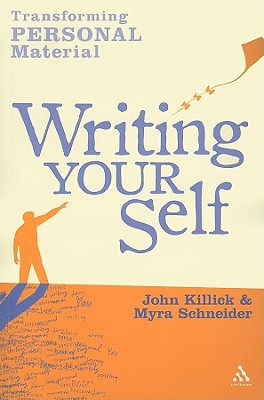
9781847062529_l

“We wrote the book because we believe that personal writing is very potent both for the writer and the reader, because some of the greatest literature is rooted in personal material.” Myra Schneider in an interview with Jamie Dedes

It always seems to me that writing  about life – “personal material” –  is a healing activity, a way to live hugely, and a way to empower ourselves and others. Whether we do it for ourselves alone or whether our purpose is to leave history behind for family, to set the record straight, or simply to share and entertain, the experience is rewarding.

Writing Your Self is a comprehensive book organized into two parts:

  • Part I: Here the focus is on life experiences, the exploration of those human experiences that are universal. These include childhood, self-concepts, relationships, displacement, physical and mental illness and disability, and abuse.
  • Part II: Here the focus is on writing techniques, recognizing material that is unfinished, working on refinements, and developing work projects.

Writing Your Self is rich with examples from unknown (students) and known writers including the authors. By example as well as explanation the authors reinforce what we intuitively understand to be true: that telling stories preserves identity and clarifies the human condition. It helps us understand what it means to be human. The experience of working through the book is rather like a rite of passage.

I can see the use of this book by individuals training themselves and by teachers of adult learners who wish to write memoir, poetry, fiction, or creative non-fiction. It would be useful in hospital therapeutic writing programs or in writing programs for active seniors.

Memories, both recent and distant, tell us who we are and so play a crucial role in our experience of life…

You may have memories which you want to plunge into or you may have material like a diary or letters which summon them up. There are other ways though of triggering memories. We offer a series of suggestions. Chapter 13, Accessing memories, secret letters, monologues and dialogues, visualizations.

Chapter 13 alone is worth the price of admission. I work a lot off of childhood memories and even the event that happened two minutes ago comes back to me with a dreamlike quality when I sit to write. I have not thought of the things I do naturally as triggers, but indeed they are. It was quite interesting to see these natural aids laid-out in the book: objects and place as starting points, physical sensation as triggers, people in memory and predominant feelings. The section on secret letters – that is, letters that you write someone and never send – was interesting. I’m sure it would make a fine jumping-off point for some. The authors go on to monologues and dialogues and visualization. We all do those things in our heads anyway. If you can see it or hear it in your mind, you can write it.

If you are inexperienced or stuck midway in a transition from one form of writing to another, you’ll benefit from the exercises, ideas, and instruction in Writing Your Self: Transforming Personal Experience. If you are a more experienced writer, you might find this book will stimulate the muse. This text is a definite thumbs-up.

13550802017232

Myra Schneider  is a British poet, a poetry and writing tutor, and author of the acclaimed book: Writing My Way Through Cancer.

John Killick was a teacher for 30 years, in further, adult and prison education. He has written all his life. John Killick’s work includes both prose works and poetry. 

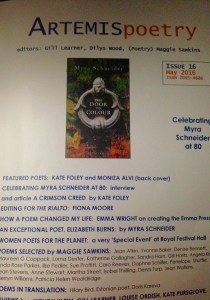
LATE-BREAKING NEWS: The May 2016 issue of ARTEMISpoetry is out …

FullSizeRender-1It’s absolute joy to see that this issue honors Myra Schneider at 80 years and includes an interview of Myra by Dilys Wood, founder of Second Light Network of Women Poets (SLN) and managing editor of ARTEMISpoetry. Bravo, SLN! 🙂

[Myra’s] poetry glows with an unembarrassed love of the quotidian – food, the kitchen, creatures, company, every leaf in the garden – especially the edible ones! – and almost above all, color.” Kate Foley, A Crimson Creed, Appreciating Myra Schneider

It’s equally wonderful after a long day to find this issue in my mailbox … with a bit of a new look, if I’m not mistaken …  a little less content and a bit more white space to enhance the readability and quite a bit more artwork, most enjoyable.

Gil Learner co-edited this issue with Dilys Wood. Kate Foley is featured poet and Maggie Hawkins chose the wealth of poetry included. There’s a nice collection of book and pamphlet reviews to excite our appetites for more.

Reminders included: SLN’s poetry competition for long and short poems by women to be judged by Alison Brackenbury. The deadline is 31 August 2016 with winners to be announced on 30 October 2016.  Details HERE.  …. Opportunity knocks!

Thanks to Dilys and team for the mentions of this site and of The BeZine. Always appreciated … and I am happy and honored to be “the American connection.”

You can sign-up for membership in SLN (recommended ladies!) or subscribe to the magazine at Second Light Live or at poetry p f, which was founded by and is run by poet, Anne Stewart.

apologies to all for the poor quality photo … the blame is mine not SLN

RELATED FEATURES:

Myra Schneider, A Life Immersed in Poetry

Dilys Wood’s “Antarctica,” the work of a highly original poet

Poet, Teacher, Inspiration: Dilys Wood and the Latter-day Sapphos

Opsimaths, Polymaths and Poets

“BROKEN HOMES,” Single Moms, Remarkable Sons …. Gil Scott-Heron, jazz poet

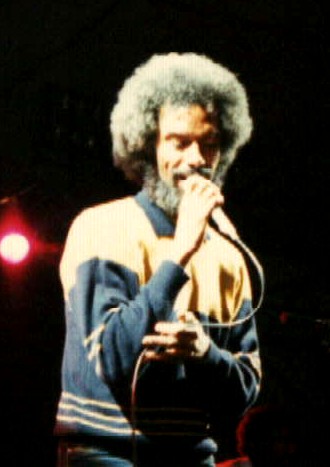
Gill Scott-Heron (1949-2011), American jazz poet, spoken-word poet, muscian and author
Gill Scott-Heron (1949-2011), American jazz poet, spoken-word poet, musician and author

All I really want to say
Is that the problems come and go
But the sunshine seems to stay

Gil Scott-Heron died around this time in 2011. He’d started out fiery and angry. Some will remember his forceful The Revolution Will Be Televised and other such works. He was always an artist of political integrity. It showed in actions such as refusing to perform in Tel Aviv because “we do not like wars.”  Over time his style mellowed, but his ideals remained.

Gil Scott-Heron is considered by many to be the grandfather of rap and the father of political rap.  Famously, he didn’t accept those titles; he was critical of young rappers, felt they needed to study more, to promote change and not perpetuate the status-quo.  He is quoted in ChickenBones: A Journal as saying …

They need to study music. I played in several bands before I began my career as a poet. There’s a big difference between putting words over some music, and blending those same words into the music. There’s not a lot of humor. They use a lot of slang and colloquialisms, and you don’t really see inside the person. Instead, you just get a lot of posturing.”

In the poem shared today (sent to me by my son on Mother’s Day, 2011) it’s interesting to see what Heron does with his personal experience.  I like that there’s nothing of the victim mentality in this piece. I like the way he talks of dealing with life as it is. I appreciate that he points out that single-parent homes are not always the result of abandonment but are often made so due to parents who were lost in war or in jobs as police officers, firefighters or pilots.

They lost their lives, but not what their lives stood for.” 

On Coming From a Broken Home (video below) is a good example of how art can explain, validate and give us new perspectives … perhaps even encourage us to talk with one another. The piece is from Gil Scott-Heron’s last studio album, I’m New Here. It came out in 2010 not long before he died.

As always if you are viewing this post from an email, you will have to click on the link to this site to see and hear the piece.

header photograph/Heron at the WOMARD festival in Bristol England, 1988 by Robman94 under CC BY SA 2.0 license.

Slam Poet Taylor Mali on what teachers make … “They make a difference!”

Taylor McDowell Mali (b. 1965) is an American slam poet, humorist, teacher, and voiceover artist.

Taylor Mali’s career in poetry evolved out of the slam poetry movement. He is a native New Yorker and taught school for nine years at Browning School for Boys (Manhattan) and Cape Cod Academy (Massachusetts). Currently, he travels the world facilitating workshops for teachers and students. He is a dedicated supporter of teachers and he says that through his New Teacher Project he hopes to attract 1,000 people into education through “poetry, persuasion, and perseverance.”

What follows is a video of Taylor Mali performing his poem, What Teachers Make? (You’ll note Billy Collins sitting side-stage.)

If you are viewing this post from an email, you will have to link through to the site to watch the video. You can read the text of the poem HERE.

portrait: Taylor Mali at the international school in Stockholm.by Emil Brikha under CC BY-2.0 license