Page 80 of 91

CHARLES W. MARTIN, poet of the social conscience
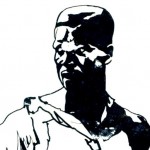
Charles W. Martin, American poet

Charles W. Martin (Read Between the Minds) …. Charlie …. “slpmartin” … was the first blogger-poet that I started to follow with some regularity.  That was back in February 2010. Charlie had – if memory serves (which it doesn’t always these days) – recently retired and just returned from a trip to Africa – Tunisia, I think – and had shared a few poems about dusty streets and ancient wisdom and social inequities.  At the time he was also sharing poems that had been published in his first book, Read Between the Minds. 

I was struck by two things in Charlie’s poetry: his unremitting concern for social and political issues and his unique style. Charlie wrote about having lost patience with the poetic forms he was taught in school. He developed a spare and direct style that worked for him. As it happens it works well for readers and is perfectly suited to blogging, where brevity is the popular preference.

As time went on, Charlie created and introduced us to the kick-in-the-pants wisdom of Aunt Bea, whom we all came to love.  It wasn’t long before Charlie created two other personalities, each with a distinct voice.

Recently, I read Charlie’s self-published collection: Bea in Your Bonnet, Volume 1, First Sting. As expected, it was pure fun laced with homey wisdom.

Here’s a sample:

word usage…

aunt bea
was reading
the paper
when i stopped by
for a visit
she noted that
there had been
a number of
indictments
of
political leaders
for fraud
and
failure
to serve
the public need
most
of these indictments
she said
were unfounded
in her opinion
since
the word
indictment
suggests
the person
may
be
innocent

– Charles W. Martin

Charlie’s backstory:

Charles W. Martin earned his Ph.D. in Speech and Language Pathology (hence the “slp” in his url) with an emphasis in statistics. His credentials allowed him to pursue a career that included teaching, research and administration in university settings, treating patients and providing administrative leadership in clinical settings.

Charlie worked as a speech pathologist professional in the public schools where he diagnosed and treated communication disorders caused by a wide range of health conditions and contextual factors. Charlie brought passion to each of his professional positions but he was always focused on mentoring his students and improving the quality of life for his clients and patients.

Throughout Charlie’s educational training and career he maintained a devotion to the arts (literature/poetry, the theater, music and photography). He was a published poet before he completed his graduate work. Since his retirement in 2010, he has turned his full attention to his poetry and photography. He publishes a poem and a photographic art piece each day at Read Between the Minds, Poetry, Photography and Random Thoughts of Life.
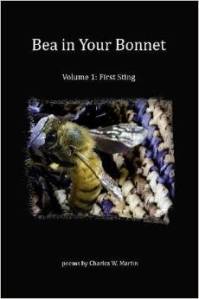
Charlie's second self-publsihed work
Charlie’s second self-published work

Aunt Bea’s backstory:

Charlie wrote me saying that “Aunt Bea, my mother’s twin sister, represents all six of the aunts, my mother, and grandmother.  Aunt Bea’s voice is one I’ve heard almost every day of my life.  The poems are family observations, lessons, and advice given to me and every other family member who had the good sense to listen.  Her homespun philosophy most likely will not be found in any collegiate textbooks or for that matter in any local town crier newspaper catering to city dwellers.  Indeed, she has a different way of viewing the world – a bit old-fashioned, sassy, and steely at times but a viewpoint which has engaged my imagination and heart.”

Charlie has three books out now including Bea in Your Bonnet: First Sting.  They are available through Amazon.  Charlie posts daily to his blog and is also a member of The Bardo Group/Beguine Again core team.

“Poetry has the power to make us aware of what is hidden in the shadows…those places that we seldom see or want to see…the poet’s voice scrapes away the facade of an issue and lays bare for all to see what has been denied. By providing a voice to these mute realities, poets have throughout history altered the course of events by enlightening readers and encouraging them to take action to stop wars, halt injustice, and to reach out to their fellow man. Like those poets who have proceeded me, I am motivated by the same desire to bring about the social changes necessary to enhance the quality of life for those around me and around the world and to give voice to those who cannot speak for themselves.” Charles W. Martin

poem and illustrations © Charles W. Martin, used here with permission

One Will Always Have Enough Simple Pleasures: my post today on Beguine Again.


Hearing Your Words … in memory of Welsh poet, Anne Cluysenaar

HEARING YOUR WORDS
For Ruth Bidgood, reading in Aberystwyth

I used, as a child, to imagine my death, or rather
beyond it. A ship setting out, in flames, at dusk,
counteracting the planet’s roll, on the sunrise path
to a waveless far horizon lit from beneath.

This came to mind, just now, clicking on close-up
through the café window – sea meeting that sky,
distantly smooth, arching high, up above
a jumble of chimneys and roofs backlit at sundown.

I found myself catching my breath, gravity’s curve
seen through such a small frame, from here where we sit
with our cups of tea. Vastness out there, our past.
But on planets elsewhere, other seas, other lives beginning.

Later, among the books, hearing your words,
it was waves I thought of – from land we may never see
reaching across the bulge of this little earth
to break, not one the same, on familiar shores.

– Anne Cluysenaar, © 2013, All rights reserved

taken from the poem diary From Seen to Unseen and Back by Anne Cluysenaar, Cinnamon Press, 2014; originally published on this site in February 2013 with Anne’s permission and that of Second Light Live, the publisher of ARTEMISpoetry, the magazine from which it was excerpted 

Anne Cluysenaar, Welsch poet
Anne Cluysenaar, Welsh poet and painter

British poet, Myra Schneider, wrote this morning saying that the esteemed Welsh poet, Anne Cluysenaar (b. 1935) died yesterday. Anne was born in Belgium and migrated  to Britain before the start of World War II. She was graduated from Trinity College at Dublin and became an Irish citizen in 1961, living there on a small property she owned and managed with her husband, Walt Jackson. She is the daughter John Edmond Cluysenaar (1899-1986), Belgian artist.

Anne had worked as a visiting teacher of creative writing at the University of Wales at Cardif and taught literature, linguistics and stylistics at a number of other universities. She was a Fellow of the Welsh Academy.

Anne’s poetry was included numerous anthologies and literary magazines and among her many poetry collections is  this year’s: From Seen to Unseen and Back, Cinnamon Press.

Anne was editor for many years of Scintilla, a journal of literary criticism, prose and poetry in the metaphysical tradition. She was active in and well-regarded by Second Light Network of Women Poets (UK). Her poetry was shared in their magazine and poetry collections and she was a tutor, mentor and often a judge in their poetry competitions. Anne Cluysenaar has left behind a stream of uplifting poetry and a legion of appreciative readers.

Anne’s portrait courtesy of Second Light Live.

– Jamie Dedes

ARTEMISpoetry: remember, sift, weigh, estimate … total …

“And when is there time to remember, to sift, to weigh, to estimate, to total?” Tillie Olsen (1912-2007), American writer and first-generation American feminist

Unknown-7

I never pick up my copy of Second Light Network’s 2006 anthology, Images of Womenor open the pages of its magazine, ARTEMISpoetry, without thinking of Tillie Olsen and her book, Silences.  Olsen, an intelligent and hugely talented woman, produced a rather modest opus by some estimates.

Ms. Olsen’s nonfiction book, Silences, was published “in 1978, an examination of the impediments that writers face because of sex, race or social class. Reviewing the book in The New York Times Book Review, Margaret Atwood attributed Ms. Olsen’s relatively small output to her full life as a wife and mother, a “grueling obstacle course” experienced by many writers.

[The book] “‘begins with an account, first drafted in 1962, of her own long, circumstantially enforced silence,’ Ms. Atwood wrote. ‘She did not write for a very simple reason: A day has 24 hours. For 20 years she had no time, no energy and none of the money that would have bought both.'” Julie Bosmen, Tillie Olsen, Feminist Writer, Dies at 94

Second Light is about just the opposite of silence. It’s about women getting a second chance to have their say. It offers older women of a certain generation and those women over forty coming up behind them a “room of their own,” if you will; a place to remember, sift, weigh, estimate and – perhaps – to total. (This is not to negate men or to deny that men are often also silenced by their circumstances, but that would be a subject for another day. Among other things, the heart aches for all the voices being silenced by wars and other violence, by starvation and by social and economic inequities.)

****

artemisIssue 12 of ARTEMISpoetry (May 2014) arrived as I was transitioning into senior digs and immediately took its place at the top of the stack of books and magazines waiting for calmer moments and a close read. Reading through the pages, it’s hard to say what is best or better because it’s all good from the featured poets and even to the ad on the back cover that offers a sample of two poems from Hilary Davies‘ poetry collection ImperiumEnitharmon Press.

It’s a difficult thing to pick just a few poems from the wealth of this issue, but here they are … you may chuckle at the first and dab at your tears when you read the other two. They are shared here with the generous permission of the poets and publisher.

The Substitute Sky

Each day we stare at screens,
a sly fluorescence, a not-quite sky
where swarms of data
aggregate and fly

while unseen cloud-and-sunlight
walks the grass, gold shoes
then grey, and aspen, oak,
the green-leaved spirits, pray.

Pilots of pixel storms
what do we bring? Less talk,
less laughter, less sun on our skins;
our lives on hold, our children wired in.

Core addiction, captive eyes.
Outside the real world breathes and dies.

– © Lynne Wycherley

Grab-Handle

In the shower you cling to me, your new grab-handle.
Ignoring my shakes, we both pretend you’re in safe hands.
Ninety years of fair usage, Mum, and your scrap of a body

is shrunken against a cage of chrome bars. Buttocks swing,
their skin an overhang of ragged sack; dugs hang
like empty toothpaste tubes; hip bones jut like garden stakes.

As if flicking a switch, before I can distance or disown them,
wartime images flash on my inner eye, a film-reel
of Pathe horrors. I feel the panic in your grip pinch

when I regulate the shower temperature, causing overflow.
I sense a warder’s buzz of control
knowing you are lost in a huddle of hurt and helplessness.

Though eager for the rush of water to relax your greying skin,
you’re fearful of falls, bruises, broken bones. Should you now
be fearful of me too? Frailty lays a hand on both of us,

each clutching at her hopes. Under the metallic power jets,
I scrub myself to clean my shame away and find the love that,
tight as a rosebud un-blossoming in winter, refused to flower today.

– © June Hall

‘Dear God, all the children can run except me’

Most children come out right. They come with all
their arms and legs, ten fingers and ten toes,
their brains wired up the ordinary way.
They go to Brownies and have sleepovers,
they learn piano, ballet and Tae Kwon Do,
they do the Duke of Edinburgh’s award.
No one avoids them, or their mothers
in the playground. When they grow up
they have good jobs, and partners
and get on the property ladder, climbing steadily.

But you were never most children, and
never will be, your whole life long
my damaged, precious boy,
my baton passed to the future, my fear, my joy.

– © Veronica Zundel

****

To my delight this issue featured  Myra Schneider’s The Real Mrs. Beeton HERE, speculating on the life of Isabella Beeton, the 19th century writer known as the first and “best” cookery writer. Mrs. Beeton wrote about more than cooking though and might be considered the Martha Stewart of her day. Her life, however, was nothing like the glamorous, wealthy and independent Ms. Stewart as you will see when you read the poem.

Further on, Anne Stewart asks:

Why do you take the dark path, knowing
its silences and hiding place?”
excerpt, Making for Home, which will post on The Bardo Group blog this Friday …

Anne handles some of the administration for Second Light, as well as being the administrator for the website. She also developed and maintains poetry p f for poets.Myra Schneider and Anne have been a great helpers, getting permissions to share the work of other poets here on The Poet by Day and on The Bardo Group blog and also sharing information, education and updates with me so that I might share with you. I appreciate these two women and Dilys Wood – the founder of Second Light – for their poetry and for their committment to encouraging other poets and the love of poetry. You can sample some of Anne’s work HERE, Dilys work HERE, and Myra’s work HERE.

Anne Stewart is an accomplished poet. Most recently her poem Snow snow more cold lonely snow won the 2014 Poetry on the Lake “Silver Wyverm” award. Her poem Tiger was long-listed for the Plough Prize. Grief’s Trick and This Stone are included in an upcoming anthology, Love and Loss edited by R. V. Bailey and June Hall.

There were two pieces by publisher, Adele Ward (Ward Wood Publishing). One on Pascale Petit, which I discuss HERE and another on Why Small Is Still Beautiful, which discusses the ins-and-outs of chapbooks from the poet and the publisher perspective. Myra Schneider examines The Rewards of Reading Poetry and there’s the second part to A C Clarke’Lies Like Truth, which is about “fictionalizing” real events. Kay Syrad discusses the radical landscape of poetry and Lavinia Singer the young woman-poet’s view of the poetry world. The issue rounds out as always with a a calendar of events and announcements of members’ new publications and latest awards … an altogether neat, stimulating and rewarding read. Recommended. 

© 2014, review, Jamie Dedes, All rights reserved

a set of dead symbols … the resurrection of the word … Jorge Luis Borges

Unknown-5“I think Emerson wrote somewhere that a library is a kind of magic cavern that is filled with dead men. And those dead men can be reborn, can be brought back to life when you open their pages.

“…Bishop Berkeley … I remember that he wrote that the taste of the apple is neither the apple itself  – the apple cannot taste itself – nor the mouth of the eater. It requires a contact between them. The same thing happens to a book or a collection of books, a library. For what is a book in itself? A book is a physical object in a world of physical objects.  It is a set of dead symbols. And the the right reader comes along, and the words – or rather the poetry behind the words, for the words themselves are mere symbols – spring to life and we have a resurrection of the word.” Jorge Luis Borges(1899-1986), Argentine poet, writer, translator, critic, This Craft of Verse