When we marched,
Slithered
Through slimy mud past riot-shielded cops in Alexander
(This is the ghetto.)
While children peered wild-eyed from dark windows,
For some of us these were re-runs of earlier apartheid-burdened days.
But, then, it was defiant resolution that drove our hearts and braced our feet.
Now, sadness at betrayal sat sadly on our hearts.
Our shouted slogans hung heavy over us in grimy air.
We winced at familiar oft-repeated lies
Oft-repeated lies.
There are people for whom poetry exists almost exclusively as an aid to social change, to political discourse– not as some sort of didacticism – but as a discussion, a wake up call (consciousness raising), a way of approaching some truth, finding some meaning, encouraging resolution. A horrific war photo, a terrorist act, a homeless person outside the grocery, a friend in pain that can be traced to a social injustice, and the words start to flow. There’s the urge to respond, to do something …. even if that something is simply the passion to express the moment in poetry. Perhaps righteous passion is the strongest form of resistance and poetry the conscience of the collective soul.
In Dennis Brutus’ poem above, he points to the world we now live in. Having survived Robben Island with Nelson Mandela, he was freed only to find that while racial apartheid ended in South Africa it had become world-pervasive,, expressing itself as economic inequality. The few haves vs. the masses of have-nots.
I can’t help but think that the revolutionary peace, justice and sustainability so many of us seek is rooted in the slow transformation of values. Hence, it is more evolutionary than revolutionary. As such, perhaps that change is as gradual as the pervasiveness of our desires.
Perhaps it is evident in our blogosphere and the heart-born prose and poems of simple folk like you and me with nary a pundit or politician among us. Perhaps it’s a bottom-up thing, more likely to be blogged than broadcast, often rising from homespun poetry – outsider art – sometimes rudimentary and awkward, but always quiet and true and slow like a secret whispered from one person to the next. It is perhaps something stewing even as we write, read, and encourage one another. Perhaps there is some bone and muscle in what we do. Individually we have miniscule “audiences.” Collectively we speak to enormous and geographically diverse populations.
So let some impact from my words echo resonance lend impulse to the bright looming dawn
Dennis Brutus
Poem on, my friends, and keep your ideals. They are real …
… and to my country-folk today …
HappyFourthof July!
In the confusion of these days, let’s not abandon the highest, most ethical and sensible of our aspirations.
In fifth grade
my father’s secrets
start to breed under my red
confirmation dress—
dig deep in the tunnel of my inner
ear, cling to sentry hairs
on the nape of my neck—
his secrets: black bodies,
glassy eyes, squeeze
beneath my fingernails—
quiet as eggs;
they spin a red thread
that cuts me inside
out.
Over Exposed, the memoir of Terri Muuss, is at once painful and triumphant. It is an examined life that exposes the family of her childhood, the obscenities imposed on her by her father, her numbing with alcohol and drugs and her journey in therapy. All of this and yet she arrives victorious and accomplished with a healthy marriage, healthy sons and a multifaceted career, elements of which reach a hand out to those in trauma.
This is the story of how a child survived and became a woman who found herself and a writer who found her voice. The experiences of a lifetime form a collection of poems and prose vignettes that bespeak the possibilities of redemption and hold out hope and affirmation to those others whose childhoods have left them wounded. I recommend this book to everyone but, most especially, to those who have a history like Terri’s.
Lately, I feel a bull’s eye on me: on the street, the A train, in the fruit market. Men infect me with words, with smiles. Eyes snatch at breasts, tongues pin me to subway walls, mouths like a cold speculum pry open my inner ear. Their words pound, pound me, a worn head of drum. Voices divide and conquer, dividing me from myself—
Emotionally it was not the easiest book to read. I often found myself in tears.It is rewarding though, not only because its subject remains unbeaten but because the writing, pacing and organization have you moving through the pages anxious to gobble up each poem, each story, every nuance. Terri’s switches from child-voice to adult are smooth, her imagery clear and moving, her poetry well-crafted.
There are two videos in this post. If you are reading this from an email, you will have to click to this site to view the videos.
INTERVIEW
JAMIE: Am I right that your first love was acting? If so, how did you transition – or what inspired – the addition of poetry to your artistic repertoire?
TERRI: Yes, acting, theatre and directing have always been my first loves. I came to acting quite young and naturally. It will always be a huge part of who I am and how I see art in a larger sense. Much of my poetry is born out of a theatricality I possess from being onstage these many years.
That being said, poetry was always sort of waiting in the wings for me. When I was in 10th grade, my best friend Leslie was a beautiful person and poet who I admired greatly. I spent long days at her house after school as I had no inclination to go home to my own dysfunctional house. There, she read and wrote poetry in front of me and it certainly inspired me to use it as an avenue for expression. Later, during senior year, I had a teacher hand me a packet of poems by e.e. cummings, T.S. Eliot, Emily Dickinson and Langston Hughes that she thought I would enjoy. That packet sent me on a journey of reading as many poets as I could. Still, poetry was off to the side while theater took center stage.
It really wasn’t until I was faced with the trauma of my past and of putting myself together that writing became both a therapeutic tool and an artistic passion. To better understand the trauma of being sexually abused as a child, I wrote and wrote and wrote. Mostly poetry but also monologues. At the end, what I’d constructed was a one-woman show skeleton that became Anatomy of a Doll. I performed the show throughout New York City and then the country at conferences and in theaters. Even then, I didn’t identify myself as a writer. I thought of myself as a performer who just happened to use my writing as a script. When Veronica Golos (my friend, mentor and a gorgeous poet who’s won numerous awards) began taking an interest in my work and started editing it in a poetry workshop she led out of her house on the Upper West Side, I started to see myself in the context of being a poet and poetry as a vocation. I think the form of poetry works well to showcase the dissociation that comes with abuse much more than prose does. Veronica is still my editor, having worked on both Anatomy of a Doll and my book, Over Exposed.
But the biggest transition from actor to writer happened during my marriage to poet Matt Pasca. He’s always seen me as a writer and, before I even claimed that identity for myself, always pushed me to go deeper, to write more, to get better, to submit my work. Through our marriage I have grown as a writer and came to see myself as a poet.
JAMIE:It is one thing to write about painful events in life and another to share them publicly. I think you are something of a hero for doing so. Where does this core of courage come from? What is the reaction from friends and relatives?
TERRI: This is a very interesting question that I get often–the question of the courage it takes to reveal my past. Many people have said they’ve seen me as courageous because I share the truth of my childhood sexual abuse, subsequent rapes, addiction and my recovery quite publicly. I have to acknowledge that this is the way it is perceived by other people. For me, however, it’s born out of necessity and so it’s never felt or seemed like courage. I have lived my life according to the 12-step saying, “You’re only as sick as your secrets.” I know that what I keep inside me, what I feel shame about, what I try to hide, will destroy me from the inside. Giving a voice to my pain and shame and grief and mistakes gives me back my power, my joy and my life.
I’ve also grown to see that if I’m hiding the fact that I was sexually abused, I am sending myself and others the message that it was somehow my fault or that there’s something for me to be ashamed of. I’ve come to understand that what happened to me was not anything that I should be ashamed of. I was the victim so why should I be ashamed. I’ve also come to understand that the sexual abuse and the rape and the violence are a part of me but they are not the entirety of me.
Lastly, if I can help someone (with my story) to recover, let go of their shame, and move into survivorhood, then it is all more than worth it. As social worker and researcher Brene Brown states, “If you put shame in a petri dish, it needs three ingredients to grow exponentially: secrecy, silence, and judgment. If you put the same amount of shame in the petri dish and douse it with empathy, it can’t survive.” I choose let go of secrecy and to douse my shame with empathy, and empathy for the world must begin with me.
Friends and relatives have been overwhelmingly supportive, although for some of them, it took a period of adjustment and listening that gave birth to deeper understanding. I surround myself with people who are willing to be empathetic, courageous, vulnerable, and honest with both me and themselves. I consider myself very lucky to have a wide circle of supportive people in my life.
JAMIE:With two parents who are poets, do your children like poetry? Have they started writing themselves? Have they read your poetry?
TERRI: Great question! Yes! We have two boys, Rainer, 10, and Atticus, 7, and they have both had poems published. Rainer is by far the more prolific writer who really loves writing and poetry. Atticus is a drummer who dabbles in writing. They both had poems published in Skipping Stones, a journal for children ages 7-14. Rainer has also been published in Stone Soup, The Louisville Review (when he was 4), and the anthology, Holiday Word Gifts (JB Stillwater, 2011). Some of the things that Rainer writes take my breath away. It’s proof positive that as artists we are always trying to get back to that place where we were as children– where we can take risks and be playful and not worry about being judged.
JAMIE:You seem to have a gift for building a poetry community. What advice do you have for readers who might be trying to do the same?
TERRI: I’m a licensed social worker and the macro version of social work is community organizing. The first rule of community organizing is to listen to the community. Too often, people come into a community with their own expectations and demands. They try to foist onto a community what they want to see the community have. If you’re really trying to build community, through the arts or otherwise, ask questions and be willing to hear the answers. The community might not want the same things you want for them but if community is your ultimate goal, you need to let its members be your guide. Too often in the poetry community, as in other communities, people set up an event that mirrors the kind of poetry THEY want but disregard what the community is really is looking for. Finding the right venue, format and publicity are integral to success.
I would also add that it’s so important to have collaborators in any community venture. Without them, burnout is a real factor. You need to be able to share the workload, bounce ideas off of each other, and laugh together to elevate stress and keep it going!
JAMIE:You put together a lovely trailer for “Over Exposed.” How long did it take to put it together and what kind of tools did you use. Have you found it helpful in getting the word out.
TERRI: Dana Maddox did my trailer. She’s a brilliant filmmaker studying in LA right now. I came in contact with her through the mother of someone I directed in a show. We did the voiceover elements in the studio first and then she came to shoot the video at my house. It took about 10 hours of shooting and about two weeks of intense editing for her to put together the trailer. It’s not something that I could have done alone. Many people have that skill set but that’s not my wheelhouse. I can direct videos but editing is a different thing. She did an amazing job and I’m very proud of it. It certainly helps get the word out about my book. I think social media and online platforms always help books.
JAMIE: So you have to my knowledge three books out: one on poetry as therapy, the recently published anthology, and “Over Exposed.” What’s next on the agenda?
TERRI: I have two books out currently. Over Exposed is my memoir, told in both poetry and prose. Grabbing the Apple is an anthology of New York women poets that I coedited with M.J. Tenerelli. The other group you mentioned here is the Poets of Well-being (Susan Dingle, Maggie Bloomfield, Nina Yavel and I). We are all social worker-writers who are in long term recovery (we have over 100 years of sobriety between us). I was the last member to join the group and so their chapbook does not include my work. It’s absolutely worth checking out. You can find the group on Facebook. As a group, we travel to conferences and venues to showcase how writing can be a therapeutic tool for helping others overcome addiction and abuse. We facilitated a workshop at AWP in Minnesota, at the Expressive Therapies Conference in NYC and were even invited to the 2016 NASW conference in DC. Susan runs a beautiful poetry event called “Poetry Street” out in Riverhead that is a fine example of great community organizing and art as a healing method.
*****
A tidbit on the light side and apropos upcoming elections in the U.S.: Atticus and Rainer Muuss on Ellen and at The White House with the First Lady.
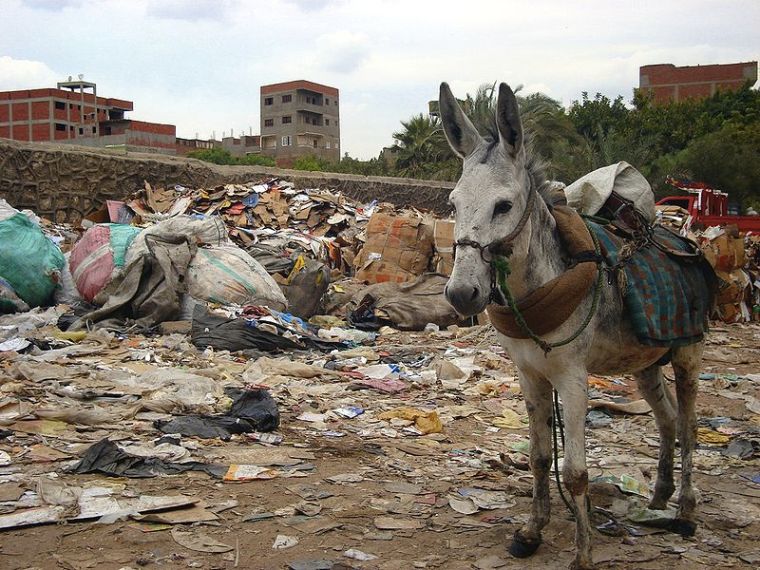
It is – unfortunately – not news that in some places (including First World countries) children and adults dig through trash cans or garbage dumps looking for something to eat or for cast-off goods that might be used or sold. There is no story, however, that quite compares to that of the Egyptian Zabbaleen or “garbage people” for sheer industry and inventiveness. From the 1940s these people ran 120 micro-enterprises that collected and recycled Cairo’s garbage. This was the Zabbaleen’s creative solution to the need for jobs and income when farming ceased to be a viable for them.
There was as you might imagine a downside: social stigma, subsistence and disease. Garbage collecting did, however, offer something of a living to an estimated 60,000 – 70,000 people and what these people did was quite remarkable. In fact, it was unique in all the world. They recycled 80-85% of the garbage, which is where their income came from. Most Western countries recycle about 20-25% of garbage.
In 2005, Egypt hired private contractors from Spain and Italy to bring in huge trucks and cart garbage to landfills. This move along with others made in the name of modernization and Westernization cost the Zabbaleen dearly and, in fact, in the end all of Cairo suffered for this decision.
A Donkey at Mokattam Hill in Cairo
I first learned the story of the Zabbaleen from Mai Iskander’s award-winning feature-length film Garbage Dreams, whichaired on the PBS Independent Lens program for Earth Day in 2010. While the context and culture of the story is unique, the experience of losing one’s livelihood to corporate giants, funding cuts, social or technological change or other conditions is all too commonplace. Almost all of us and our communities have been touched – if not devastated – and sometimes recreated by such experience.
Some people are remarkably resourceful and inspiring, like the Zabbaleen when they transitioned from farming to garbage collection. During The Depression, my own father’s import & export business was failing. He got the idea to tell the furriers in the neighborhood that he would clean their offices at night. He made them an offer “they couldn’t refuse.” Then, in the same spirit as the Zabbaleen, while he handled the factory and office maintenance, he’d sort through the trash and save all the tossed away bits of fur. He made them into little bow-ties and earings and little mink teddy bears and sold them to Macy’s. Even in a depression there are people with enough money to buy useless luxury tchotchkes, so that’s the market he went after. He eventually became a furrier.
WRITING PROMPT: Write a poem, short story or article about the impact of job loss on an individual, family or community. This might be a poem about someone’s grief over job loss or how they reinvented themselves in the face of hard times. It might be a short story about family dynamics in the aftermath of financial catastrophe. Or, it might be an article about your own community and how it survived (or not) the loss of a company or industry that was once the foundation of your town’s economy. Is there a story in your heart or your own back yard that until now you hadn’t thought of telling?
The received wisdom given to writers for as long as I can remember is “write what you know.” I haven’t a clue where on earth that might have come from. I have read that Hemingway’s advice was . . .
“From all things that you know and all those you cannot know, you make something through your invention that is not a representation but a whole new thing truer than anything true and alive.”
That makes more sense to me then “write what you know.” So does Nikki Giovanni’s comment …
I want to be clear about this. If you wrote from experience, you’d get maybe one book, maybe three poems. Writers write from empathy.”
Danny Strong (b. 1974), actor, screenwriter, television and film director and producer
In this video Danny Strong makes the same point in his own colorful way.
If you are viewing this post in an email, you will have to link through to the site for view the video.
Photo credit: Danny Strong courtesy of the Annual Peabody Awards under CC SA 2.0 license
Thank you for sharing your love of words. Comments will appear after moderation.







 Jamie Dedes' THE POET BY DAY Webzine