“It never leaves. It’s always there, watching, steadfast, knowing us in our light and dark moments, changing forever just as we do. Every day it’s a different version of itself. Sometimes weak and wan, sometimes strong and full of light. The moon understands what it means to be human. Uncertain. Alone. Cratered by imperfections.” Tahereh Mafi, Shatter Me
See the softness of the moon on my block,
Visiting on this street’s end, smiling at that woman
She collects tossed cigarette butts, a homeless man
Raising arms, large hands waving blessing, at the
Bench by the bus stop, food magically there where
He habitually sits, food left by a stranger, no stranger
To hunger, lights beam from open windows, fortunate
Housed, dinner and television, maybe heart wonder
Maybe heart break, there are some who want to
Die and haven’t, some who want to live but died
Some who take to joy, some pained, stewing in
Despair, the varied elements of the human spirit,
The softness of grandmother moon, gracious
Company for an old poet in reverie watching
Jamie Dedes. I’m a freelance writer, poet, content editor, and blogger. I also manage The BeZineand its associated activities and The Poet by Dayjamiededes.com, an info hub for writers meant to encourage good but lesser-known poets, women and minority poets, outsider artists, and artists just finding their voices in maturity. The Poet by Day is dedicated to supporting freedom of artistic expression and human rights and encourages activist poetry. Email thepoetbyday@gmail.com for permissions, commissions, or assignments.
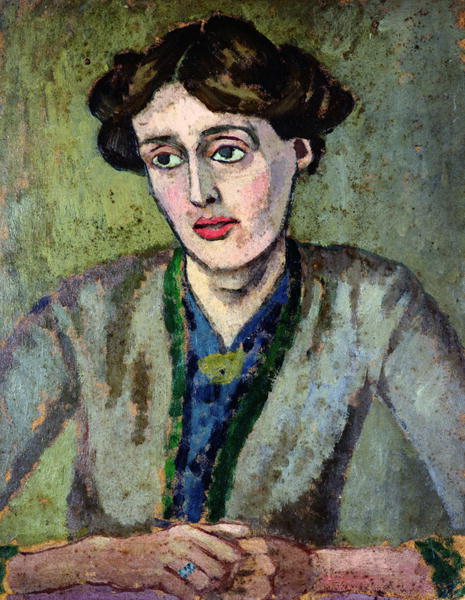
A portrait of Woolf by Roger Fry c. 1917 – Leeds Art Gallery / Public Domain
“How much better is silence; the coffee cup, the table. How much better to sit by myself like the solitary sea-bird that opens its wings on the stake. Let me sit here for ever with bare things, this coffee cup, this knife, this fork, things in themselves, myself being myself.” Virginia Woolf, The Waves
The New York Public Library just announced the acquisition of an extensive Virginia Woolf Collection. This collection provides a rare glimpse into the life of the iconic writer and, merged with existing Library collections related to Woolf, formulates one of the world’s most complete and important collections of Virginia Woolf material.
The Library has acquired by purchase and gift this collection of rarely seen Virginia Woolf material: correspondence, rare printed books and unique material such as photographs, original artwork and ephemera, including Woolf’s passport.
Patience and Fortitude, the “Library Lion” statues, in the snowstorm of December 1948 / Public Domain Photograph from the now defunct United States Information Agency
The collection of 153 items was assembled over decades by William Beekman. It will join the Library’s existing Virginia Woolf holdings in the Henry W. and Albert A. Berg Collection of English and American Literature, accessible from the Library’s Stephen A. Schwarzman Building on Fifth Avenue and 42nd Street. With this new acquisition, The New York Public Library holds what is arguably the most complete and important collection of Virginia Woolf material in the world.
The Library’s Berg Collection is currently home to Virginia Woolf’s diaries and notebooks; draft material for all of her works of fiction; nearly 3,000 pieces of incoming and outgoing correspondence, as well as photographs; books; legal documents; and her walking stick. The existing collection, which spans the years 1888 to 1941, numbers nearly 3,700 individual items and began with the acquisition of Woolf’s diaries in 1958, directly from her husband, Leonard Woolf.
“Virginia Woolf’s writings are essential to literary modernism, long one of the core collecting areas—and one of the most frequently accessed—of the Berg Collection at The New York Public Library,” said Andrew W. Mellon Director of the Research Libraries, William Kelly. “The acquisition of the William Beekman Collection of Virginia Woolf and Her Circle adds extraordinary depth to what is already one of the Berg’s strongest collections. With this acquisition, the Library reaffirms its commitment to Virginia Woolf, to literary modernism, to early feminist writing, and to documenting the creative process through incomparably rich collections.”
Highlights of the new acquisition:
Extensive correspondence, including a set of eight letters from Virginia Woolf’s husband, Leonard, and sister, Vanessa Bell, to Vita Sackville-West regarding Woolf’s disappearance and suicide.
Showing a different side of the author’s personality, a humorous “proclamation” written on the eve Vanessa Bell’s marriage, which Woolf wrote from the perspectives of three apes, Billy, Bartholomew, Mungo, and a Wombat.
Copies of the first editions of Woolf’s books, including Jacob’s Room (1922), Mrs. Dalloway (1925), and To the Lighthouse (1927). Each retain the original jacket illustrations designed by Vanessa Bell and several are inscribed to intimate associates
Unique items such as Woolf’s passport name card with picture, unpublished poetry by Vita Sackville-West, and books from Woolf’s own library.
Letters and gift books inscribed to Florence Hardy (widow of Thomas Hardy), David Garnett, Clive Bell, and other prominent members of the Bloomsbury group.
The Beekman collection complements the Library’s holdings, while providing greater breadth and important context for many of the items. This is seen with the addition of the letter from Leonard Woolf to Vita Sackville-West regarding Virginia’s presumed suicide and finding her walking stick floating in the river. The Berg Collection is home to the walking stick.
Virginia Woolf
Adeline Virginia Woolf (1882–1941) was an English novelist, essayist, biographer, and feminist. Woolf was central to the Bloomsbury Group*, a coterie of British artists, writers, and intellectuals active in the first half of the twentieth century. In 1917, Woolf founded with her husband, Leonard, the Hogarth Press and published what would become foundational works of Modernism, including T. S. Eliot’s The Waste Land in 1923. She also wrote nine novels, two collections of short stories, a biography, and three book-length essays in addition to other works. She wrote approximately 400 essays and 4,000 letters, and kept a diary for most of her life before committing suicide in 1941.
*The Bloomsbury Group—or Bloomsbury Set—was a group of associated English writers, intellectuals, philosophers and artists in the first half of the 20th century,[1]including Virginia Woolf, John Maynard Keynes, E. M. Forster and Lytton Strachey. This loose collective of friends and relatives was closely associated with the University of Cambridge for the men and King’s College London for the women, and they lived, worked or studied together near Bloomsbury, London. According to Ian Ousby, “although its members denied being a group in any formal sense, they were united by an abiding belief in the importance of the arts.” Their works and outlook deeply influenced literature, aesthetics, criticism, and economics as well as modern attitudes towards feminism, pacifism, and sexuality. A well-known quote, attributed to Dorothy Parker, is “they lived in squares, painted in circles and loved in triangles”. Wikipedia MORE
“I could not be more delighted to see my collection find a permanent home with the marvelous Woolf material already held by The New York Public Library in the Berg Collection,” said collector, William Beekman. “The Berg’s wealth of related holdings and its curatorial resources mean that these books and documents, which have given me so much pleasure, will be available to scholars and the general public to study and enjoy for years to come.”
The collection has been processed and is available for research purposes at the Berg Collection.
This post is complied courtesy of The New York Public Library, Leeds Art Gallery, Wikipedia, and my bookshelf.
Rose Main Reading Room
The New York Public Library is a free provider of education and information for the people of New York and beyond. With 92 locations—including research and branch libraries—throughout the Bronx, Manhattan, and Staten Island, the Library offers free materials, computer access, classes, exhibitions, programming, and more to everyone from toddlers to scholars, and has seen record numbers of attendance and circulation in recent years. The New York Public Library serves nearly 17 million patrons who come through its doors annually and millions more around the globe who use its resources at nypl.org. To offer this wide array of free programming, The New York Public Library relies on both public and private funding. Learn more about how to support the Library at nypl.org/support.
Jamie Dedes. I’m a freelance writer, poet, content editor, and blogger. I also manage The BeZineand its associated activities and The Poet by Dayjamiededes.com, an info hub for writers meant to encourage good but lesser-known poets, women and minority poets, outsider artists, and artists just finding their voices in maturity. The Poet by Day is dedicated to supporting freedom of artistic expression and human rights and encourages activist poetry. Email thepoetbyday@gmail.com for permissions, commissions, or assignments.
“Medium taps into the brains of the world’s most insightful writers, thinkers, and storytellers to bring you the smartest takes on topics that matter. So whatever your interest, you can always find fresh thinking and unique perspectives.” Medium About
Karen Fayeth (Oh Fair New Mexico) and I have been playing on Medium for about six weeks or so, checking it out and – each for our own reasons – are reservedly pleased. This is a online publishing platform started in 2012 by Evan Williams, former chairman and CEO of Twitter. It offers the opportunity to share “stories.” They don’t say “posts.” These stories can be poems, flash fiction, fiction, creative nonfiction, opinion pieces and so forth. Today, we share our first impressions of Medium. We do plan to continue our experiments with Medium, at least for awhile. Should you decide to come along for the ride, do follow us so that we can follow you. / J.D.
I have been blogging since 2007 so going over to Medium felt at first like giving up a lot of control. The more I use the site, the more I have come to appreciate the ease of creating, editing and posting stories. They are doing all the management and maintenance of the site and I can just write. That is pretty cool.
That said, Medium does work in many ways like a social media site. By that I mean you have to have plenty of followers and claps to get your work seen, and I don’t have a particularly large network. In the early days, Jamie was kind enough to give me a boost via her network, which is robust, and I’m grateful for the reads and comments. I’m slowly building my own network via reading and commenting on stories. I’ve also befriended some wonderful writers on the platform.
There are some writers who make a lot of money on Medium, and it’s easy to get caught up in feeling like I have to be at that level. There are lots and lots of stories on the site about how to make money on Medium and I did find myself feeling anxious, as though I had to write as often as they did and I had to make as much money as they did, and if I didn’t I was a failure. I’m a lot more sanguine now as there is NO WAY I can hold down a full time job and write 2 or 3 posts a day.
Now about the money, in the three months so far, the most I have made in a single month is $7.46. One might say that is a pittance, but to me, I’m actually getting paid to write. It’s small but it’s something.
During the week of November 17th, I challenged myself to write a post every day and while it was a lot of fun it was also a lot of hard work. As expected some of the stories did better than others.
I did try using a service that drives clicks to a link for one of my stories to see if sheer volume of clicks would help. That post has 550 clicks but only 35 reads, so it has made a grand total of .08. The earnings model really does depend on Medium users clicking the link and reading the story.
So to sum it all up, I would say I’m still learning and I’m cautiously optimistic.
KAREN FAYETH: Raised most of my life in New Mexico, my job brought me to Northern California. I don’t usually identify myself as a Californian, simply a New Mexican living in California. In the first couple years after moving, I distanced myself from my home state thinking it backward and remote. Then I began to visit home more frequently and truly learned a love for my home state that only comes by gaining perspective. I’m a writer, a crafter, a photographer and labor at a “real job” during the days.
My focus is a bit different than Karen’s. I’m in search of platforms where I can have my say. I’m considering Spillwords and a few others as well. These for myself and on behalf of both off-and-online friends who post their poems on Facebook but are looking for somewhere more visually appealing to collect and showcase their work for access by others. These are folks who don’t want the burden or expense of a blog.
Medium might be ideal:
It is in effect a minimalist blogging platform, easy and intuitive to use.
Everything is maintained. No work on your part.
No advertising. No clutter.
Other pros depending on what you are looking for:
Ability to social network, if inclined.
Potential to earn back your monthly $5 USD investment. I’d say posting poetry is not going to net much. Payments are based on time it takes to read. Poems will net you a few cents each. So far for November, I’ve earned $2.69. That’s with a couple of short stories thrown in.
You get a “friends link” to go with each “story.” You can use your friends link in texts and emails and on Facebook, Twitter, or other micro-blogging and social media networks.
Possible Cons:
Medium uses Strip for payments, which may work in counties where you haven’t been able to take advantage of opportunities that make payments via PayPal. You’ll have to do your homework on that. Neither PayPal nor Strip is available everywhere around the world.
If as I am you are already heavily networking elsewhere, Medium might be just a bit too much of an addition.
You are able to register and feature your poems on Medium without a paying membership. They won’t be shared among Medium community members. Unlike Twitter, however, readers don’t have to be registered to read and folks outside the Medium Community can view your work whether or not you are a paying member.
Jamie Dedes. I’m a freelance writer, poet, content editor, and blogger. I also manage The BeZineand its associated activities and The Poet by Dayjamiededes.com, an info hub for writers meant to encourage good but lesser-known poets, women and minority poets, outsider artists, and artists just finding their voices in maturity. The Poet by Day is dedicated to supporting freedom of artistic expression and human rights and encourages activist poetry. Email thepoetbyday@gmail.com for permissions, commissions, or assignments.
“What is Shamanic Journeying? Shamanism represents a universal conceptual framework found among indigenous tribal humans. It includes the belief that the natural world has two aspects: ordinary everyday awareness, formed by our habitual behaviors, patterns of belief, social norms, and cultural conditioning, and a second non-ordinary awareness accessed through altered states, or ecstatic trance, induced by shamanic practices such as repetitive drumming. The act of entering an ecstatic trance state is called the soul flight or shamanic journey, and it allows the journeyer to view life and life’s problems from a detached, spiritual perspective, not easily achieved in a state of ordinary consciousness.” MORE
A soul journey today: So much happening in the world and in my life, I decided to take time for “ecstatic trance.” This may sound strange to many, but it is a healing practice that has worked well for me for some time.
About twenty-years ago the daughter of my Native American friends committed suicide, hanging herself in the coat closet by their front door. As part of the healing process for her mom and dad, a local shaman performed a “soul retrieval.” Some would call this ceremony pseudoscience. I’d prefer to call it proto-science out of respect for my friends and their tradition, though that term more properly refers to science as it was evolving in the 17th and 18th century.
At any rate, though I knew nothing about shamanic drumming and soul retrieval, I went to the ceremony out of love and without any expectation. The shaman was a gentleman of both Mexican and Native American shamanic family traditions. His mother combined a Catholic belief system with traditional Mexican shamanism. Think of some of the curandeira like Ultima in Rudolfo Anaya’s coming of age novel, Bless Me, Ultima. His father was a shaman of the Objiwe peoples.
The ceremony was beautiful and I unexpectedly went into trance with the drumming. I discovered that this is rather easy and like prayer and meditation, it brings with it release, healing, vision, and other unexpected gifts. This poem shares a bit of what the experience is like. If you’ve had experience with soul journeying, I’d love to hear about it in the comments.
Riding the shaman’s drum
seeing through the heart
magenta sunlight against
an untamed chartreuse sky
grabbing the river as it runs
wrapping the sea in clouds
Elements of peace, like fledglings
nesting in the tree of life, nature
buzzing with heart’s thrum
heart’s thrum and the drum, drumming
Spirit quickens under a blithe sun ~
Journey on the hypnotic beat
below the outer-crust, tunnels
and tumbling, disarticulating bone
body bursting into shards … ….drawn back ……..reassembled! …. soul retrieved
filled with light, fed on knotty sedges,
the breeze, flowers chanting praises
and the dawning visions: progenitors
ghost-dancing on metamorphic rock
Earthkeepers dreaming the world
This is the video I used should you wish to try it yourself.
Jamie Dedes. I’m a freelance writer, poet, content editor, and blogger. I also manage The BeZineand its associated activities and The Poet by Dayjamiededes.com, an info hub for writers meant to encourage good but lesser-known poets, women and minority poets, outsider artists, and artists just finding their voices in maturity. The Poet by Day is dedicated to supporting freedom of artistic expression and human rights and encourages activist poetry. Email thepoetbyday@gmail.com for permissions, commissions, or assignments.

 Jamie Dedes. I’m a freelance writer, poet, content editor, and blogger. I also manage The BeZine and its associated activities and The Poet by Day jamiededes.com, an info hub for writers meant to encourage good but lesser-known poets, women and minority poets, outsider artists, and artists just finding their voices in maturity. The Poet by Day is dedicated to supporting freedom of artistic expression and human rights and encourages activist poetry. Email thepoetbyday@gmail.com for permissions, commissions, or assignments.


 Jamie Dedes' THE POET BY DAY Webzine