Page 2 of 3

Anne Stewart’s poetry p f … good resource for poets and poetry lovers
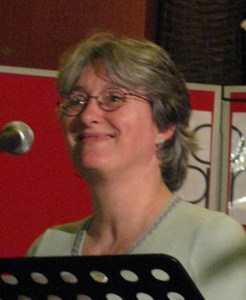
annephotoAnne Stewart’s poetry p f is a wonderful go-to place when you want to expand your reading to include accomplished contemporary (mostly UK) poets. Assuming you meet the membership requirements, it can also be the means to making your own collection/s more visible on the Internet.

“Membership requirements” might seem to imply a certain elitism, but the standard is in my opinion not onerous but reasonable enough to ensure that the poets represented have refined their craft and have a serious interest in and commitment to poetry.

As I write this post, there are some 300 top-notch poets on poetry p f  and their collections might be difficult to find without this resource. I’m not a member, but I do like to make purchases from poetry p f. It’s convenient and, unlike Amazon, the poet pages are uniform and you can count on them to be there. They offer you a sample poem, a photograph and contact information as well as information about the publisher.

There’s an event page, largely London and surrounding areas, with a schedule of readings, workshops and courses. Included is a useful “Favorite” sites page offering resources that will help you connect with other poets. A convenient listing of competitions and calls for submissions makes it easier to target potential markets for your work. The home page features one poet and the poet featured is rotated.

poetry p f offers a rich collection of feature articles and Anne also has poetry cards available for purchase.  Anne welcomes commissions to produce tailor-made Poem Cards for purchases of 100 or more cards.

Since Anne is affiliated with Second Light Network of Women Poets (SLN), I find it convenient to pay my SLN member fees through her site. When I wanted to gift a membership (a great gift for the women poets in your life), I just emailed Anne to let her know I purchased an SLN membership and to whom it was supposed to go.  No dealing with nameless service representatives and policy inconsistencies.

In the May 2010 issue of acumen, a literary journal, Anne was interviewed by William Oxley and explained the “p f'” in the name.

The p f was Monty Python inspired – I thought we poets needed to rage a bit and the People’s Front, Popular or otherwise, seemed to fit the bill.”

Opportunity knocks:  16 November 2016 is the deadline for the Barnet poetry competition for adults & juniors and Anne Stewart is the judge for the adult category.  Details HERE.

the-janus-hour-fullANNE STEWART is a poet, reviewer, and provider of services to poets and poetry organisations. In 2000, she began working towards a life with poetry at the centre of it, joining the Post-graduate Creative Writing programme at Sheffield Hallam University. In 2003, she was awarded an MA with Distinction and in 2005, was selected as one of the “Ten Hallam Poets” represented in the anthology published by Mews Press (eds. Sean O’Brien, Steven Earnshaw and EA Markham). The anthology attracted high praise from top-calibre poets (Don Paterson, Julia Darling, Helen Dunmore).

In 2008, she won the Bridport Prize for her sonnet, Still Water, Orange, Apple, Tea. Judge, David Harsent, said of it “…what marks it out is the way this emotional commonplace is adapted to language … no line lacked a surprise … I liked its briskness – celebratory, but never cloying – and liked too, the fine-tuning: … a tone of voice that promotes brevity … where the notes in question sing and tease and intrigue … ”

Her first collection, The Janus Hour (Oversteps Books, 2010), “is characterised by a view of the world that is quizzical, appraising, unflinching yet non-judgemental: this is how things look from here, it says; take it or leave it. Her poems address, with the same deft lightness of touch, both uncomfortable truths about our time and the surreal in the everyday, achieving a rare consistency of expression without ever being predictable.” – Jeremy Page, editor, The Frogmore Papers.

© Anne’s photo and book cover art belong to her; the bio is from her site and is also under her copyright

SECOND LIGHT NETWORK … showcasing the ambitious poetry of ambitious women

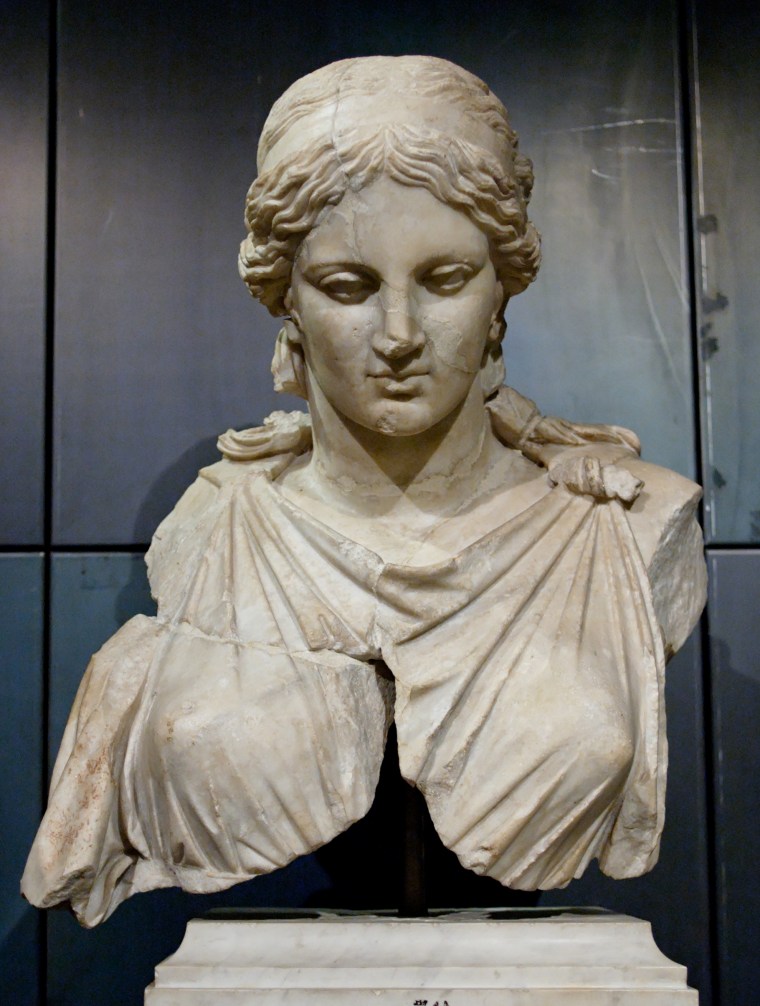
Roman marble Bust of Artemis after Kephisodotos (Musei Capitolini), Rome.

“Women, of course, write good and bad poetry – ‘ambitious’ implies more enterprising subject-matters and approaches, as well as a unique voice for each poet.” Kate Foley and Dilys Wood, Editorial Page, ARTEMISpoetry, November 2015

Here it is April – Poetry Month! – and the month in which I know that Dilys Wood, Anne Stewart and other poets in London at Second Light Network of Women Poets (SLN) are hard at work putting a wrap on the May 2016 issue of ARTEMISpoetry. This biannual literary magazine specializes in the work of women bent on honest self-expression, subjects of substance, and well-crafted poetry.

The last issue was published in November 2015 and the focus was on ecology with an interesting feature article by Jemma Borg, scientist and poet. I touched on it in a short piece, Poets and Poetry, In the Shadow Land of Technology and Social Networking.

The issue included poems by Anne Stewart, the featured poet and the author of Janus Hour and Only Here till Friday.

Myra Schneider was the judge for the 2015 poetry contest. The winning poems are featured as well as the commended and we get a bit of the behind-the-scenes look at the hard work of judging.

“I went through over a thousand poems looking for poems that traveled, paid attention to form and made words work. Eventually I reduced a long list of 101 poems to 26 … I was very excited because the winning poems were telling me loud and clear which they were!”

No doubt it is an honor to be selected to judge – and clearly there are  rewards – but what a job as well. Certainly a labor of love. The winners for 2015 were: Carolyn King, Margaret Wilmot, Judith Taylor and Kathy Miles.

I was also pleased to read Myra’s feature on one of my own favorites, American poet Louise Glück.

In line with the issue’s theme, politics and eco-politics were explored by Kay Syrad, a regular contributor.  She discussed Priscila Uppal’s Sabotage (explores private and public acts of destruction, disruption, and vandalism in the 21st century) and Helen Moore’s Ecozoa (response to the destruction caused by industrial civilization).

Fiona Owen gifted us a thoughtful piece – both homage and exploration – on Anne Cluysenaar‘s eco-poetry.

“… Anne ponders ‘the tenuous job of the poet’ and sees the arts as having an intrinsic evolutionary role …”

In addition to poetry, ARTEMISpoetry always offers book reviews and announcements of publications, events and classes of interest … and lately continues some discussion and promotions of SLN’s last two anthologies Her Wings of Glass and Fanfare.

🙂 I recommend both. 🙂

Below is a sampling (three poems) from Fanfare with thanks to the poets and their publishers, to SLN and especially to Anne Stewart for doing the work of acquiring the permissions for me to share these poems with you here today.

January

Going into the sun
over mud flats skimmed with water

people are walking on ice or glass
their reflections perfect

and you know it’s a new year

walking into the sun
beach and sky cast in light

sheer

gone when you turn

and wave rippled mud
takes your footsteps, softly.

– Caroline Natzler

Caroline Natzler: January and Life’s Work, from Fold (Hearing Eye, 2014)

Untouchable

She shines like Lakshmi through the fields –
a gentle stride, arms at her sides.
By the houses, stooping her beauty
to the earth, she raises the brimming bucket,
its stench sealing her nostrils. Slurry clings
to hair and skin, but nothing changes
on her face, only a puckering of lips
in silent thanks to Kali
for twenty years of women’s work,
this dawn till dusk that’s nurtured seven sons;
thanks that she’s never known the blessing of –
nor visited this curse upon –
a daughter.

– Jill Sharp

Jill Sharp: Untouchable, from Ye gods (Indigo Dreams, 2015)

A Miracle at Iskitim

In Siberia, a symbol –
this is what the locals believe,
a magical birth of water:

a fresh water spring, a spurt
close to the ground, a low white
eternal flame.
We dip our cups
(plastic, from the hotel) and say,
“It tastes pure. The water is pure.”

Some people here heard the last trucks
grind out of sight, after they shut
the ‘lagpunkt’,
the slow-killing place,
left the scar for people like us
in a half circle, dark barrels

in our padded coats, gloves, hats, scarves …
With our white breaths, we breathe out lives
as we raise up transparent cups,

“The future came too late.”

– Dilys Wood

In her Gulag, A History (Penguin, 2004)Anne Applebawm refers to a new fresh-water spring near a former camp at Iskatim.

This slideshow requires JavaScript.

SLN, through community, classes, magazines and books, regularly serves up thought-provoking, often heart stirring and always engaging poetry by women as well as informative explorations and analyses of poems, collections, news and views. Whether you are an experienced professional or an amateur poet, there’s plenty to enjoy here, plenty to learn and think about. I venture to say though that if you are an older woman poet working to find your voice, you’ll discover special inspiration and encouragement through Second Light.

Membership (demographic restrictions), ARTEMISpoetry and the anthologies and other books can be purchased through Second Light Network of Women Poets or p f poetry

©the poets own the copyrights to their poems and they are featured here with permission; the photograph of the Artemis statue is courtesy of Marie-Lan Nguyen and generously released by her into the Public Domain.

POET, TEACHER, INSPIRATION: Dilys Wood & the Latter-day Sapphos

Sappho (/ˈsæfoʊ/; Attic Greek Σαπφώ [sapːʰɔ̌ː], Aeolic Greek Ψάπφω, Psappho [psápːʰɔː]) was a Greek lyric poet, born on the island of Lesbos. The Alexandrians included her in the list of nine lyric poets. She was born sometime between 630 and 612 BCE, and it is said that she died around 570 BCE, but little is known for certain about her life. The bulk of her poetry, which was well-known and greatly admired through much of antiquity, has been lost; however, her immense reputation has endured through surviving fragments.
“Sappho (/ˈsæfoʊ/; Attic Greek Σαπφώ [sapːʰɔ̌ː], Aeolic Greek Ψάπφω, Psappho [psápːʰɔː]) was a Greek lyric poet, born on the island of Lesbos. The Alexandrians included her in the list of nine lyric poets. She was born sometime between 630 and 612 BCE, and it is said that she died around 570 BCE, but little is known for certain about her life. The bulk of her poetry, which was well-known and greatly admired through much of antiquity, has been lost; however, her immense reputation has endured through surviving fragments.” [Wikipedia]
Sunday: I began my dive into Dilys Wood’s Antarctica* (Greendale Press, 2008), spending my discretionary time engaged by this collection, which includes The South Pole Inn, a novella in verse.

“I dreamt I gave you the white continent
I wrapped it in white wedding wrap, embossed
with silver penguins and skiis …”
from Her Birthday Present in the section Love in a Freezing Climate: Four Poems

*****

“Wherever I look, the bacillus of melt
weakens the floes.”
from Future

DILYS WOOD is a poet, an editor and the founder (“convenor” as she might say) of the London-based Second Light Network of Women Poets (SLN), which produces the biannual ARTEMISpoetry and includes a publishing arm, Second Light Publishing.  I first encountered Dilys thanks to Myra Schneider. That award-winning poet with eleven published collections is a consultant to SLN.

While Internet and email have a way of helping to cross borders and make affinity-based connections, closing the gaps in culture and miles – in this case some 5,500 miles as the crow flies – the tools are imperfect. It’s not the same as meeting, talking and observing in person. However, when you read what people write, when they risk themselves by putting their very souls on paper, you do get to know something about their values and passions. My strongest sense of Dilys was as the quiet persistent energy behind a women’s poetry collective and an apparently indefatigable advocate for women’s right – including women over 40 – to poetic voice. 

At the point in which I first encountered Myra, Dilys and SLN, Dilys had collaborated on (mainly with Myra) four anthologies of women’s poetry. She had two collections of her own poetry published, Women Come to a Death (Databases, 1999) and Antarctica. That was, I think around 2010. Since that time, we are gifted through Dilys and Myra, Anne Stewart (poetry p fand others on the SLN team with so many fine anthologies and magazines of women’s poetry, that I can hardly keep track. 

This slideshow requires JavaScript.

Dilys is modest in presenting herself. Her Poet’s Page on SLN’s website says simply –

Dilys started writing poetry again after retiring from the Civil Service, where her jobs included being secretary of the Women’s National Commission. She shortly after founded Second Light, focussed on the needs of women reconnecting with writing after forty. Second Light Network developed into a support group and, on a small scale (though reviews suggest significant), publisher of women’s poetry. Together with her own writing (Antarctica, 2008; Women Come to a Death, Katabasis, 1997), Dilys has been the joint editor (mainly with Myra Schneider) of 4 womens poetry anthologies.

If The Poet by Day was a poem, its title would have to have the tagline after Dilys Wood. This site is not the product of collaboration and membership. Nonetheless, its commitment to sharing information on poets and poetry, including gifted if lesser-known poets, and promoting and encouraging poets who are marginalized by their gender, ethnicity, disability or age – is very definitely inspired by Dilys work and commitment to mature women and the work and commitment of Myra Schneider and the other SLN women as well as by my own love of poets and poetry and the whole of poesy history and culture.

This is Dilys in her own words as she “spoke” in a guest blog post here several years ago:

NEW SAPPHOS, CHALLENGES FOR WOMEN POETS

I run a network for women poets and naturally I want our members to be treated equitably, with recognition of any woman’s potential to be in the top flight of creative artists.

Some poets feel that ‘male and female he made them’ should not be an issue. I disagree because I want to celebrate and gain personal inspiration from the last fifty years. There has been a vastly increased involvement of women as students of poetry, published poets, book purchasers and consumers of ‘products’ such as poetry festivals. I also want it debated why this has not meant equality of treatment by journals.

Why do some leading journals publish fewer poems by women and use fewer women reviewers? What part is played by prejudice and what by our diffidence? Do we submit enough work and persist when submissions are rejected? Are there subtle shades of prejudice? Are we taken seriously on ‘women’s topics’ but not when writing about spiritual experience or politics?

A first step is to convince ourselves that there is no ceiling. Emily Dickinson surely lives up to the epithet ‘unique genius’? Her work is incredibly economical, dense, universal and deeply moving. She is totally original in style and thought. Her work alone ought to kill the slur that biology-based inferiority explains historical under-achievement.

So many more women have found now their voice. Let’s celebrate poets who excite us, from Emily Bronte (say) to Jorie Graham (say). We can also start thinking seriously about differences and about inflated reputations. Let’s be wary about ‘celebrity status’. This tends to narrows true appreciation. Read voraciously. Include lesser known poets and dead poets. You will be impressed by how much exciting writing is on offer.

– Dilys Wood

* “Antarctica,” Greendale Press, 2008 (all proceeds to Second Light Network funds). �5.95 through poetry p f (scroll down on the page to which this is linked)

© The New Sapphos, Dilys portrait, book cover art, Dilys Wood; © introduction, Jamie Dedes; Sapho embrassant sa lyre Jules Elie Delaunay (1828-1891), public domain

Mail from Across the Pond: “Hands & Wings” and other collections …

booksSometimes a package arrives that is like a party in the mailbox. Often it’s a poetry party, especially the one that just arrived from Anne Stewart‘s poetry p f. The site is affiliated with Second Light Network of Women Poets. There are no gender or age restrictions at poetry p f, which is now a go-to resource for me when I want to buy the collections of U.K. poets.

“The site is principally intended to be a showcase of modern poets, and to provide a focused point for members to take advantage of the visibility and searchable presence the Internet provides; further to promote poets and poetry.” MORE

cardsMy recent acquisitions from across the pond include Anne Cluysenaar‘s Touching Distances, Diary Poems (Cinnamon Press, 2014), which was a gift from Myra Schneider and my own purchases: Janus (Oversteps Books, 2010) by Anne Stewart and Dilys Wood‘s novel-length poem, Antarctica. Wow! . . . and all the lovely poetry cards, some purchased and some gifted … so much better than Hallmark. These include Horses by poet and blogger, Carolyn O’Connell.
TIP FOR POETS: Poetry greeting cards are a nice idea some might like to borrow for promoting their own chapbooks and so forth. Myra Schneider first introduced me to this idea, which I have used. Myra’s are works of art. Mine, not so much.  Not yet anyway. Can’t seem to get them lined up properly.

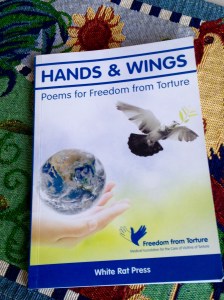
Hands & WingsDilys Wood and Anne Stewart added a collection to my package, which deserves special attention: Hands & Wings, Poems for Freedom from Torture (White Rat Press, 2015).  The poems in it are freely shared by A-list poets. The proceeds go to help with the rehabilitation and support of torture victims seeking protection in the U.K. That made me look into what services specificially designed for victims of torture might be available in other countries and that readers might want to support through donations or volunteer work. You may find your country’s offerings listed HERE.

Hands & Wings, Poems for Freedom from Torture was produced by Freedom from Torture, Medical Foundation for the Care of Victims of Torture, a registered charity in the U.K.

© 2016, words and photographs, Jamie Dedes, All rights reserved