Page 2 of 2

CELEBRATING AMERICAN SHE POETS (26): May Sarton … when poet becomes woman, “Sisters, My Sisters”

May Sarton (1912-1995), American poet, memoirist and novelist

“The creative person, the person who moves from an irrational source of power, has to face the fact that this power antagonizes. Under all the superficial praise of the “creative” is the desire to kill. It is the old war between the mystic and the nonmystic, a war to the death.”  May Sarton, Mrs. Stevens Hears the Mermaids Singing

Eleanore Marie Sarton – nom de plume, May Sarton – was born in Ghent in Belgium to an English portrait-artist and interior-designer mother, Mabel Eleanor Elwes, and George Alfred Leon Sarton, a chemist and historian renown as the father of science history.

When the German invasion of Belgium began in August 1914 the family escaped to Mabel Sarton’s mother’s home in Ipswich, England. From there they traveled to America and settled in Boston so George Sarton could teach at Harvard University. May came from a family of gentle nonconformists and her maternal grandfather was among the original Fabians.

“Perhaps every true poem is a dialogue with God … when we are able to write a poem we become for a few hours part of Creation itself.” May Sarton in The Practice of Two Crafts, Christian Science Monitor (1974)
51ryhQbcxtL._SX322_BO1,204,203,200_May Sarton’s parents did not belong to any church but she seemed to feel that her parent’s views were not inconsistent with those of the Unitarian Church.

Interviewed in The World in 1987, she told Michael Finley, “My father and mother believed that, though Jesus was not God, he was a mighty leader, and the spirit of Jesus, the logos of him, is the worship of God and the spirit of man.

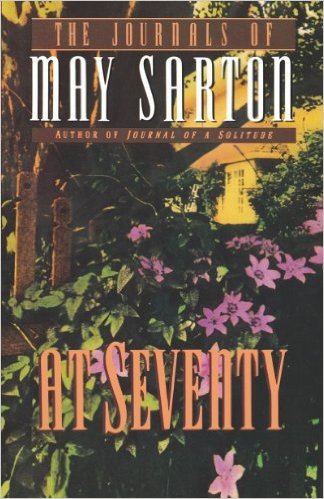
“At the age of ten May was introduced to the Unitarian church by her neighborhood friend Barbara Runkle, whose family attended the First Parish in Cambridge. May was impressed by the minister, Samuel McChord Crothers, whose sermons she thought “full of quiet wisdom.” One sermon in particular, she recalled in her memoir At Seventy, 1984, “made a great impression on me—and really marked me for life. I can hear him saying, ‘Go into the inner chamber of your soul—and shut the door.’ The slight pause after ‘soul’ did it. A revelation to the child who heard it and who never has forgotten it.” The Encyclopedia of Unitarian and Universalist Biography

May began writing early and her first poems – sonnets – were published in Poetry magazine in 1930. Her other love was theatre and she abandoned a scholarship to Vassar to study theatre and to eventually found  a theatre company. However, in I Knew a Phoenix, Sketches for an Autobiography she wrote that when her first collection was published she focused on writing and “never looked back.”

Her novel Mrs. Stevens Hears Mermaids Singing is considered a “coming out” book and her work was then labeled lesbian and featured in women’s studies classes. She regretted the label seeing it as limiting, which it is.  May Sarton wrote about the experiences, fears and other emotions that are part of being human. Journal of Solitude, for example, is a meditation on aging and the changes aging brings to life, on solitude ( a frequent theme in her work), on love affairs and creativity. May Sarton’s true gifts are poetry and memoir and not to be missed. Her novels – as she knew and admitted – were good but not top-notch.

“Loneliness is the poverty of self; solitude is richness of self.”  May Sarton, Journey of Solitude

The following poem, Sisters, My Sisters, is one of May Sarton’s most well know poems. She reads it herself in this video. It was originally published in Kenyon Review in 1943 and is in Selected Poems of May Sarton.

If you are reading this in email, you’ll likely have to link through to the site to view it.
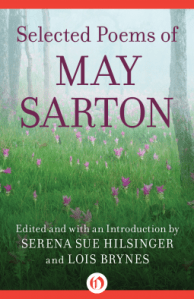
cover57866-medium“Nous que voulions poser, image ineffaceable
Comme un delta divin notre main sur le sable”
– Anna de Noaille

Dorothy Wordsworth, dying, did not want to read,
“I am too busy with my own feelings,” she said.

And all women who have wanted to break out
Of the prison of consciousness to sing or shout

Are strange monsters who renounce the measure
Of their silence for a curious devouring pleasure.

Dickinson, Rossetti, Sappho — they all know it,
Something is lost, strained, unforgiven in the poet.

She abducts from life or like George Sand
Suffers from mortality in an immortal hand,

Loves too much, spends a whole life to discover
She was born a good grandmother, not a good lover.

Too powerful for men: Madame de Stael. Too sensitive:
Madame de Sevigne, who burned where she meant to give

Delicate as that burden was and so supremely lovely,
It was too heavy for her daughter, much too heavy.

Only when she built inward in a fearful isolation
Did any one succeed or learn to fuse emotion

– May Sarton, excerpt from Selected Poems of May Sarton (recommended)

***

“Does anything in nature despair except man? An animal with a foot caught in a trap does not seem to despair. It is too busy trying to survive. It is all closed in, to a kind of still, intense waiting. Is this a key? Keep busy with survival. Imitate the trees. Learn to lose in order to recover, and remember that nothing stays the same for long, not even pain, psychic pain. Sit it out. Let it all pass. Let it go.”
― May Sarton, Journal of a Solitude 

© portrait, Don Cadoret; poem, Sarton estate

CELEBRATING AMERICAN SHE-POETS (#22): Jane Hirshfield, a human poet

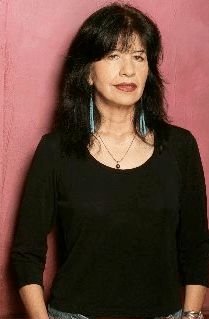
Jane Hirshfeld (b. 1953), poet, essayist, translator
Jane Hirshfield (b. 1953), poet, essayist, translator

I always feel a slight dismay if I’m called a “Zen” poet. I am not. I am a human poet, that’s all.” Poet Jane Hirshfield on the Mystery of Existence, Spirituality & Health Magazine, Mar./Apr. 2013

When I think of Jane Hirshfield, I think first of her kindness to my friend, Bay Area poet, Ann Emerson (poet #9 in this series), who died a few years back and who received compassionate and generous guidance from Jane at a conference some years ago. It meant a lot to Ann and was a high-point in her six-year journey through cancer with poetry. Once having read Jane Hirshfield’s work, you can’t conceive of her as being anything but kind. The empathy expressed in her poetry is vast.

I admit to being one of those who also thinks of her as a Buddhist poet. Her poetry is Zen-like in its attentiveness, its inward-looking meditative quality, a quality of the ineffable given expression. Jane Hirshfield is a Zen practitioner, lived for several years at Tassajara and is ordained in Soto Zen.

Immersion in the life of the world, a willingness to be inhabited by and to speak for others, including those beyond the realm of the human, these are the practices not just of the bodhisattva but of the writer.” Jane Hirshfield in Nine Gates: Entering the Mind of Poetry

Another New York girl who eventually migrated to the San Francisco Bay Area, Jane Hirshfield was famously graduated from Princeton University’s first class to include women. She is the author of eight collections including The Lives of the Heart (Harper Collins, 1997), which won the Bay Area Book Reviewers Award and Given Sugar, Given Salt: Poems.

51LEMWRIG0L._SX326_BO1,204,203,200_

TREE

It is foolish
to let a young redwood
grow next to a house.

Even in this
one lifetime,
you will have to choose.

That great calm being,
this clutter of soup pots and books —

Already the first branch-tips brush at the window.
Softly, calmly, immensity taps at your life.

– ©Jane Hirshfield (from Given Sugar, Given Salt, Poems)

Originality requires the aptitude for exile.” The Question of Originality in Nine Gates

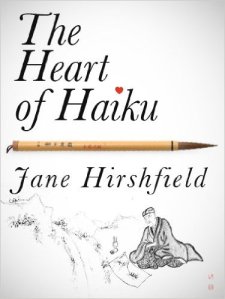
Her two collections of essays (must reads, no pedantry here) are Nine Gates: Entering the Mind of Poetry (Harper Perennial, 1998) and Ten Windows: How Great Poems Transform the World (Knopf, 2015). She also translated a collection of poems by Japanese women with Mariko Aratani: The ink dark moon : love poems by Ono no Komachi and Izumi Shikibu, women of the ancient Court of Japan (Vintage Classics). Her study The Heart of Haiku is available in Kindle Edition.

51oJEaBJOEL._SX373_BO1,204,203,200_

Reading Jane Hishfield’s work is both a joy and education for your writerly self and a balm for your spirit. If by some incalculable misfortune you haven’t met her yet, seize this day.

© 2016, words, Jamie Dedes; photograph by A. Phillips and generously released into the public domain

CELEBRATING AMERICAN SHE-POETS (18): Joy Harjo, Crazy Brave

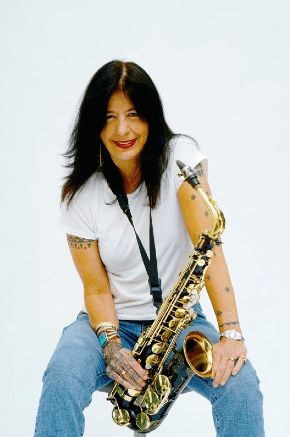
Joy Harjo (b 1951), Mvskoke (Creek) Poet, Musician, author and key player in the second wave of the Native Merican Renaissance (literary efflorescence)
Joy Harjo (b 1951), Mvskoke (Creek) Poet, Musician, author and key player in the second wave of the Native American literary efflorescence

51fFPVB5FTL._SX329_BO1,204,203,200_

 Crazy Brave (Norton & Company, 2012), Joy Harjo’s eminently engaging memoir, flows like a long prose poem. It is rich and well-built on a foundation of tribal mythologies, a strong sense of her ancestry, her difficult childhood and youth and salvation found in poetry and music. From her birth to a handsome much-loved fire-spirit father who inherited Indian oil money, allowing him to indulge a passion for cars, and her beautiful water-spirit singer-mother whose voice was stilled by a bully of a second-husband, Harjo tells the story of girl who survived a physically and emotionally abusive step-father, crushing poverty and the greater cultural obscenities to become one of our most influential poets and a formidable advocate for justice for Native Americans and liberation for women.

I was entrusted with carrying voices, songs, and stories to grow and release into the world, to be of assistance and inspiration. These were my responsibility.”

*****

I can’t imagine the human being who wouldn’t relate to Joy Harjo’s history, but those who have come from “broken” homes, poverty and a family of mixed ethnicity will most especially appreciate it and perhaps find some healing and strength in the pages of Crazy Brave. That Joy Harjo survived so much to become a decent loving person leaves the rest of us with no excuse; and any writer, poet or musician will take to heart the dreams and visions of that long journey to find hope and creative voice in poetry.

Joy Harjo, a member of the Mvskoke tribe was born in Tulsa, Oklahoma, an area where the Native American trail of tears ended, an area to which the indigenous peoples were removed – forced to relocate –  as people of European descent moved into their original home places. The removed were the Five Civilized Tribes – Cherokee, Chickasaw, Choctaw, Mvkoke and Seminole  – who were living as autonomous nations in what is now the American Deep South.

“I fought through the War Between the States and have seen many men shot, but the Cherokee Removal was the cruelest work I ever knew”. Georgian soldier who participated in the removal

*****

When the World as We Knew It Ended
It was coming.
We had been watching since the eve of the missionaries in their long
and solemn clothes, to see what would happen.
We saw it
from the kitchen window over the sink
as we made coffee, cooked rice and potatoes
enough for an army.
We saw it all, as we changed diapers and fed
the babies. We saw it,
through the branches of the knowledgeable tree,
through the snags of stars, through
the sun and storms, from our knees
as we bathed and washed the floors …
The conference of the birds warned us as they flew over
destroyers in the harbor, parked there since the first takeover.
It was by their songs and talk we knew when to rise,
when to look out the window

excerpt from When the World Ended in How We Became Human, New and Selected Poems (W.W. Norton & Co., 2004)

*****

screen-shot-2013-12-27-at-9-02-25-pm

Joy Harjo’s poetry and music are influenced by her ethnic heritage and her feminist and social concerns as well as by her love of word and sound and her education in the arts. Largely autobiographical, her poetry is informed with descriptions of the Southwestern landscape and the mythologies, symbols and values of the Mvskoke people. Hers is the sort of writing that sits with you to become part of your own bone and marrow, which is the way of good poetry and good story. A poet of the people but also a critically-acclaimed poet, her many awards include the Wallace Stevens Award of the Academy of American Poets, The William Carlos Williams Award from the Poetry Society of America and the American Indian Distinguished Achiement in the Arts Award. She is the recipient of several grants and is a teacher, musician (saxophone) and singer.  She has published some fourteen books and ten music albums.

It was a dance,
her back against the wall
at Carmen’s party. He was alone
and he called to her – come here, come here
that was the firs time she saw him
and later she and Carmen drove him home
and all the way he talked to the moon,
to the stars, to someone riding

excerpt from There Was a Dance, Sweetheart in How We Became Human: New and Selected Poems (1975-2022) (W.W. Norton & Co., 2004) © Joy Harjo

If you are reading this post from email, you will likely have to link though to this blog to enjoy the video. Joy Harjo’s Eagle Song, poem and music:

© review, Jamie Dedes; poems, Joy Harjo, photographs courtesy of Ms Harjo