Inside the Brightness of Red

NOTE: Originally published here about two years ago, this post is worthy of a wider audience and more than one read; and so, with some additions, I post it again for the benefit new readers and old. Among other things, the evolution of Mary’s poetic grace in her maturity is certain inspiration for those who come to their art late in life as she did. Enjoy …
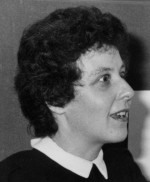
Mary MacRae “wrote and published poetry for only the last ten years of her life, after ill-health forced her to take early retirement from teaching. She taught for 15 years at the James Allen Girls School (JAGS), Dulwich, London. Her commitment to writing led to her deep involvement with the first years of the Poetry School under Mimi Khalvati, studying with Mimi and Myra Schneider, whose advanced poetry workshop she attended for 8 years. In these groups her exceptional talent was quickly recognised, leading to publication in many magazines and anthologies.” MORE (Second Light Live)
Elder
A breathing space:
the house expands around me,
·
 unfolds elastic lungs
drowsing me back
·
to other times and rooms
where I’ve sat alone
writing, as I do now,
when syncope –
·
one two three one two –
breaks in;
·
birdcall’s stained
the half-glazed door with colour,
·
enamelled the elder tree
whose ebony drops
·
hang in rich clusters
on shining scarlet stalks
·
while with one swift stab
the fresh-as-paint
·
starlings get to the heart
of the matter
of matter
·
in a gulp of flesh
and clotted juice that leaves me
·
gasping for words transparent
as glass, as air.
– Mary MacRae
Elder is from Mary MacRae’s postumously published collection, “Inside the Color of Red,” published here with the permission of the publisher and Ms. MacRae’s family. © poem, portrait, and book cover art (above and below), estate of Mary MacRae, All rights reserved
Δ
 My profound gratitude to poet Myra Schneider for the introduction to a new-to-me poet, Mary MacRae, and to poet Dilys Wood of The Second Light Network (England) for granting this interview. Jamie Dedes
JAMIE: Clearly, and as has been stated by others, Mary was profoundly inspired by art, nature (particularly flowers and gardens), and love. What can you tell us about her life and interests that would account for that?
DILYS: Mary writes tender and accurate poems about wild nature, creatures and landscape, drawing on her stays in a cottage on an untamed part of the coast in Kent, England and visits to her daughter living in remote West Wales. In her London home, it’s easy to guess from her poems about garden birds and flowers how much time she spent at the window. She almost always sees nature in flux, changing moment by moment, unpredictable, mysterious, a spiritual inspiration. One of her great strengths as a poet is catching movement.
Many of Mary’s poems focus on love between close family members. This may relate to a difficult relationship with her own father, which she sought to understand, and the relationships which compensated (with mother, sister, husband Lachlan, daughter and grandchild). A back problem prevented her from holding her baby daughter and she often refers in her poems to young children. She clearly has a yearning towards them.
JAMIE: She wrote poetry apparently only at the end of her life and for ten years. What were her creative outlets before that? How did she come to poetry?
DILYS: Mary was a dedicated teacher of English Literature and language in a leading girls’ secondary school. She was also deeply interested in music and painting (these are strongly reflected in her poetry). Though she had written as a young woman she followed the pattern of many women creative artists in becoming absorbed into her home life and her paid work, only turning to writing when her illness released her from the daily grind of intensive teaching. The remarkable, rapid development of her poetry shows how strong her latent powers really were.
JAMIE: Was writing poetry a part of her healing process when she was diagnosed with cancer? If so, how did it help her?
DILYS: I’m confident that Mary’s diagnosis with cancer enabled her to change her life-style and from then on concentrate on her poetry, urged by the sense that she might be short of time. There is no evidence that Mary wrote therapeutically to come to terms with her cancer. In fact she only ever addressed her illness in relation to the possible unkindness of fate in cutting her off from beloved people and life itself. The poems written in the last 2-3 years of her life give the impression that her dedication to writing, with the spiritual experiences which accompanied it, enabled her to bear terrible distress. She records this distress, using imaginative and metaphorical approaches to focus it, and these poems make heart-wrenching reading.
JAMIE: Can you tell us about her process? When did she write? Where? For how long?
 DILYS: I have the impression that Mary’s life revolved around three things, people she loved, gathering experiences that would feed her poetry (travel, listening to music, visiting galleries) and very hard work in direct furtherance of her writing (extensive reading, attending workshops with other inspirational poets, writing, revising and submitting her poems to criticism from critics she respected). She used notebooks to make a full, accurate record of those experiences – landscapes, human encounters, thoughts – that would feed her work. There is an extract from one such entry in the section about keeping a journal in the resource book Writing Your Self, Transforming Personal Material by Myra Schneider and John Killick. This book also includes a contribution in the chapter on spirituality which reveals much about Mary’s attitudes to life, nature and also her writing process.
JAMIE: Do you have any advice from her for other poets and aspiring poets?
DILYS: Mary was a dedicated writer, entirely sincere in her commitment to poetry as opposed to ‘career’ as a poet. She was always ready to enjoy and praise the widest range of subject-matter, approaches and styles from other poets, providing she thought they were ‘busting a gut’ to get their poems right, and not indulging in the trendy or superficial, which she despised (whether from well-knowns or unknowns). She put much emphasis on wide-reading of both past and contemporary poets and she herself had absorbed a huge amount of other poets’ work, always quoting fully and accurately. She liked using another’s work as a starting pont for her own (the Glose) and particularly admired the work in strict form (including Sonnet, Villanelle and Ghazal), which began to be more acceptable from the mid-1990s (eg from such poets as Marilyn Hacker and Mimi Khalvati).
JAMIE: Are any other collections of her poetry planned? If so, when might we look forward to them?
DILYS: When putting together ‘Inside the Brightness of Red’, Myra Schneider and I went through the whole of Mary’s unpublished work and selected all those poems we felt were both complete and would have satisfied her high standards. What remains unpublished would be mainly fragments and early versions of poems she did more work on. There will not, as far as we know, be a further book, but Mary did achieve her aim of being a significant lyric poet, whose work is very attractive, polished and, above all (as she would have wished) deeply moving and consolatory.
* The Second Light Network aims to promote women’s poetry and to help women poets, especially but not only older women poets develop their work. It runs weekends of workshops and readings in London usually twice a year, a residential extended workshop with readings and discussions at least once every 18 months and occasional other events. It is nationwide and includes and some members who live outside Britain altogether. Importantly Dilys is the main editor of ARTEMIS poetry a major poetry magazine for women produced by Second Light twice a year for all women poets. It includes a lot of reviews and some articles as well as poetry. Second L. members receive it free as part of their subscription. An e-newsletter is sent out every few weeks. A few anthologies of poetry have been published by the network but now this magazine has been developed books are only produced in special circumstances – such as Mary’s collections.
Thanks to Second Light Web Administrator, poet Ann Stewart, for the following: The books (Inside the Brightness of Red and As Birds Do) can be bought: via order form and cheque in post: http://www.secondlightlive.co.uk/books.shtml or here online: http://www.poetrypf.co.uk/shop.php (typing ‘ Mary MacRae collection ’ in the filter box will reduce the list to just those 2 books).




 Jamie Dedes' THE POET BY DAY Webzine