On the 31st Anniversary of the Tiananmen Square Massacre . . .

A replica of the memorial in the Polish city of Wrocław depicting a destroyed bicycle and a tank track as a symbol of the Tiananmen Square protests. The original was destroyed by Security Service despite the fact that it was after the 1989 elections./ Photograph courtesy of Masur and generously released into the Public Domain.

The Tiananmen Square protests or the Tiananmen Square Incident, commonly known as the June Fourth Incident were student-led demonstrations held in Tiananmen Squarei n Beijing during 1989. The popular national movement inspired by the Beijing protests is sometimes called the ’89 Democracy Movement. The protests started on April 15 and were forcibly suppressed on June 4 when the government declared martial law and sent the military to occupy central parts of Beijing. In what became known as the Tiananmen Square Massacre, troops with assault rifles and tanks fired at the demonstrators and those trying to block the military’s advance into Tiananmen Square. Estimates of the death toll vary from several hundred to several thousand, with thousands more wounded. MORE


On June 4th, the 31st anniversary of the Tiananmen Square massacre, PEN America announced it will bestow the 2020 PEN/Barbey Freedom to Write Award on Chinese essayist, civil rights activist, and lawyer Xu Zhiyong. Xu, a longtime civil rights leader, was detained February 15 for penning an essay criticizing the leadership of China’s president Xi Jinping, including his handling of the COVID-19 outbreak, and calling on Xi to resign.


Xu Zhiyong / Photograph courtesy of Shizhao under CC BY 3.0

Xu Zhiyong (b. 1973) is a Chinese civil rights activist and formerly a lecturer at the Beijing University of Post and Telecommunications. He was one of the founders of the NGO Open Constitution Initiative and an active rights lawyer in China who helped those underprivileged. He is the main founder and icon of the New Citizens’ Movement in China. In January 2014 he was sentenced to four years in prison for “gathering crowds to disrupt public order”. He was detained again on 15 February 2020, in the southern city of Guangzhou.Xu was born in Minquan County, Henan Province.  He is married to Cui Zheng, a journalist. Their daughter was born on January 13, 2014, while Xu was in a detention center facing trial. He had been in hiding since late 2019 and was detained by Chinese police on February 15, 2020.

Xu received his Bachelor of Law degree from Lanzhou University in 1994 and Doctor of Law degree from Peking University in 2002.

Xu is currently being held incommunicado in state custody, and it is widely expected that he will soon be formally charged with “subverting state power,” an offense that carries a maximum 15-year prison sentence. Earlier this spring, PEN America labeled China as the top jailer of writers worldwide based on a global census published in the PEN America 2019 Freedom to Write Index.


The PEN/Barbey Freedom to Write Award, given annually, recognizes an imprisoned writer targeted for the exercise of free expression. Of the forty-seven jailed writers who have received the this honor since 1987, forty-one have been released due in part to the global attention and pressure the Award generates. By conferring the award on Xu, PEN America kickstarts a global campaign for his release.

“Xu Zhiyong has guts,” said Suzanne Nossel, PEN America’s CEO. “His essays have served as calls to conscience at pivotal moments in China’s recent history. The one that resulted in his arrest was a detailed, blistering analysis of President Xi Jinping’s blind spots and shortcomings as a leader, published while COVID-19 still raged in China. His detention forms part of a Chinese government effort to control the global narrative about the outbreak, including by disciplining Chinese doctors and journalists who tried to sound alarm bells and punishing critics of the government response to the pandemic. In his writings, Xu has been a persistent voice calling out Beijing’s intolerance for dissent—and campaigning for social equity, rule of law, and a joyful vision for his country’s future.”

Alongside his human rights advocacy, Xu is well known for his series of online essays concerning contemporary social issues in China. He has written prolifically online on issues including access to fair education, governmental mistreatment and repatriation of migrant workers, corruption, and wasteful government spending. His essays have achieved the status of samizdat-like writing among reform-minded intellectuals and advocates across China. In the essay published just before his detention, entitled “Dear Chairman Xi, It’s Time for You to Go,” Xu wrote: “If you are determined to set yourself against history, you will surely visit disaster upon this country. What China needs above all other things is freedom! Only with freedom will creativity truly flourish and progress be possible.”

“Thirty-one years ago today, Chinese dissidents and activists peacefully protesting to demand greater liberty—including the freedom to speak openly and without fear—were massacred in Tiananmen Square,” said novelist and PEN America’s president Jennifer Egan. “As our own country reels in crisis, citizens peacefully demanding that leaders be held accountable must be protected. We stand in passionate solidarity with those who use language as a tool of protest—in words and writings, and as a spur to mobilize others and drive forward public debate—around the world and here at home. We are proud to honor Xu Zhiyong for his indomitable will to speak the truth in the face of grave danger, and we pledge that his voice will not be silenced, nor his name erased. We will fight on his behalf until he is free.”

PEN AMERICA’S 2019

FREEDOM TO WRITE INDEX

PEN America’s 2019 Freedom to Write Index, the organization’s first annual global count of writers and public intellectuals unjustly detained or imprisoned worldwide, found that China held 73 writers and public intellectuals in prison or detention for their writing in 2019—more than any other country.

Traditionally bestowed at PEN America’s annual New York City gala, the PEN/Barbey Freedom to Write award kicks off a campaign of advocacy for the awardee’s freedom. Past honorees include Saudi writer-activists Nouf Abdulaziz, Loujain Al-Hathloul, and Eman Al-Nafjan (2019); Reuters reporters Wa Lone and Kyaw Soe Oo (2018, freed in 2019), Ukrainian writer and filmmaker Oleg Sentsov (2017, freed in 2019), Egyptian novelist Ahmed Naji (2016, freed in 2018), Azerbaijani investigative reporter Khadija Ismayilova (2015, freed in 2016 with continued restrictions on her movement), and Uyghur professor Ilham Tohti (2014).

PEN America’s annual gala is scheduled for December 8, 2020 at the American Museum of Natural History, health and safety permitting.

This post is complied courtesy of PEN America and Wikipedia.


Jamie Dedes:

Your donation HERE helps to fund the ongoing mission of The Poet by Day in support of poets and writers, freedom of artistic expression, and human rights.

Poetry rocks the world!


FEEL THE BERN

For Peace, Sustainability, Social Justice

Maintain the movement.

“Democracy is not a spectator sport.” Bernie Sanders


“Every pair of eyes facing you has probably experienced something you could not endure.”  Lucille Clifton

ORWELL MATTERS, “A Little Poem” and … “Power is not a means. It’s an end.”

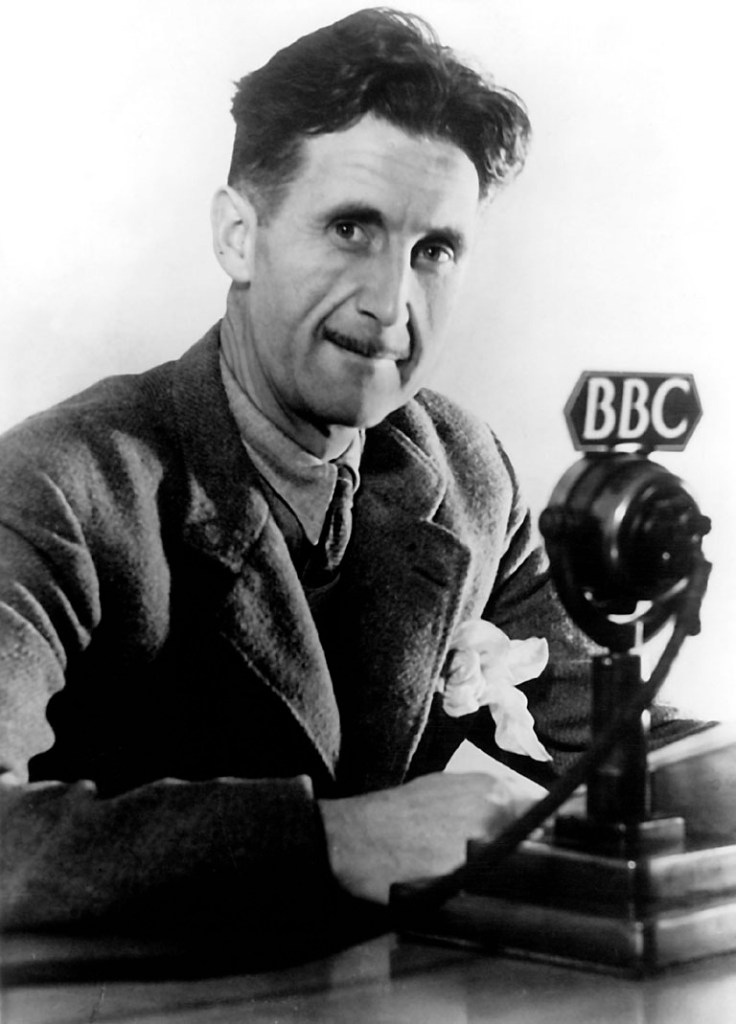
George Orwell (1903-1950), BBC Photograph in the public domain an curtesy of Penguin Books, India
George Orwell (1903-1950), BBC Photograph in the public domain, curtesy of Penguin Books, India

A LITTLE POEM

A happy vicar I might have been
Two hundred years ago
To preach upon eternal doom
And watch my walnuts grow;

But born, alas, in an evil time,
I missed that pleasant haven,
For the hair has grown on my upper lip
And the clergy are all clean-shaven.

And later still the times were good,
We were so easy to please,
We rocked our troubled thoughts to sleep
On the bosoms of the trees.

All ignorant we dared to own
The joys we now dissemble;
The greenfinch on the apple bough
Could make my enemies tremble.

But girl’s bellies and apricots,
Roach in a shaded stream,
Horses, ducks in flight at dawn,
All these are a dream.

It is forbidden to dream again;
We maim our joys or hide them:
Horses are made of chromium steel
And little fat men shall ride them.

I am the worm who never turned,
The eunuch without a harem;
Between the priest and the commissar
I walk like Eugene Aram;

And the commissar is telling my fortune
While the radio plays,
But the priest has promised an Austin Seven,
For Duggie always pays.

I dreamt I dwelt in marble halls,
And woke to find it true;
I wasn’t born for an age like this;
Was Smith? Was Jones? Were you?

– George Orwell


POWER IS NOT A MEANS. IT’S AN END.

The current state of affairs has many pulling 1984 and Animal Farm off their bookshelves, dusting them off and reading them again, probably for the first time since school days.

“Now I will tell you the answer to my question. It is this. The Party seeks power entirely for its own sake. We are not interested in the good of others; we are interested solely in power, pure power. What pure power means you will understand presently. We are different from the oligarchies of the past in that we know what we are doing. All the others, even those who resembled ourselves, were cowards and hypocrites. The German Nazis and the Russian Communists came very close to us in their methods, but they never had the courage to recognize their own motives. They pretended, perhaps they even believed, that they had seized power unwillingly and for a limited time, and that just around the corner there lay a paradise where human beings would be free and equal. We are not like that. We know that no one ever seizes power with the intention of relinquishing it. Power is not a means; it is an end. One does not establish a dictatorship in order to safeguard a revolution; one makes the revolution in order to establish the dictatorship. The object of persecution is persecution. The object of torture is torture. The object of power is power. Now you begin to understand me.” George Orwell, 1984


51fgdfc5bl-_sx315_bo1204203200_Eric Arthur Blair (pen name George Orwell) “was born in 1903 in Motihari, Bengal, in the then British colony of India, where his father, Richard, worked for the Opium Department of the Civil Service. His mother, Ida, brought him to England at the age of one. He did not see his father again until 1907, when Richard visited England for three months before leaving again until 1912. Eric had an older sister named Marjorie and a younger sister named Avril. With his characteristic humour, he would later describe his family’s background as “lower-upper-middle class.” MORE

DREAMING THE WORLD, An Interview with Michael Watson, M.A., Ph.D., LCMHD

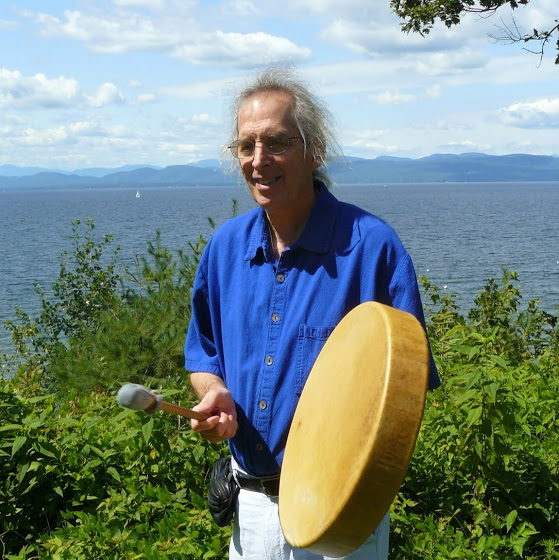
Michael Watson
Michael Watson

MICHAEL WATSON, M.A., Ph.D., LCMHC is a poet of the spirit, if not of the pen, and a contributing editor to The BeZine, an essayist and a practitioner of the Shamanic arts, psychotherapist, educator and artist of Native American and European descent.

Michael lives and works in Burlington, Vermont,where he recently retired from his teaching position in undergraduate and graduate programs at Burlington College,. He was once Dean of Students there. He also had wonderful experiences teaching in India and Hong Kong, which are documented on his blog. In childhood Michael had polio, an event that taught him much about challenge, struggle, isolation, and healing.

This interview was originally featured in the June issue of The BeZine.

JAMIE: I often tell people that if they have time for only one blog, it should be yours, DREAMING THE WORLD. You bring such a wealth of understanding, experience and education to your posts, so gently delivered and so healing. Thank you! You write a lot about nature. Did you grow up in the country?

MICHAEL: Thank you, Jamie. I am deeply moved and honored. My dad was in the Air Force so we moved periodically. He hailed from Southwest Indiana, from a hillside farm overlooking the Ohio river. My mom grew up on a farm in Texas, a couple of hours west of Dallas. The upshot was we tended to be stationed near one family or the other. When I was six or so, we lived in rural Lincolnshire, England, on an estate, complete with a game warden, where I spent untold hours in the woods with friends. Then we moved to rural Illinois, where we lived on the edge of a small town, and I was free to roam the countryside. From there we spent a year in suburban Ft. Worth, Texas, then we lived in urban Ohio while I finished high school and college. No matter where we were my parents had a garden, and made sure we kids had access to Nature. Given the option, I would head for the forest or prairie. I spent quite a few fabulous summers on my uncle’s farm in the fertile Ohio river valley near Madison. My dad’s family encouraged me to understand myself as part of the Natural world.

JAMIE: How did you get interested in therapy as a profession?

MICHAEL: I had a good therapist in college, then was clinical coordinator for a large “Free Clinic”. After working for the Soil Conservation Service for a while (I had a splendid job where I was outside most of the time, often in wilderness), I realized my legs were not going to tolerate the demands on them, and I had best find a more sedentary job. I already had an MA in Studio Art, and was offered a position as a community based artist, so I grabbed the opportunity to explore engaging people in arts for healing. I also went back to school to get a degree in counseling. During that time I provided some services to patients in the local university medical center, and when I finished my degree they offered me a part-time position, as did an outpatient clinic in town. One of my teachers worked in the clinic, and when he decided to leave his private practice, he essentially gave it to me.

JAMIE: What spurred your interest in shamanism?

MICHAEL: My dad’s side of the family has always identified as Native, although they steadfastly refused to tell us our tribal identity. One of my cousins, who is a genealogist, has tried several times to trace our family, without success. There are birth certificates for family members that go back three or four generations, then there is simply no record. All the birth certificates list us as being Caucasian. Indiana was a very nasty place for Native people during much of the last two centuries and it was very common for light skinned Natives to pass. My grandmother used to say, “We must protect the children.”

Anyway, I mostly didn’t think much about Natives, except to identify with the cowboys when we kids played cowboys and Indians. I could never figure out why my dad got upset with me for being a cowboy! Then in college there were all these books about Native American healers and shamans. A lot of those books turned out to be fraudulent but they got my attention. When I went to New Mexico for grad school I had many Native friends. I ran a small ranch in the mountains so I could afford school, and got a real hit of the sacredness of that country. Eventually I moved to California, then back East. I kept meeting Native elders who offered to teach me something. I’d protest that I wasn’t Native and they would look at me as though I was completely out to lunch. Often they would say, “We know more about you than you do.” I guess they were right.

When I was living in northern California I had a vision that turned my life upside down, and set me to trying to understand what I was being asked to do. That was forty years ago. I still ask the Powers what they want, and I’m still not the best at engaging with them.

JAMIE: You have lived virtually all your life with polio: traumatic, painful and disabling. I know you’ve thought a lot about disability, about cultural misconceptions and about meaning. What is the most important thing you think we need to know as a culture about the nature of disability and the impact – not so much of the disability itself – but of the assumptions that are made about people with disability?

MICHAEL: I was seven when we came back from England. I started school, second grade, and after a week we had the Labor Day weekend holiday. I developed Polio during that weekend and spent the next year trying to recover. I was in the iron lung and had significant paralysis; I made a rapid recovery (one of those “miraculous” recoveries that happened fairly often) and left the hospital after only a bit more than three months. We Polios were encouraged to believe we were not disabled, but many of us were. Much later, we discovered there is a correlation between the severity of the illness, the degree of one’s recovery, and the disabling that comes with Post-Polio Syndrome. PPS had been studied for about a hundred years, but everyone conveniently forgot about it once the vaccines arrived and the epidemics ended. (The same thing happened with us Polios, we were forgotten, even by the March of Dimes, an organization that had promised to support us, and our families, for as long as we needed them.)

Being an enlisted person in the military means one is not well paid; a lot of military families are on food stamps! As it turned out, I most likely survived Polio only because I was in a military hospital, and the Air Force literally did whatever was necessary to support me during the acute phase of the illness; they even flew in two top Polio docs to help me.

Being a closet Native and a Polio who tried, rather unsuccessfully, to pass as able, I learned a lot about the way our culture attends to people with disabilities. There is a strong Calvinistic streak in the culture, one that subtly, or not so subtly, places the blame for disabling events on the disabled person and their family. There is a strange cultural belief that disability is a moral failure, rather than an act of Fate; there is also a belief that physical disability implies cognitive impairment. (There are more reportedly Ph.D.s among Polio survivors than any other segment of the population.) There is also a willful refusal to notice and address all sorts of physical and cultural barriers that greatly affect disabled people.

I have worked on issues of disability throughout my adult life. When I am teaching about the experience of disability I remind students/participants that disability is largely a social construct; even the medical definition of disability is socially constructed, a fact many doctors forget. (Actually, younger physicians tend to be much more aware of this.) I often ask those present to speak about the experiences that disable them; I find it immensely useful to aid individuals to understand the experience of being disabled by locating parallel experiences in their own lives. The truth is, most of us have had moments when someone else’s attitudes, behaviors, or beliefs are/were disabling to us. Disability is created!

Oh, one more thing. There is, in North America, a cultural expectation that persons with disability will be either unceasingly cheerful or despondent. We should never be angry. Well, what is one to say to that? I have a wide array of responses to my experience, certainly including anger.

[I very much appreciate this written by Michael on his blog: “We find it useful to define disability as a lack of access to the social and/or physical environment, a lack created by the beliefs and behaviors of self, or, especially, others. While many disability activists and theorists find this definition overly broad, we believe it aids people to understand the experience of disability, building empathy and community.”

JAMIE: You also have been involved in education at the university level for good part of your life. How do you feel about the current emphasis on vocational vs. liberal arts/humanities? What price do we pay or will we pay for this?

MICHAEL: I have long encouraged students to explore widely, to engage the fine and liberal arts, and to create internships and other avenues for applying their learning in the everyday world. Being educated in the fine/performing arts, and the liberal arts, gives one models for being creative, and understanding historical and cultural context, as well as opportunities to learn about human nature. Hopefully, one also gets enough science to be able to understand the broader ecosystem implications of one’s behavior. Unfortunately, those who have overly specialized training tend to be lacking in tools.

JAMIE: What is the major work or interest of the next year for you?

MICHAEL: I’m dealing with progressive Post-Polio Syndrome, and approaching seventy, so I am practicing becoming more choosy about the projects I take on. I will continue to see clients in my counseling and healing practices. I have a list of photographic and writing projects, and Jennie, my wife, and I are working on new toy theater shows. Now that I am no longer classroom teaching, I’m also working to create time to read for fun!

© portrait and answers to interview questions, Michael Watson, All rights reserved