VIVIENNE, THE POET (Part 1): The Song of Joy and Pain (from my perspective), by poet Mike Stone

To come and pierce your solitude. I know
More than you dream, how precious are your thoughts,
Guarded and unperceived. You see, dear heart,
We are but one. You are the child I was,
I am the poet grown that you will be.
“I never saw my mother’s book of poetry until a couple years ago (2018). I don’t remember seeing any of her poems or seeing her in the act of writing.” Mike Stone
Editor’s Note: The photographs here belong to Mike and his family. Please be respectful. Note also that Mike’s mom changed the spelling of her name from Vivian to Vivienne, hence the discrepancy between the narrative and the name on the book and the header photograph. / J.D.

These are the dry facts of my life relating to my mother and her hand-written leather-bound book of poetry, The Song of Joy and Pain. The facts form a triangle in my mind: my father, my mother, and my stepmother.
My father and mother eloped and got married young. Dad was nineteen. Mom was eighteen. I was born nine months and twelve days later. My sister, Victoria, was born four-and-a-half years after me.
At this point, I must state that I have no factual memories of my mother prior to the age of thirteen. I have memories. They just aren’t factual; that is, whatever I might have remembered from personal experience had been supplanted by a collage of other people’s narratives and the few physical documents I happened to come across.
It has been said that we see only what we expect to see. I believe that the memories that we’ve experienced directly are replaced by parts of narratives that are associated with those experiences. Those narratives come to us from the people we trust.


Dad divorced Mom when I was seven years old. Victoria was three. This was when the narratives started. Dad’s narrative went like this: Mom was an unfit mother. She was hysterical. She beat me with a pancake turner. This was why he divorced her and sued for custody of my sister and me. She wrote “poetry” (deprecatingly said) and held poetry “salons” in which she would sit on the floor in a circle of “poetry” admirers. Dad hated these salons.
I never saw my mother’s book of poetry until a couple years ago (2018). I don’t remember seeing any of her poems or seeing her in the act of writing.
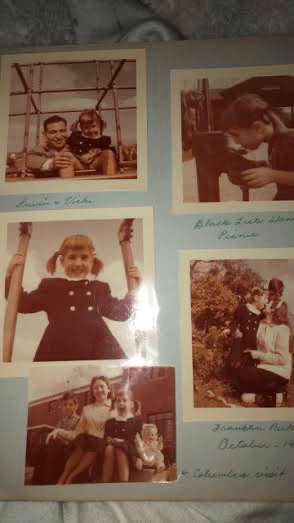 Dad remarried two years later. I was encouraged to call my stepmother “Mom”, although it was a few months before I felt able to do so. A new narrative began: our mother had never loved us. After a while, after calling my stepmother “Mom”, I began referring to my birthmother as “my biological mother” to avoid confusion when discussing her. As time went on, I just called my birthmother by her first name, “Vivian”.
Vivian remarried a year or so after the divorce. Her husband (Irv) was a psychiatrist. They visited my sister and me twice a year. Eventually, Irv was called up to the Army and they were transferred to Panama for three years. A few months before they were to be rotated Stateside, they adopted two infants, Lisa and Chris.
Three days before they were to fly back home, Vivian was killed in a freak pedestrian accident. I was fourteen when we received a letter informing us of her death.
Six years ago (2014), Lisa contacted my sister and me on Facebook. Although she was only an infant when Vivian was killed and had no direct memories of her, she had heard many stories about Vivian from Irv and also from friends of the family in Panama and America who knew Vivian and knew her history with my father, my sister, and me. The narratives Lisa had heard contradicted the narratives on which I was raised: Vivian had loved my sister and me very much. Dad’s family had been against the marriage and had forced my father to divorce Vivian or he would not receive any financial support from them. Vivian was unwilling to give up custody of us. Dad’s parents had Vivian committed to an insane asylum until she agreed to sign the divorce papers.
Lisa told my sister and me that Irv had sent her two hand-written leather-bound books of Vivian’s poetry, which were word-for-word copies of each other. Lisa had read Vivian’s poetry and it was clear to her from Vivian’s poems how much she had loved us.
Narratives against narratives. The ground shook under my feet. My childhood memories crashed and lay in ruins. I couldn’t imagine any possible motive for Lisa to lie about Vivian’s past, but I could imagine a few possible motives for my father and stepmother to lie to us.
Dad passed away in 2010. By 2017 our stepmother suffered from vascular dementia. We placed her in a 24/7 nursing care facility. She passed away in October 2019.
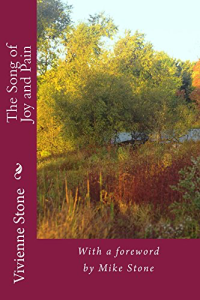
How did I come into possession of my mother’s poetry collection?
Lisa had told my sister and me that she would be happy to give us one of the hand-written copies of our mother’s poetry. She sent the book to Victoria since Lisa lived in New York state and Victoria lived in Connecticut. I live in Israel. We didn’t trust the international postal carriers to get such a precious book to me in Israel, so the next time I went to Columbus Ohio to visit our stepmother in 2018, Victoria mailed the book to my cousin in Columbus who handed it to me when I arrived.
What did I think of her poems?
I love poetry, both the writing and reading of poetry; however, I’m very demanding of the poets and poetry that I read. Poets must be authentic in their expression. They must be brilliant. Poems must leap with originality. They must surprise me. I have scant patience for less-than-brilliant poets. My only rule in writing is that I write what I’d like to read.
Before I opened our mother’s book of poetry, I trembled in fear of what I was about to read. I was afraid that I would be disappointed, that her poetry would be just “poetry”, as Dad had described in deprecation.
I opened her book and read the first poem and then the next, and the next. Her poetry exceeded my wildest expectations. Her poems were beautiful; they were brilliant; and they were authentic. She wrote poems about everything and everyone around her, and how she felt about them. She wrote about how she loved my father as only a poet can love. She wrote of the betrayal she felt when Dad told her he was divorcing her. She wrote of the despair and loneliness she felt. She wrote about her thoughts of suicide.
How did I feel about her poems?
I believed every word my mother wrote. A poet who is authentic does not lie. If you must lie in a poem you write, then what is the point of writing the poem? The authentic poet needs to reveal his soul. Perhaps that is the difference between a poet and a wordsmith. A wordsmith connects one word to another, considering rhyme and meter, showing off his or her knowledge and vocabulary. A poet’s soul needs to peek out of his or her poetry.
Therefore, the truth about our mother and us cracked and crumbled the narratives of my childhood memories. I feel freed of my shackles. I feel empty though. I know my childhood memories are false, but her poems cannot replace my memories because I have no memories to replace.
I transcribed our mother’s poetry into digital form, using a script font reminiscent of her handwriting. There were fifty-four poems in all. I added a foreword and, at the end, poems that I had written about her, to her. It was a labor of love for me.
How did I feel?
I felt that my father had thrown away a goddess worth more than all the wealth his family had threatened to withhold from him. He should have stood up to his parents and protected his wife who had loved him with the purest of innocence. That is what I would have done if I had been in his shoes. I felt that my father had lied to us, to me, because he was ashamed of what he had done. I felt that our stepmother had lied to us because she had wanted us to love her instead of our mother.
In what ways did her poetry change me?
Her poetry made me return to my childhood to love and cherish her, retrospectively. In doing so, I’ve grown to love the little boy that I was once. Now, I am seventy-three years old. It’s about time.
© 2020, Mike Stone
RELATED:
- Mothers and Other Collateral Damage, a narrative poem, Mike Stone
- VIVIENNE, THE POET (Part 2): Poems and Biography of poet Mike Stone’s Mom

 MIKE STONE (Uncollected Works) is a regular participant in The Poet by Day, Wednesday Writing Prompt. We are always delighted with the opportunity to read and share his work. Mike was born in Columbus Ohio, USA, in 1947 and was graduated from Ohio State University with a BA in Psychology. He served in both the US Army and the Israeli Defense Forces. He’s been writing poetry since he was a student at OSU and supports his writing habit by working as a computer networking security consultant. He moved to Israel in 1978 and lives in Raanana. He is married and has three sons and seven grandchildren. Mike’s Amazon Page is HERE. His work is recommended without reservation.




 Jamie Dedes' THE POET BY DAY Webzine