HOW TO BE ALONEby Tanya Davis, poet, songwriter and singer. Her style is primarily spoken word set to music. She performed in this video, which was directed by Andrea Dorfman. Andrea did the animation. She is a screenwriter as well as a director.
The film was shot in Halifax, Nova Scotia. As of this writing, this poetry video has had more than 7,620,000 views, which is a league of its own when it comes to poetry videos. As far as I know the only poet who gets those numbers – actually twice as much – is Shane Koyczan, also a Canadian and a spoken word poet.
After making the film Tanya and Andrea put together a book, How to Be Alone (Harper,2013) with the poem and illustrations. Tanya also has a published poetry collection, At First, Lonely (Acorn Books, 2011). The former, I think, makes a good gift for someone after a break-up, separation or divorce. The later explores falling in love and out, searching for truth and for roots. The writing is intimate, very personal.
“Each day I squeeze the contents of my heart over whatever expression I’m wearing & imprint it onto a notebook page–my version of St. Veronica’s veil.”
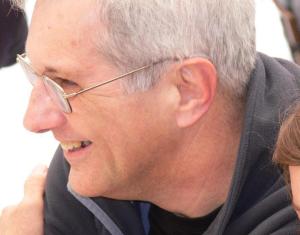
Joseph Hesch (A Thing for Words) lives in a beautiful region, upstate New York, at the confluence of my own beloved Hudson River and the Mohawk River. It’s a nice setting for a poet.
Joe was a professional writer for forty years. Post-retirement finds him doing writing that is more creative – poetry and fiction – with publication in quite a number of magazines, literary journals and an anthology here and there. He has self-published two collections of poetry. Joe is also a member of The BeZinecore team of contributing writers and his poems and flash fiction are featured in the zine just about every month.
JAMIE: Joe, I know you worked as a journalist for a good part of your life. Did you also write poetry or did you come to it late? What’s it like now that you are not working for “the man?”
JOE: Journalist or hired typewriter and gum-flapper for Skidmore College, a three-state professional organization or the State of New York over my 40-plus years in the working world. And no, I definitely was not writing poetry until I reached the age of 55. Not in high school, college nor when I was a professional writer.
A pretty miraculous recovery from a heart condition let me know each day is a blessing not to be wasted. I decided I’d best hurry and let the writer’s heart I thought I had within me live again.
I started to write sassy essays that I shared with friends. Then I wrote a bit of memoir one afternoon about my childhood Christmases. I took a chance and it was accepted for publication in a Christmas anthology. I continued to write for the discoveries I was making in myself and my world. And then everything stopped. Absolutely dead in the water. I’d run out of those easily reached ideas and emotions. I didn’t know what to do.
A friend told me my prose always sounded quite poetic to her. “Why don’t you write a poem?” she said. So I started out with the 5-7-5 structured hug of haiku. Then I wrote a poem about not being able to write anymore, stringing together those five-and-seven-syllable lines. She suggested I submit it to some journals. I did and it was accepted for publication. Poetry had recharged my life machine and put me back in the world as a writer.
I never wanted to be a poet. Never wrote a poem in my life before those haiku. I consider myself a storyteller. You could say my poems are stories with the sentences broken into bite-sized pieces, stacked like crackers. But I’ve discovered more about myself as an emotional being, as a feeling man since I began to write poetry than I could have imagined in fifty-some years on this Earth. So, about no longer writing for the man? They can’t pay you enough in any job to learn the discoveries I have as a poet.
JAMIE: Tell us about your two collections.Do you have plans for another? If so, what would be the theme.
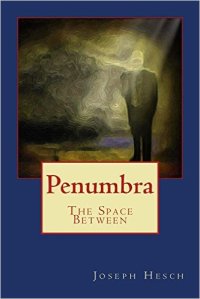
JOE: Oh, thanks for asking. Yes, I have two collections available on amazon.com. The first, Penumbra: The Space Between, I put together in 2014. I guess you could say it’s my coming-out as a poet in middle age. I hope I expressed my impressions on life and nature from the view of a man emerging from years of darkness into a brighter personal and artistic existence, standing astride middle age. Neither young nor old, still peering at things from the edge of shadow and light, the penumbra. I’m kinda proud of it as a first effort.
In my second collection,One Hundred Beats A Minute, I hope to convey impressions and imaginings of life, love, art, nature and what I see outside or inside the swirly-glassed windows of my soul. All of its sixty poems, the number of seconds in a minute, are bound within the frame of one hundred words. No wiggle room, exactly one hundred, or my obsessive mind gets all edgy. When I succeeded at hitting 100 and putting that final period on the page, where my obsession met compulsion and life met art, I squirmed in my seat, my knees and heels tended to flutter up and down from the floor and my heart beat like I’d just run a sprint of a hundred meters. I hope readers can experience that feeling here and there in this collection, too.
My next collection? I haven’t thought very hard about anything yet. However, I have thought for long time about putting together a collection of my short stories and flash fiction. Already have the title, the title of my first short story after I began writing for myself again—But Don’t Touch, as in “You can look, but…” So many of my stories are the opposite of my poetry. Many seem to have the theme of men who have problems reaching out to or accepting intimacy, whether it be carnal or merely the simple warm touch of another’s hand.
“Writer and poet who’s spent decades writing for The Man. Still do. Except now I’M the man.”
JAMIE: What sorts of poetic activities do you participate in and why?
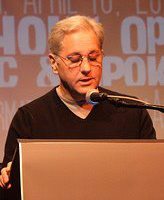
JOE: Not many, and I feel badly about that. But when I go out to read to other writers, I just don’t feel a sense that I belong. Never have. Nevertheless, for the past four or five years, I’ve read at the Albany Word Fest Open Mic that the Albany Poets group holds during April for National Poetry Month. I’ve also run up the Adirondack Northway to read at the legendary Caffe Lena in Saratoga Springs. That’s an interesting feeling, reading your poetry where Bob Dylan made his bones as a poet in song. But I don’t get out enough to share my work with others. Maybe I’m shy that way. Or maybe just lazy, other than writing something for someone, only lately myself, every day for the past 40 years.
JAMIE: Why is poetry important to you and why should it be important to us?
JOE: Wow, that’s a big one. I guess it merits a big answer, then. Simply put, poetry, my finding poetry as an outlet for my long dormant creative self, helped save my life, most certainly the quality of it. I don’t know how long I could go on wandering in that vast desert of empty when I knew I was supposed to do something creative to fulfill myself.
Beyond that, though, I like to think poetry holds up a mirror, sometimes cracked and refracting, others with a soul-illuminating clarity, to who we are as individuals, families, communities, nations, a world. They can bring us the great Ahh moment, as well as the Ahh-Hah! And most of the time goes for the writer—at least this one—as well as the reader.
IN THE ROOM
Here in the room the breaths come
maybe every ten seconds apart,
snoring sounds from a mouth agape,
now voiceless, beneath eyes mostly closed,
but probably unseeing.
She doesn’t hear the talk in the room.
We think. We hope.
Above the bed, a little plastic bag
of morphine perches like blessed fruit
from a swirly silver branch atop
the six-wheeled tree they’ll roll
out of the room whenever her spirit does.
Here in the room we watch, we wait,
hearing only the sounds of the family,
of the bubbling O2 humidifier,
the beeps of monitors and machines,
the murmurs and shoe-squeaks from staff
in the hallway on the fifth floor
as the hospital awakens this morning.
And punctuating it all come
the snorting gasps of a life dwindling away
every ten–no, fifteen–seconds.
We think. God help her, we hope.
This post is a gift – as all of Michael’s work is – of friend and The BeZine colleague, Michael Watson,LCMHC. It is shared here with Michael’s permission and as a follow-up to Turning Pain into Beauty … a triumph of tattoo and poem over mastectomy, published here yesterday.
Michael Watson is a shamanic healer, psychotherapist, educator, and visual and theater artist of Native American and European descent. Michael’s blog is Dreaming the World. If you were to feed your soul on only one blog, his would be the one to choose.
*****
Writing about being fitted for a new brace, and reading and responding to, the comments on that post, seems to have opened a doorway on to the immediacy of the past in the present, and to meaning making in the aftermath of intense experience, particularly illness. This morning I awoke early, before there was any hint of light in the sky. I awoke into a memory. It was not a “proper” memory; rather, it was more a flood of complex, even contradictory, emotions and sensations. There have been times in my life when such an awakening would have filled me with dread, but this morning I felt curiosity.
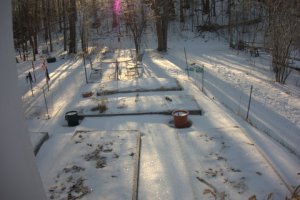
Today features a high, slightly broken overcast with the very occasional glimpse of milky blue sky. Here, at the end of January, there is a thin covering of snow on the ground. At the feeder, the male finches are showing the beginnings of bright red plumage in preparation for their February mating season. As has been true for most of the winter, the temperature is unseasonably warm, and we face another bout of rain.
Our kitchen looks out, through the sun room, into the garden and back yard where the feeder is hung from the crab apple tree. With this as a backdrop I opened a small jar of strawberry/plum jam. Immediately the fragrance of strawberries permeated the kitchen, as though a genie had been freed from the bottle. For a moment it was June! The jam promptly went on a croissant; Also on said croissant were several slices of brie which had melted under the broiler!
These experiences, the overcast, jam, and memory, set me to wondering about the body-self’s capacity for richly nuanced experience. Later, when I sat down to read through my e-mail, there was a blog post from Jamie Dedes, who writes at the Poet By Day. Today’s post was about the transformation of disfigurement into beauty. She wrote about scars, particularly those left by mastectomy, and women who use tattoos to completely alter the look and meaning of those scars.
Suddenly there was yet another layer of complexity in my pondering. Scars, fragrances, and those unbidden, complex memories, are all traces, events and meanings written in and on the body. It is, I imagine, these traces that give shape to our experiences of our bodies and lives. Our responses to these traces reflect our personal struggles to wrestle meaning from mishaps and joys; they are also suggestive of the responses of others to our scars, and our fears and expectations of how others will react. (I have been asked several times how I imagine others will react to my new, very visible, brace.) Thus, our relationship to memory and scar becomes thickly layered and re-membered.
Above me, on the bookshelf, stand the six thick volumes of Proust’s In Search of Lost Time, a masterpiece set in motion by a memory of a Madeleine. The writing is a sort of quarrying, exposing the myriad layers and accretions of association attached to a singular, somehow pivotal, event. I wonder: is every moment, every event, pivotal, somehow a singularity of infinite mass and importance? Or do we remember more selectively, creating islands of meaning contextualized by specific moments in time, somehow giving more weight to specific events, allowing them to draw innumerable associations to themselves, thus creating constellations of great depth. Perhaps both are true.
My first reaction is: I want it,
can’t wait to squeeze into
a scarlet sheath that promises
breasts round as russet apples,
a waist pinched to a pencil,
hips that know the whole dictionary
of swaying, can’t wait
to saunter down an August street
with every eye upon me.
But the moment I’m zipped in
I can’t breathe and the fabric
hugging my stomach without mercy
pronounces me a frump.
Besides, in the internet café,
where you can phone Tangiers
or Thailand for almost nothing
fourteen pairs of eyes
are absorbed by screens.
No one whistles when I smile
at boxes of tired mangoes
and seedy broccoli heads
outside the Greek superstore.
By now I’m in a fever to undo
the garment and pull it off.
And for all its flaws, for all
that it only boasts one breast,
I’m overjoyed to re-possess
my body. I remember I hate
holding in and shutting away.
What I want is a dress easy
as a plump plum oozing
juice, as a warm afternoon
in late October creeping
its ambers and cinnamons into
leaves, a dress that reassures
there’s no need to pretend,
a dress that’s as capacious
as generosity, a dress that willingly
unbuttons and whispers in the ear:
be alive every minute of your life.
I know that there are a number of women who read this blog who have or are in remission from cancer, including breast cancer. Also there a few who are the caretakers of someone with cancer. Mulling on that today while I acted as scribe and moral support for a friend visiting her primary care physician, I decided that Ms. Schneider would be the next in my periodic and informal sharing of favorite poets. Ms. Schneider’s first poetry collection was published in 1984. In 2000, she was diagnosed with breast cancer. Writing for her – as for many – was a part of the healing process. She journaled two weeks after diagnosis:
I have to hang onto the thought of friends and the relatives and friends of people I know who have survived for years and years after breast cancer. I owe it to myself to manage my panic and to make this a life experience not a death experience, to concentrate on possibilities, to grab every moment of life I can, to use what has happened for writing, to include the awfulnesses but also the plusses. I mustn’t forget the moments of joy: the sun lying in swathes on the grass, the sharp clean cut of the air, the disc of the sun on water. I must keep the words that came into my head about the snowdrops I saw in a garden when we walked to the shops a couple of hours ago. I think it’s the starting point of a poem. MORE
An accessible poet, Ms. Schneider has authored several poetry collections, young adult fiction, and books on writing: Writing for Self Discovery and Writing My Way Through Cancer. The later describes her journey from diagnosis to recovery and encompasses various treatments and their effects, including mastectomy. She provides practical suggestions for using writing in recovery and healing.
This post:
IN MEMORY OF MOM and GIGI EVANS, MARY, PARVATHI, and DEBORAH.



 Writing about being fitted for a new brace, and reading and responding to, the comments on that post, seems to have opened a doorway on to the immediacy of the past in the present, and to meaning making in the aftermath of intense experience, particularly illness. This morning I awoke early, before there was any hint of light in the sky. I awoke into a memory. It was not a “proper” memory; rather, it was more a flood of complex, even contradictory, emotions and sensations. There have been times in my life when such an awakening would have filled me with dread, but this morning I felt curiosity.


 Jamie Dedes' THE POET BY DAY Webzine