Those everyday saints
Who come comfortably
[sometimes uncomfortably]
Casting their light into our shadow land
Perhaps a trap,
Perhaps safe-haven
The river of remembrance,
Before eons made manifest
One backward glance and …
Forgotten the star-crossed loves, the cross tempers
The spine breaking crosses to bear
Sit in their darshan on the path of the saints
They are everywhere, as populous as fish
in a sea that might otherwise be empty
“The purpose of life seems to be to acquaint a man with himself and whatever science or art or course of action he engages in reacts upon and illuminates the recesses of his own mind. Thus friends seem to be only mirrors to draw out and explain to us ourselves; and that which draws us nearer our fellow man, is, that the deep Heart in one, answers the deep Heart in another, — that we find we have (a common Nature) — one life which runs through all individuals, and which is indeed Divine.” Ralph Waldo Emerson
2015, Kevin Young at Library of Congress National Book Festival September 5, 2015 Washington, DC, by fourandsixty, CC BY SA 2.0
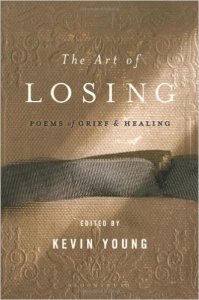
The recommended read for this week is The Art of Losing by Kevin Young. I find this to be an extraordinarily beautiful anthology about grief and recommend it for all those who work with living and dying, clergy of all faiths, hospice workers, physicians and nurses as well as those grieving a lost family member or friend. It was conceived and edited by Kevin Young, a poet in his own right and the editor of four poetry anthologies. His book Jelly Roll: A Blueswas a finalist for both the National Book Award and the Los Angeles Times Book Prize. It won the Paterson Poetry Prize.
By shopping at Amazon through The Word Play Shopor through links in the body of a post, you help to support the maintenance of this site. Thank you!
The WordPlay Shop offers books and other tools especially selected for poets and writers.
she’s present
returned to bite through the umbilical of tradition,
to flick her tongue
and cut loose the animus-god of our parents,
like a panther she roams the earth, she is eve wild in the night,
freeing minds from hard shells
and hearts from the confines of their cages,
she’s entwined in the woodlands of our psyches
and offers her silken locks to the sacred forests of our souls ~
naked but for her righteousness,
she stands in primal light,
in the untrammeled river of dreams
the yin to balance yang
the cup of peace to uncross the swords of war ~
through the eons she’s been waiting for her time
her quiet numinosity hiding in the phenomenal world,
in the cyclical renewal of mother earth,
whispering to us in the silver intuition of grandmother moon
watching us as the loving vigilance of a warming sun ~
she, omen of peace birthed out of the dark,
even as tradition tries to block her return,
her power leaps from the cleavage of time
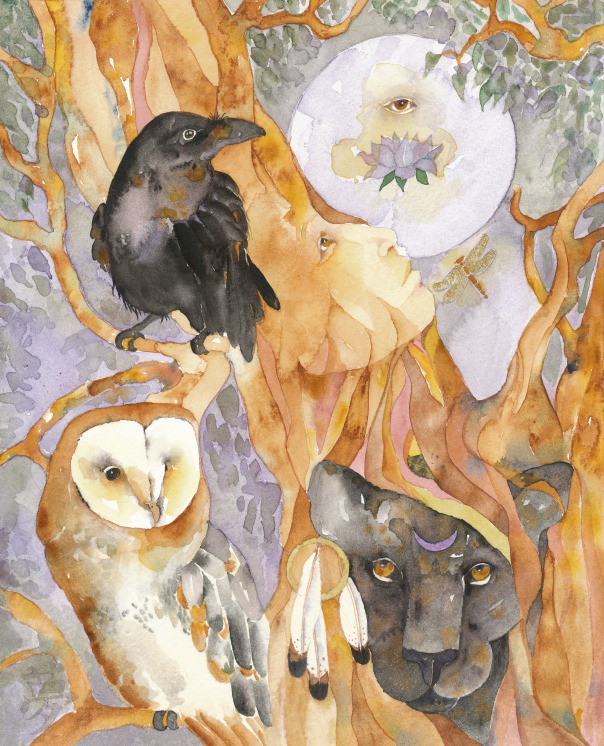
Illustration ~ this lovely watercolor painting by Gretchen Del Rio with its girl-tree, panther and other spirit animals was the perfect inspiration for a poem on the spiritual return of the divine feminine. The real back-story on the painting is just as interesting. Gretchen says, “I painted this for a 14 year old Navaho girl. It is for her protection and her power. She sees auras and is very disturbed by this. She is just amazing. Beauty beyond any words. You can see into the soul of the universe when you look at her eyes. She has no idea. I loved her the moment I saw her. My blessings for her well being are woven into the art.” Such a delightful piece. I purposely posted it full-size so that everyone can enjoy the detail. Bravo, Gretchen, and thank you.
Write a poem, a fiction or a creative nonfiction piece telling us how you envision a feminine God or about the feminine side of God. What might S/he be like? Does/would such a view change the way you feel about yourself and the world? Would it change the world? How? You don’t need to believe in God or in a feminine aspect of God. This is an exercise in imagination not faith. Have fun with the exercise and if you feel comfortable, share the piece or the link to the piece below so that we might all enjoy.
2015, Kevin Young at Library of Congress National Book Festival September 5, 2015 Washington, DC, by fourandsixty, CC BY SA 2.0
The recommended read for this week is The Art of Losing by Kevin Young. I find this to be an extraordinarily beautiful anthology about grief and recommend it for all those who work with living and dying, clergy of all faiths, hospice workers, physicians and nurses as well as those grieving a lost family member or friend. It was conceived and edited by Kevin Young, a poet in his own right and the editor of four poetry anthologies. His book Jelly Roll: A Blueswas a finalist for both the National Book Award and the Los Angeles Times Book Prize. It won the Paterson Poetry Prize.
By shopping at Amazon through The Word Play Shopor through links in the body of a post, you help to support the maintenance of this site. Thank you!
The WordPlay Shop offers books and other tools especially selected for poets and writers.
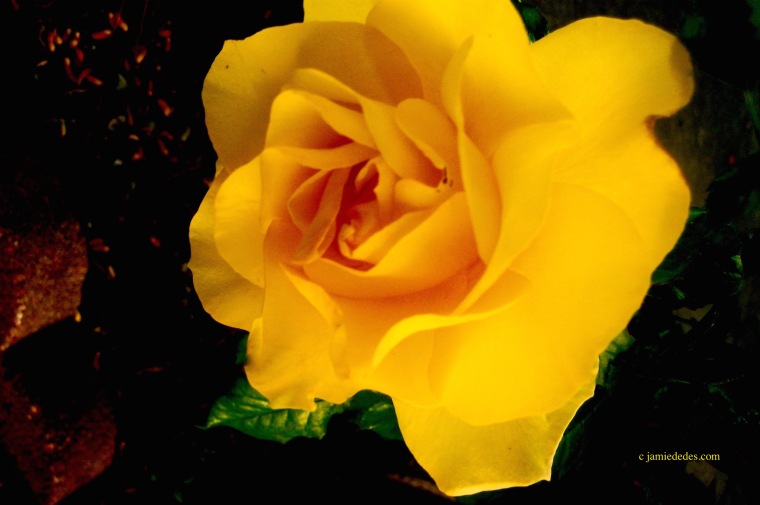
they line the pebbled walkway like so many faithful, meditating
along the El Camino, earnest little faces catching the sunlight
or tossing Gregorian chant into the weather when it rains
their bright colors and blessed incense bare witness to the sacred,
soften the brittle longitudes and aching latitudes of the heart
2015, Kevin Young at Library of Congress National Book Festival September 5, 2015 Washington, DC, by fourandsixty, CC BY SA 2.0
The recommended read for this week is The Art of Losing by Kevin Young. I find this to be an extraordinarily beautiful anthology about grief and recommend it for all those who work with living and dying, clergy of all faiths, hospice workers, physicians and nurses as well as those grieving a lost family member or friend. It was conceived and edited by Kevin Young, a poet in his own right and the editor of four poetry anthologies. His book Jelly Roll: A Blueswas a finalist for both the National Book Award and the Los Angeles Times Book Prize. It won the Paterson Poetry Prize.
By shopping at Amazon through The Word Play Shopor through links in the body of a post, you help to support the maintenance of this site. Thank you!
The WordPlay Shop offers books and other tools especially selected for poets and writers.
our gray skies pass when mango sky comes,
warm with laughter, chanting its gentle way into
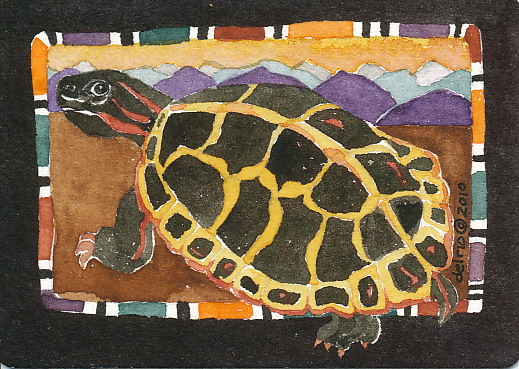
the space where turtle speaks in earthy colors,
speaks in that easy way only turtle can, as one who is
at home in herself, between her plastron and carapace,
wisdom in her slow ballet; her introversion, a model
for living well in this grinding war-spun world . . .
turtle is my totem and we live on our turtle island,
she is the everyday re-enchantment of my solitary
cosmos, my solidarity with life, i read her pastoral
letters in green on green, the sweet grasses and seas,
she speaks of connectedness, the basic constituents
of enigma, wizardry, and the madness of the times
and how best to dance the madness into light, she is
essence, the unrushed cure for wretched nature-deficit,
that consuming affliction, the spawn of modern day’s
backlit screens and relentless marketers of every bilk;
turtle healing is simple peace and master lessons in
self-containment, she draws us into our meditations
and back along the first path of Maka Ina, the lost or
forgotten primal path of the earth ways and feminine
energies and the lunar cycles that whirl us heavenward
Turtle ~ totem or power animal representing earth in Native American tradition
Turtle Island ~ in Iroquois tradition, when the earth was covered over with water, sundry animals attempted to create land by swimming to the bottom of the ocean and hauling up dirt. Muskrat succeeded. He placed the dirt on the back of Turtle, which grew into the landmass known today as North America.
Maka Ina ~ Lakota (Sioux) ~ “maka” is earth and “ina” is mother, so Mother Earth. Earth teachings were/are considered a path to wholeness (heaven) by the First Peoples.
Several years ago I had the rather odd experience of having three shamans, two Native American and one Mexican, tell me out of the blue (I never asked) that my totem is Turtle. I think these good people had a fine sense of intuition and of the sacred and possibly were good observers. It would not be surprising or illogical for anyone to decide that an obvious introvert is a Turtle.
If you’ve never been given a totem animal, imagine one yourself. Write a poem about your personal totem. HERE is a list of Native American totems and their meanings to help you along. Take your time. Enjoy! … and if you feel comfortable, leave the poem or a link to it in the comments section below.
PAUL BROOKS was shop assistant, security guard, postman, admin. assistant, lecturer, poetry performer, with Rats for Love and his work included in Rats for Love: The Book, Bristol Broadsides, 1990. His first chapbook was The Fabulous Invention Of Barnsley, Dearne Community Arts, 1993. He has read his work on BBC Radio Bristol and had a creative writing workshop for sixth formers broadcast on BBC Radio Five Live. Recently published in Clear Poetry, Nixes Mate, Live Nude Poems and others. Forthcoming in the spring 2017 an illustrated chapbook The Spermbot Blues, published by OpPRESS.
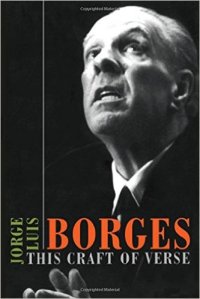
The recommended read for this week is Borges’ The Craft of Verse. (One of my faves.) These are the famed lost lectures given in English at Harvard University (1967/68) by Jorge Luis Borges that were transcribed (c. 2000) and published in 2002.
The WordPlay Shop offers books and other tools especially selected for poets and writers. By making your Amazon purchases through this site, you help support it.
 Those everyday saints
 By shopping at Amazon through The Word Play Shop or through links in the body of a post, you help to support the maintenance of this site. Thank you!

 she’s present


 Jamie Dedes' THE POET BY DAY Webzine