We must not forget that only a very few people are artists in life, that the art of life is the most distinguished and rarest of all the arts. Who ever succeeded in draining the whole cup with grace? So for many people all too much unlived life remains over— sometimes potentialities which they could never have lived with the best of wills, so that they approach the threshold of old age with unsatisfied demands which inevitably turn their glances backwards.” Carl G. Jung
Through the past several weeks, I have once-again turned my glances backward over the practical space-saving necessity of shedding and shredding some more of the notebooks and files of one small lifetime. I found that quote of Jung’s written on note almost as if from my younger self to my older self. After some forty or so years, I no longer remember from which of his works it was clipped and I left myself no hint. In those days I always trusted my memory as reliable, something I can no longer do. I’m guessing the quote might have been from his Stages of Life.
The art of life is surely the superior art, but without art – whatever ours is by interest, vocation or avocation – poetry and literature, music, theater, painting or photography – much more of our lives might be “too much unlived” and the glass drained without the hope of any grace. It is our art or arts that help us to savor beauty and to understand – or at the very least sooth – pain and double joy.
Jung said further that “The creative mind plays with the objects it loves.” We come to a specific art as a lover attracted to what appeals most: words, sound, story, vision. Through these gifts of the spirit our lives are enriched and we practice the art of living hugely.
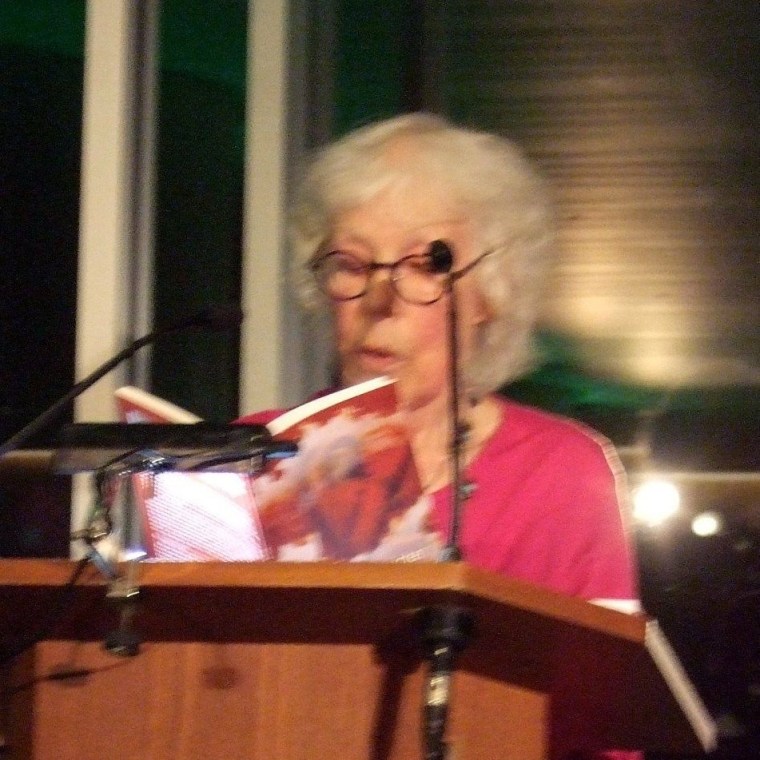
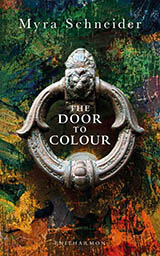
When I learned that Myra would be celebrating her 80th birthday this June, I figured I’d better grab her for an interview before anyone else pounces. Having said that, I don’t think I was the first in line. Who wouldn’t want to gather and savor the voice of so much experience: eleven collections of poetry, children’s books, author of Writing My Way Through Cancer and, with John Killick, Writing Yourself: Transforming Personal Material. Myra has collaborated on more anthologies than I can count, is a poetry coach and champion of women poets, a consultant to Second Light Network of Women Poets and a poetry editor. Myra’s professional life seems like it is and always has been quite full and busy. Yet along the way – even when coping with catastrophic illness – Myra is able to take a breath and pen …
Today there is time
to contemplate the way life
opens, claims, parts, savour
its remembered rosemaries,
spreading purples, tight
white edges of hope, to travel
the meanings of repair, tug
words that open parachutes.
excerpt from Today There Is Time in Writing My Way Through Cancer
JAMIE: I know your interest in poetry started quite early in life. As you look back through the lens of long life, how have your preferences, interests and style of poetry changed and why?
MYRA: By the time I’d finished at university at the beginning of the 1960s I was steeped in poetry of the past. As well as Shakespeare and Chaucer I loved Anglo-Saxon poetry, John Donne, Wordsworth and the other Romantic poets, also Gerard Manley-Hopkins. I expected poetry to be intense, spiritual and often about the natural world. My knowledge of twentieth century poetry was limited mainly to T S Eliot, some poems by Ted Hughes, Sylvia Plath and the war poets, all of whom I was excited by. However, the poetry scene in London, where I lived and still do, was pretentious at that time and male-dominated. I was soon put off poetry and for several years I read and wrote very little. When I came back to it I gradually began to read much more widely: contemporary British poets such as Seamus Heaney, Gillian Clarke, Anne Cluysenaar, Mimi Khalvati and John Burnside, and poets from further afield such as Derek Walcott and Les Murray. I also read American poets as varied as Elizabeth Bishop, Mark Doty, Louise Gluck and Philip Levine. I particularly like the expansiveness I have found in American poetry. Intensity and spirituality and the natural world are still central to me but my view of what they include has greatly widened which has influenced my own writing. This, over time, has become much more honed and also more varied in style and subject matter.
JAMIE: Has your way of organizing yourself changed overtime; for example, the times that you write, when you do revisions and so forth?
MYRA: When I started writing I did not think much about the writing process. I tended to write down whatever came into my head for poem and then draft it letting it take whatever shape it seemed to fall into. Very occasionally I wrote a rhyming poem in regular verses. Later, I thought much harder about form and also in the 1990s I started to keep a notebook in which I jotted down words, ideas and details for poems. Around this time I discovered the poem worked much better if I spent a longer time working on the material and trying out the form it might go into before I started drafting unless, which happened rarely, a poem suggested itself and its shape very clearly. I found out too that allowing raw material to incubate either for a day or two or much longer frequently helped me to see what to do with it. Now I often work on more than one poem at a time – one that’s in its late stage and needing revision and one at an early stage. My main writing time has always been in the morning but I sometimes work on poems later in the day or on a train journey. In addition a certain amount of ‘writing’ goes on in my head and this could be at any time of the day or night – I might see how to cope with a problematic line or an idea for a new poem might start germinating.
JAMIE:What – if anything – has changed in terms of inspiration for poetry?
MYRA: When I started to write I had a very strong need to explore personal material – my childhood and my difficult relationships with my parents. Beyond that my poems were mainly triggered by my immediate reactions to the natural world and my teaching experience of severely disabled adults. A much greater range of subjects inspires me to write now. These include the role of women which I have explored in a number of ways, also issues like the environment, violence and the refugee problem. I feel a need too to write longer narrative poems which explore relationships and usually an issue or a theme in depth. For several years now many of my short poems have been set off by something apparently small: making tea in my yellow teapot, a painting or a small occurrence such as watching an old man running in long grass. The poem then follows a line of shifting thought aroused by the object or occurrence and takes in more than one subject. I firmly believe the most everyday material can connect with serious subject matter. My poem In theBeginning, which follows a line of thought about the big bang theory, starts and ends with a cat bowl.
JAMIE:What suggestions would you make to someone just beginning to write poetry?
MYRA: The first thing I would mention is the importance of reading a wide range of contemporary poets and I would also advise the reading of some key poets from the past. Poetry is a craft as well as an art and it’s crucial to discover how poets use different techniques and to learn as much as possible from outstanding poets about how they write. Elizabeth Bishop is a very good person to study as she uses both strict and free forms brilliantly and also tackles her subject matter in a variety of ways. There is an invaluable book, How to Read a Poem by Edward Hirsch, which looks in depth at how to read a poem and it includes a useful glossary which explains poetic terms. Quite soon after starting to write I would advise learning about the full range of poetic forms. This can be done either in a class or from a book, preferably one that’s been recommended. If at all possible I also suggest joining a poetry class or workshop which offers rigorous but supportive feedback.
JAMIE:And finally, what is the job of the poet, what is the place of poetry in our lives and in the greater world?
MYRA: I believe the role of the poet is to reflect on human experience and the world we live in and to articulate it for oneself and others. Many people who suffer a loss or go through a trauma feel a need for poetry to give voice to their grief and to support them through a difficult time. When an atrocity is committed poems are a potent way of expressing shock and anger, also of bearing witness. I think that the poet can write forcefully, using a different approach from a journalist, about subjects such as climate change, violence, abuse and mental illness and that this is meaningful to others. I very much believe too that poetry is a way of celebrating life. I think it deserves a central place in our world.
This slideshow requires JavaScript.
IN THE BEGINNING
Wheatflakes in a chestnut-brown bowl, thinking
slowed down by sleep: the morning is the same
as any other. But no repeat is exact –
the cloud cover is thicker/thinner, skin
a day more creased, closer to dust.
And this morning is marked by tufts of sparrow
on the floor: the machine that laced a small body
with blood has been stopped. The postman’s late.
Headlines exclaim from the paper. When I put on
the right glasses I discover today is momentous.
Scientists have proved the big bang they believe
set off the universe. Trying to follow, I soon
flounder among technical terms, am rescued
by the tulips standing on the breadcrumbed counter.
Their parrot scarlet sings and sings in my head.
If I’m to get a grip on time and space
I must widen my field of vision. Outside,
car tyres hiss. As drivers slow
at the roundabout they’ll read: ‘Jesus is alive’,
chalked in pigeon-dropping white on a support
of the railway bridge. I question this slogan
as I swoop underneath in my crimson Mini estate…
If I’m to understand I must study sciences
for decades, and focus on a past before bridges
arched, before Jesus walked on water,
before ape men squatted in caves,
before dinosauars lumbered,
before leaves fleshed steaming forests,
before rocks hardened,
before the Earth was flung into orbit round the Sun,
before the birth of galaxies now burnt out,
before matter scattered.
Warm fingers black with newsprint, I tremble
at the dark and shapelessness before the beginning,
the mystery of something grown out of nothing,
the changes that led to the kickstart moment
when space ballooned and time began.
Today has shrunk too small to tackle but from habit
I pour Go Cat for the murderer. A petal
falls. The post flaps onto the mat. I pick up
your letter, and suddenly nothing in the universe
is more important than reading your words.
This past Saturday (January 16), in the North Central Neighborhood of San Mateo, the children in the county school system gathered at the Martin Luther King, Jr. Community Center to listen and support the poets, essayists, and artists who participated in this year’s (the 31st annual) event. Afterward, everyone was invited to gather at UUSM, to celebrate the children and to honor Martin Luther King, Jr. and his legacy with activities, music and buffet.
In most communities across the country, the practice of inviting school-age children to ponder King’s legacy and its impact on the American culture and society is fast becoming a standard practice and tradition. This year’s MLK contest topic encourages an exploration of other leaders who were influenced by King’s message of hope, unity, enfranchisement, and peace. It is right that the “next” generation engage in the continuance of King’s impact because we live in a time when those ideas are daily challenged by continued despair, disparity, and violence. We can yet ask, “Where do we go from here?”
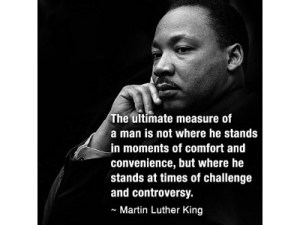
As we celebrate Martin Luther King, Jr.’s birth today, let this be a time when, along with paying our respects to the memory of King’s life and his historic legacy, we raise our consciences from our “moments of comfort and convenience” and ask ourselves in ways never before, “Where are we standing among the current challenges and controversies that yet plague our communities, thwarting our dreams of equality and shredding the network of mutuality of which Dr. King spoke so eloquently?” It is time to know where, or even if, we stand for justice and equity and peace.
If we do not like the answer to our inquiry, let us have the courage and the audacity to move ourselves from our comfort and complacency to a place more inconveniently situated, and stand tall.




 by Rev. Ben Meyers,
 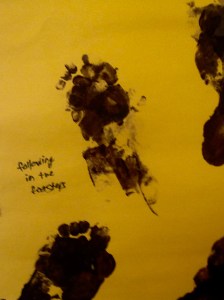 As we celebrate Martin Luther King, Jr.’s birth today, let this be a time when, along with paying our respects to the memory of King’s life and his historic legacy, we raise our consciences from our “moments of comfort and convenience” and ask ourselves in ways never before, “Where are we standing among the current challenges and controversies that yet plague our communities, thwarting our dreams of equality and shredding the network of mutuality of which Dr. King spoke so eloquently?” It is time to know where, or even if, we stand for justice and equity and peace.
 Jamie Dedes' THE POET BY DAY Webzine