Page 3 of 4

WRITING YOUR SELF, Transforming Personal Material with John Killick & Myra Schneider
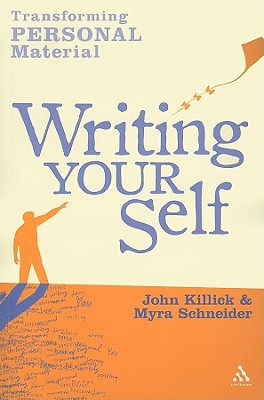
9781847062529_l

“We wrote the book because we believe that personal writing is very potent both for the writer and the reader, because some of the greatest literature is rooted in personal material.” Myra Schneider in an interview with Jamie Dedes

It always seems to me that writing  about life – “personal material” –  is a healing activity, a way to live hugely, and a way to empower ourselves and others. Whether we do it for ourselves alone or whether our purpose is to leave history behind for family, to set the record straight, or simply to share and entertain, the experience is rewarding.

Writing Your Self is a comprehensive book organized into two parts:

  • Part I: Here the focus is on life experiences, the exploration of those human experiences that are universal. These include childhood, self-concepts, relationships, displacement, physical and mental illness and disability, and abuse.
  • Part II: Here the focus is on writing techniques, recognizing material that is unfinished, working on refinements, and developing work projects.

Writing Your Self is rich with examples from unknown (students) and known writers including the authors. By example as well as explanation the authors reinforce what we intuitively understand to be true: that telling stories preserves identity and clarifies the human condition. It helps us understand what it means to be human. The experience of working through the book is rather like a rite of passage.

I can see the use of this book by individuals training themselves and by teachers of adult learners who wish to write memoir, poetry, fiction, or creative non-fiction. It would be useful in hospital therapeutic writing programs or in writing programs for active seniors.

Memories, both recent and distant, tell us who we are and so play a crucial role in our experience of life…

You may have memories which you want to plunge into or you may have material like a diary or letters which summon them up. There are other ways though of triggering memories. We offer a series of suggestions. Chapter 13, Accessing memories, secret letters, monologues and dialogues, visualizations.

Chapter 13 alone is worth the price of admission. I work a lot off of childhood memories and even the event that happened two minutes ago comes back to me with a dreamlike quality when I sit to write. I have not thought of the things I do naturally as triggers, but indeed they are. It was quite interesting to see these natural aids laid-out in the book: objects and place as starting points, physical sensation as triggers, people in memory and predominant feelings. The section on secret letters – that is, letters that you write someone and never send – was interesting. I’m sure it would make a fine jumping-off point for some. The authors go on to monologues and dialogues and visualization. We all do those things in our heads anyway. If you can see it or hear it in your mind, you can write it.

If you are inexperienced or stuck midway in a transition from one form of writing to another, you’ll benefit from the exercises, ideas, and instruction in Writing Your Self: Transforming Personal Experience. If you are a more experienced writer, you might find this book will stimulate the muse. This text is a definite thumbs-up.

13550802017232

Myra Schneider  is a British poet, a poetry and writing tutor, and author of the acclaimed book: Writing My Way Through Cancer.

John Killick was a teacher for 30 years, in further, adult and prison education. He has written all his life. John Killick’s work includes both prose works and poetry. 

MAXINE HONG KINGSTON, “Joy and beauty and delight!” … I Love a Broad Margin to My Life

Maxine Hong Kingston (b. 1940), Chinese-American atuhor, educator and activist
Maxine Hong Kingston (b. 1940), Chinese-American author, story-teller, poet, educator and activist

“Keep this day. Save this moment;
Save each scrap of moment; write it down.
Save this moment. And this one. And this.”  

Randolph College announced last month that Maxine Hong Kingston would be the sixth recipient of the college’s Pearl S. Buck Award. The ceremony will be held on April 20.

Pearl Buck and Ms. Kingston share the distinction of shining a light on Chinese culture. For Pearl Buck it was the Chinese people in their homeland and for Maxine Hong Kingston it is Chinese-Americans. Both are known for their activism and for their memoirs and fictions, Pearl Buck more for the later than the former I think.

What these women also have in common is poetry. Pearl Buck’s slender collection, Words of Love (John Day, Co., 1974), was published posthumously. Ms. Kingston’s I Love a Broad Margin to My Life (Alfred A. Knopf, 2011) was the fruit of coming to terms with turning sixty-five.

As part of the two-week-long celebrations of my own birthday (61st) in 2011, the CitySon Philosopher took me to dinner one night at Cafe Barrone in Menlo Park, California. Afterward we went next door to Kepler’s Books – a favorite among family and friends, the local independent –  to hear Maxine Hong Kingston talk about what was then her new book. She is a “neighbor,” living only a few miles away in Stanford.

“Story gives form and pleasure to the chaos that’s life. By the end of the story, we have found understanding, meaning, revelation, resolution, reconciliations.” 

The book is a memoir in free verse, a long poem in effect like the old-country tradition of writing a poem on a scroll. Flowing.

“Am I pretty at 65?
What does old look like?”

Ms. Kingston immediately addressed the  issues of aging, both in her presentation and in the book itself. She talked about being superstitious and thinking that as long as she has things to write “I keep living…” She told of the origins of the title: Thoreau. It’s a line from Walden that, she says, also hangs framed over her desk.

She explained the Chinese custom of “writing poems back” and told of her dad who would write poems to her in the margins of her books. She was at that time translating these for publication, though that was never her dad’s intention. Or so I would infer. She encouraged us to write our own poems in the margins of her book.

Ms. Kingston stood in front of us, like a fragile little bird, reading excerpts from the book, delightful to hear in her voice. She is ten years older than me but we’ve lived through the same events and movements: civil rights, women’s rights, Vietnam, Iraq … and so on. She too is the child of immigrants. She sounds like a Buddhist, has the Buddhist sensibility: respect for life, for silence, for present moment.

When Ms. Kingston finished her presentation and Q & A, my son excused himself and kindly went to buy two copies for us. We stood in line with other guests, waiting for Ms. Kingston to sign our books. Every moment spent attending to writers of good conscience, talking about books and writing, is precious…even more this one, because I was with my son and the writer happened to be one with whom I share values, gender, and the context of time. She also is a mother with one child, a son.

Finally it was our turn: Ms. Kingston sat tiny and cheerful with pen in hand. She greeted us just as cordially as she had each reader throughout the long night. She wrote my name in bold sprawling black letters followed by “Joy and beauty and delight” and then signed her full name with “Hong” in hanzi (Chinese characters).

I wrote in my journal that night that “as long as we have cherished children, valued friends, conscientious authors and quality books, we have everything. Life is indeed joy and beauty and delight.”

As far as the book goes: The charm of I Love a Broad Margin to My Life is its gentle meandering. It made me think of the way books meandered before the modern preference for brevity and before computers and word processing and the ease technology brings to rewrites, cuts, and tight line-by-line editing … and perhaps needless to say, before life was so tightly packed with activity, rush and noise.

In her promising opening, Ms. Kingston is bemused in her self-awareness as she examines questions of aging, appearance, and vanity. As the book moves on, she blends nonfiction with fiction, a few references and viewpoints from characters that people her novels.

This long poetic memoir is a backward look at a time some might enjoy revisiting and others might want to learn about through the memory of one who was there. One of its strengths is the contemplation of life by a dedicated activist whose creative work helps the reader understand. I enjoyed the book, got value out of it; but I did feel rather like Ms. Kingston was putting on the unaccustomed robes of a poet and didn’t feel quite at home with this form.  Unlike other poetry books on my shelves, I suspect I’ll never pull it out for another read.

© 2016, essay and photograph of Ms. Kingston at Kepler’s Books on February 22, 2011, Jamie Dedes;  All rights reserved

the gentleman of the bocce court, a poem

IMG_3537
that other time and other place are history –
and so too the gentleman of the bocce court

i am seven, this is part of my world

the men play bocce of an afternoon
while the women sip vin santo
and savor the nutty taste of a
biscotto before a nap, then time
to start dinner, set the table

my friend’s grandfather, Pop-Pop,
the yellow man, i think of him,
jaundiced skin, yellow teeth,
fingers stained with nicotine  . . .
he’s the neighborhood champ

and heat rising from the ground,
the grass growing as fulvous as
Pop-Pop, he throws the pallino –
it’s like summer always is here
heat, sweat, and bocce ball …

the one they call il Signore taunts,
mean and rude, he swears at Pop-Pop –
no matter, we know who is best,
better than anyone; yet little girls
say nothing, steering clear of
il Signore, a.k.a. Frankie Fists

© Jamie Dedes, All rights reserved


You Left to Pirouette on the Moon

800px-Pointe_shoe_ribbonsyou left one winter day to balancé on sunbeams
and pirouette on the moon, artfully swirling
lunar dust and scattering it over our dreams,
sparking our lives with your memory, your love
a legacy of dance for tiny ballerinas

…………see us now . . . 
as well-worn as your old toe shoes

© 2015, poem, Jamie Dedes, All rights reserved; Photo credit ~ pointe shoes by Lambtron via Wikipedia under Creative Commons Attribution-Share Alike 3.0 Unported license