“A woman in Brooklyn decided to prepare her will. She told her rabbi she had two final requests. First, she wanted to be cremated. Second, she wanted her ashes scattered over the local shopping mall.
‘Why the shopping mall?’ asked the rabbi.
‘Then I’ll be sure my daughters will visit me twice a week.’
Note: This is the first in a three-part series celebrating Mothers’ Day, which is this Sunday. All the pieces were published some time ago – here and/or elsewhere and it just feels right to publish again this year. I hope you’ll enjoy this short series … And ♥ Happy Mothers’ Day to all the mothers and to all the dads, aunts, uncles, grandparents and older siblings who are covering for moms who are gone.♥
I met my Jewish friend, Laurel, when she came to a meeting at our local Insight Meditation Center on the San Francisco Peninsula where we now live. Laurel and I got on right away. We both like Broadway shows, opera, reading, writing, and good meals seasoned with great conversation. We’re both from New York and we’re about the same age. So we come from the same time and the same place.
Now New York moms get a bad rap, especially Jewish moms – but none of us gets off free. Laurel reminded me of that with a stereotypical New York joke at the expense of mothers. These jokes usually illustrate moms making caustic remarks or tell of their attempts to foster guilt in adult children. While we do use regional idioms and have a distinct style of delivery, I’m really not sure that mothers from our time and place had the corner on either caustic commentary or the laying on of guilt.
Like all of us, my mother was very much in process and very much a product of her place and time. Among other things, what that means is that modesty was a primary concern. For my Catholic mother this included modest dress, which in turn included girdles. Now I’ve got to tell you that until I hit forty I was mostly underweight. In fact at Christmas when I was nineteen, I was ninety-three pounds, stood 5′ 3 1/2″, and was three months pregnant with my son. Nonetheless, from seventh grade and until her death when I was forty-four, my mother was adamant that I should wear a girdle so that I wouldn’t “jiggle.” That would be immodest and unseemly. Only my mother, I would think, would put me through this torture for nothing. As my husband said, “What’s to jiggle? If she turned sideways and stuck out her tongue she’d look like a zipper.”
Those old, typically New York jokes at the expense of our mothers were funny because there’s an element of truth in them. They did pave the pathways to their homes and hearts with guilt. They could be cruelly caustic. Often, their fall-back position was stone-cold silence. They were as tough as life. They tended to be rigid and narrow on some subjects; their lives woefully circumscribed. Often they were unworldly and painfully unread. But they were also largely present.
They were idealistic. They worked hard, often at jobs as well as at home. Many of them worked for hours each week to make the most unbelievably complex old world dinners for traditional Sundays that included religious services and family gatherings. No matter how difficult things got, they did not resort to drugs or alcohol. They got us into the best schools they could afford and kept us in school for as long as they could afford to do so. They protected us from young men who did not have “honorable” intentions. Though they’d never admit to us that they were really pleased with us, they would proudly show photographs of us to all their friends and boast of our accomplishments.
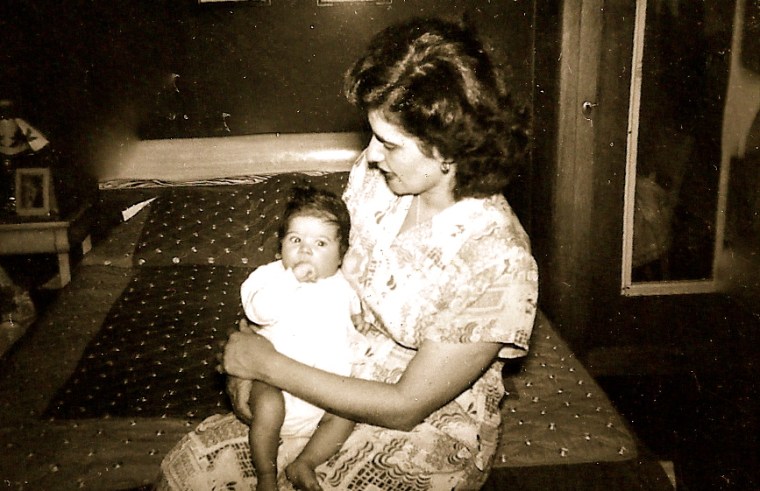
In the parlance of the sixties, it took me years to understand where they were “coming from.” You can tell by the posture in the photo that ends this post, that well into my thirties, I was still struggling with mixed feelings. The reason in this particular case: Before I left for work, I left money on the kitchen table for a pizza. I called home at 5:00 p.m. as I was leaving the office and asked Mom if she’d order the pizza right away because I was “starving.” I got home and “binged”: I ate one slice of pizza and left the crust. “I thought you were hungry,” Mom said. “I was. Now I’m stuffed.” The fact that I was in my thirties and still “eating like a bird” and underweight disturbed her. In turn, I was disturbed because she was still trying to tell me how to eat, which given my habits was a legitimate concern. I do the same sorts of things to my son now, not about food, but about other things. Mom’s long gone now, but often I think of her and wish she was here nagging me to clean my plate.
Poet and writer, I am a former columnist and associate editor of a regional employment publication. Currently, I run this site, The Poet by Day, an information hub for poets and writers. I am the managing editor of The BeZine published by The Bardo Group Beguines (originally The Bardo Group), a virtual arts collective I founded. I am a weekly contributor to Beguine Again, a site showcasing spiritual writers. My work is featured in a variety of publications and on sites, including: Levure littéraure, Ramingo’s Porch, Vita Brevis Literature,Compass Rose, Connotation Press, The Bar None Group, Salamander Cove, Second Light, I Am Not a Silent Poet, Meta / Phor(e) /Play, and California Woman. My poetry was recently read byNorthern California actor Richard Lingua for Poetry Woodshed, Belfast Community Radio. I was featured in a lengthy interview on the Creative Nexus Radio Show where I was dubbed “Poetry Champion.”
“What if our religion was each other. If our practice was our life. If prayer, our words. What if the temple was the Earth. If forests were our church. If holy water–the rivers, lakes, and ocean. What if meditation was our relationships. If the teacher was life. If wisdom was self-knowledge. If love was the center of our being.” Ganga White, teacher and exponent of Yoga and founder of White Lotus, a Yoga center and retreat house in Santa Barbara, CA
“Every pair of eyes facing you has probably experienced something you could not endure.” Lucille Clifton
Thank you for sharing your love of words. Comments will appear after moderation.
my mother never knew the names for things
the trees were just trees, the flowers just flowers,
she knew life as a sigh and aspiration as a linchpin,
she could get to work and maneuver in the dark,
she could squeeze a penny too
and force tired feet into worn shoes
the fields that year taught the art of sleeping outside,
sleeping without walls, watching the stars and moon,
our dreams spun from sunsets and morning dew ~
we slept in bedrolls configured from old white sheets and
the khaki wool blankets my uncles took to war, i wondered
about my uncles as i did about many people, many things
and that summer held varied delights, climbing trees,
eating cherries without washing them . . . oh! ~
and there were blueberry bushes and fig trees and
i lined the path to the food hut with odd sunday stones
i said my own prayers while the big girls were at Mass
and marveled at my middle-aged mother’s plump knees
i marked her spirit for wearing bermudas, for joining
children’s games, sitting ’round fires, making ‘smores ~
now I wonder at summer camp morphing into metaphor,
all our lives we did those things: gathering dreams,
mom and me, outsider artists sleeping without walls
they dwelt in houses of silence
chewed through grudging fences
swam in oceans of best intentions
tried to find one another on the
shores of their fears and confusions,
alienation was their warrior shield, silence, the mom’s default position
their lives were lived in a boxing ring
the fist in the glove was a malignancy
and the mom passed her days sparring,
she thought the winner would be the
woman who was pretty and hushed
even when she got knocked out, she
wearied the charity of her own mother
she became embittered in isolation,
there was no one else she could
beat upon or say her grief to or even
show her bruises and lacerations ~
except for that small child of silence,
useless in matters of this magnitude
mom stressed
as she sat
with her 10-key
urgently
conscientiously
feeding it numbers
for a business
in Redhook
a commercial building
in old red brick
her calculations spun
Monday through Friday
dripping white paper
in ribbons
pooling on the floor
with all her adds
all her minuses
she accounted
in gray led
on lined green paper
A/R and A/P
payroll
chart of accounts
bank reconciliations
consolidated financials
transactions
neatly ticked and tied
to ledgers and subledgers
hand formulated
amounting to
zilch
zip
squat
zero
nothing
gone
forgotten
except
for the echo of her sighs
“All you need is a sense that there is no such thing as ‘no’ and everything is possible.” Moira Kelly
This shining face, this sweet spirit with reason to be bitter and yet he is not. He is a hero and pure inspiration. When Naomi Baltuck (Writing Between the Lines/Life from a Writer’s POV) posted this video on Facebook, I was as touched as anyone would be. I had to wonder though about his mom. What kind of hero is she, I thought, remembering the heroes of my childhood: Josephine Baker and my spiritual mother, Pearl Buck. Each of these women grew their families in unique – and extraordinarily unselfish – ways.
“All my life, I have maintained that the people of the world can learn to live together in peace if they are not brought up in prejudice.” Josephine Baker (1906-1975)
Josephine Baker was born in America but became a French citizen. She was a dancer, singer, actress and civil-rights activist. As a child living in St. Louis, Missouri, she suffered from discrimination, abandonment, and poverty. As an adult she had one miscarriage. She adopted twelve children, two girls and ten boys. They were from diverse races and cultures because, in addition to caring for them, she wanted to show that people can get along despite their different backgrounds. In the early ’80s two of her sons went into business together. They started Chez Josephine, which is on Theatre Row (42nd Street) in Manhattan. They dedicated the restaurant to their adoptive mom’s memory and decorated it with her memorabilia.
“. . . the test of a civilization is the way that it cares for its helpless members.”Pearl Buck (1892-1973)
Pearl Buck was an American novelist, writer, humanitarian and the first woman to be awarded the Noble Prize in Literature (1938). She grew up in China and spent most of her life there until 1934. She had a deep affection for and knowledge of the countries of the East, not just China. She suffered through the Nanking Incident when the National Revolutionary Army captured Nanking (now Nanjing) in 1927. Many Westerners were killed, their homes destroyed, and their property stolen. Her only biological child, Carol, had phenylketonuria (PKU), which causes mental retardation and seizures. Pearl Buck adopted seven children. At a time when mixed-race children were considered unadoptable, Pearl Buck founded Welcome House, Inc., the first international, interracial adoption agency. At the time of this writing, Welcome House has placed some five thousand children since it was established 1949.
“The greatest act of kindness changes generations. Wherever there is the greatest evil, the greatest good can be achieved.” Moira Kelly (b. 1964)
This brings us to a contemporary hero: the mother of Emanuel Kelly, the young man in the video. Moira Kelly is an Australian humanitarian whose work has garnered her many awards and acknowledgements. When she was eight years old, after seeing a movie about then Blessed (now saint) Teresa of Calcutta (now Kolkata), Moira committed herself to working with disadvantaged children. She is the legal guardian of twins from Bangladesh, Trisha and Krishna. They are surgically separated but originally cranially conjoined twins. Moira Kelly also adopted the Iraqi-born Emmanuel and his brother Ahmet, both born with underdeveloped limbs. Among her efforts is Children First Foundation, formed to provide transportation and healthcare for children with urgent needs in developing countries.
These women are mothers in the best senses of that word. Their ideals are real and they stand by them. They have saved children from abandonment and loneliness, from poverty and hopelessness and from early death. They are goddess mothers and true heroes.
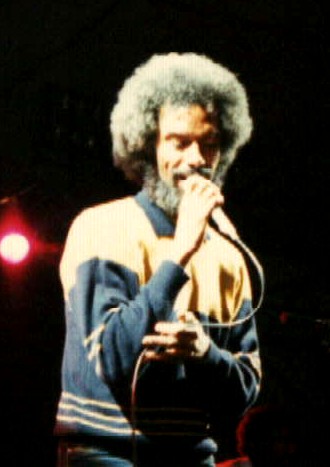
Gill Scott-Heron (1949-2011), American jazz poet, spoken-word poet, musician and author
“All I really want to say Is that the problems come and go But the sunshine seems to stay . . . “
My son sent me On Coming from a Broken Home (an excerpt from the album,I’m New Here) for Mother’s Day in 2011. Since then I publish some version of this piece every two years. I think Gil Scott-Heron’s message here is important.
Gil Scott-Herondied around this time in 2011. He’d started out fiery and angry. Some will remember his forceful The Revolution Will Be Televised and other such works. He was always an artist of political integrity. It showed in actions such as refusing to perform in Tel Aviv because “we do not like wars.” Over time his style mellowed, but his ideals remained.
Gil Scott-Heron is considered by many to be the grandfather of rap and the father of political rap. Famously, he didn’t accept those titles; he was critical of young rappers, felt they needed to study more, to promote change and not perpetuate the status-quo. He is quoted in ChickenBones: A Journal as saying …
“They need to study music. I played in several bands before I began my career as a poet. There’s a big difference between putting words over some music, and blending those same words into the music. There’s not a lot of humor. They use a lot of slang and colloquialisms, and you don’t really see inside the person. Instead, you just get a lot of posturing.”
In the poem shared today it’s interesting to see what Heron does with his personal experience. I like that there’s nothing of the victim mentality in this piece. I like the way he talks of dealing with life as it is. I appreciate that he points out that single-parent homes are not always the result of abandonment but are often made so due to parents who were lost in war or in jobs as police officers, firefighters or pilots.
“They lost their lives, but not what their lives stood for.”
On Coming From a Broken Home (video below, escerpt fromI‘m New Here) is a good example of how art can explain, validate and give us new perspectives … perhaps even encourage us to talk with one another. The piece is from Gil Scott-Heron’s last studio album, I’m New Here.It came out in 2010 not long before he died.
As always if you are viewing this post from an email, you will have to click on the link to this site to see and hear the piece.
Header photograph/Heron at the WOMARD festival in Bristol England, 1988 by Robman94 under CC BY SA 2.0 license.
Thank you for sharing your love of words. Comments will appear after moderation.

 Poet and writer, I am a former columnist and associate editor of a regional employment publication. Currently, I run this site, The Poet by Day, an information hub for poets and writers. I am the managing editor of The BeZine published by The Bardo Group Beguines (originally The Bardo Group), a virtual arts collective I founded. I am a weekly contributor to Beguine Again, a site showcasing spiritual writers. My work is featured in a variety of publications and on sites, including: Levure littéraure, Ramingo’s Porch, Vita Brevis Literature,Compass Rose, Connotation Press, The Bar None Group, Salamander Cove, Second Light, I Am Not a Silent Poet, Meta / Phor(e) /Play, and California Woman. My poetry was recently read by Northern California actor Richard Lingua for Poetry Woodshed, Belfast Community Radio. I was featured in a lengthy interview on the Creative Nexus Radio Show where I was dubbed “Poetry Champion.”








 Jamie Dedes' THE POET BY DAY Webzine