Thanks to many of you who read here, the December issue of “The BeZine” with its special section “Waging Peace” went moderately viral with more visits and more shares through the whole diversity of social media than ever before. It did our hearts good. It was healing to see just how many people supported the ideas and ideals expressed in this special section. For those of you who missed “Waging Peace,” do your own heart good and check it out . . .
Keeping it Kind. I am so very proud of the Unitarian Universalistist Clergy of the San Francisco Bay Area for their open hearts and their OPEN LETTER in support of the MUSLIM COMMUNITY. It was read at the MultiFaith Prayer service at the Yasmeen (Islamic) Cultural Center in Burlingame, California on Sunday, December 13, 2015.
December 13, 2015 An Open Letter
Dear People,
We are writing to call attention to a great injustice and to ask your help in addressing it.
Not that many years ago Catholics were seen as some “other” who could not be good Americans. More recently Jews suffered many insults and abuses because they did not belong to the dominant faith – again, seen as “other”. Good people rallied to stand with them and, over time, they have become so integrated into the fabric of our country that it is now unimaginable without them.
Today we are seeing the same sort of prejudice and, on occasion, dreadful acts of violence directed at Muslims. They are our contemporary “other”. These are our neighbors, co-workers, and our friends. They serve in every branch of our American military. They are our doctors, lawyers, police officers, nurses, teachers and social workers. They are us.
Because of the actions of a very few, some current American politicians and others are sparking fear and hatred against the entire Muslim faith community.
In response, people of good-will and conscience must stand up and speak out. Many already have. Some, clinging to the haunting words of Pastor Martin Niemoeller, are asking “who will stand with them?” It is time to answer that question. We will. We, the Unitarian Universalist clergy of the San Francisco Bay/Peninsula, stand with the Muslim community.
We urge you to do so as well. Please take a stand and say your peace.
With faith in love beyond all beliefs,
The Reverend JD Benson, San Francisco
The Reverend John Buehrens, San Francisco
The Reverend Stefanie Etzbach-Dale, Redwood City
The Reverend Pamela Gehrke, San Mateo
The Reverend Elaine Gehrmann, Monterrey
The Reverend Axel Gehrmann, Monterrey
The Reverend Alyson Jacks, San Francisco
The Reverend Nancy Palmer Jones, San Jose
The Reverend Nina Kalmoutis, Sunnyvale
The Reverend Russ Menk, Aptos
The Reverend Ben Meyers, San Mateo
The Reverend Vail Weller, San Mateo
The Reverend Amy Zucker-Morgenstern, Palo Alto
Note: Please feel free to share this letter through WordPress’ “reblog” feature or by cutting and pasting. If you’d like me to the post in HTML to make it easier, please let me know. J.D.
Thank you for sharing your love of words. Comments will appear after moderation.
Dan and me as kids and probably the last time he was shorter than I am. He stands 6’5″ and I am 5’2″.
With all its faults – and there are many – Facebook can be a blessing. I haven’t seen my cousin Dan in almost forty years. I lost track of him, but was much delighted to find him again on Facebook last March.
Dan and I were raised in the United States, but our family was from Lebanon. Our mothers were sisters. Our religious roots are Melchite (our grandfather’s side) and Maronite (our grandmother’s side).
My mother, Zabaida, used to tell me that in Lebanon first cousins were like brothers and sisters. Among other things this was one way she tried to understand what people meant when they talked or wrote about Jesus having brothers. I understood it as my relationship to my cousins, especially cousins Daniel and Christopher, who were brothers (Christopher died prematurely) and my most beloved relatives. Though we haven’t seen one another in forever and we’ve walked different paths in life, I suspect our basic values remain the same: peace, love (respect) for others and for life, and appreciation of life’s gifts. Dan has worked in many places around the world, including Algeria and Dubai. Currently he teaches Theology in the Philippines. This essay is Dan’s.
*****
What Have We Done That People Can Pick Up Weapons and Kill?
by
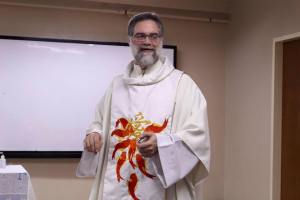
Fr. Daniel S. Sormani, C.S. Sp.
DANIEL S. SORMANI C.S. Sp.
It was one of those things you think but don’t want to say. In the horror of the carnage in Paris and the world’s reaction, it struck me how very little had been said about the terrorist attack in Beirut the day before…or the attack on a funeral in Baghdad…or so much of the other violence that shakes the world. And I felt like I couldn’t say it for fear of looking like I was somehow diminishing the horror or pain of Paris, afraid it could been seen as a lack of respect and understanding. But I wondered. And now so many people are indeed raising such questions, and others are also reacting to such questions, calling them an appalling lack of sympathy…and things have at times spiraled down to a repulsive debate of numbers and geography, rather than of lives and humanity.
When I was young, it was the last hurrah of Lebanon’s golden era when people still referred to it as the “Switzerland of the East” and the wealthy went there to bask on the beach in the morning and ski on its snow-capped mountains in the afternoon. It was the land of poets and artists, and welcomed refugees and visitors equally.
I remember all the Lebanese women with my mother at fundraisers for the Palestinian refugees. We were all kinds of Christians, Muslims, Druze and even a lone family of Lebanese-Jews who ran a shop in our neighborhood. We were just “us”, the Lebanese diaspora, the children of the Phoenicians. And if you were Syrian or Egyptian, that didn’t matter, then we simply enlarged our self-definition to being Middle Easterners. And if you were anything else, then we were “the melting pot” and loved to learn from you.
But so much interference in the internal workings of the country, so much pushing and shoving, dangling of carrots by different powers and religious groups, and finally civil war exploded in Lebanon. What we had known suddenly disappeared. There were a myriad of political parties I couldn’t keep up with, weekly fundraisers for dozens of necessary causes, a flood of refugees, some legal, some not. It should have brought us together, made us one in the struggle for peace and justice. But it didn’t.
I remember vividly the look of joy on the face of complete strangers if they heard my family speak a bit of Arabic. There would be warm introductions and everyone wanted to know everyone. Suddenly it was different. I would say something in Arabic, and the other person would immediately ask “Muslim?” I remember once in my old neighborhood I went into an Arabic music store and was taken by the album playing. Great music, but the dialect threw me a bit. I cheerfully greeted the young man behind the counter with a wish for a morning filled with goodness. He gave me an annoyed look and pointed to the veiled young woman. When he walked away the woman leaned over and whispered in Arabic, “Don’t mind my brother. It’s clear from the way you greeted him that you’re not Muslim.”
I remember in Algeria when I used the traditional Muslim greeting of peace in the market place and the stall-keeper rudely told me I had no right to say such a thing because he knew I wasn’t Muslim. To my delight, an elderly gentleman in traditional dress got angry and shouted at him, “And what should he do, wish you war and trouble instead?” He went on to greet me with great poetry and many warm blessings. Touched, I kissed him the way one kisses his favorite uncle and a few of the women, all wrapped in the white haiks of western Algeria, applauded and blessed God. This, I thought, is what family is, this is how we will conquer the darkness.
We have become our own worst enemy. Whenever we separate the world into “them” and “us”, whenever we accept blind generalizations and cease to see a unique individual before us, whenever we forget we are all victims of carefully orchestrated deceit and deception for wealth and power, the force of darkness wins. Bullets will never win this struggle, only the heart and mind will.I know political scientists and analysts can tear my thoughts to shreds. I do not claim an intellectual understanding…I am only sharing a broken heart that grieves.
A young Melchite priest once told me a story from his village in Lebanon during the war. There was intense shelling and sniper fire for almost three days. After it stopped, people went out to gather up the dead. An old man went to the church and asked the priest to offer two masses. The priest took his pen and book and asked the man to continue. The first mass, he said, was for his son whom they found shot to death in the orchard by their house. And the second mass was for the person who shot him. Startled, the young priest looked at the old man with amazement. The old man explained the obvious saying “What have we done that people can pick up weapons and kill strangers? What have we done that some poor fellow can kill my son without feeling it? We must pray for him, and ask God’s forgiveness.” When I remember that story, after all these years, I still cry.

 Today we are seeing the same sort of prejudice and, on occasion, dreadful acts of violence directed at Muslims. They are our contemporary “other”. These are our neighbors, co-workers, and our friends. They serve in every branch of our American military. They are our doctors, lawyers, police officers, nurses, teachers and social workers. They are us.


 Jamie Dedes' THE POET BY DAY Webzine