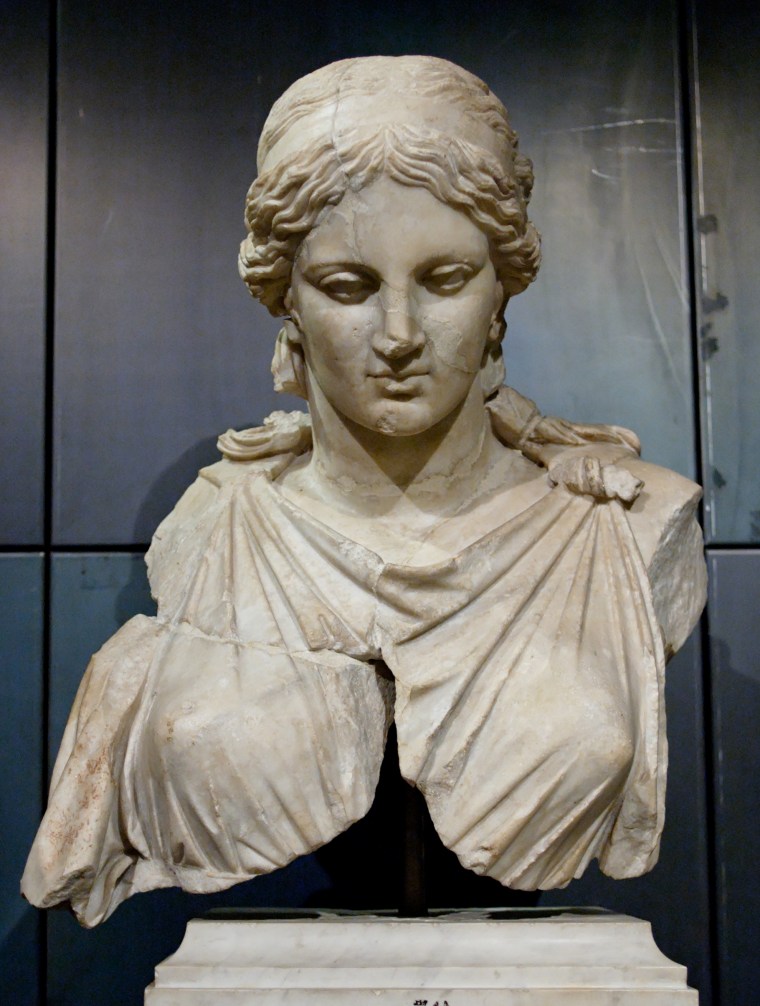
Roman marble Bust of Artemis after Kephisodotos (Musei Capitolini), Rome.
“Women, of course, write good and bad poetry – ‘ambitious’ implies more enterprising subject-matters and approaches, as well as a unique voice for each poet.” Kate Foley and Dilys Wood, Editorial Page, ARTEMISpoetry, November 2015
Here it is April – Poetry Month! – and the month in which I know that Dilys Wood, Anne Stewart and other poets in London at Second Light Network of Women Poets(SLN) are hard at work putting a wrap on the May 2016 issue of ARTEMISpoetry. This biannual literary magazine specializes in the work of women bent on honest self-expression, subjects of substance, and well-crafted poetry.
The issue included poems by Anne Stewart, the featured poet and the author of Janus Hour and Only Here till Friday.
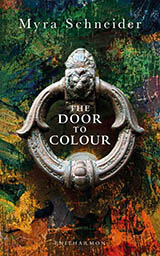
Myra Schneider was the judge for the 2015 poetry contest. The winning poems are featured as well as the commended and we get a bit of the behind-the-scenes look at the hard work of judging.
“I went through over a thousand poems looking for poems that traveled, paid attention to form and made words work. Eventually I reduced a long list of 101 poems to 26 … I was very excited because the winning poems were telling me loud and clear which they were!”
No doubt it is an honor to be selected to judge – and clearly there are rewards – but what a job as well. Certainly a labor of love. The winners for 2015 were: Carolyn King, Margaret Wilmot, Judith Taylor and Kathy Miles.
I was also pleased to read Myra’s feature on one of my own favorites, American poet Louise Glück.
In line with the issue’s theme, politics and eco-politics were explored by Kay Syrad, a regular contributor. She discussed Priscila Uppal’s Sabotage (explores private and public acts of destruction, disruption, and vandalism in the 21st century) and Helen Moore’s Ecozoa(response to the destruction caused by industrial civilization).
Fiona Owen gifted us a thoughtful piece – both homage and exploration – on Anne Cluysenaar‘s eco-poetry.
“… Anne ponders ‘the tenuous job of the poet’ and sees the arts as having an intrinsic evolutionary role …”
In addition to poetry,ARTEMISpoetry always offers book reviews and announcements of publications, events and classes of interest … and lately continues some discussion and promotions of SLN’s last two anthologies Her Wings of Glass and Fanfare.
🙂 I recommend both. 🙂
Below is a sampling (three poems) from Fanfare with thanks to the poets and their publishers, to SLN and especially to Anne Stewart for doing the work of acquiring the permissions for me to share these poems with you here today.
January
Going into the sun
over mud flats skimmed with water
people are walking on ice or glass
their reflections perfect
and you know it’s a new year
walking into the sun
beach and sky cast in light
sheer
gone when you turn
and wave rippled mud
takes your footsteps, softly.
– Caroline Natzler
Caroline Natzler:January and Life’s Work, from Fold (Hearing Eye, 2014)
Untouchable
She shines like Lakshmi through the fields –
a gentle stride, arms at her sides.
By the houses, stooping her beauty
to the earth, she raises the brimming bucket,
its stench sealing her nostrils. Slurry clings
to hair and skin, but nothing changes
on her face, only a puckering of lips
in silent thanks to Kali
for twenty years of women’s work,
this dawn till dusk that’s nurtured seven sons;
thanks that she’s never known the blessing of –
nor visited this curse upon –
a daughter.
– Jill Sharp
Jill Sharp:Untouchable, from Ye gods (Indigo Dreams, 2015)
A Miracle at Iskitim
In Siberia, a symbol –
this is what the locals believe,
a magical birth of water:
a fresh water spring, a spurt
close to the ground, a low white
eternal flame.
We dip our cups
(plastic, from the hotel) and say,
“It tastes pure. The water is pure.”
Some people here heard the last trucks
grind out of sight, after they shut
the ‘lagpunkt’,
the slow-killing place,
left the scar for people like us
in a half circle, dark barrels
in our padded coats, gloves, hats, scarves …
With our white breaths, we breathe out lives
as we raise up transparent cups,
“The future came too late.”
– Dilys Wood
In her Gulag, A History (Penguin, 2004)Anne Applebawm refers to a new fresh-water spring near a former camp at Iskatim.
This slideshow requires JavaScript.
SLN, through community, classes, magazines and books, regularly serves up thought-provoking, often heart stirring and always engaging poetry by women as well as informative explorations and analyses of poems, collections, news and views. Whether you are an experienced professional or an amateur poet, there’s plenty to enjoy here, plenty to learn and think about. I venture to say though that if you are an older woman poet working to find your voice, you’ll discover special inspiration and encouragement through Second Light.
“Mohammed al-Ajami Pardoned by Qatari Emir. It seems that the Government of Qatar has finally listened to the concerns of the United Nations and international community,” says ADHRB’s Executive Director, Husain Abdulla, “The Emir’s decision to pardon Mohammed al-Ajami is not only a victory for free expression over the forces of censorship and repression in Qatar, it is also a testament to the power of public, international pressure to improve human rights everywhere.” Americans for Democracy and Human Rights in Bahrain
You can register your book with Publishers Weekly and submit it for review via its BookLife platform HERE.
Writer’s Digest Deadline for WD Self-Published Book Awards: April 1, 2016 … “here’s your chance to enter the premier self-published competition exclusively for self-published books. Writer’s Digest hosts the 24th annual self-published competition–the Annual Self-Published Book Awards. This self-published competition, co-sponsored by Book Marketing Works, LLC spotlights today’s self-published works and honors self-published authors.” Details HERE
Information on other self-published book awards is offer by The Book Designer HERE.
EVENTS:
April 16, 7-9 pm.
LITERARY PUB OR PERISH
Stickyz Rock N’ Roll Chicken Shack
107 River Market Avenue
Little Rock, Arkansas 72201
Join Sharon Frye, Ayara Stein, Silva Zanoyan Merjanian, RJ Looney, Donnie Lamon, MH Clay and Justin Booth. You’ll find the bios of presenters HERE.
MARCH 21, 6-7pm in HumSS G27, University of Reading Whiteknights Campus. Poet, playwright, director, producer and teacher Mojisola Adebayo will give a talk on and reading from her work, Mojisola Adebayo: Plays One (Oberon Books, 2012), on Monday 21 March, Mojisola will discuss her work with the Department’s expert on black British theatre, Nicola Abram. No charge and no reservation needed.
Mojisola Adebayo: Plays One includes the plays Moj of the Antarctic, Desert Boy, Matt Henson: North Star and Muhammad Ali and Me
Moj of the Antarctic is inspired by the true story of an African American woman who cross-dresses as a white man to escape slavery; taken on a fantastical odyssey to Antarctica.
Desert Boy, a time-travelling a capella musical, offers a sharp twist on the subject of knife crime, black youth and absent fathers.
Matt Henson, North Star is a biographical tale of Arctic betrayal, mixed with Greenlandic folk tales; all about love, climate and change.
Muhammad Ali and Me is a lyrical coming of age story, following the parallel struggles of a gay girl child growing up in foster care and the black Muslim boxing hero’s fight against racism and the Vietnam war.
APRIL 15: Special Poetry Issue of The BeZine. April, National Poetry Month in the United States, is celebrated as an international event at The BeZine. This year Contributing Editor Michael Dickel hosts and The Woven Tale Press is a partner. Poets featured include: Michael Rothenberg, Myra Schneider, Carolyn O’Connell, Terri Muuss, Dilys Wood, Liliana Negoi, Michael Dickel, Jamie Dedes, Imen Benyoub, Natasha Head and Aprilia Zank.
Notes: The Woven Tale Press offers a copy of their first Press Selected Works for free; and National Poetry Month is sponsored by the American Academy of Poets. Link HERE for activities in which you may join and to send for a free poster.
APRIL 21: Litquake Celebrates National Poetry Month at Gardenias: A Poets Supper; 1963 Sutter Street, San Francisco, CA 94115; featured poets include Kimberly Grey, D.A. Powell, and Solmaz Sharif. Details HERE.
JULY 3 – 18:W/rites and Rhapsodies: Israel Writing Tour
Write! Tour! Perform! Listen! Learn! Feast! With tour leaders Adeena Karasick and Michael Dickel. Registration deadline: 15 April 2016 Link HEREItinerary. Cost: $3,080, which does not include air fare, more details HERE. Register HERE.
SEPTEMBER 24: is the next Global Event Day for 100,000 Poets for Change (peace, sustainability, social justice). Check out 100TPC.org for details on this initiative, to find events in your area and/or to register an event you’re organizing. Poets Michael Rothenberg and Terri Carrion are founders and hosts.
In honor of 100TPC, The BeZineis focusing on Environment and Environmental Justice this year. Message G Jamie Dedes on Facebook if you want to join our ongoing Facebook discussion group. Our September 15 issue of The BeZine is dedicated to Environmental subjects and hosted by Associate Editor, Priscilla Galasso. On the global event day, September 24, the Zine will sponsor a virtual event with reader participation. Michael Dickel hosts.
OCTOBER 17: Under the leadership of Terri Stewart, Beguine Again founder and managing editor, will host a 100,000 Beguines for Peace event. This interfaith effort will focus on spiritual topics. Details to come from Terri in months ahead. Beguine Again and The BeZine are sister sites and The Bardo Group Beguines support and often contribute to both sites. Terri Stewart is a Methodist Minister. Her popular Daily Practice posts on Beguine Again feature poetry, art and music to address timely topics in a conscious and prayerful manner.
OCTOBER 20-23:The 30th Annual Dodge Poetry Festival, the largest poetry festival in the United States will be held in Newark, New Jersey. Details HERE. Readings from past festivals are archived on YouTube HERE.
SAN FRANCISCO JAPAN TOWN 2016, 110th Anniversary: This is one of the only three remaining Japan towns in the United States. Events are scheduled throughout the year to celebrate culture and history. Of special interest are photographic displays, a book launch, a concert and performing arts nights. Details HERE.
THE POET BY DAY
TESTIMONY:
“Here be inspiration. There are blogs and there are blogs. There is writing; there is poetry; there is art; there is human endeavour and there is ‘The Poet by Day’. Rarely, if ever, have I come across a web log like this, of such towering integrity. Seldom have I encountered such a willingness to subjugate self for the benefit not only of the art of the written word, but also for the benefit of poets and writers everywhere. Here be a deep well of inspiration.” Poet, essayist and musician: John Anstie (My Poetry Library)
MISSION STATEMENT:
to honor the place of poetry in our lives;
to acknowledge good poets, both established and emerging;
to encourage poetry for social and environmental justice;
to shine a light on women and minority poets and poets just finding their voices in maturity;
to encourage you in your writing and provide helpful information and resources;
to have fun, to laugh, to feel good … and to cry when that’s needed.
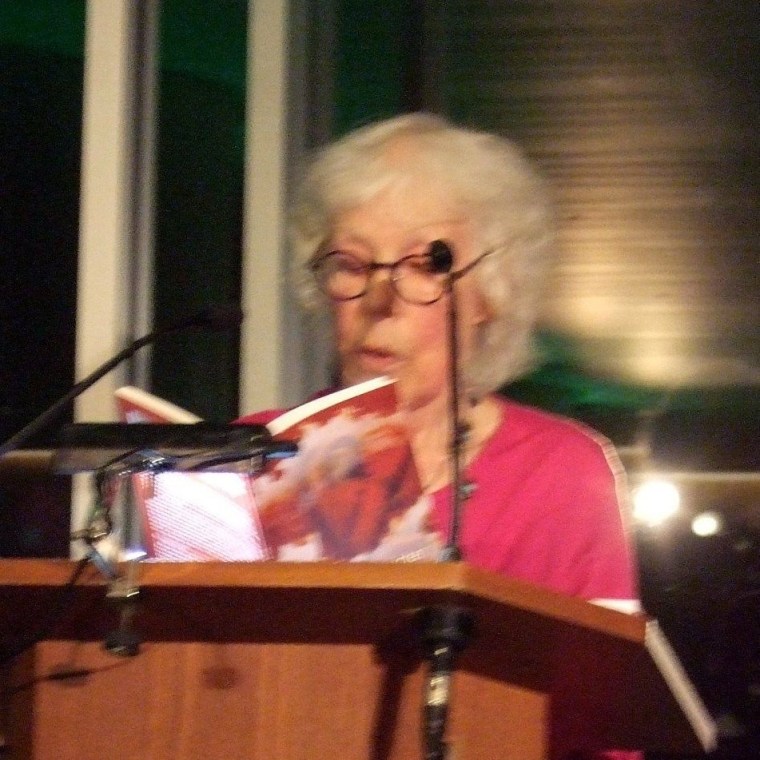
When I learned that Myra would be celebrating her 80th birthday this June, I figured I’d better grab her for an interview before anyone else pounces. Having said that, I don’t think I was the first in line. Who wouldn’t want to gather and savor the voice of so much experience: eleven collections of poetry, children’s books, author of Writing My Way Through Cancer and, with John Killick, Writing Yourself: Transforming Personal Material. Myra has collaborated on more anthologies than I can count, is a poetry coach and champion of women poets, a consultant to Second Light Network of Women Poets and a poetry editor. Myra’s professional life seems like it is and always has been quite full and busy. Yet along the way – even when coping with catastrophic illness – Myra is able to take a breath and pen …
Today there is time
to contemplate the way life
opens, claims, parts, savour
its remembered rosemaries,
spreading purples, tight
white edges of hope, to travel
the meanings of repair, tug
words that open parachutes.
excerpt from Today There Is Time in Writing My Way Through Cancer
JAMIE: I know your interest in poetry started quite early in life. As you look back through the lens of long life, how have your preferences, interests and style of poetry changed and why?
MYRA: By the time I’d finished at university at the beginning of the 1960s I was steeped in poetry of the past. As well as Shakespeare and Chaucer I loved Anglo-Saxon poetry, John Donne, Wordsworth and the other Romantic poets, also Gerard Manley-Hopkins. I expected poetry to be intense, spiritual and often about the natural world. My knowledge of twentieth century poetry was limited mainly to T S Eliot, some poems by Ted Hughes, Sylvia Plath and the war poets, all of whom I was excited by. However, the poetry scene in London, where I lived and still do, was pretentious at that time and male-dominated. I was soon put off poetry and for several years I read and wrote very little. When I came back to it I gradually began to read much more widely: contemporary British poets such as Seamus Heaney, Gillian Clarke, Anne Cluysenaar, Mimi Khalvati and John Burnside, and poets from further afield such as Derek Walcott and Les Murray. I also read American poets as varied as Elizabeth Bishop, Mark Doty, Louise Gluck and Philip Levine. I particularly like the expansiveness I have found in American poetry. Intensity and spirituality and the natural world are still central to me but my view of what they include has greatly widened which has influenced my own writing. This, over time, has become much more honed and also more varied in style and subject matter.
JAMIE: Has your way of organizing yourself changed overtime; for example, the times that you write, when you do revisions and so forth?
MYRA: When I started writing I did not think much about the writing process. I tended to write down whatever came into my head for poem and then draft it letting it take whatever shape it seemed to fall into. Very occasionally I wrote a rhyming poem in regular verses. Later, I thought much harder about form and also in the 1990s I started to keep a notebook in which I jotted down words, ideas and details for poems. Around this time I discovered the poem worked much better if I spent a longer time working on the material and trying out the form it might go into before I started drafting unless, which happened rarely, a poem suggested itself and its shape very clearly. I found out too that allowing raw material to incubate either for a day or two or much longer frequently helped me to see what to do with it. Now I often work on more than one poem at a time – one that’s in its late stage and needing revision and one at an early stage. My main writing time has always been in the morning but I sometimes work on poems later in the day or on a train journey. In addition a certain amount of ‘writing’ goes on in my head and this could be at any time of the day or night – I might see how to cope with a problematic line or an idea for a new poem might start germinating.
JAMIE:What – if anything – has changed in terms of inspiration for poetry?
MYRA: When I started to write I had a very strong need to explore personal material – my childhood and my difficult relationships with my parents. Beyond that my poems were mainly triggered by my immediate reactions to the natural world and my teaching experience of severely disabled adults. A much greater range of subjects inspires me to write now. These include the role of women which I have explored in a number of ways, also issues like the environment, violence and the refugee problem. I feel a need too to write longer narrative poems which explore relationships and usually an issue or a theme in depth. For several years now many of my short poems have been set off by something apparently small: making tea in my yellow teapot, a painting or a small occurrence such as watching an old man running in long grass. The poem then follows a line of shifting thought aroused by the object or occurrence and takes in more than one subject. I firmly believe the most everyday material can connect with serious subject matter. My poem In theBeginning, which follows a line of thought about the big bang theory, starts and ends with a cat bowl.
JAMIE:What suggestions would you make to someone just beginning to write poetry?
MYRA: The first thing I would mention is the importance of reading a wide range of contemporary poets and I would also advise the reading of some key poets from the past. Poetry is a craft as well as an art and it’s crucial to discover how poets use different techniques and to learn as much as possible from outstanding poets about how they write. Elizabeth Bishop is a very good person to study as she uses both strict and free forms brilliantly and also tackles her subject matter in a variety of ways. There is an invaluable book, How to Read a Poem by Edward Hirsch, which looks in depth at how to read a poem and it includes a useful glossary which explains poetic terms. Quite soon after starting to write I would advise learning about the full range of poetic forms. This can be done either in a class or from a book, preferably one that’s been recommended. If at all possible I also suggest joining a poetry class or workshop which offers rigorous but supportive feedback.
JAMIE:And finally, what is the job of the poet, what is the place of poetry in our lives and in the greater world?
MYRA: I believe the role of the poet is to reflect on human experience and the world we live in and to articulate it for oneself and others. Many people who suffer a loss or go through a trauma feel a need for poetry to give voice to their grief and to support them through a difficult time. When an atrocity is committed poems are a potent way of expressing shock and anger, also of bearing witness. I think that the poet can write forcefully, using a different approach from a journalist, about subjects such as climate change, violence, abuse and mental illness and that this is meaningful to others. I very much believe too that poetry is a way of celebrating life. I think it deserves a central place in our world.
This slideshow requires JavaScript.
IN THE BEGINNING
Wheatflakes in a chestnut-brown bowl, thinking
slowed down by sleep: the morning is the same
as any other. But no repeat is exact –
the cloud cover is thicker/thinner, skin
a day more creased, closer to dust.
And this morning is marked by tufts of sparrow
on the floor: the machine that laced a small body
with blood has been stopped. The postman’s late.
Headlines exclaim from the paper. When I put on
the right glasses I discover today is momentous.
Scientists have proved the big bang they believe
set off the universe. Trying to follow, I soon
flounder among technical terms, am rescued
by the tulips standing on the breadcrumbed counter.
Their parrot scarlet sings and sings in my head.
If I’m to get a grip on time and space
I must widen my field of vision. Outside,
car tyres hiss. As drivers slow
at the roundabout they’ll read: ‘Jesus is alive’,
chalked in pigeon-dropping white on a support
of the railway bridge. I question this slogan
as I swoop underneath in my crimson Mini estate…
If I’m to understand I must study sciences
for decades, and focus on a past before bridges
arched, before Jesus walked on water,
before ape men squatted in caves,
before dinosauars lumbered,
before leaves fleshed steaming forests,
before rocks hardened,
before the Earth was flung into orbit round the Sun,
before the birth of galaxies now burnt out,
before matter scattered.
Warm fingers black with newsprint, I tremble
at the dark and shapelessness before the beginning,
the mystery of something grown out of nothing,
the changes that led to the kickstart moment
when space ballooned and time began.
Today has shrunk too small to tackle but from habit
I pour Go Cat for the murderer. A petal
falls. The post flaps onto the mat. I pick up
your letter, and suddenly nothing in the universe
is more important than reading your words.
“Sappho (/ˈsæfoʊ/; Attic Greek Σαπφώ [sapːʰɔ̌ː], Aeolic Greek Ψάπφω, Psappho [psápːʰɔː]) was a Greek lyric poet, born on the island of Lesbos. The Alexandrians included her in the list of nine lyric poets. She was born sometime between 630 and 612 BCE, and it is said that she died around 570 BCE, but little is known for certain about her life. The bulk of her poetry, which was well-known and greatly admired through much of antiquity, has been lost; however, her immense reputation has endured through surviving fragments.” [Wikipedia]Sunday: I began my dive into Dilys Wood’s Antarctica* (Greendale Press, 2008), spending my discretionary time engaged by this collection, which includes The South Pole Inn, a novella in verse.
“I dreamt I gave you the white continent
I wrapped it in white wedding wrap, embossed
with silver penguins and skiis …”
from Her Birthday Present in the section Love in a Freezing Climate: Four Poems
*****
“Wherever I look, the bacillus of melt
weakens the floes.”
from Future
DILYS WOOD is a poet, an editor and the founder (“convenor” as she might say) of the London-based Second Light Network of Women Poets (SLN), which produces the biannualARTEMISpoetryand includes a publishing arm, Second Light Publishing. I first encountered Dilys thanks toMyra Schneider. That award-winning poet with eleven published collections is a consultant to SLN.
While Internet and email have a way of helping to cross borders and make affinity-based connections, closing the gaps in culture and miles – in this case some 5,500 miles as the crow flies – the tools are imperfect. It’s not the same as meeting, talking and observing in person. However, when you read what people write, when they risk themselves by putting their very souls on paper, you do get to know something about their values and passions. My strongest sense of Dilys was as the quiet persistent energy behind a women’s poetry collective and an apparently indefatigable advocate for women’s right – including women over 40 – to poetic voice.
At the point in which I first encountered Myra, Dilys and SLN, Dilys had collaborated on (mainly with Myra) four anthologies of women’s poetry. She had two collections of her own poetry published,Women Come to a Death(Databases, 1999)andAntarctica. That was, I think around 2010. Since that time, we are gifted through Dilys and Myra, Anne Stewart (poetry p f) and others on the SLN team with so many fine anthologies and magazines of women’s poetry, that I can hardly keep track.
This slideshow requires JavaScript.
Dilys is modest in presenting herself. Her Poet’s Page on SLN’s website says simply –
Dilys started writing poetry again after retiring from the Civil Service, where her jobs included being secretary of the Women’s National Commission. She shortly after founded Second Light, focussed on the needs of women reconnecting with writing after forty. Second Light Network developed into a support group and, on a small scale (though reviews suggest significant), publisher of women’s poetry. Together with her own writing (Antarctica, 2008; Women Come to a Death, Katabasis, 1997), Dilys has been the joint editor (mainly with Myra Schneider) of 4 womens poetry anthologies.
If The Poet by Day was a poem, its title would have to have the tagline after Dilys Wood. This site is not the product of collaboration and membership. Nonetheless, its commitment to sharing information on poets and poetry, including gifted if lesser-known poets, and promoting and encouraging poets who are marginalized by their gender, ethnicity, disability or age – is very definitely inspired by Dilys work and commitment to mature women and the work and commitment of Myra Schneider and the other SLN women as well as by my own love of poets and poetry and the whole of poesy history and culture.
This is Dilys in her own words as she “spoke” in a guest blog post here several years ago:
NEW SAPPHOS, CHALLENGES FOR WOMEN POETS
I run a network for women poets and naturally I want our members to be treated equitably, with recognition of any woman’s potential to be in the top flight of creative artists.
Some poets feel that ‘male and female he made them’ should not be an issue. I disagree because I want to celebrate and gain personal inspiration from the last fifty years. There has been a vastly increased involvement of women as students of poetry, published poets, book purchasers and consumers of ‘products’ such as poetry festivals. I also want it debated why this has not meant equality of treatment by journals.
Why do some leading journals publish fewer poems by women and use fewer women reviewers? What part is played by prejudice and what by our diffidence? Do we submit enough work and persist when submissions are rejected? Are there subtle shades of prejudice? Are we taken seriously on ‘women’s topics’ but not when writing about spiritual experience or politics?
A first step is to convince ourselves that there is no ceiling. Emily Dickinson surely lives up to the epithet ‘unique genius’? Her work is incredibly economical, dense, universal and deeply moving. She is totally original in style and thought. Her work alone ought to kill the slur that biology-based inferiority explains historical under-achievement.
So many more women have found now their voice. Let’s celebrate poets who excite us, from Emily Bronte (say) to Jorie Graham (say). We can also start thinking seriously about differences and about inflated reputations. Let’s be wary about ‘celebrity status’. This tends to narrows true appreciation. Read voraciously. Include lesser known poets and dead poets. You will be impressed by how much exciting writing is on offer.
– Dilys Wood
* “Antarctica,” Greendale Press, 2008 (all proceeds to Second Light Network funds). �5.95 through poetry p f (scroll down on the page to which this is linked)


 April 16, 7-9 pm.
 Mojisola Adebayo: Plays One includes the plays Moj of the Antarctic, Desert Boy, Matt Henson: North Star and Muhammad Ali and Me
 SAN FRANCISCO JAPAN TOWN 2016, 110th Anniversary: This is one of the only three remaining Japan towns in the United States. Events are scheduled throughout the year to celebrate culture and history. Of special interest are photographic displays, a book launch, a concert and performing arts nights. Details

![Sappho (/ˈsæfoʊ/; Attic Greek Σαπφώ [sapːʰɔ̌ː], Aeolic Greek Ψάπφω, Psappho [psápːʰɔː]) was a Greek lyric poet, born on the island of Lesbos. The Alexandrians included her in the list of nine lyric poets. She was born sometime between 630 and 612 BCE, and it is said that she died around 570 BCE, but little is known for certain about her life. The bulk of her poetry, which was well-known and greatly admired through much of antiquity, has been lost; however, her immense reputation has endured through surviving fragments.](https://jamiededes.com/wp-content/uploads/2016/03/800px-sahpo_embrassant_sa_lyre-jules_elie_delaunay_mg_8275.jpg?w=634&h=1024)


 Jamie Dedes' THE POET BY DAY Webzine