Miguel Piñero: poet, playwright, actor, and the cofounder of Nuyorican Poets Café with Miguel Algarín, Pedro Pietri

- His poetry and the plays are so fraught with the things that aggravated and influenced him and ultimately made his life successful. He took this form and infused it with an urban, Latin lifeblood that had never been used in poetry before. He was remarkable as a writer in terms of never really self-editing himself or censoring himself.
- Benjamin Bratt on how he crafted the artist’s portrayal in the biopic Piñero (2001) in “Interview: Benjamin Bratt and Leon Ichaso Talk Piñero” in Slant Magazine(2001 Dec 21)
- I happen to feel that [Piñero] was a romantic character and there was something about his love for land that was very wonderful, the way he held Puerto Rico, that elusive homeland in the foreground of his thoughts and writing. For all of us who are uprooted and thrown into this city, to keep a semblance of that is always so dignified. That would make it perhaps a bit nostalgic for me because people like that don’t seem to be around anymore.
- On how he characterizes Miguel Piñero in “Interview: Benjamin Bratt and Leon Ichaso Talk Piñero” in Slant Magazine (2001 Dec 21)
I spent the better part of yesterday 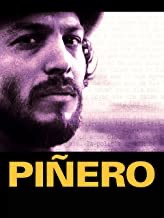 responding to submissions to The BeZine and setting up International Poetry Month blog posts for our special series, which I am collaborating on with Michael Dickel. When I was through I decided to watch the acclaimed movie, Piñero, which I’ve been wanting to see for some time. I’m streaming through Amazon. So far, so good. Benjamin Bratt’s performance is stellar. I’ve taken a break to share this with you.
Miguel Piñero was an award-winning poet, playwright, actor, and a leading member of the Nuyorican literary movement. He was inducted posthumously into the New York Writers Hall of Fame in 2013.
Piñero was born on December 19, 1946, in Gurabo, Puerto Rico. In 1950 he moved with his parents and sister to Loisaida (the Lower East Side) in New York City. When his father abandoned the family, his mother moved her children into a basement, applied for and received welfare.
Piñero would steal food to feed his mother and siblings. Thus the criminal convictions came early in his life. The first time when he was eleven years old. He was sent to the Juvenile Detention Center in the Bronx, New York, and to Otisville State Training School for Boys. He joined a street gang called “The Dragons” when he was 13; when he was 14, he was hustling in the streets of Manhattan. Over time he was drawn heavily to alcohol and drugs and died prematurely – aged 41 – on June 16, 1988 from cirrhosis.
Eventually, Piñero moved to Brooklyn, where he and three other friends committed robberies, until they were caught at a jewelry store. Piñero was sent to Rikers Island prison in 1964. In 1972, he was incarcerated in Sing Sing prison for second-degree armed robbery. His first literary work was Black Woman with a Blonde Wig On. Marvin Felix Camillo, the director of The Family, an acting troupe made up of ex-cons, submitted the poem to a contest, which it won.
While serving time in prison, Piñero wrote the play Short Eyes as part of the inmates’ playwriting workshop. Reviewer Mel Gussow came to see it, and due to his review in the New York Times, the director of the Theater at Riverside Church invited Piñero to present the play there.
“The theatre is the only thing that belongs to the people.” Miguel Piñero.
When Piñero left Sing Sing on parole in 1973, he was able to present Short Eyes with The Family. The title comes from “short heist”, the prison slang term for child molestation. Puerto Ricans could not pronounce the ‘h’ so it became “short eyes.” The play is a drama based on his experiences in prison and portrays how a house of detention populated primarily by black and Latino inmates is affected by the incarceration there of a white pedophile. Pedophiles are considered the lowest form of prison life. After all, the prisoners have siblings and children for whom they have concerns.
In 1974, Short Eyes was presented at Riverside Church in Manhattan. Theater impresario Joseph Papp (played in the movie by Mandy Patinkin) saw the play and was impressed. Papp moved the production to Broadway.
The play was nominated for six Tony Awards. It won the New York Drama Critics Circle Award and an Obie Award for the “best play of the year”. The play catapulted Piñero to literary fame. Short Eyes was published in book form by the editorial house Hill & Wang. It was the first play written by a Puerto Rican to be put on Broadway. This initial success was followed by: Sideshow(1974), The Guntower (1976), The Sun Always Shines for the Cool (1976),Eulogy for a Small-Time Thief (1977), and Playland Blues (1980).
The following excerpt from the movie serves as an intro to it and to Piñero’s work if you are not familiar with him. Also recommended is Outlaw, The Collected Works of Miguel Piñero.
This post is complied from the following sources: Wikipedia, Poetry Foundation, Outlaw:The Complete Works of Miguel Piñero, and the movie Piñero.
Jamie Dedes:
- About /Testimonials / Disclosure / Facebook / Medium / Ko-fi
- 2020 Poet Laureate of Womawords Literary Press
- The Wombwell Rainbow interviews Jamie Dedes
Your donation HERE helps to fund the ongoing mission of The Poet by Day in support of poets and writers, freedom of artistic expression, and human rights.
Poetry rocks the world!
FEEL THE BERN
For Peace, Sustainability, Social Justice
The Poet by Day officially endorses Bernie Sanders for President.
The New New Deal
“Democracy is not a spectator sport.”
“Every pair of eyes facing you has probably experienced something you could not endure.” Lucille Clifton


 Jamie Dedes' THE POET BY DAY Webzine