Taylor McDowell Mali (b. 1965) is an American slam poet, humorist, teacher, and voiceover artist.
Taylor Mali’s career in poetry evolved out of the slam poetry movement. He is a native New Yorker and taught school for nine years at Browning School for Boys (Manhattan) and Cape Cod Academy (Massachusetts). Currently, he travels the world facilitating workshops for teachers and students. He is a dedicated supporter of teachers and he says that through his New Teacher Project he hopes to attract 1,000 people into education through “poetry, persuasion, and perseverance.”
What follows is a video of Taylor Mali performing his poem, What Teachers Make? (You’ll note Billy Collins sitting side-stage.)
If you are viewing this post from an email, you will have to link through to the site to watch the video. You can read the text of the poem HERE.
portrait: Taylor Mali at the international school in Stockholm.by Emil Brikha under CC BY-2.0 license
Thank you for sharing your love of words. Comments will appear after moderation.
oh! simple the beginnings,
the apple of amazement,
the core of an idea, and
out slips the memories,
the injustices on which
the child-mind puzzled,
processing in adolescence,
then big girl, grown woman,
chasten the world, plant
the seeds of awakening
courage in slender frame, high
thoughts in rounded forehead,
the long expressive hands,
the sweeping circumstances,
Africa, Arabia, Europe, U.S.,
first the suffering and tears,
then the work, work, work ~ courage in the face of tyranny,
voices of the voiceless: theJustias!
the Prudentias! of our modern day
“Only in art will the lion lie down with the lamb, and the rose grow without the thorn.” Martin Amis
if my voice was an angel voice
i’d sing you into ecstasy
if my hand was a healing hand
i’d touch you into grace
would that i could measure poems
to turn tears into light
to put dance in your feet
if i knew my own soul, i could
touch the tarnished silver of yours
and bring your smiles back again
I love the line of Flaubert about observing things very intensely. I think our duty as writers begins not with our own feelings, but with the powers of observing.
AWARDS: Mary Oliver’s fourth book, American Primitive, won the Pulitzer Prize for Poetry in 1984. She received the Shelley Memorial Award; a Guggenheim Fellowship; an American Academy and Institute of Arts and Letters Achievement Award; the Christopher Award and the L.L. Winship/PEN New England Award for House of Light; the National Book Award for New and Selected Poems; a Lannan Foundation Literary Award; and the New England Booksellers Association Award for Literary Excellence.
When it’s over, I want to say: all my life I was a bride married to amazement. I was the bridegroom, taking the world into my arms.
How often we turn to certain poets for certain healing, to those greater “technicians of the sacred” (to borrow from Jerome Rothenberg): Jane Hirchfield for her gentle Buddhist sensibility, John O’Donohue for his lilting Celtic reflections, W.S. Merwin and his deep ecology. Not the least among the greater technicians is Mary Oliver. Our hunger for spiritual healing is underscored by her popularity. The New York Times declared her the best-selling poet. Poet, activist and critic Alicia Ostriker writes of Oliver that she is as “visionary as Emerson.” Where there is criticism, it tends to be among feminists and others who feel she idealizes the feminine connection with nature.
Mary Oliver’s work is deeply rooted in nature and a sense of place, the Ohio of her childhood and the New England of her adult life. More recently Florida, where she moved to be with friends after her partner of forty years died.
Influenced by Thoreau and Whitman, she’s a keen observer. She has said that she found healing in nature and the greater beauty of the world. Nature was her refuge through a difficult childhood and from an abusive father. She writes about her experience of her father in Rage from Dream Work (the Atlantic Monthly Press, 1989).
Rage
You are the dark song
of the morning…
But you were also the red song
in the night..
When the child’s mother smiles
you see on her cheekbones
a truth you will never confess
and you see how the child grows
timidly, crouching in corners…
In your dreams she’s a tree that will never come to leaf..
in your dreams you have sullied and murdered
and dreams do not lie.
However dark Rage might be, Oliver’s poems are more often filled with light and encouragement. Journey is one such:
You strode deeper and deeper
into the world,
determined to do
the only thing you could do,
determined to save
the only life you could save.
excerpt from The Journey, in Dream Work
… and Wild Geese
You do not have to be good.
You do not have to walk on your knees
for a hundred miles through the desert, repenting.
You only have to let the soft animal of your body
love what it loves. […]
The world offers itself to your imagination,
calls to you like the wild geese, harsh and exciting-
over and over announcing your place
in the family of things.
excerpt from Wild Geese in Dream Work
When we want to breathe the clear air of nature and the best of the human spirit, we turn to Mary Oliver and the singular meditative grace of her poetry.


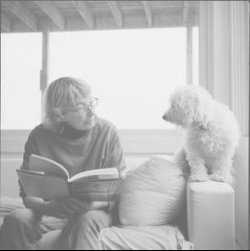
 Mary Oliver’s work is deeply rooted in nature and a sense of place, the Ohio of her childhood and the New England of her adult life. More recently Florida, where she moved to be with friends after her partner of forty years died.
 Jamie Dedes' THE POET BY DAY Webzine